
Morgan lives in San Francisco and likes to dine out. Morgan has noticed that prices at
restaurants near popular tourist destinations in the city tend to be higher than at
restaurants of the same quality in other neighborhoods. One reason for this is that:
A. search costs are higher for people who are unfamiliar with the area.
B. residents don’t like to eat in restaurants frequented by tourists.
C. tourists don’t worry about money while on vacation.
D. restaurant meals are a small fraction of the total cost of a vacation.
If real GDP per person in a country equals $20,000 and 40 percent of the population is
employed, then average labor productivity equals:
A. $8,000.
B. $20,000.
C. $40,000.
D. $50,000.
If the marginal propensity to consume is 0.75, then a $100 increase in disposable
income leads to a ______ increase in consumption.
A. $13.33

B. $25
C. $75
D. $133
If the desired reserve/deposit ratio equals 0.10, then every dollar of currency in bank
reserves supports ______ of deposits and the money supply, while every dollar of
currency held by the public contributes ______ to the money supply.
A. $1; $10
B. $0.10; $1
C. $1; $0.10
D. $10; $1
The value of final goods and services equals:
A. total business profits.
B. the sum of the value added by all firms.
C. total business spending.

D. the sum of revenues from all sales.
Suppose Jordan and Lee are trying to decide what to do on a Friday. Jordan would
prefer to see a comedy while Lee would prefer to see a documentary. One documentary
and one comedy are showing at the local cinema. The payoffs they receive from seeing
the films either together or separately are shown in the payoff matrix below. Both
Jordan and Lee know the information contained in the payoff matrix. They purchase
their tickets simultaneously, ignorant of the other’s choice.
Which of the following statements is true?
A. Lee does not have a dominant strategy.
B. For Lee, seeing a comedy is a dominant strategy.
C. For Lee, seeing a documentary is a dominant strategy.
D. Lee’s dominant strategy depends on Jordan’s choice.
You own shares in a well-managed and diversified company. If a booming economy
decreases investors’ concerns about market risk, then the price of your shares will

_____, holding other factors constant.
A. increase.
B. decrease.
C. not change.
D. either increase or decrease.
The cost of a higher living standard in the future is giving up:
A. current consumption.
B. current investment.
C. future consumption.
D. future investment.
Refer to the figure below. If the original curves are MB1 and MC1, rational consumers
will gather ______ units of information.
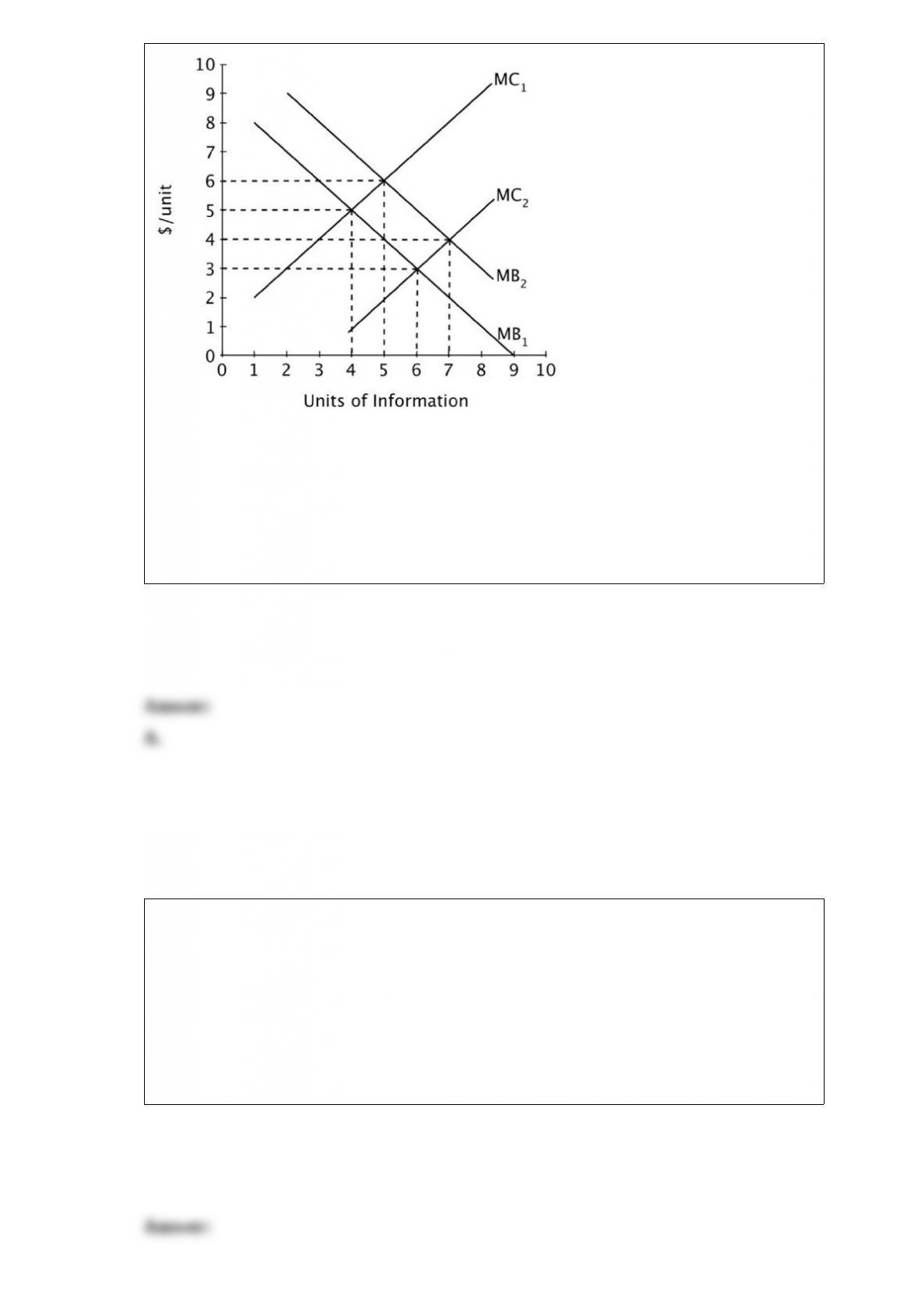
A. 4
B. 5
C. 6
D. 9
If the United States has a $300 billion trade deficit, then there must be:
A. net capital inflows of $300 billion.
B. net capital inflows of “$300 billion.
C. no capital inflows or capital outflows.
D. net capital outflows of $300 billion.
Consumer surplus is the cumulative difference between:
A. consumers’ incomes and consumers’ expenditures.
B. the amount consumers are willing to pay and the price they actually pay.
C. the suggested retail price and the price consumers actually pay.
D. consumers’ savings and consumers’ expenditures.
The nominal return on an inflation-protected bond equals a fixed real return:
A. plus the actual rate of inflation.
B. minus the actual rate of inflation.
C. divided by the price level.
D. plus the expected rate of inflation.
In general, perfectly competitive firms maximize profit if they produce a level of output
at which:
A. average cost is minimized.
B. total cost is minimized.
C. average cost equals price.
D. marginal cost equals price.
In sequential games, the player who moves first:
A. always has a first-mover advantage.
B. has a first-mover advantage only when he or she is able to make a credible threat or
promise to choose a dominated strategy.
C. has a first-mover advantage only when the second mover fails to choose the
dominant strategy.
D. sometimes has an advantage and sometimes has a disadvantage.
In 1985 a desert community stopped pumping water from a 1000 foot well because it
had run dry. In 2005 the price of water doubled. The community then drilled the well
deeper and started pumping again. In this community,
A. the supply of water is perfectly inelastic because it is a finite resource.
B. water production is characterized by increasing opportunity costs.
C. markets cannot reach equilibrium because there is a persistent shortage of water.
D. higher water prices can reduce quantity demanded but cannot increase quantity
supplied.
Prior to January 2000, the demand for money increased as people anticipated Y2K
problems. To offset this increase in money demand, the Fed would have had to ______
the money supply, which would have put ______ pressure on nominal interest rates.
A. increase; downward
B. increase; upward
C. decrease; downward
D. decrease; upward

A minimum wage law prohibits employers from paying workers less than a specified
hourly wage. If the minimum wage is above the equilibrium wage:
A. there will be an excess supply of labor.
B. there will be an excess demand for labor.
C. it creates a price ceiling.
D. employment levels will not fall.
Starting from potential output, if firms become more optimistic and decide to increase
their investment in new capital, then this will shift the ______ curve to the right and
generate ______.
A. aggregate demand; a recessionary output gap
B. aggregate supply; a recessionary output gap
C. aggregate demand; an expansionary output gap
D. aggregate supply; an expansionary output gap
The real rate of return on holding cash ______ inflation is correctly anticipated.
A. is higher when
B. is lower when
C. does not depend on whether
D. equals the nominal interest rate when
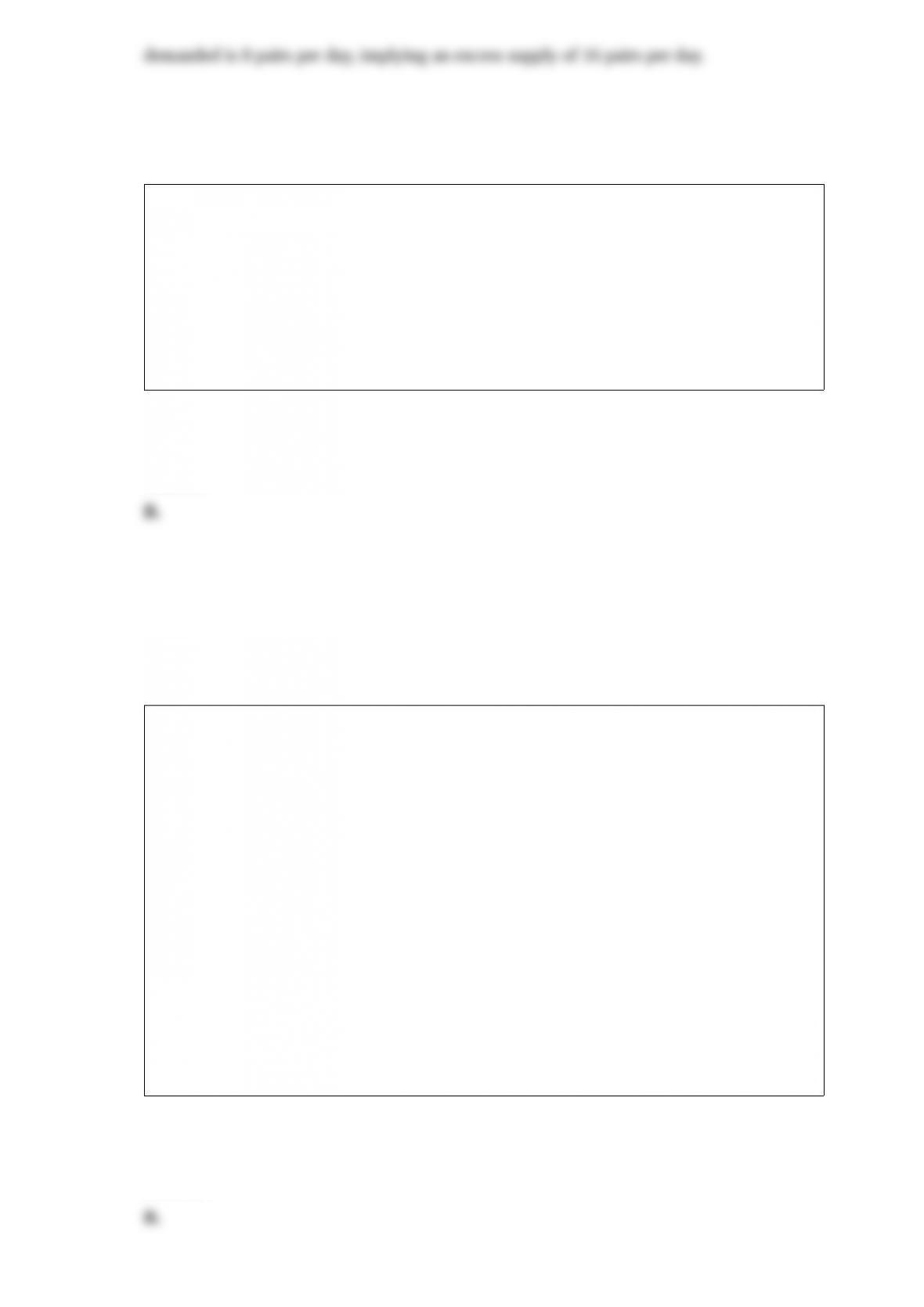
The figure below shows the supply and demand curves for jeans in Smallville.
At a price of $60 per pair, there will be an excess ______ of ______ pairs of jeans per
day.
A. supply; 24
B. supply; 16
C. demand; 16
D. demand; 8
A positive demand shock will shift the ______ curve to the ______.
A. AD; left
B. AD; right
C. AS; left
D. AS; right
Suppose you have $200 with which you can buy shares of stock from two companies:
ABC Hot Chocolate Company and XYZ Lemonade. Each company’s stock currently
sells for $100 per share. If the temperature next year is lower than average, the stock
price for ABC will increase by $20, and the stock price for XYZ will not change. If the
temperature next year is higher than average, the stock price for XYZ will increase by
$20, and the stock price for ABC will not change. There is a 50% chance that it will be
colder than average next year, and a 25% chance that it will be warmer than average. If
you purchase two shares of ABC stock and no shares of XYZ stock, your expected gain
will be ______.
A. $0
B. $20
C. $30
D. $40
Recessions tend to be ______ by ______ the rate of inflation.
A. followed; an increase in
B. followed; a decrease in
C. preceded; a decrease in the stability of
D. neither preceded nor followed; any change in
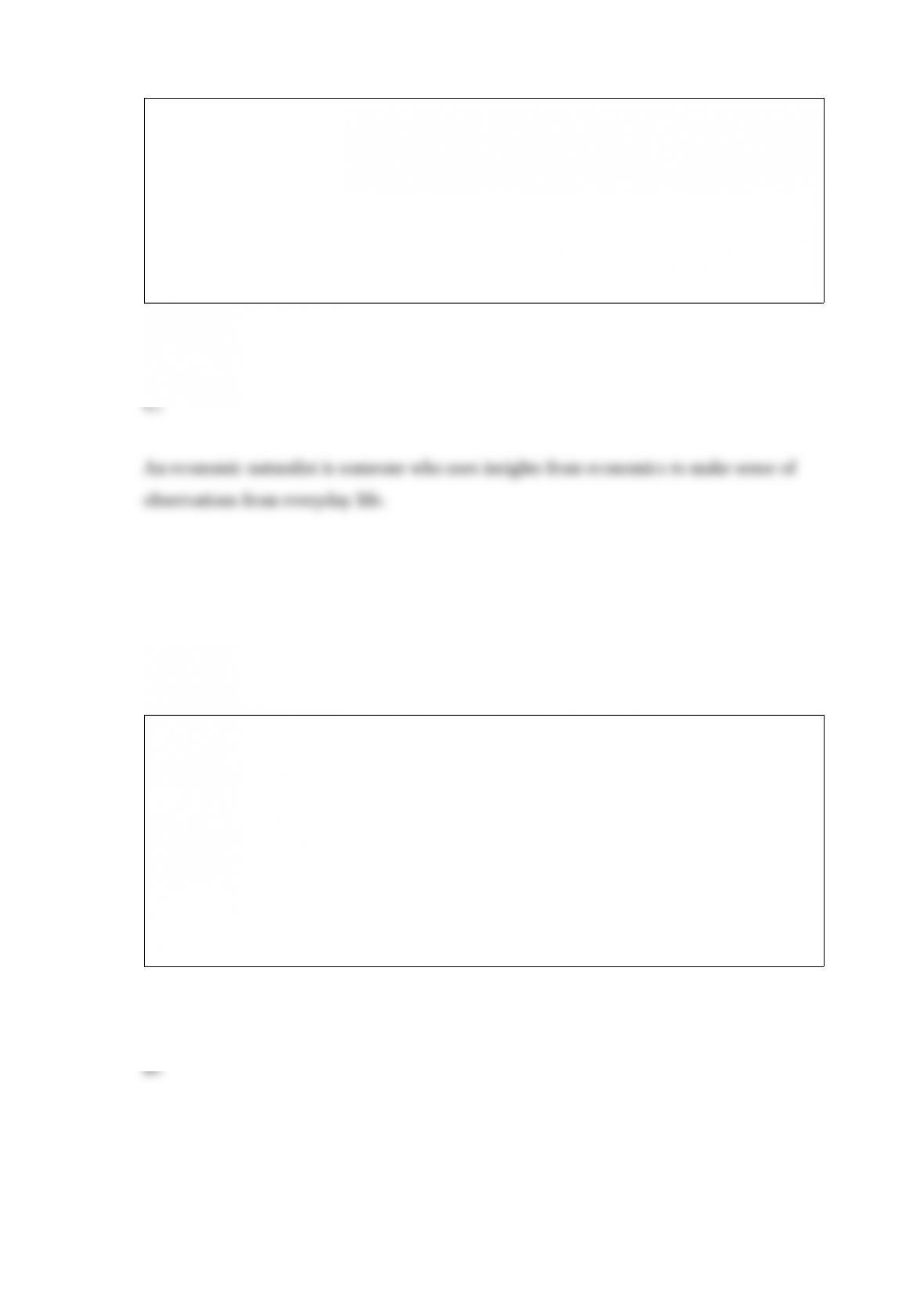
Refer to the figure above. A decrease in supply is represented by shifting from:
A. curve A to curve B.
B. curve B to curve A.
C. curve C to curve D.
D. curve D to curve C.
An economic naturalist is someone who:
A. uses economic arguments to protect the environment.
B. has an innate talent for using economic concepts.
C. applies economic insights to understand everyday life.
D. studies the process of natural selection in a cost-benefit framework.
Holding other factors constant, if the income tax is replaced with a consumption tax so
that saving is not taxed, then the real interest rate will ______ and the equilibrium
quantity of saving and investment will _______.
A. increase; increase
B. increase; not change
C. increase; decrease
D. decrease; increase
The benefits of specialization can be used to explain why:
A. workers prefer to work on a variety of tasks during the day.
B. machines are more productive than human workers.
C. individuals and nations benefit from trade.
D. big companies take advantage of smaller ones.
The maturation date of a bond is the date at which:
A. coupon payments will be made.
B. the principal will be repaid.
C. dividend payments will be made.
D. taxes on the bond are due.
A boom is:
A. a period in which the economy is growing at a rate significantly below normal.
B. the high point of economic activity prior to a downturn.
C. a particularly severe and protracted recession.
D. a particularly strong and protracted expansion.
A country is most likely to have a comparative advantage in the production of cars if:
A. it imports most of the raw materials necessary to produce cars.
B. its citizens prefer driving cars to other forms of transportation.
C. it has strict environmental protection laws governing automobile emissions.
D. it has a relative abundance in the natural resources needed to produce cars.
Who from among the following would be classified as out of the labor force?
A. A person with a part-time job who wants and is looking for a full-time job.
B. A person who is willing to work and has looked for a job in the last week.

C. A person who is willing to work but has not looked for a job in two months.
D. None of these people would be classified as out of the labor force.
The following data show the relationship between the number of drivers who leave for
work at 8:00 a.m., their average commute time, and their marginal benefit of
commuting.
If there is no charge to use the highway, then one would expect that ______ the socially
optimal number of drivers will leave at 8:00 a.m. because ______.
A. more; each driver’s use of the highway imposes an external cost on other drivers by
increasing the commute time
B. more; the social marginal benefit of using the highway is greater than the private
marginal benefit
C. less; each driver’s use of the highway imposes an external cost on other drivers by
increasing the commute time
D. less; the private marginal benefit of using the highway is greater than the social
marginal benefit
Holding all else constant, an increase in Mexican real GDP will ______ the demand for
dollars in the foreign exchange market and ______ the equilibrium Mexican peso/U.S.
dollar exchange rate.

A. increase; increase
B. increase; decrease
C. decrease; decrease
D. decrease; increase
The recession of 2007-2009 happened in part because, after the housing bubble burst in
2006, the ensuing financial crisis:
A. made it difficult for government to finance deficit spending.
B. led to widespread inflation.
C. increased the level of uncertainty about the future.
D. shifted the PAE line upward.