If the U.S. dollar increases in value relative to other currencies, how does this affect the
aggregate demand curve?
A) This will move the economy up along a stationary aggregate demand curve.
B) This will move the economy down along a stationary aggregate demand curve.
C) This will shift the aggregate demand curve to the left.
D) This will shift the aggregate demand curve to the right.
The money supply curve is vertical if
A) banks and the Fed jointly determine the money supply.
B) the Fed is able to completely determine the money supply.
C) banks and households determine the money supply.
D) households and the Fed jointly determine the money supply.
Figure 1-1
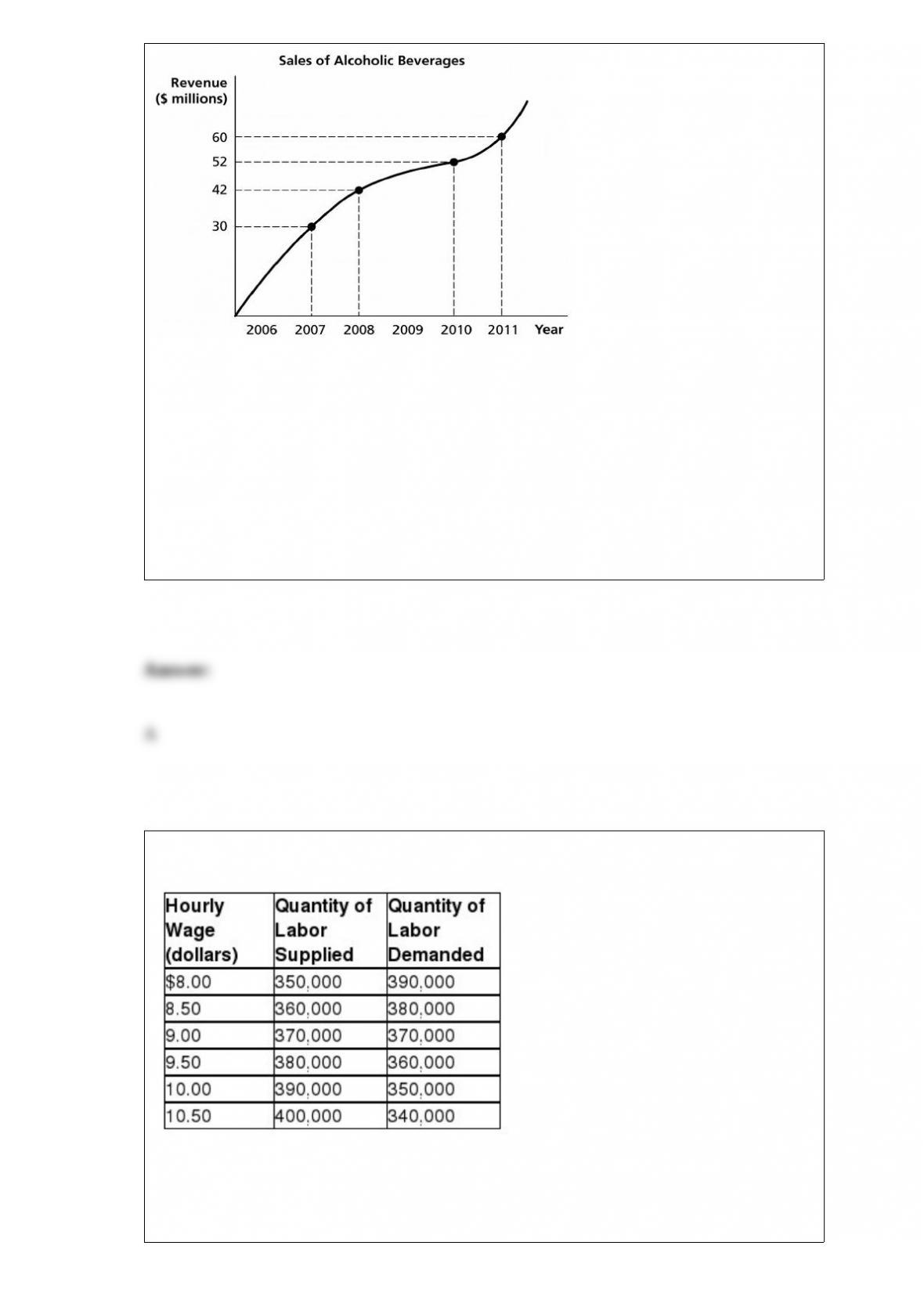
Refer to Figure 1-1. Using the information in the figure above, calculate the percentage
change in sales of alcoholic beverages between 2008 and 2010.
A) 23.8%
B) 40%
C) 42.9%
D) 73.3%
Table 4-4
Table 4-4 shows the demand and supply schedules for the low-skilled labor market in
the city of Westover.
Refer to Table 4-4. Suppose that the quantity of labor supplied increases by 40,000 at

each wage level. What are the new free market equilibrium hourly wage and the new
equilibrium quantity of labor?
A) W = $9.00; Q = 410,000
B) W = $9.50; Q = 420,000
C) W = $8.50; Q = 400,000
D) W = $8.00; Q = 390,000
If money demand is extremely sensitive to changes in the interest rate, the money
demand curve becomes almost horizontal. If the Fed expands the money supply under
these circumstances, then the interest rate will
A) fall substantially and investment and consumer spending will fall substantially.
B) rise substantially and investment and consumer spending will rise substantially.
C) fall substantially and investment and consumer spending will change very little.
D) change very little and investment and consumer spending will change very little.
When a U.S. investor buys a bond issued in a foreign country,
A) the balance on the capital account decreases.
B) the balance on the current account decreases.
C) the balance on the financial account decreases.
D) the balance of trade decreases.
If foreign holdings of U.S. dollars decrease, holding all else constant,
A) the balance on the U.S. financial account will decrease.
B) the balance on the U.S. current account will decrease.
C) the balance on the U.S. capital account will decrease.
D) the U.S. balance of trade will decrease.
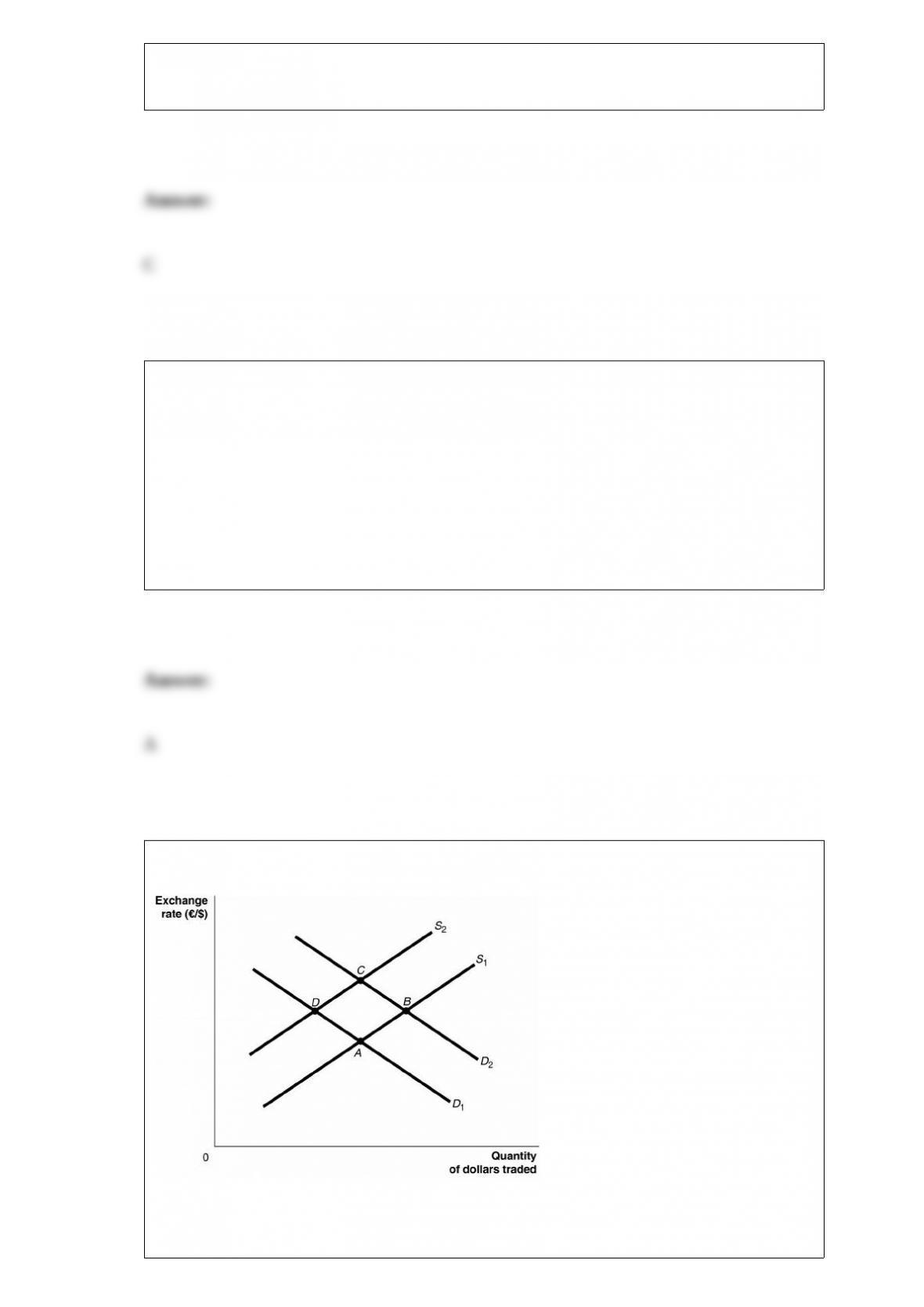
Figure 18-1
Refer to Figure 18-1. Italians cut back on smoking and cut their demand for American
cigarettes in half. Assuming all else remains constant, this would be represented as a
movement from

A) B to A.
B) D to C.
C) B to C.
D) A to D.
Spending on the war in Afghanistan is essentially categorized as government purchases.
How do increases in spending on the war in Afghanistan affect the aggregate demand
curve?
A) They will move the economy down along a stationary aggregate demand curve.
B) They will move the economy up along a stationary aggregate demand curve.
C) They will shift the aggregate demand curve to the right.
D) They will shift the aggregate demand curve to the left.
The difference between adverse selection and moral hazard is that
A) moral hazard happens at the time parties enter into a transaction; adverse selection
occurs after the transaction takes place.
B) adverse selection happens at the time parties enter into a transaction; moral hazard
occurs after the transaction takes place.
C) moral hazard is the motive that is behind one party entering into a transaction with
another party. Adverse selection refers to the other party being harmed by the
transaction.
D) moral hazard refers to the likelihood that a transaction will lead one party to be
better off at the expense of the other party to the transaction. Adverse selection refers to
the consequences of the transaction after it has occurred.
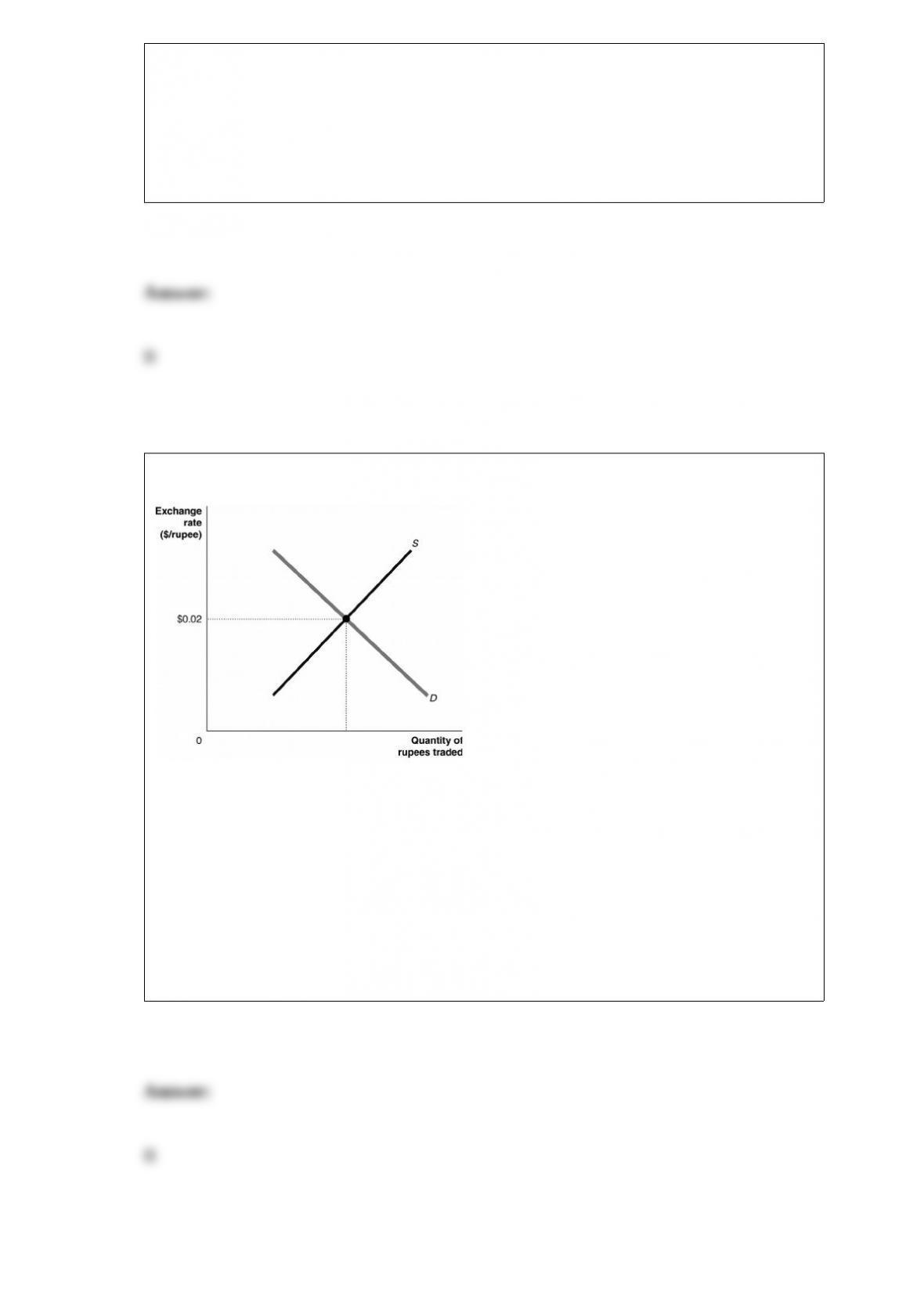
Figure 19-7
Refer to Figure 19-7. If the Indian government pegs its currency to the dollar at a value
above $.02/rupee, we would say the currency is
A) undervalued.
B) overvalued.
C) parity valued.
D) equilibrium valued.
In which of the following situations would the Fed conduct contractionary monetary
policy?
A) The Fed believes that aggregate demand was growing too slowly to keep up with
potential GDP.
B) The Fed fears that unemployment is climbing above the natural rate.
C) The Fed is concerned that aggregate demand would continue to exceed the growth in
potential GDP.
D) The Fed is worried that deflation will become a problem.
How would an increase in the U.S. federal budget deficit affect the exchange rate in the
market for dollars?
A) The exchange rate will increase.
B) The exchange rate will decrease.
C) The exchange rate will not be affected by a change in the federal budget deficit.
D) The impact of the increase in the federal budget deficit on the exchange rate cannot
be predicted.