
If the real interest rate in the United States increases, foreign investors will ________
their demand for U.S. dollars because they desire to ________ more U.S. financial
assets.
A) increase; buy
B) increase; sell
C) decrease; buy
D) decrease; sell
Which of the following would cause the unemployment rate as measured by the Bureau
of Labor Statistics to overstate the true degree of joblessness in the economy?
A) discouraged workers
B) unemployed persons who falsely report themselves as actively looking for a job
C) retired people who have no intention of returning to work
D) people with part-time jobs who would prefer to be working full time
Luke purchases a $50,000 face value one-year Treasury bill for $46,296.30, and the
next day investors decide they will only buy one-year Treasury bills if they receive an
interest rate of 4%. If Luke decides to sell his Treasury bill to another investor the day
after he purchased it, he will

A) receive a capital gain of $1,780.62.
B) receive a capital gain of $2,000.00.
C) suffer a capital loss of $1,923.08.
D) suffer a capital loss of $1,851.85.
To increase the money supply, the Federal Reserve could
A) engage in an open market sale.
B) decrease reserve requirements.
C) decrease income tax rates.
D) lower the discount rate.
New Keynesian economists believe that nominal wages and prices respond ________ to
shocks, and classical economists believe that nominal wages and prices respond
________ to shocks.
A) quickly; quickly
B) quickly; slowly

C) slowly; quickly
D) slowly; slowly
Suppose the economy is initially in equilibrium where real GDP equals potential GDP
and the inflation rate is at the target rate. Other things equal, a housing boom will cause
aggregate expenditures to increase, which will result in a new, short-run equilibrium. To
return GDP to its potential level, the inflation rate will adjust. With adaptive
expectations, this moves the economy to another new short-run equilibrium point. Since
the housing boom is temporary, the end of the housing boom will now cause
A) a decrease in aggregate demand and an increase in the inflation rate.
B) a decrease in aggregate supply and an increase in the inflation rate.
C) a decrease in aggregate demand and a decrease in the inflation rate.
D) a decrease in aggregate supply and a decrease in the inflation rate.
Figure 10.8
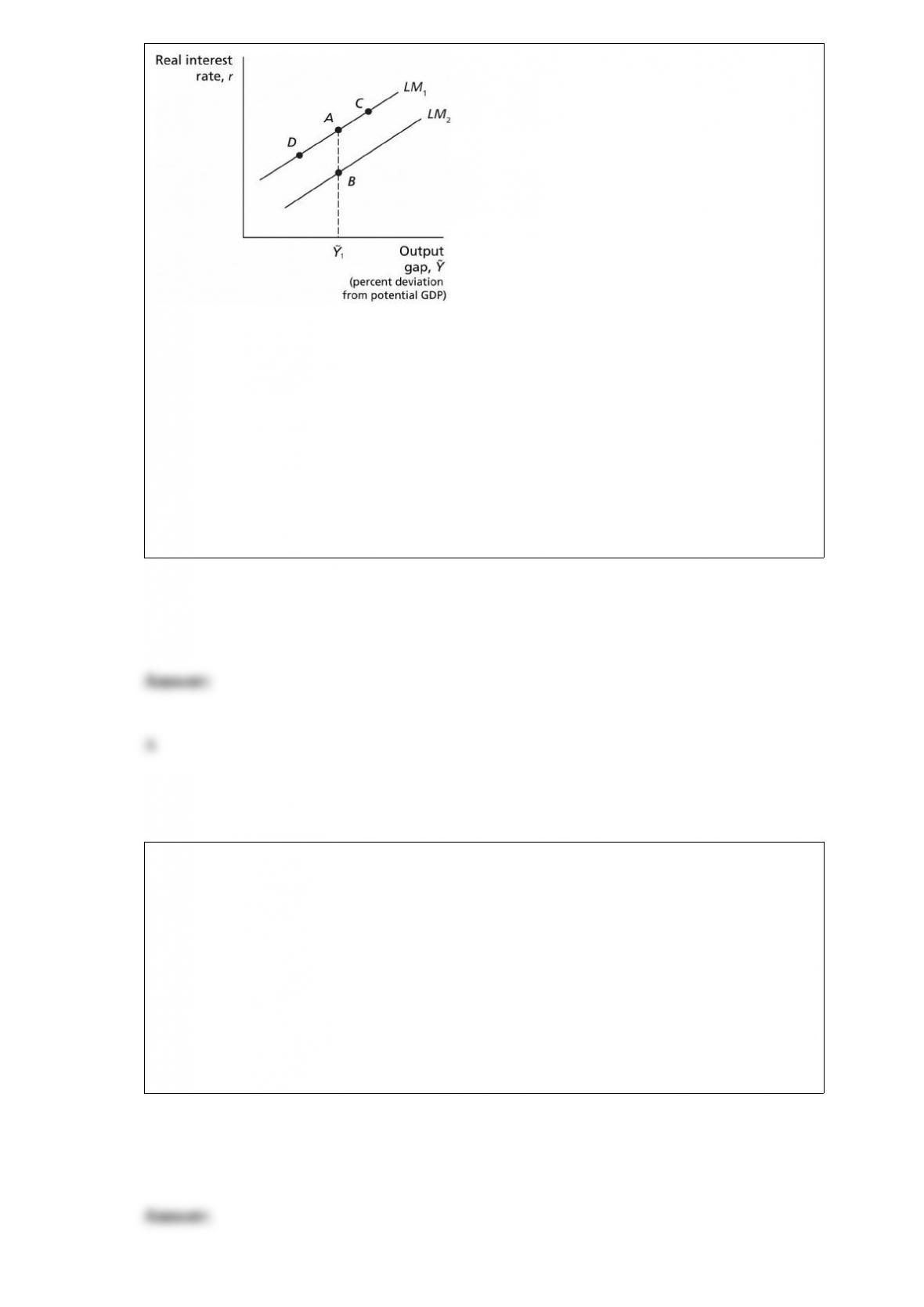
Refer to Figure 10.8. Other things equal, an increase in the demand for money and the
accompanying change in the real interest rate would best be represented by
A) a movement from point A to point C.
B) a movement from point A to point D.
C) a shift from LM1 to LM2.
D) a shift from LM2 to LM1.
In the United States, the growth rate of expenditures has been most volatile for
A) durable goods.
B) nondurable goods.
C) services.
D) The volatility has been roughly equal for all three categories of consumption
expenditures.

Suppose the economy is initially in equilibrium where real GDP equals potential GDP
and the inflation rate is at the target rate. Other things equal, a housing boom will cause
aggregate expenditures to increase, which will result in
A) an increase in aggregate demand and an increase in the inflation rate.
B) an increase in aggregate supply and an increase in the inflation rate.
C) an increase in aggregate demand and a decrease in the inflation rate.
D) an increase in aggregate supply and a decrease in the inflation rate.
The Fed has control over the long-term real interest rate provided that three variables
remain unchanged. These three variables include all of the following except
A) the expected rate of inflation.
B) the default premium.
C) term structure effects.
D) the short-term real interest rate.

Multiplier effects occur when there is a change in spending which does not depend on
income. Spending which does not depend on income is referred to as
A) coincident spending.
B) nominal spending.
C) autonomous expenditures.
D) induced expenditures.
A reason why a firm’s demand for labor curve slopes downward is that, holding
everything else constant,
A) the extra cost of hiring additional units of labor increases as a firm hires more units
of labor.
B) as more labor is hired, labor’s marginal product falls due to diminishing marginal
returns.
C) the firm’s demand curve for the product produced by the labor is downward sloping.
D) each additional unit of labor hired is less efficient than previously hired units.
When break-even investment is subtracted from investment per worker, the result is
A) the change in the capital-labor ratio.

B) saving.
C) the steady state.
D) capital stock dilution.