
1) Rapid population growth can be an obstacle to economic development because:
A.it can translate a relatively large increase in real output into a small increase in real
output per capita.
B.more investment will be required to simply maintain the quantity of capital goods per
person.
C.it may lead to the overutilization and therefore ecological degradation of farmland.
D.all of these reasons.
2) by summing the values added at each stage in the production of some good we
obtain:
a.the price of that good.
b.the total income generated by that good’s production.
c.the total cost (including profits) of that product.
d.all of these.
3) if we say that two variables are directly related, this means that:
a.the relationship between the two is purely random.
b.an increase in one variable is associated with a decrease in the other variable.
c.an increase in one variable is associated with an increase in the other variable.
d.the two graph as a downsloping line.
4) Technological change:
A.always entails increased investment.
B.never entails increased investment.
C.may or may not entail increased investment.
D.is of little relevance to economic growth in the DVCs.
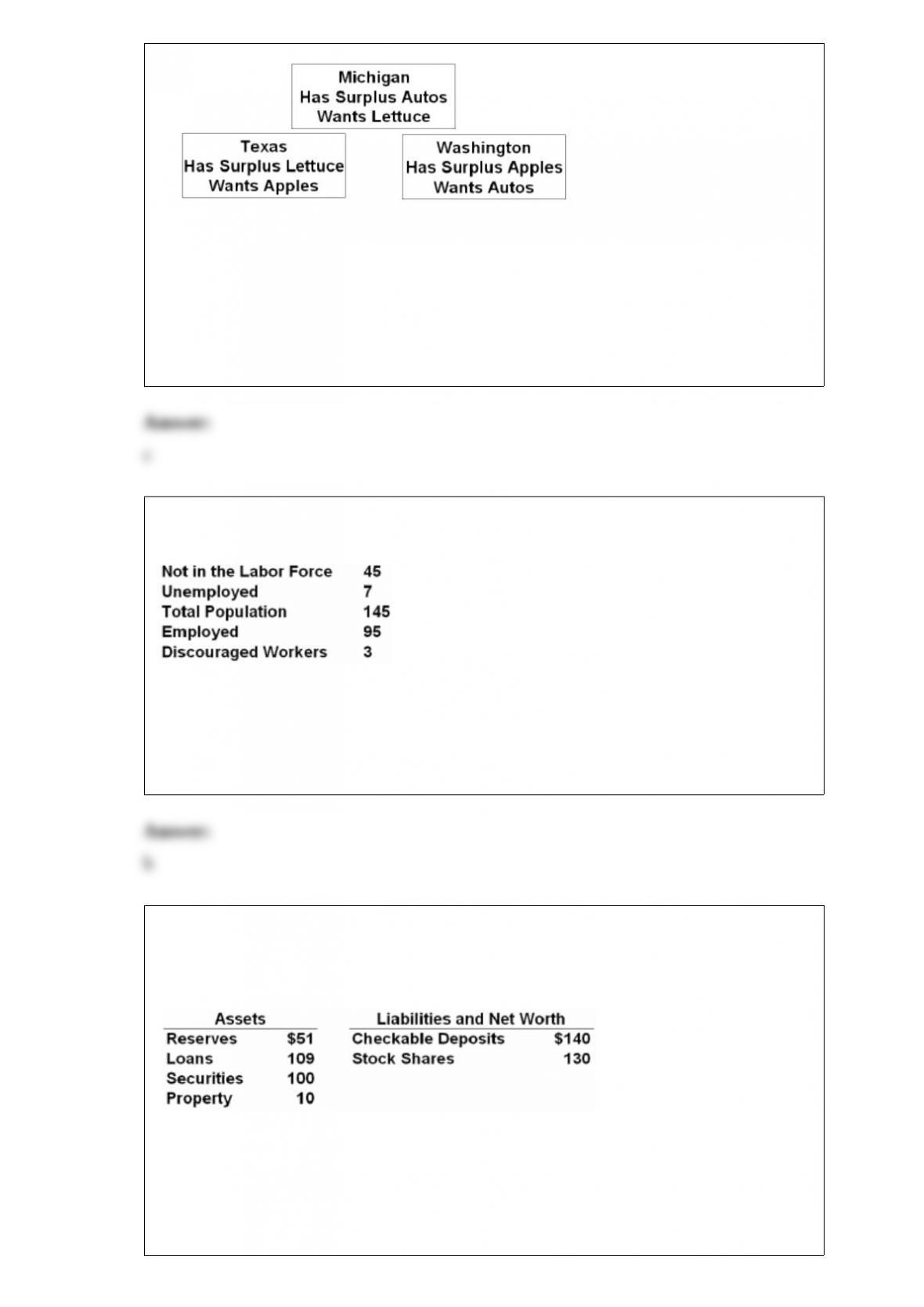
5)
given the above information and assuming trade occurs between the three states we can
expect:
a.that there is no means by which michigan can obtain lettuce while specializing in the
production of autos.
b.that money will not be needed to accomplish the desired exchanges.
c.money to flow counterclockwise from michigan to texas to washington.
d.money to flow clockwise from michigan to washington to texas.
6) answer the next question(s) on the basis of the following information about the
hypothetical economy of scoob. all figures are in millions.
refer to the above information. the labor force in scoob is:
a.95 million.
b.102 million.
c.105 million.
d.145 million.
7) The following consolidated balance sheet for the commercial banking system.
Assume the required reserve ratio is 30 percent. All figures are in billions.
Refer to the above data. If the commercial banking system actually loans the maximum
amount it is able to lend:
A.reserves and deposits equal to that amount will be gained.
B.excess reserves will be $2.6 billion.
C.excess reserves will fall to $1.7 billion.
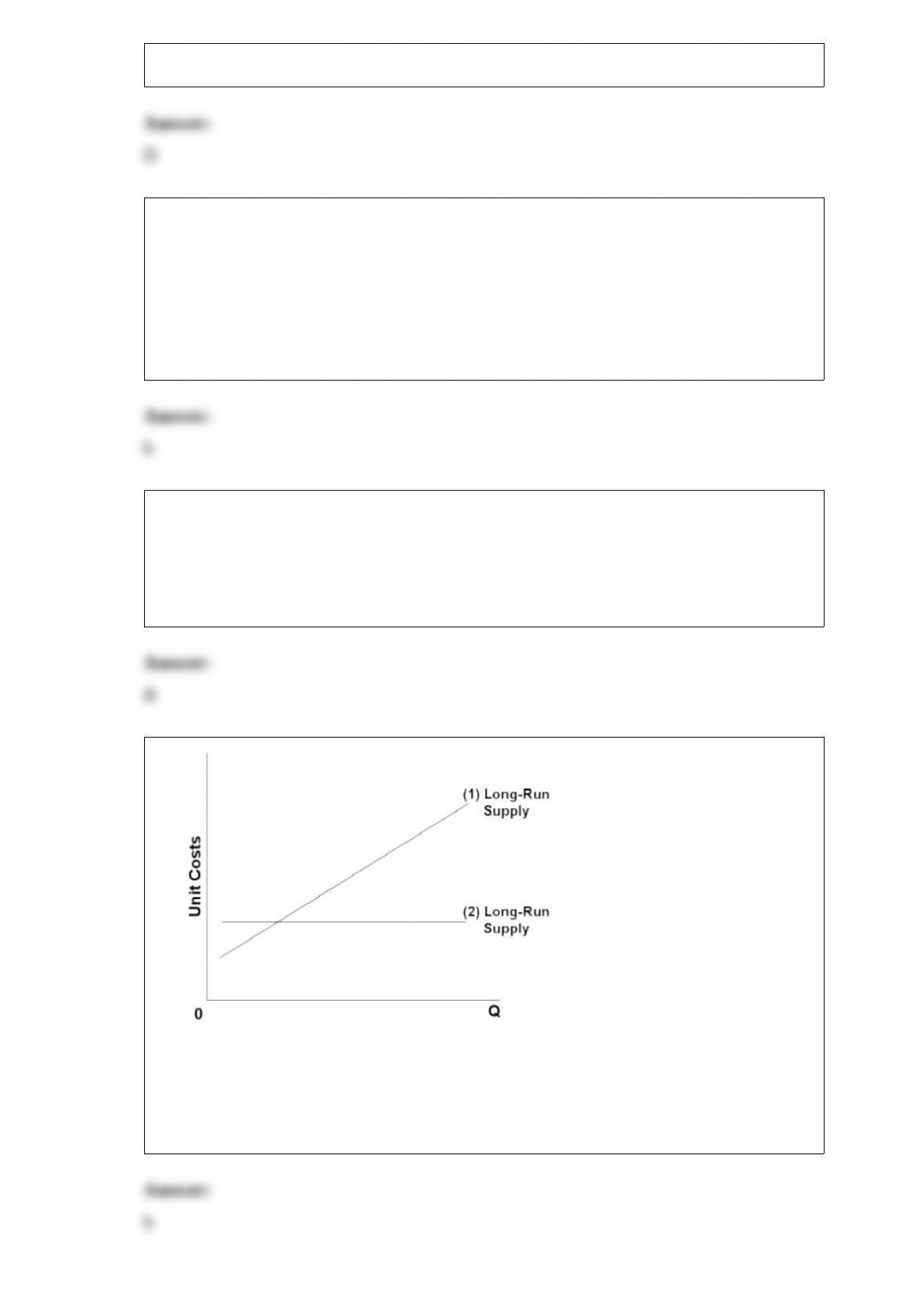
D.excess reserves will be reduced to zero.
8) at the output where the combined amounts of consumer and producer surplus are
largest:
a.the areas of consumer and producer surplus necessarily are equal.
b.the maximum willingness to pay for the last unit of output equals the minimum
acceptable price of that unit of output.
c.consumer surplus exceeds producer surplus by the greatest amount.
d.marginal benefit exceeds marginal cost by the greatest amount.
9) The largest component of the money supply (M1) is:
A.currency in bank vaults.
B.currency in circulation.
C.checkable deposits.
D.stock certificates.
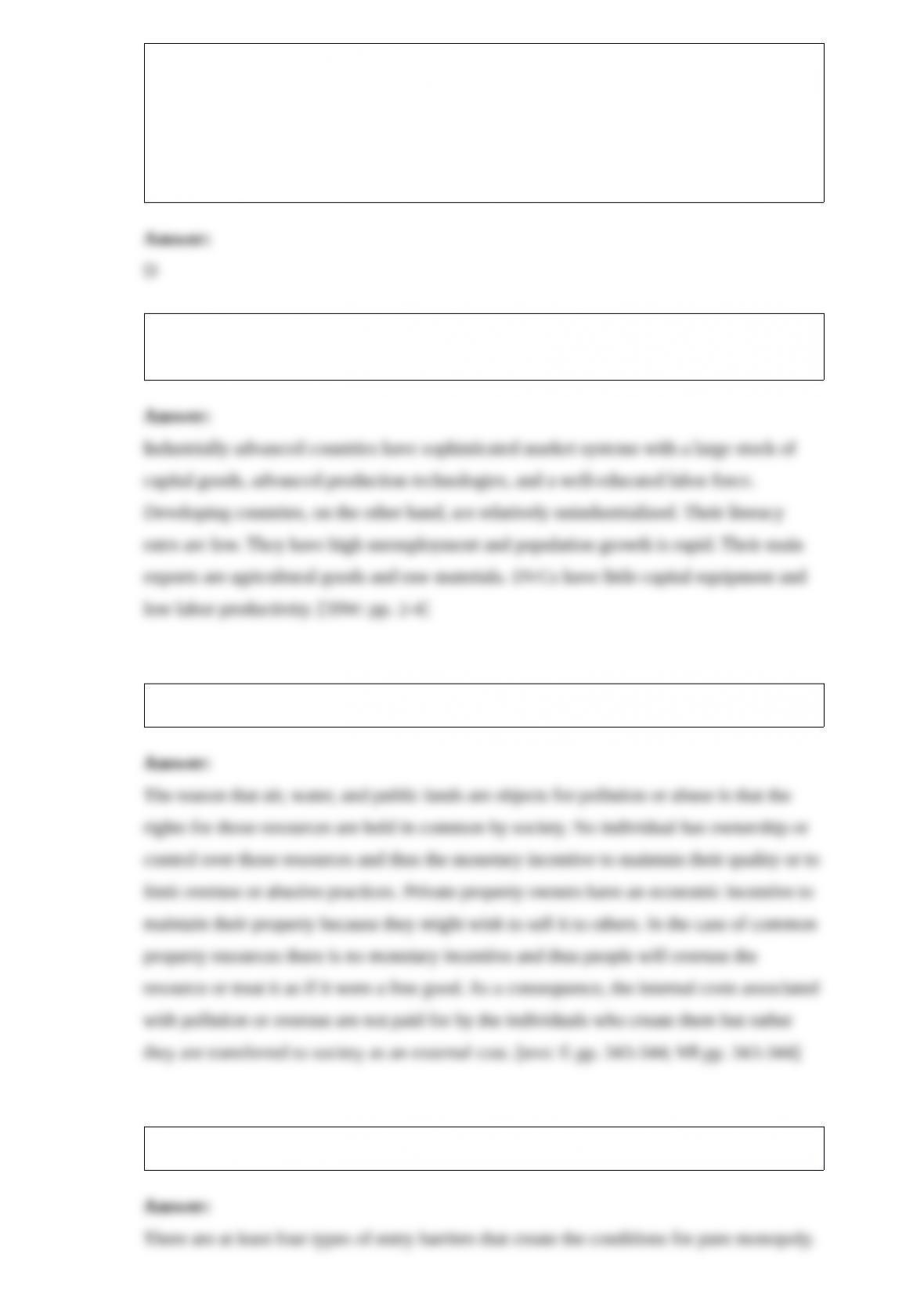
10)
refer to the above diagram. line (1) reflects a situation where resource prices:
a.decline as industry output expands.
b.increase as industry output expands.
c.remain constant as industry output expands.
d.are unaffected by the level of output in the industry.
11) Which of the following actions can a country take in order to maintain fixed
exchange rate?
A.Currency interventions using official reserves.
B.Altering tariffs and quotas.
C.Implement exchange controls and rationing.
D.All of these.
12) In terms of economic and social conditions, how do industrially advanced countries
and developing countries differ?
13) Explain the idea of the tragedy of the commons.
14) What are the major barriers to entry that explain the existence of monopoly?
15) How does price elasticity affect the price-quantity combination and segment of the
demand curve that the monopolist would prefer for price and output?
16) Assume that an economy has 9000 workers, each working 2000 hours per year. The
average real output per worker-hour is $20. What will the total output or real GDP be?
Explain.