1) (last word) critics of the 2006 massachusetts law requiring all residents to have
health care insurance claim that:
a.the law fails to address the problem of rising health care prices.
b.the law will drive health care prices up faster by increasing the demand for health
care.
c.even if viable in massachusetts, it could be cost prohibitive on a national scale.
d.all of these are concerns of the massachusetts law.
2)
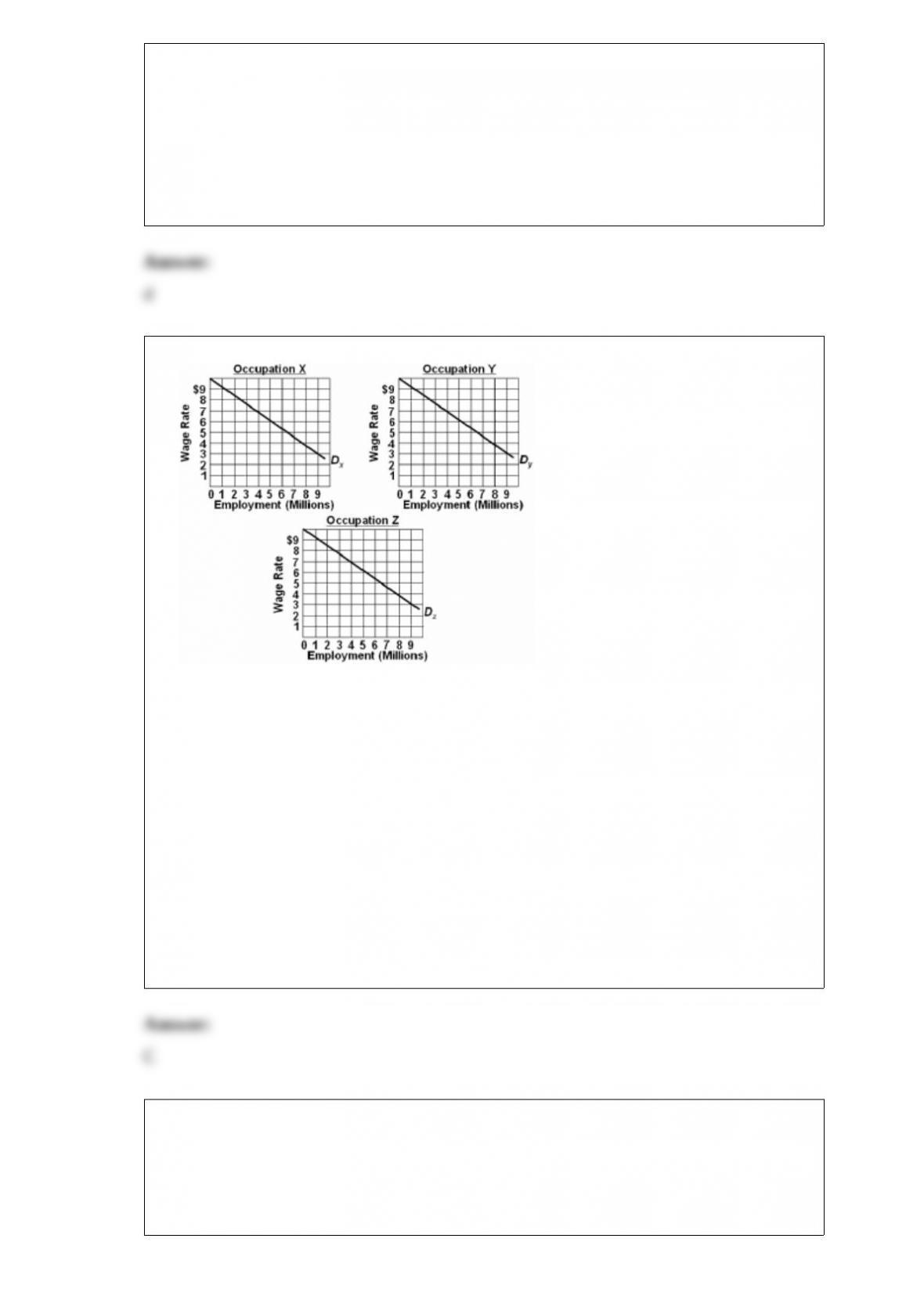
Assumptions: (1) the labor force is comprised of 9 million men and 9 million women
workers; (2) the economy has 3 occupations, X, Y, and Z, each having identical demand
curves for labor; (3) men and women workers are homogeneous with respect to their
labor-market capabilities; (4) women are discriminated against by being excluded from
occupations X and Y and are confined to Z; and (5) aside from discrimination, the
economy is competitive.
Refer to the above diagram and list of assumptions. The allocation of employment
determined in the previous question will result in which of the following wage
structures?
A.Men and women will both be paid $5.
B.Men will be paid $5 and women $4.
C.Men will be paid $6.50 and women $3.
D.Women and men will both be paid $6.50.
3) at an annual growth rate of 7 percent, real gdp will double in about:
a.11 years.
b.10 years.
c.13 years.
d.9 years.
4)
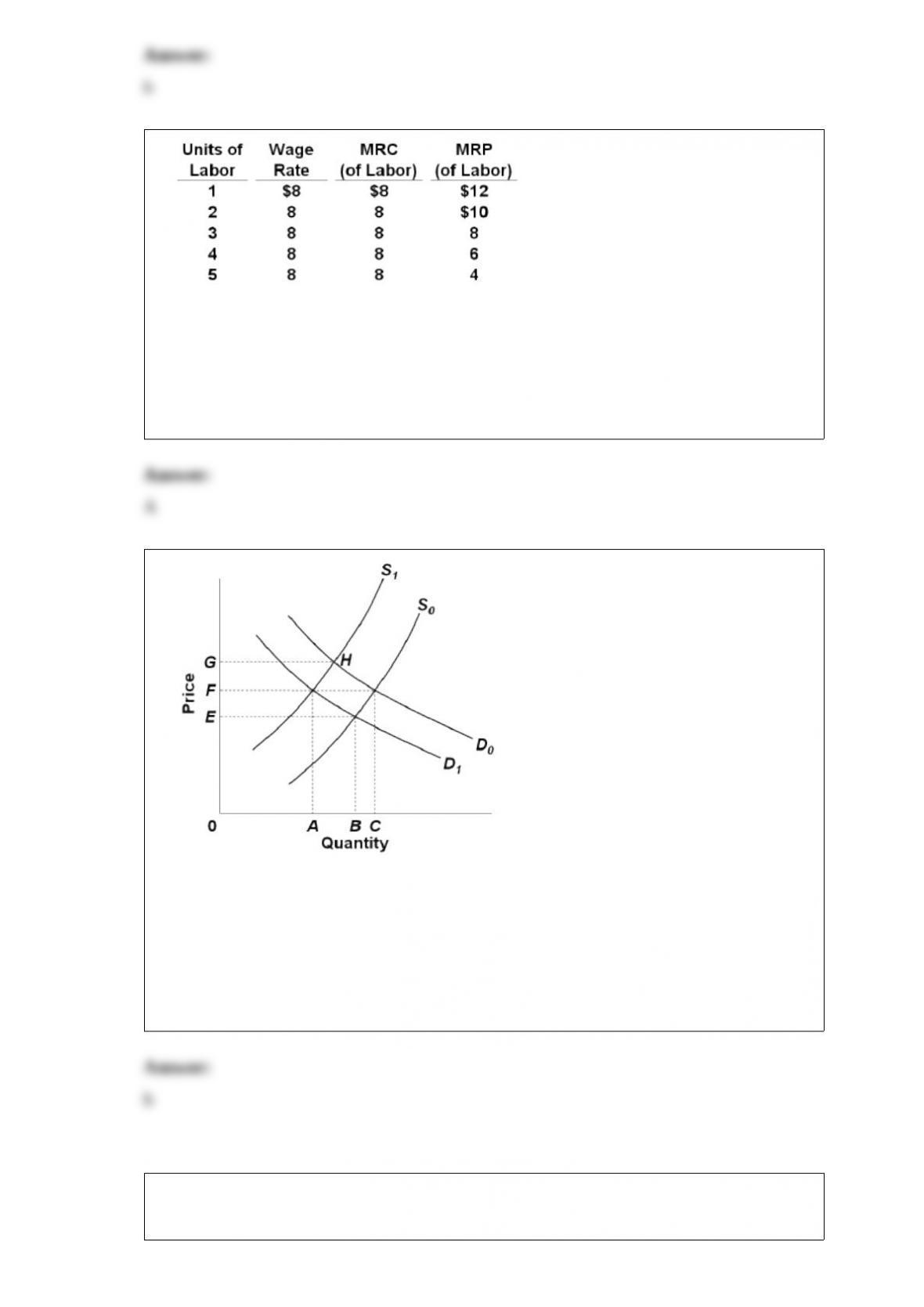
Refer to the above data. If there is neither a union nor a minimum wage, we can
conclude that this firm:
A.”purchases” labor in purely competitive labor market.
B.is a monopsonist.
C.faces a perfectly inelastic labor supply curve.
D.has a perfectly elastic labor demand curve.
5)
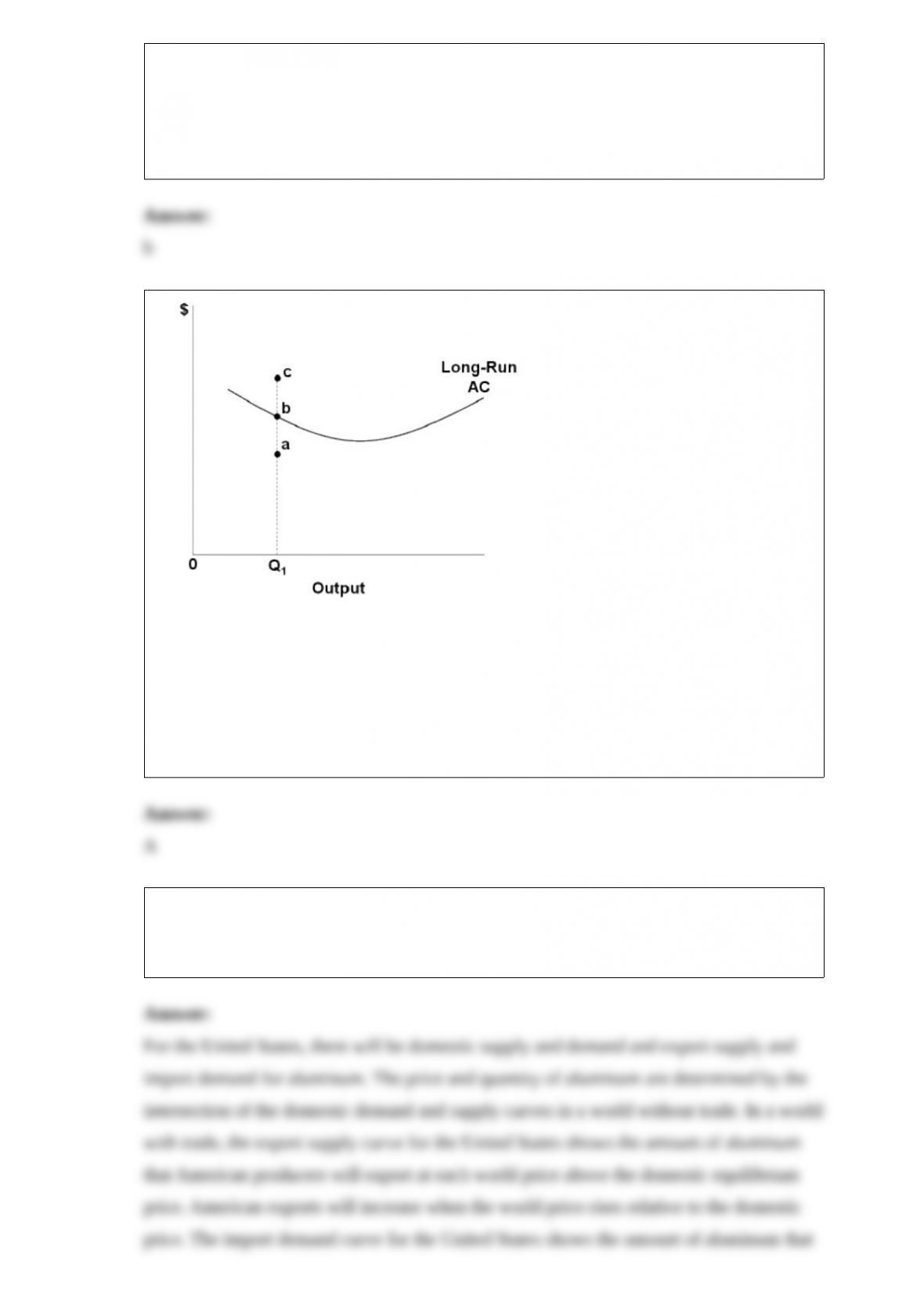
refer to the above diagram, which shows demand and supply conditions in the
competitive market for product x. a shift in the demand curve from d0 to d1 might be
caused by a(n):
a.decrease in income if x is an inferior good.
b.increase in the price of complementary good y.
c.increase in money incomes if x is a normal good.
d.increase in the price of substitute product y.
6) suppose you own $50,000 of personal property, $5,000 of stock in general statics
corporation, a $10,000 savings account, and $20,000 of government bonds. if general
statics goes bankrupt, the most you could lose is:
a.$50,000.
b.$5,000.
c.$35,000.
d.$85,000.
7)
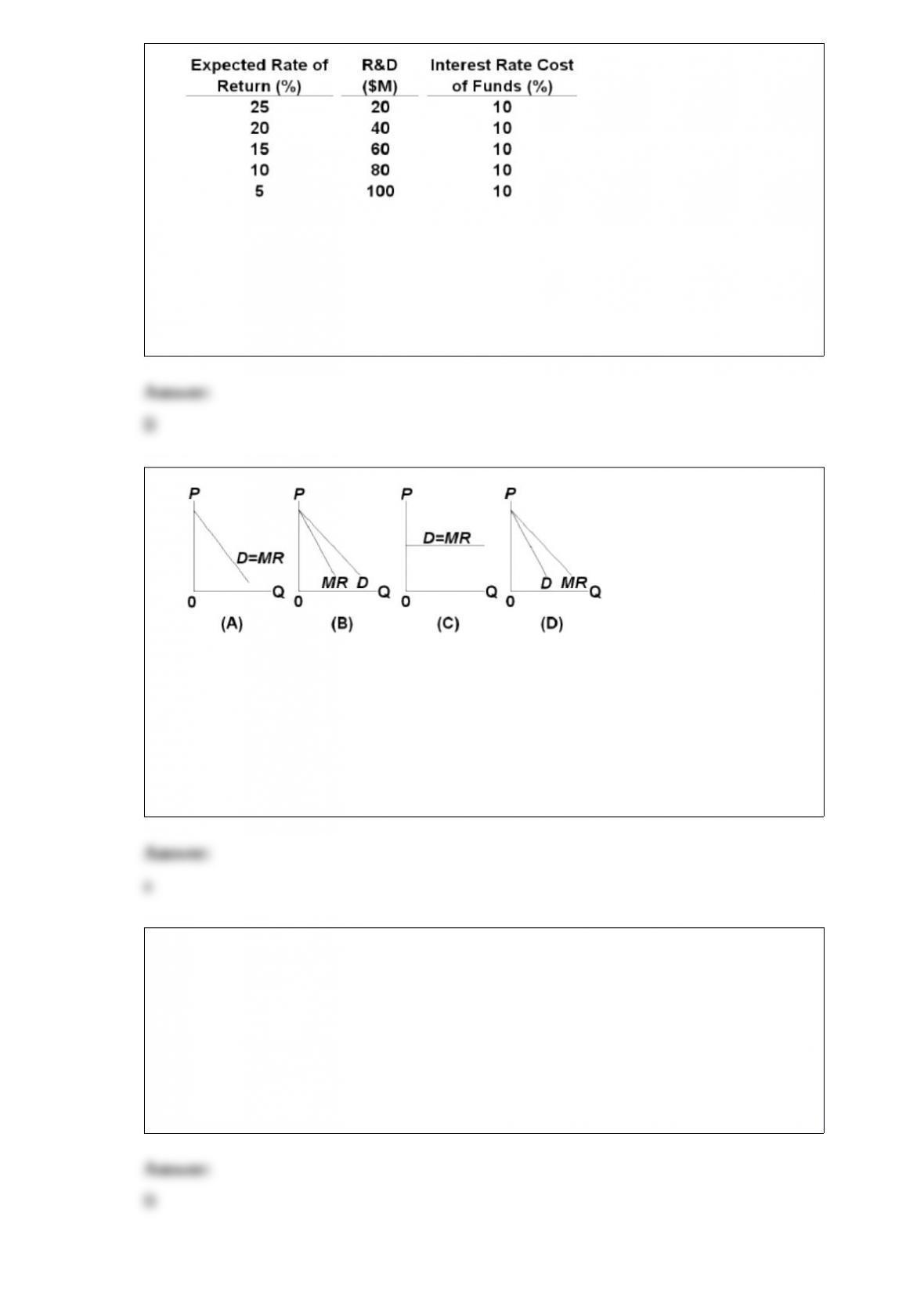
Refer to the above diagram. The production of Q1 units of output at an average cost of
a:
A.is not possible, given present technology and resource prices.
B.can be achieved if the firm would hire the optimal mix of resources.
C.would entail X-inefficiency.
D.can be realized if the last dollar spent on each input were equal to its marginal
product.
8) How can supply and demand analysis be used to explain the equilibrium price and
quantity of exports and imports for aluminum when there is trade between two nations
(e.g., the United States and Canada)?

9) As distinct from reductions in the price level, reductions in the rate of inflation are
referred to as:
A.dollar depreciation.
B.stagflation.
C.deflation.
D.disinflation.
10) Which of the following describes a purely competitive labor market?
A.MRP < Wage Rate
B.MRP > Wage Rate
C.Wage Rate = MRC
D.Wage Rate < MRC

11) The large trade deficit that the U.S. has with China persists in part because:
A.the U.S. economy has grown slowly in recent years.
B.China has fixed its exchange rate and not allowed the yuan to appreciate relative to
the U.S. dollar.
C.China has experienced rapid economic growth over the past decade.
D.China has recently imposed or increased tariffs on most goods imported from the
U.S.
12) Paying an above-equilibrium wage rate might reduce unit labor costs by:
A.permitting the firm to attract lower-quality labor.
B.increasing the cost to workers of being fired for shirking.
C.increasing voluntary worker turnover.
D.increasing the supply of labor.
13) The infant industry argument for tariffs is criticized:
A.because it is difficult to determine which industries merit protection.
B.because direct subsidies are probably a better means of stimulating such industries.
C.because the tariffs may remain after the industry reaches maturity.
D.for all of these reasons.
14) The U.S. poverty rate for:
A.Hispanics is higher than that for African-Americans.
B.children under 18 years of age is higher than for the overall population.
C.African-Americans has increased since 1993.
D.foreign-born individuals who are not citizens is below the poverty rate for the general
population.
15)
If we plotted the above data on a graph with R&D expenditures on the horizontal axis,
the:
A.interest-rate-cost-of-funds-curve would be a vertical line.
B.interest-rate-cost-of-funds-curve would be horizontal line.
C.expected-rate-of-return-curve would slope upward.
D.expected-rate-of-return-curve would be a horizontal line.
16)
which of the above diagrams correctly portray the demand (d) and marginal revenue
(mr) curves of a pure monopolist that is able to price discriminate by charging each
customer their maximum willingness to pay?
a.a
b.b
c.c
d.d
17) Assume the equation for the total demand for money is L = 0.4Y + 80 – 4 i, where L
is the amount of money demanded, Y is gross domestic product, and i is the interest
rate. If gross domestic product is $200 and the interest rate is 10 (percent), what amount
of money will society want to hold?
A.$200
B.$120
C.$320
D.$160

18) Even where imitation is possible, a firm may gain advantage from being the first to
introduce an innovative product because of:
A.long-lasting brand-name recognition.
B.a time lag between innovation and imitation by rivals.
C.trade secrets that limit the ability of rivals to imitate the product.
D.all of these.
19) the largest category of federal spending is for:
a.agriculture and rural development.
b.science, space, and technology.
c.pensions and income security.
d.national defense.
20) if consumers are willing to pay a higher price than previously for each level of
output, we can say that, the following has occurred:
a.a decrease in demand.
b.an increase in demand.
c.a decrease in supply.
d.an increase in supply.