
Historically, U.S. federal expenditures have ________ as a percentage of GDP.
A) remained fairly stable
B) increased dramatically
C) slowly declined
D) been extremely volatile
All of the following are examples of financial securities except
A) checking accounts.
B) corporate bonds.
C) shares of stock.
D) Treasury bonds.
An increase in the level of total factor productivity will lead to
A) an increase in the capital-labor ratio and an increase in real GDP worker.
B) an increase in investment and a decrease in depreciation.
C) an upward shift of the break-even investment line and an increase in the
capital-labor ratio.
D) a higher rate of dilution and lower break-even investment.
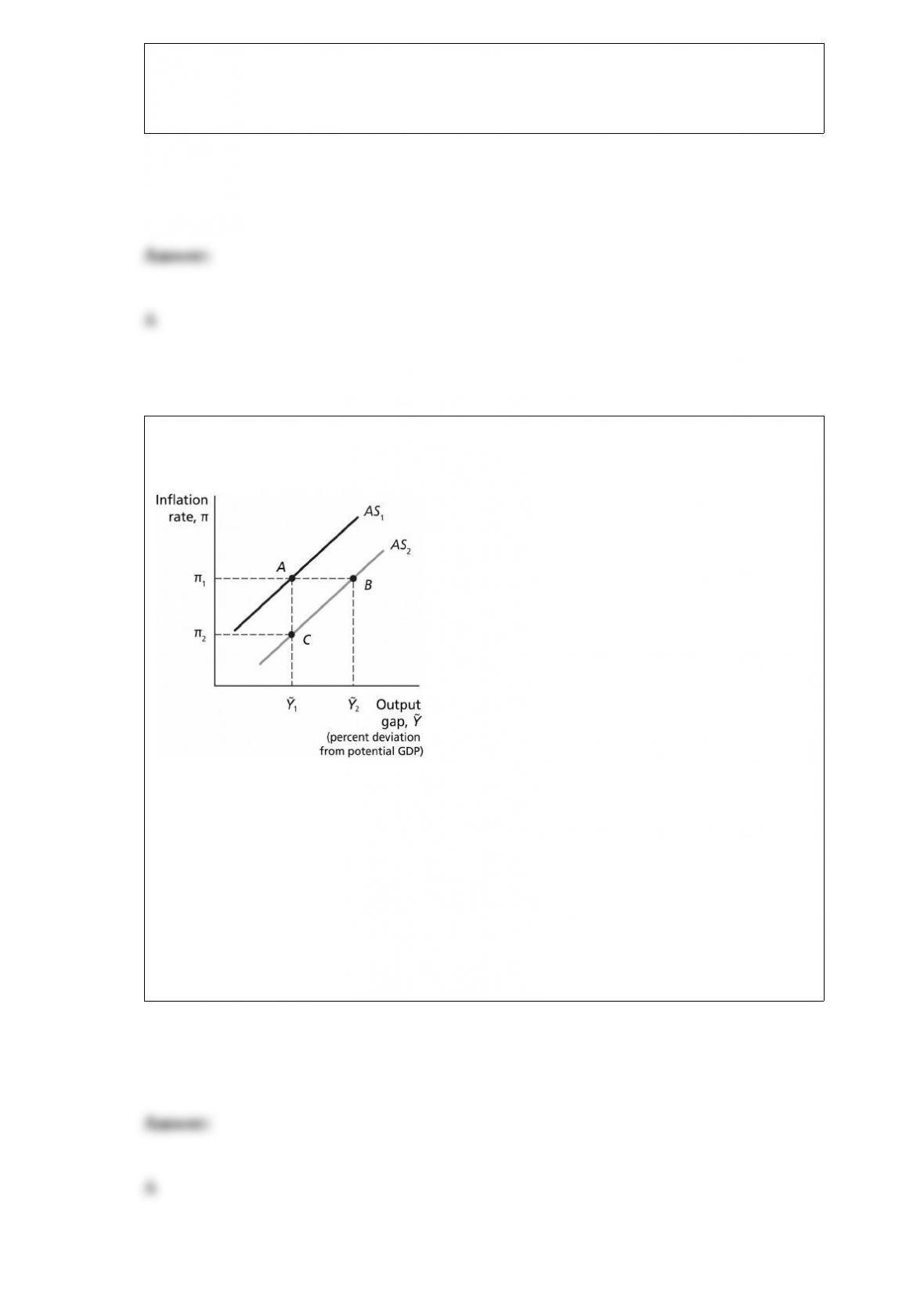
Figure 14.2
Refer to Figure 14.2. Other things equal, a movement from point C to point B would be
caused by
A) an increase in the price level.
B) a decrease in the price level.
C) a positive supply shock.
D) a negative supply shock.

The break-even investment line becomes steeper when the depreciation growth rate
________ or the labor force growth rate ________.
A) increases; decreases
B) increases; increases
C) decreases; increases
D) decreases; decreases
All of the following are examples of residential investment spending except
A) the purchase of a new apartment building by a property management company.
B) Sandra purchases her childhood home from her parents.
C) the purchase of a new home by the MacGregor family.
D) Tobias purchases a new duplex and plans to live in one half and rent the other half to
his brother Dorian.
Hector’s wealth is zero, he expects to work for another 45 years at a constant salary of
$80,000 and live for another 60 years. Assuming taxes are zero, if Hector completely
smooths consumption over his lifetime, his annual consumption is
A) $60,000.

B) $62,222.
C) $80,000.
D) $106,667.
The deliberate change in taxes, transfer payments, or government expenditures to
achieve macroeconomic policy objectives is known as
A) expansionary fiscal policy.
B) contractionary fiscal policy.
C) discretionary fiscal policy.
D) automatic stabilizers.
An increase in real GDP will shift the money demand curve to the ________, causing
the nominal interest rate to ________.
A) right; increase
B) right; decrease
C) left; increase

D) left; decrease
When an economy begins to move from a recession to an expansion, the output gap
typically
A) remains positive.
B) remains negative.
C) switches from negative to positive.
D) switches from positive to negative.
As a part of the tax cut package signed into law on December 17, 2010, the government
reduced the employee portion of the payroll tax from 4% to 2% for 2011. According to
the permanent-income hypothesis, households that smooth consumption will
A) use all of the extra income generated by this tax reduction for consumption during
2011.
B) use a large portion of the extra income generated by this tax reduction for
consumption during 2011.
C) use most of the extra income generated by this tax reduction as saving during 2011.
D) split the income evenly between consumption and saving during 2011, since the tax
cut will expire after one year and consumption is smoothed.
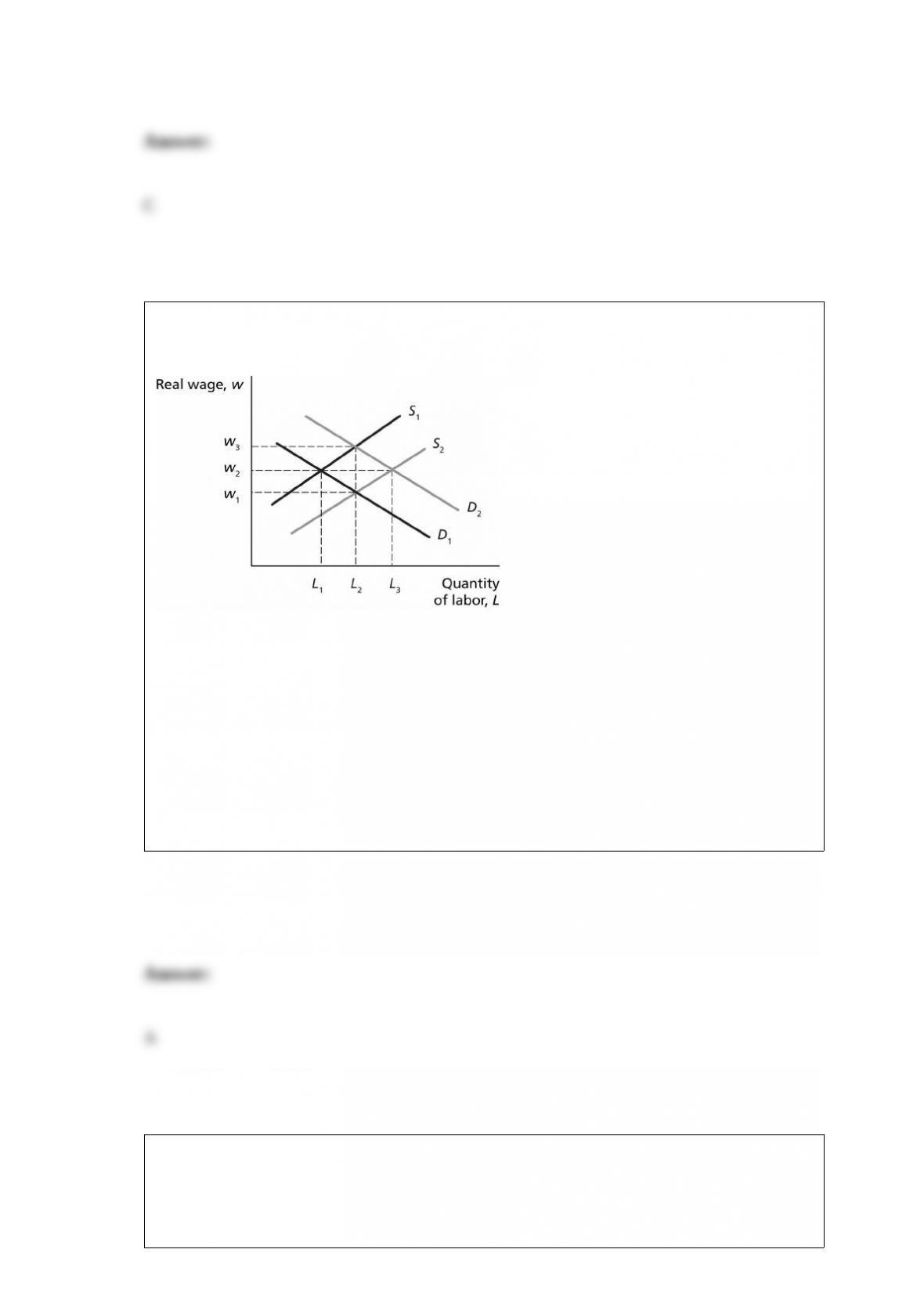
Figure 8.3
Refer to Figure 8.3. Holding other variables constant, a decrease in households’ wealth
accompanied by an increase in the capital stock will definitely result in
A) an increase in the equilibrium quantity of labor.
B) a decrease in the equilibrium quantity of labor.
C) an increase in the equilibrium real wage.
D) a decrease in the equilibrium real wage.
Shifts in the IS curve ________ the AD curve, and changes to the reaction function
________ the AD curve.
A) cause a movement along; shift

B) shift; cause a movement along
C) temporarily shift; permanently shift
D) permanently shift; temporarily shift
The income effect of a real wage increase is observed when
A) the higher wage causes workers to take more leisure and work fewer hours.
B) the higher wage causes workers to take less leisure and work more hours.
C) leisure’s higher opportunity cost causes workers to take less leisure and work more
hours.
D) leisure’s higher opportunity cost causes workers to take more leisure and work more
hours.

The Federal Open Market Committee consists of
A) 12 members, each of which is the president of one of the 12 regional Federal
Reserve banks.
B) the seven members of the Board of Governors , the Chairman of the Fed, the U.S.
Treasury Secretary, and the president of the Federal Reserve Bank of New York.
C) the chairman of the Fed, the chairman of the president’s council of economic
advisors, the U.S. Treasury Secretary, and 4 of the 12 Federal Reserve Bank presidents
who serve on a rotating basis.
D) the seven members of the Board of Governors , the president of the Federal Reserve
Bank of New York, and 4 other Federal Reserve Bank presidents.
Other things equal, when the real interest rate rises, C, I and NX ________ and real
GDP will ________ relative to potential GDP.
A) decrease; decrease
B) decrease; increase
C) increase; increase
D) increase; decrease
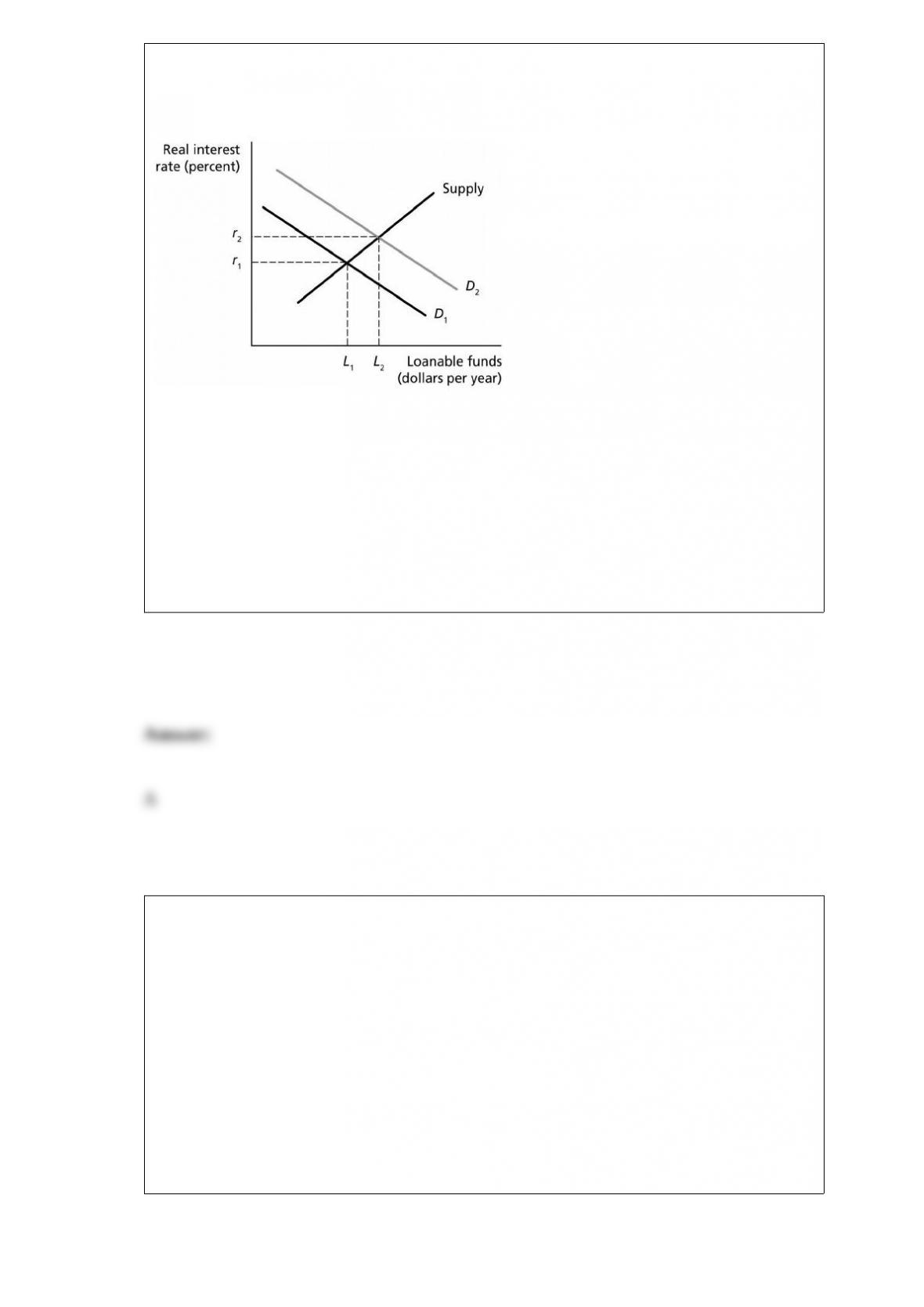
Figure 2
Refer to Figure 4.2. A shift from D1 to D2 will result from which of the following?
A) an increase in expected future profits
B) an increase in corporate taxes
C) an increase in tax credits for savings
D) a decrease in the desire of households to consume today
Hector’s wealth is zero, he expects to work for another 45 years at a constant salary of
$80,000 and live for another 60 years. Assuming taxes are zero, if Hector receives a
$20,000 bonus during his first year of work and he completely smooths consumption
over his lifetime, his annual consumption is
A) $60,000.
B) $60,333.
C) $80,444.
D) $107,000.

The value of bonds outstanding
A) increases when the government runs a budget deficit and decreases when the
government runs a budget surplus.
B) decreases when the government runs a budget deficit and increases when the
government runs a budget surplus.
C) is independent of the government running either a budget deficit or a budget surplus.
D) changes only when the government runs a budget deficit or surplus if the federal
debt is zero.
The oil shock of 2007-2008 saw the price of oil rising from less than $60 a barrel in
March 2007 to over $145 a barrel in July 2008, and decreasing again to just over $30 a
barrel in December 2008. Assuming the economy was at potential GDP prior to the oil
shock, the increase in the price of oil, such as what occurred between March 2007 and
July 2008, acts as a negative supply shock, causing the inflation rate to ________ and
the output gap to ________.
A) increase; become negative
B) increase; become positive
C) decrease; become negative
D) decrease; become positive

Of the three primary tax sources of revenue for the U.S. federal government, which of
the following has trended upward as a percentage of GDP since 1962?
A) corporate income taxes
B) social insurance taxes
C) sales and excise taxes
D) individual income taxes
For each of the following changes, identify whether there will be a shift in the IS curve
or a movement along the IS curve. In each case identify the direction of the movement
or shift.
a. The real interest rate decreases.
b. The government decreases tax rates.
c. Government spending decreases.
d. Investors become optimistic about future profitability.
According to the life-cycle hypothesis, if a person wants consumption to be constant
over her lifetime, she will smooth consumption by initially ________ over her lifetime.
A) saving, then dissaving, then borrowing
B) borrowing, then saving, then dissaving
C) dissaving, then borrowing, then saving
D) saving; then borrowing; then dissaving
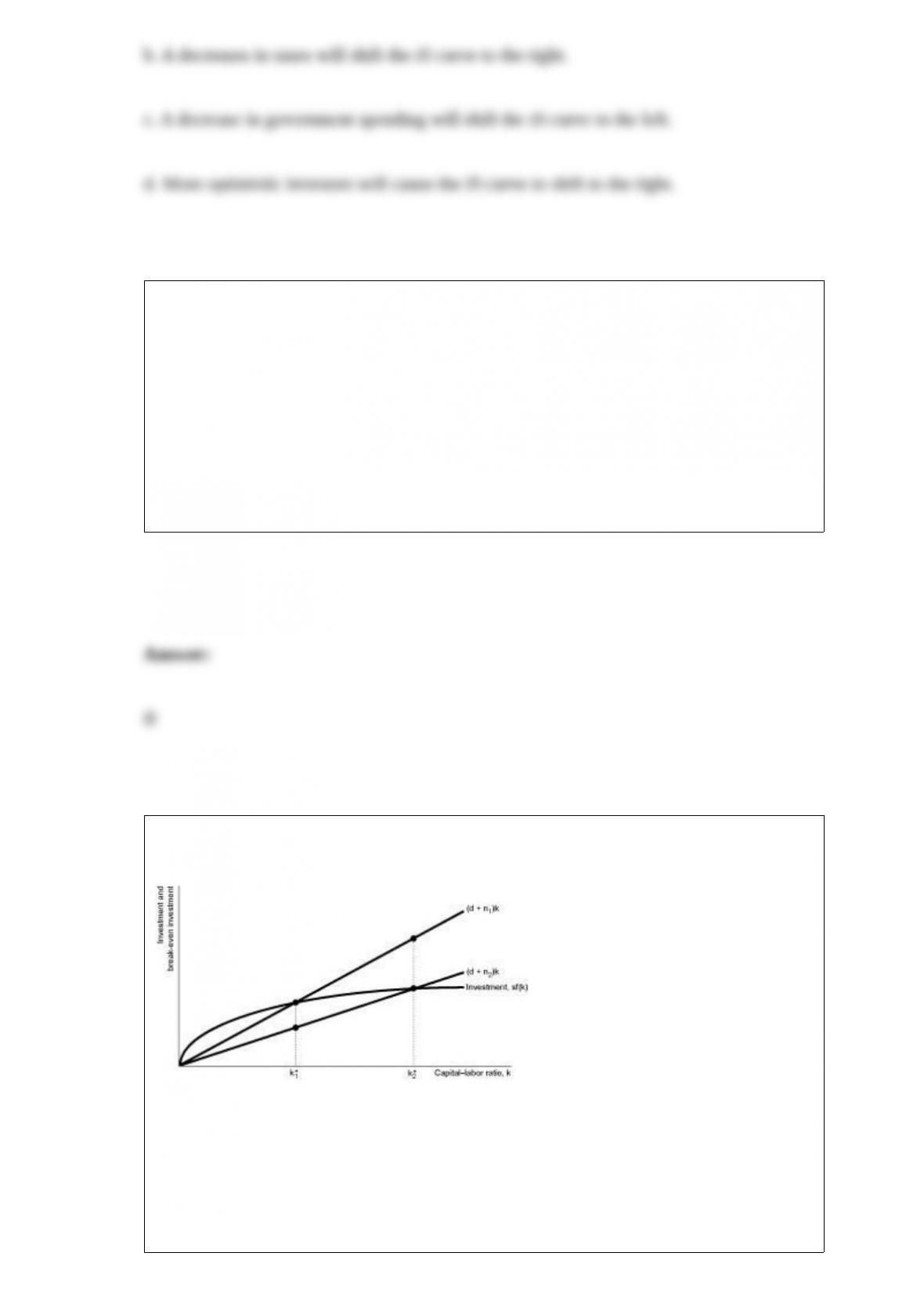
Figure 6.2
Refer to Figure 6.2. Suppose the economy is originally in steady state at k*2. All else
equal, if the labor force growth rate increases ,
A) break-even investment will shift from (d + n1)k to (d + n2)k, and the capital-labor
ratio will move from k*2 to k*1.

B) break-even investment will shift from (d + n1)k to (d + n2)k, and the capital-labor
ratio will remain at k*2.
C) break-even investment will shift from (d + n2)k to (d + n1)k, and the capital-labor
ratio will move from k*2 to k*1.
D) break-even investment will shift from (d + n2)k to (d + n1)k, and the capital-labor
ratio will remain at k*2.
Endogenous growth theory tries to explain why
A) the growth rate of technological change varies across countries.
B) capital is not subject to diminishing marginal returns.
C) total factor productivity is the only determinant of labor productivity.
D) balanced growth occurs in all economies.
In the steady state, assuming that a constant share of the population is working,
A) both real GDP per worker and real GDP per capita will grow at the same rate.
B) real GDP per worker will grow at a faster rate than real GDP per capita.

C) real GDP per capita will grow at a faster rate than real GDP per worker.
D) both real GDP per worker and real GDP per capita will remain constant.
Based on the CBO’s projections of governments revenue and expenditure, if entitlement
programs remain large and unfunded, the current fiscal policy of the federal
government
A) will lead to a larger, but sustainable debt-to-GDP ratio.
B) will have to become more expansionary to remain sustainable.
C) is not sustainable.
D) will still keep the debt-to-GDP ratio relatively stable.
Once economists take into consideration changes in the expected inflation rate and
supply shocks, the Phillips curve
A) only remains useful when explaining the long-run trade-off between unemployment
and inflation.
B) remains a useful tool for explaining the short-run trade-off between unemployment
and inflation.
C) is no longer a useful tool for explaining any trade-off between unemployment and
inflation.

D) accurately explains the short-run and long-run trade-offs between unemployment
and inflation.
Other things equal, by decreasing the interest rate paid on banks’ required reserve
deposits, the Fed can ________ the level of reserves banks are willing to hold, which
would result in a(n) ________ in the money supply
A) increase; increase
B) increase; decrease
C) decrease; increase
D) decrease; decrease
During the financial crisis of 2007-2009, the Fed’s quantitative easing program raised
fears of inflation among investors, and to combat this fear, the Fed announced it would
withdraw the monetary stimulus as the economy recovered. What happened to
inflationary expectations during the latter part of the 2007-2009 recession?
A) Inflationary expectations decreased based on the Fed’s promise to withdraw stimulus
money from the economy.
B) Inflationary expectations increased to record high levels despite the Fed’s promise to
withdraw stimulus money from the economy.

C) Inflationary expectations did increase, but the increase only returned expected
inflation to its pre-recession level.
D) Inflationary expectations decreased to the point where the Fed became worried
about the economy becoming deflationary.
Explain what will happen to the equilibrium real wage and quantity of labor for each of
the following scenarios, and use a graph of the aggregate labor market to show the
changes.
a. The government decreases income tax rates.
b. The skill level of workers increases.
c. A hurricane destroys a large portion of the capital stock.
d. Workers increase their preference of labor over leisure.
e. A technological change occurs that increases the productivity of all workers, and at
the same time the government increases income tax rates.
f. The overall skill level of workers decreases, and at the same time household wealth
increases.

Which of the following is not generally considered one of the three main causes of the
financial crisis of 2007-2009?
A) insufficient regulation of the shadow banking system
B) excessive risk taking by commercial banks and other financial intermediaries
C) the “too-big-to-fail problem” of large financial firms
D) inaction by the Federal Reserve in acting as lender of last resort