
The “investment” component of aggregate demand will include all of the following
except
a. expenditures of business firms on new plants.
b. expenditures of business firms on new equipment.
c. resales of existing physical assets.
d. household spending on new homes.
If the production possibilities curves of two countries have the same slope,
a. neither has a comparative advantage, and there are no gains from trade.
b. although there is no comparative advantage, there are potential gains if there are
differences in absolute advantage.
c. neither has an absolute advantage, and there cannot be gains from trade.
d. both have an absolute advantage, and can gain from trade.
Economic profit equals gross earnings minus the firm’s direct costs.
a. True
b. False

At any given airport, the airlines hold long-term leases for passenger loading gates.
New gates cannot be added without approval of the airlines. Frequent flier programs are
also common in the industry. It is, therefore, more difficult for a new airline to enter a
given airport (market). Such factors:
(i) are called barriers to entry.
(ii) tend to decrease the contestability of the air travel market.
a. i and ii
b. i not ii
c. ii not i
d. neither i nor ii
For any given change in taxes, the multiplier
a. will work indirectly through consumption.
b. effect will occur in two steps.
c. effect will be smaller than for an equivalent dollar change in government spending.
d. All of the above are correct.
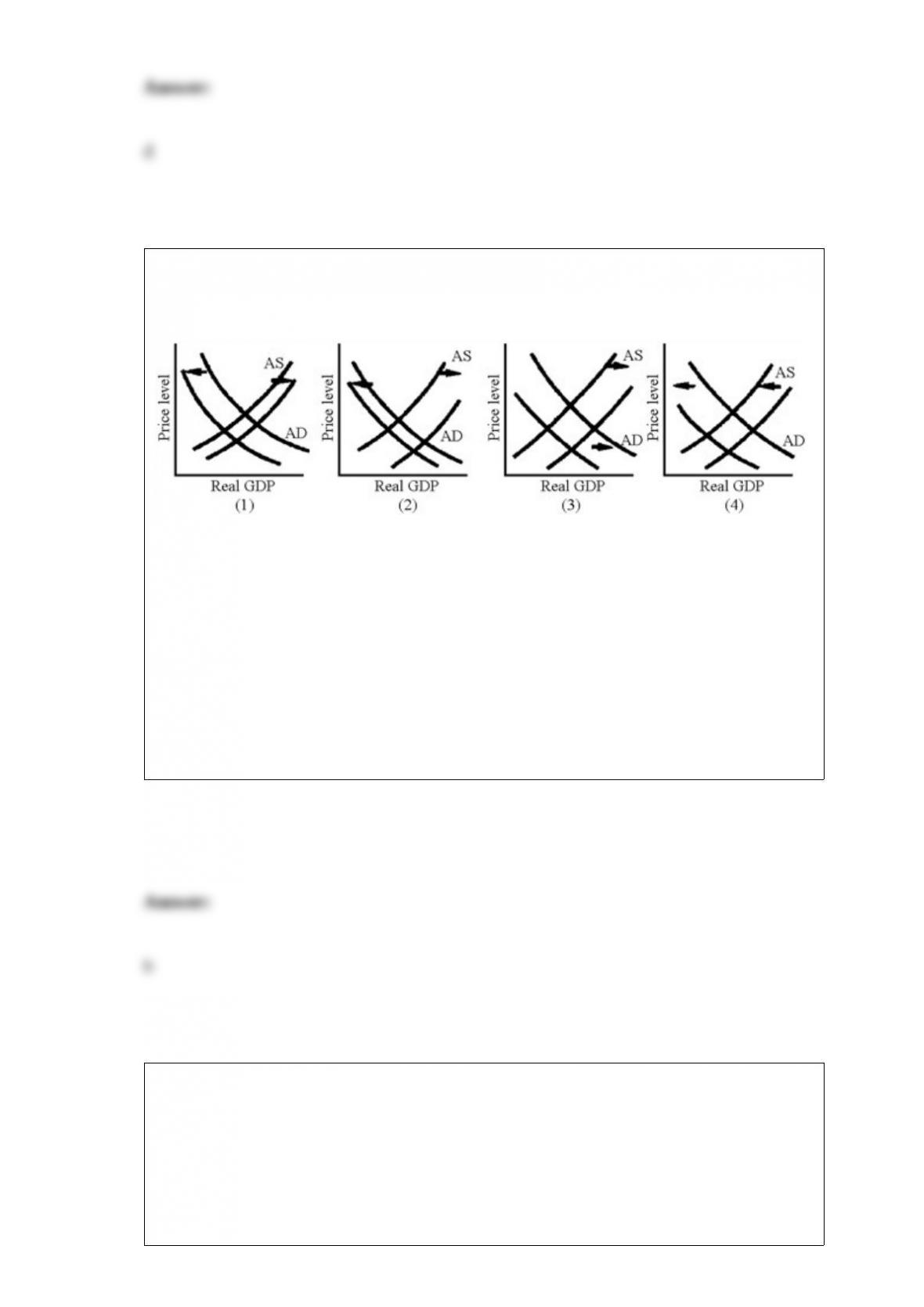
Figure 20-3
Which of the situations illustrated in Figure 20-3 shows the effects of a currency
appreciation leading to real GDP growth?
a. 1
b. 2
c. 3
d. 4
Dunston Military Academy has an annual deficit of $250,000. Its 1,000 students pay
tuition of $10,000 each per year. The economics faculty has recommended solving the
problem by recruiting additional athletes with $5,000 scholarships. Each additional
athlete will cost the school $2,500 (equipment, etc.). Assuming the academy agrees,
how many athletes are needed to eliminate the deficit?
a. Zero, the deficit cannot be eliminated by giving more scholarships.

b. 25
c. 50
d. 100
The cost disease of personal services causes
a. the cost of health care to rise faster than the economy’s rate of inflation.
b. legislators to blame declining standards of quality at public hospitals on greedy
doctors or administrators.
c. legislators to propose price controls on insurance.
d. All of the above are correct.
When governments rapidly increase the supply of money, the usual result is
a. deflation.
b. low inflation.
c. hyperinflation.
d. increasing long-term investment.

If velocity remains relatively constant, changes in the money supply can have a
predictable effect on nominal GDP.
a. True
b. False
During periods of high inflation, such as the 1979-1980 period, the existence of usury
laws may cause
a. nominal rates of interest to be above real rates.
b. negative nominal rates of interest.
c. negative real rates of interest.
d. real rates of interest to be above nominal rates.

Monetarists use the equation of exchange to predict the effects of changes in M on
a. velocity.
b. nominal GDP.
c. real GDP.
d. the price level.
Society would be better off with more products that create beneficial externalities.
a. True
b. False
Herbert Simon has concluded that decision making in industry is often best described as
a. optimizing behavior.
b. profit maximizing.
c. satisficing.
d. saturating.

Total revenue
a. can be calculated directly from the demand curve.
b. can be calculated directly from the average revenue curve.
c. is found by multiplying price times quantity.
d. All of the above are correct.
In a planned economy,
a. prices are used to coordinate economic activity.
b. central planners set production targets and tell producers how to produce.
c. high prices discourage use of the most scarce resources.
d. central planners allow the price to determine distribution of a product.

In a long-run equilibrium in a perfectly competitive market, firms are selling at a price
equal to marginal cost.
a. True
b. False
Between 1980 and 2005, the Vanguard Index Fund earned 12.3%/year, while the
average mutual fund investor earned:
a. 1.9%
b. 2.3%.
c. 5.1%.
d. 7.3%.
If the population increase in India is smaller than the increase in Indian real GDP, then
GDP per capita will
a. decrease.
b. increase.
c. remain constant.

d. increase more slowly than real GDP.
The demand curve for a monopolistic competitor is likely to be flatter than that of a
monopolist.
a. True
b. False
Recently, Dow Chemical 8.5 percent bonds maturing in 2006 closed at $92 with a face
value of 100. This means the Dow bonds
a. sold for $92 each.
b. increased in value $92 that day.
c. sold at 92 percent of par value.
d. had the year of maturity changed to 1992.

The exchange rate of Country X is set by government decisions and maintained by
government actions. Country X follows a
a. floating exchange rate policy.
b. free market exchange rate policy.
c. pegged exchange rate policy.
d. fixed exchange rate policy.
Growth in potential GDP depends on
a. the labor force growth rate, capital stock growth rate, and rate of technical progress.
b. government spending, growth in prices, and labor productivity.
c. cyclical fluctuations and growth in the capital stock.
d. growth in real GDP, nominal GDP, and the population.
Which of the following is true about the United States?
a. There has only been one recession in U.S. history.

b. There have been recessions every couple of years throughout U.S. history.
c. Recessions have never occurred in the United States.
d. Recessions have occurred periodically in U.S. history.
e. Recessions in the United States have generally been worse than in other countries.
An unexpected discovery of a new mineral deposit will cause the
a. demand curve to shift outward.
b. demand curve to shift inward.
c. supply curve to shift outward.
d. supply curve to shift inward.
Compared to the unemployed during the Great Depression, persons unemployed in
today’s economy are
a. worse off due to higher price levels.
b. worse off due to higher rates of unemployment in the 1990s.
c. better off due to unemployment insurance.

d. better off due to lower price levels.
A tax on wages will
a. reduce labor supply since leisure becomes cheaper.
b. raise labor supply since income is reduced.
c. have an unpredictable impact on labor supply since there are both substitution and
income effects.
d. have a predictable impact since economists know substitution effects will dominate.
If an economy is producing inefficiently, it is
a. possible to increase production of all goods simultaneously.
b. possible to increase production of one good at the expense of another.
c. not possible to increase production of any good.
d. not possible to increase economic growth.
e. possible to increase production with no effort.

Why do firms spend money on costly innovation?
a. Competitive markets leave firms no choice but to innovate.
b. Innovation is a low-risk activity.
c. Innovation always results in higher profits for firms.
d. Innovation is usually profitable because the majority of innovations reach the market
place.
e. Because innovation is beneficial for society and firms are motivated to act in ways
that are beneficial for society.
The slope of the aggregate supply curve decreases as total output increases.
a. True
b. False

The demand for borrowed funds is a derived demand.
a. True
b. False
An article in The Economist reported that prices of CDs in Britain was much higher
than prices in the United States or other European countries. There were only a few
major companies, and a report from a Parliament committee said there was no serious
price competition. The best explanation for this is that
a. the industry was a contestable market.
b. there were entry barriers in production and distribution of CDs.
c. firms were avoiding profit opportunities.
d. there were substantial differentiation of product.
In the spring of 1993, President Clinton proposed an energy tax. At one point in the
congressional review of the proposal there was discussion of various exemptions for
farmers, truckers, etc. One plan was to dye fuel different colors to better track the
appropriate tax on the user of the fuel. Economists would label these exemptions
a. loopholes.
b. economically efficient.

c. obviously fair.
d. all of the above.
On May 12, 2011, it cost U.S. $.04 to buy one Russian ruble. How many Russian rubles
would U.S. $1 buy?
a. 40
b. 33
c. 25
d. 14
It is not optimal to have equal incomes.
a. True
b. False