
1) Piece-rates may not be appropriate pay in some situations because they might reduce
product quality.
2) graphically, the consumer maximizes total utility where the budget line is tangent to
an indifference curve.
3) if the nominal interest rate is 8 percent and the real interest rate is 5 percent, then the
inflation premium is 13 percent.
4) Thrifts are known as “banker’s banks” because they lend money to commercial
banks.
5) The pursuit through government of a transfer of wealth at society’s expense is called
“rent seeking.”
6) people who work part time, but desire to work full time, are considered to be
officially unemployed.
7) The United States Treasury is the only source of money in the U.S. economy.
8) A restrictive monetary policy reduces investment spending and shifts the economy’s
aggregate demand curve to the right.
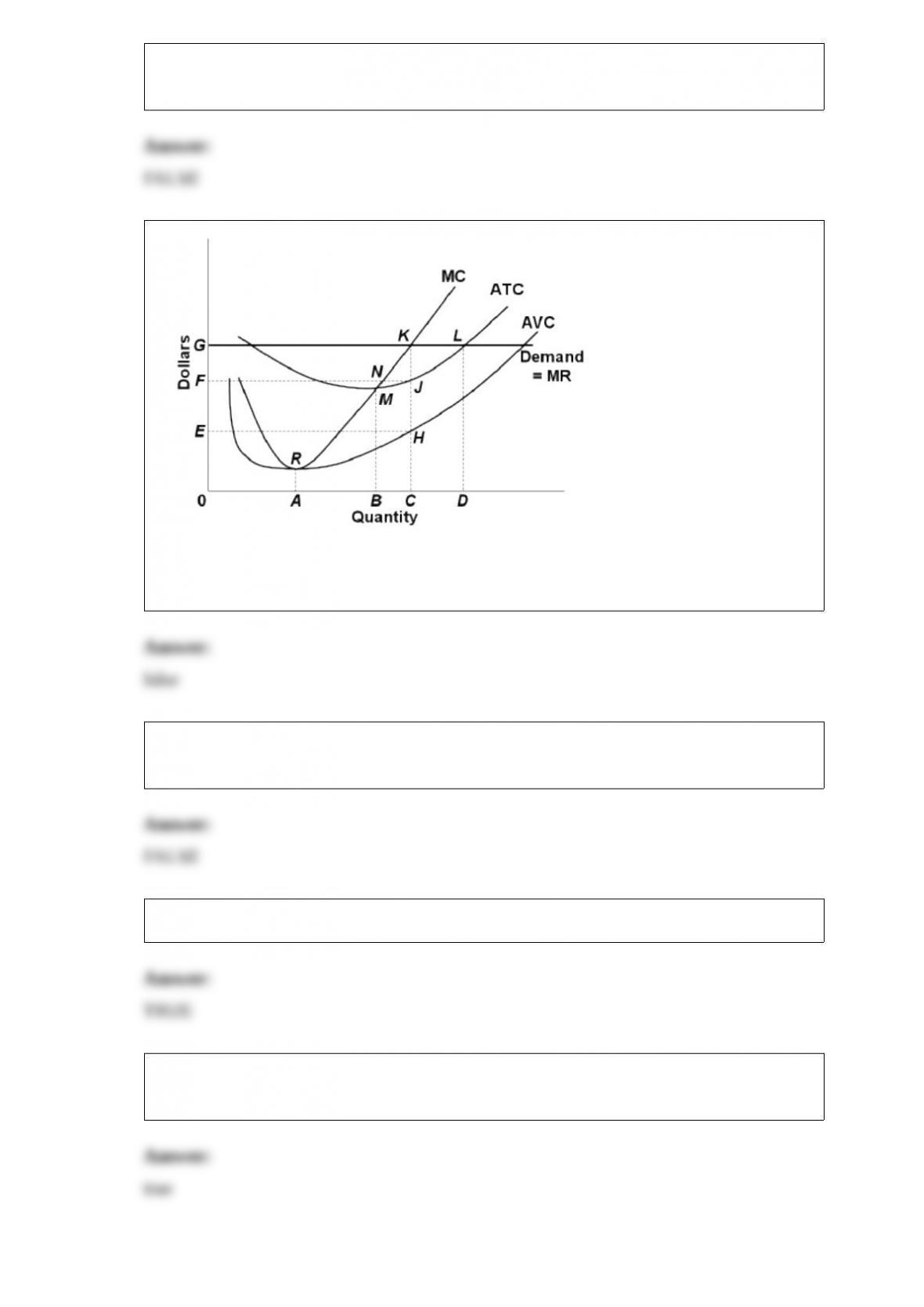
9)
refer to the above diagram. if this represents a typical firm in the industry and the firm
is producing at the profit-maximizing level of output in the short run, then in the long
run we would expect economic profits in this market to rise.
10) In electricity generation, it is most economically efficient to use a single energy
source.
11) An increase in business excise taxes will shift the aggregate supply curve leftward.
12) marginal cost is a measure of the alternative goods which society forgoes in using
resources to produce an additional unit of some specific product.
13) A specific reduction in government spending will dampen demand-pull inflation by
a greater amount, the:
A.smaller is the economy’s MPC.
B.flatter is the economy’s aggregate supply curve.
C.smaller is the economy’s MPS.
D.less the economy’s built-in stability.
14) In the United States from 1929 to 1933, real GDP _____________, and the
unemployment rate ________________.
A.declined by 27 percent; rose to 25 percent.
B.increased by 21 percent; fell to 2 percent.
C.declined by 21 percent; rose to 27 percent.
D.declined by 40 percent; rose to 50 percent.
15) assume an economy that is producing only one product and that year 3 is the base
year. output and price data for a five-year period are as follows. answer the next
question(s) on the basis of these data.
refer to the above data. real gdp for year 5 is:
a.$160.
b.$49.
c.$40.
d.$64.
16) The following table shows the total costs and total benefits facing a city of five
different potential baseball stadiums of increasing size. All figures are in millions of
dollars.
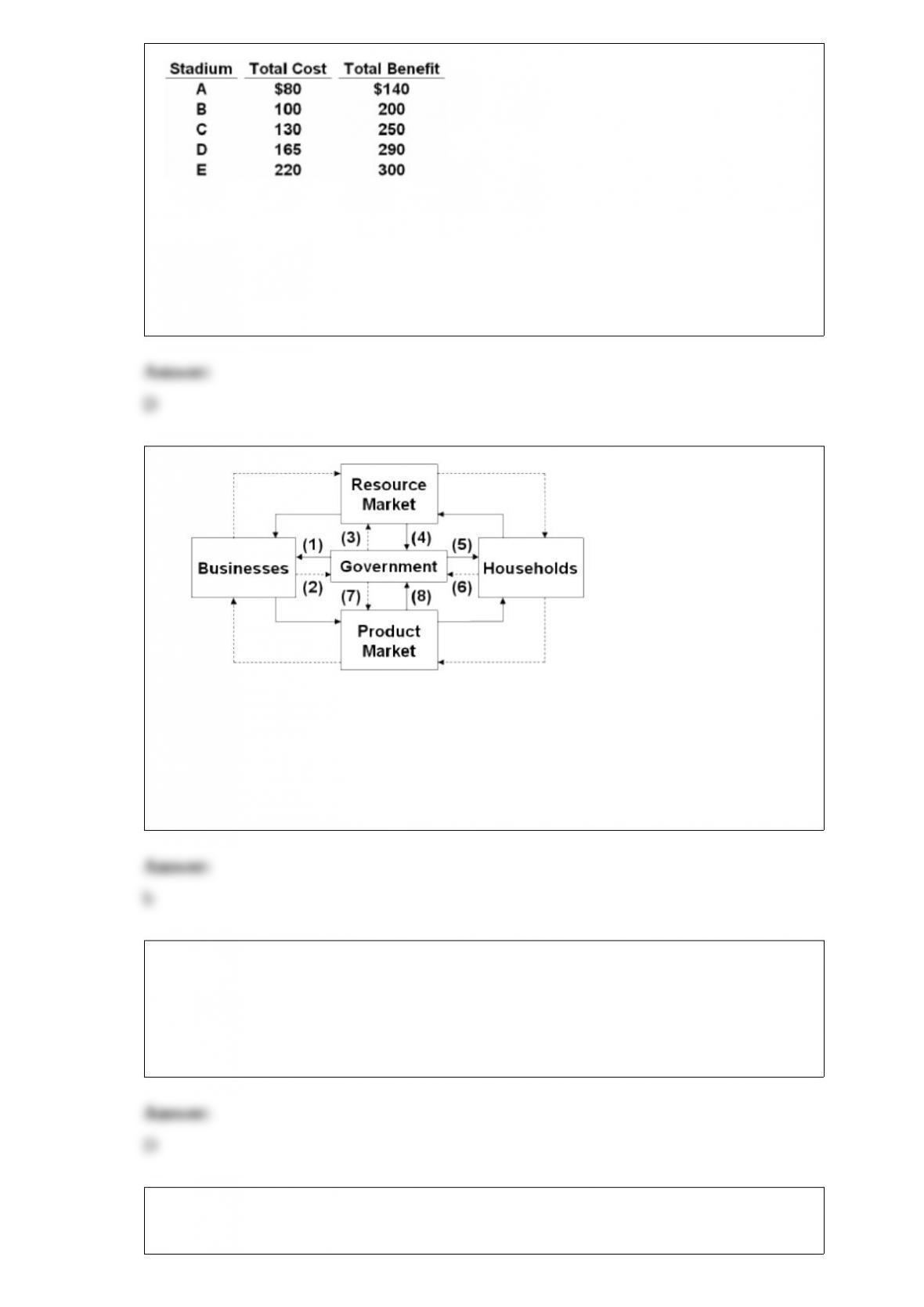
Refer to the above table. The marginal cost and marginal benefit of stadium B (relative
to A) are:
A.$20 million and $50 million, respectively.
B.$100 million and $200 million, respectively.
C.$30 million and $50 million, respectively.
D.$20 million and $60 million, respectively.
17)
refer to the above diagram, in which solid arrows reflect real flows; broken arrows are
monetary flows. flow (1) might represent:
a.corporate income tax payments.
b.government provision of highways for truck transportation.
c.business property tax payments.
d.transfer payments to low-income families.
18) If firms are paying efficiency wages, they:
A.may be reluctant to increase nominal wages when aggregate demand increases.
B.are highly vulnerable to import competition.
C.may be targeted for takeover by firms paying market wages.
D.may be reluctant to cut wages when aggregate demand declines.
19) indy currently earns $50,000 in taxable income and pays $8000 in taxes. suppose
that indy faces a marginal tax rate of 25 percent and his boss offers him a raise of $2000
per year. indy should:
a.accept the raise because his after-tax income will rise by $1500.
b.reject the raise because his after-tax income will fall by $3000.
c.reject the raise because his after-tax income will fall by $4500.
d.reject the raise because his after-tax income will fall by $6000.
20) the building of a production plant in china by an american firm best illustrates a(n):
a.trade flow.
b.resource flow.
c.financial flow.
d.information flow.
21) the given supply and demand data for wheat:
refer to the above data. equilibrium price will be:
a.$4.
b.$3.
c.$2.
d.$1.
22) if a monopolist’s marginal revenue is $3.00 and its marginal cost is $4.50, it will
increase its profits by:
a.reducing output and raising price.
b.reducing both output and price.
c.increasing both price and output.
d.raising price while keeping output unchanged.
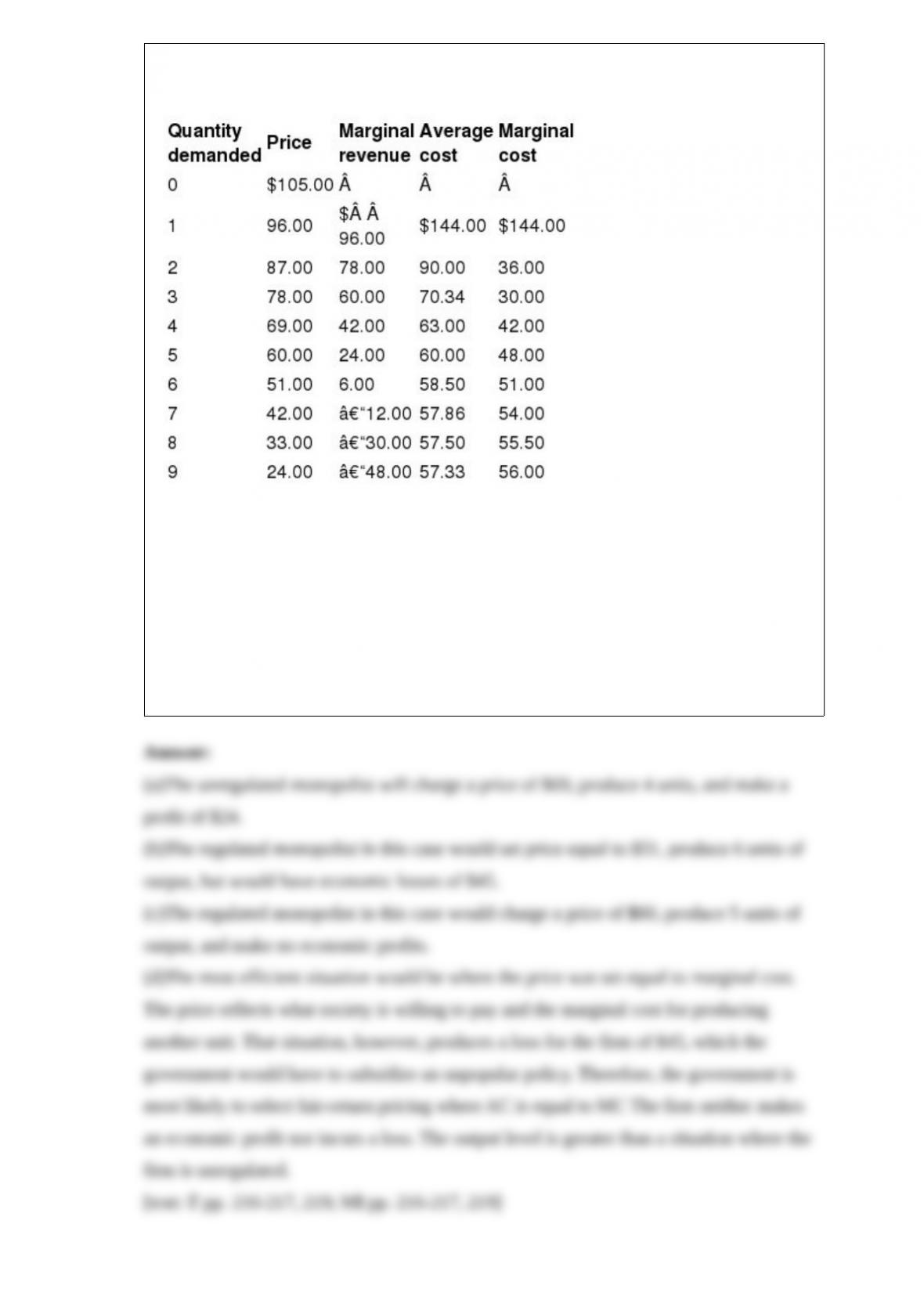
23) In the table below are cost and demand data for a pure monopolist.
(a)What is the level of price, output, and amount of profit for an unregulated
monopolist?
(b)Using the data in the table, what are the price, output, and profit for a regulated
monopolist that sets price equal to marginal cost compared with an unregulated
monopolist?
(c)Using the data in the table, what are the price, output, and profit for a regulated
monopolist that charges a fair-return price compared with an unregulated monopolist?
(d)Analyze the effect of regulation on the allocation of resources. Which situation is
most efficient? Which situation is most likely to be chosen by government? Why?
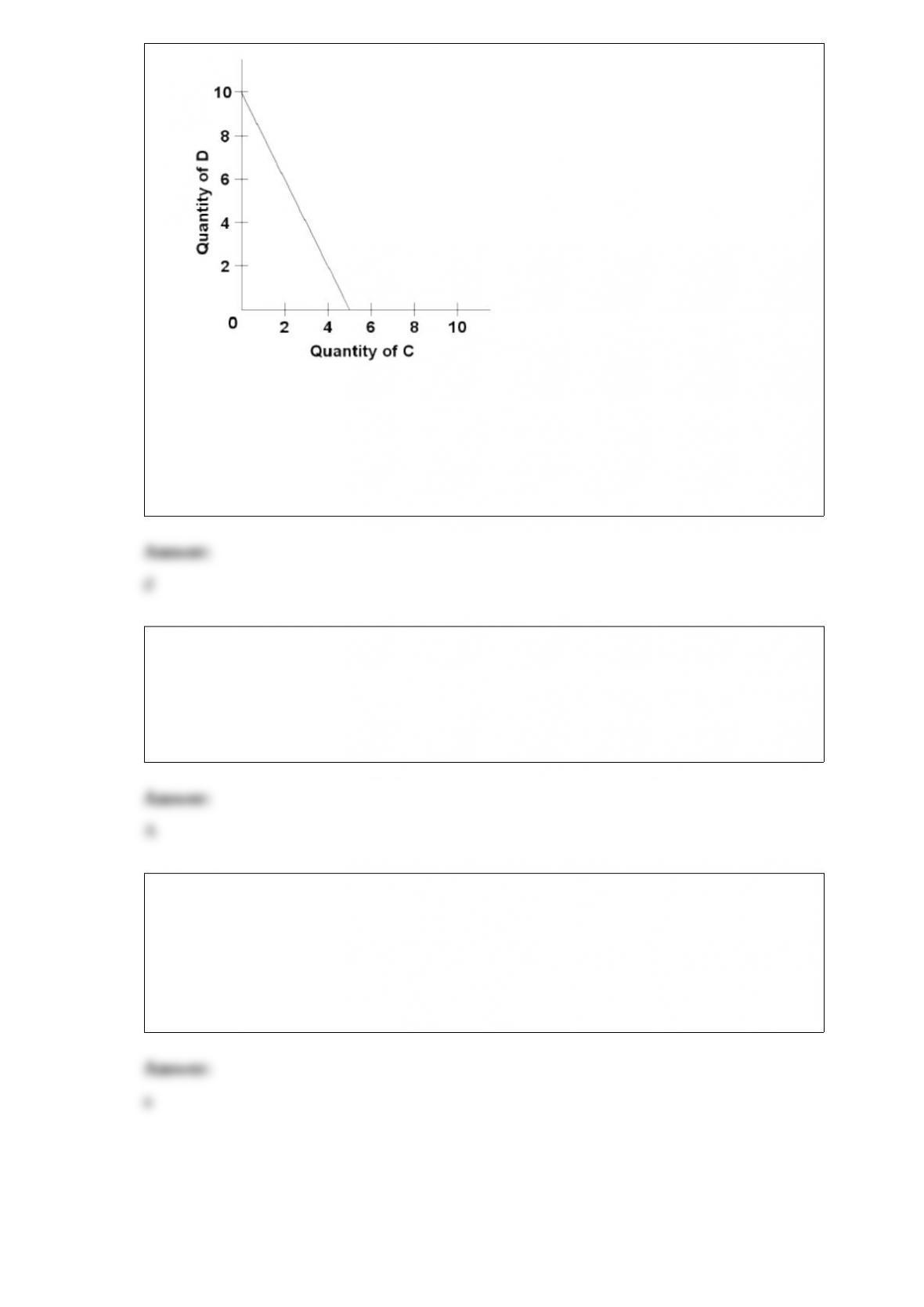
24)
refer to the budget line shown in the diagram above. if the consumer’s money income is
$20, the:
a.prices of c and d cannot be determined.
b.price of c is $2 and the price of d is $4.
c.consumer can obtain a combination of 5 units of both c and d
d.price of c is $4 and the price of d is $2.
25) In a market for pollution rights an increase in demand would:
A.raise the price of pollution rights, but leave the quantity unchanged.
B.stimulate the economic incentive to pollute.
C.increase the actual amount of pollution.
D.induce an increase in the supply of pollution rights.
26) the fact that the slope of the production possibilities curve becomes steeper as we
move down along the curve indicates that:
a.the principle of increasing opportunity costs is relevant.
b.society’s resources are limited.
c.the opportunity cost of producing each product is constant.
d.resources are perfectly shiftable between alternative uses.
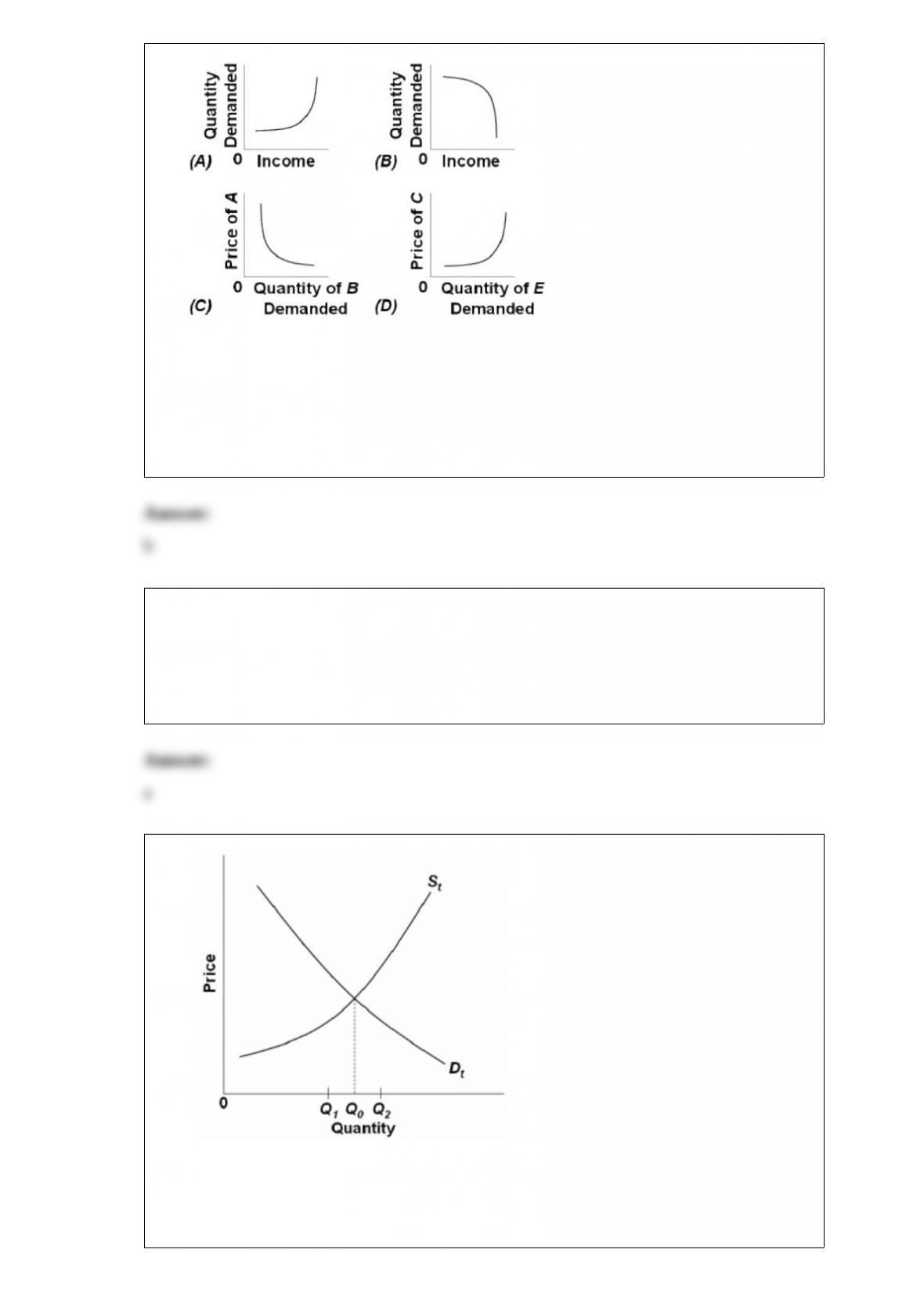
27)
refer to the above diagrams. in which case would the coefficient of income elasticity be
negative?
a.a
b.b
c.c
d.d
28) unemployment rates in the united states:
a.tend to be lower than rates in europe, but higher than rates in japan.
b.tend to be lower than rates in japan, but higher than rates in europe.
c.tend to be lower than rates in europe and japan.
d.tend to be higher than rates in europe and japan.
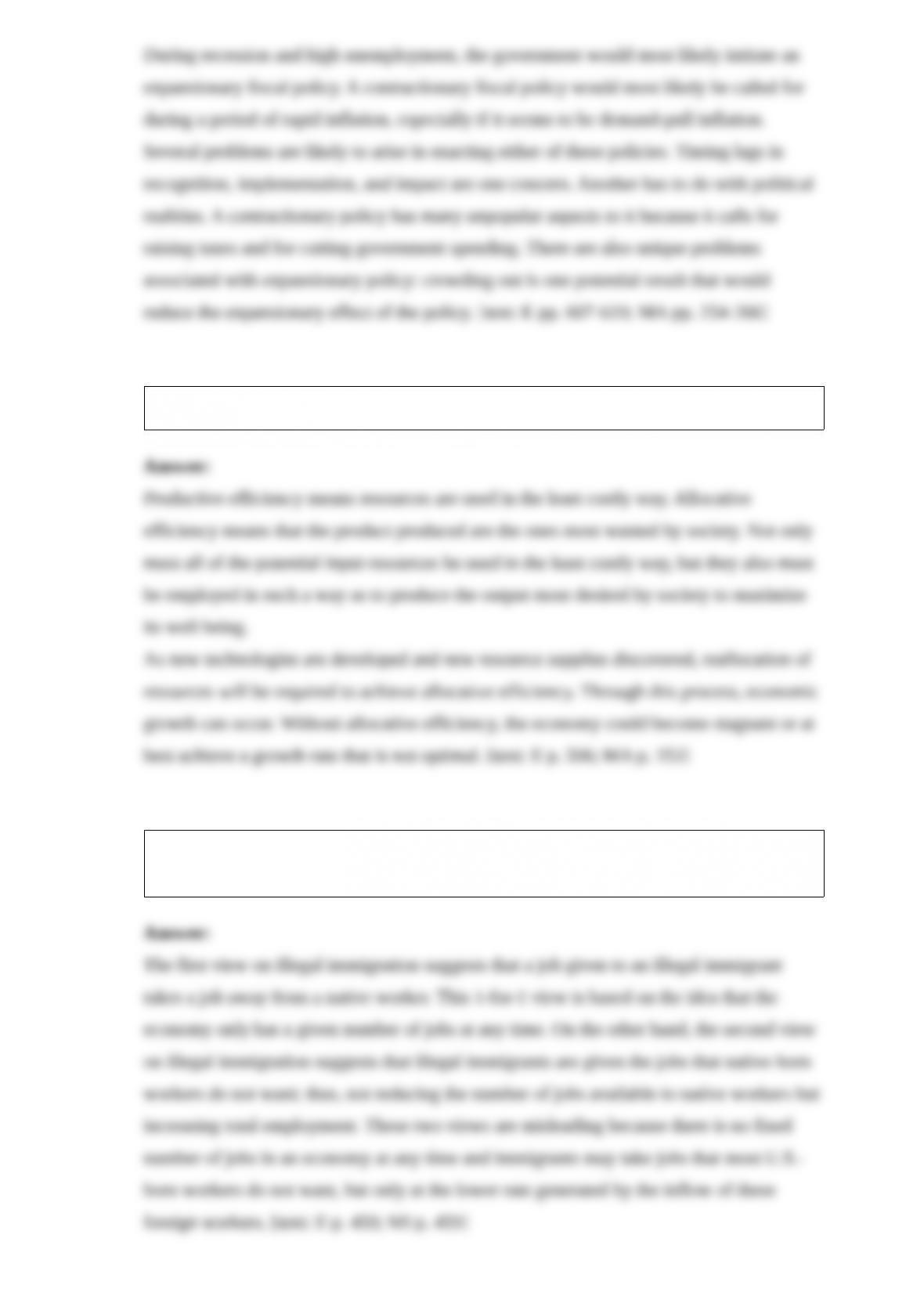
29)
Refer to the above diagram of the market for product X. Curve St embodies all costs
(including externalities) and Dt embodies all benefits (including externalities)
associated with the production and consumption of X. Assuming the equilibrium output
is Q1, we can conclude that the existence of external:

A.costs has resulted in an overallocation of resources to X.
B.benefits has resulted in an overallocation of resources to X.
C.costs has resulted in an underallocation of resources to X.
D.benefits has resulted in an underallocation of resources to X.
30) inflation means that:
a.all prices are rising, but at different rates.
b.all prices are rising and at the same rate.
c.prices in the aggregate are rising, although some particular prices may be falling.
d.real incomes are rising.
31) If government increases its purchases by $15 billion and the MPC is 2/3, then we
would expect the equilibrium GDP to:
A.increase by $30 billion.
B.increase by $45 billion.
C.decrease by $35 billion.
D.increase by $50 billion.
32) Does the recent productivity acceleration experienced in the U.S. mean that the
business cycle is dead?
33) What fiscal policy is most likely to be invoked during a period of recession and
high unemployment? A period of rapid inflation? What political, investment, and
international problems might the U.S. Congress encounter in enacting these policies and
putting them into effect?
34) What is the relevance of productive and allocative efficiency to the growth process?
35) Describe the two extreme views on illegal immigration and their employment
effects. Why are these two views misleading?
36) What are five sources of government failure?