
A French firm sells its good at a lower price in England than in France. It follows that
the French firm is necessarily
a. dumping.
b. saving domestic jobs.
c. being subsidized by the French government.
d. part of an infant industry.
e. none of the above
The perfectly competitive firm will shut down in the short run if price is
a. less than average variable cost.
b. greater than average variable cost but less than average total cost.
c. greater than average total cost.
d. equal to average total cost.
e. a and b
The Federal Trade Commission Act of 1914
a. made interlocking directorates illegal.

b. set up the Federal Trade Commission (FTC) to deal with “unfair methods of
competition.”
c. made monopolization of trade a misdemeanor.
d. prohibited suppliers from offering special discounts to large chain stores without
offering them to everyone else.
e. empowered the FTC to deal with false and deceptive acts or practices.
Cross elasticity of demand measures consumer responsiveness to a change in the price
of one good, in terms of the quantity demanded of some other good.
a. True
b. False
Refer to Exhibit 21-2. Total utility for all five oranges is

a. 70 utils.
b. 12 utils.
c. 68 utils.
d. 80 utils.
e. 40 utils.
In the theory of perfect competition, the assumptions of many buyers and sellers, the
production of a homogeneous product, and the possession of all relevant information by
buyers and sellers imply that the perfectly competitive firm
a. sets the price it wishes.
b. has a demand curve that is downward sloping.
c. has a demand curve that is perfectly elastic.
d. a and b
e. a and c
If the four-firm concentration ratio in an industry is 80 percent, and the top four firms
hold equal market shares, the Herfindahl index for the industry is
a. 1,600.
b. 2,000.
c. 3,200.
d. 6,400.
e. There is not enough information provided to answer this question.
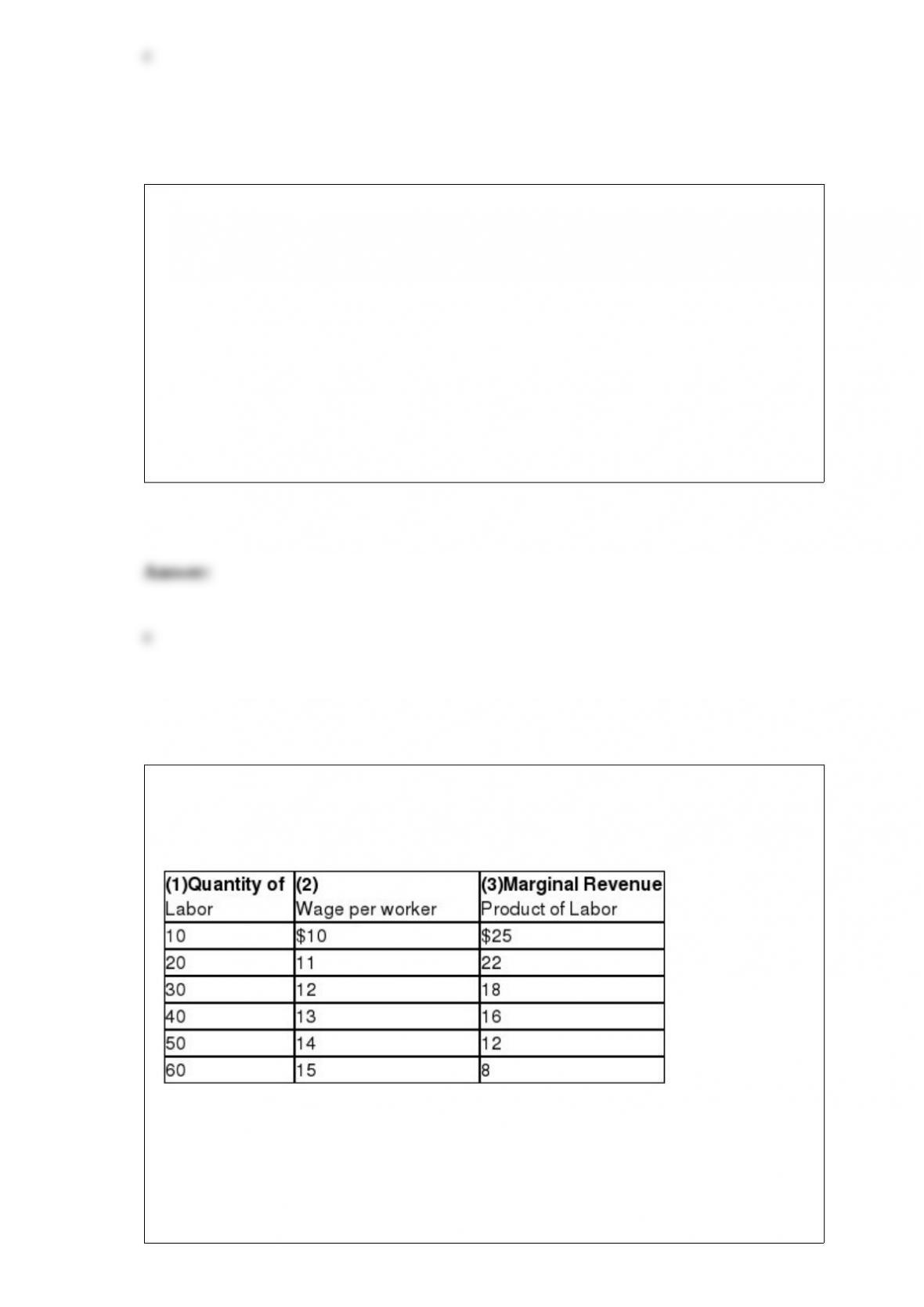
Refer to Exhibit 28-7. For each quantity of labor hired (after the first worker), marginal
factor cost (MFC) will
Exhibit 28-7
a. be less than column (2).
b. exceed column (2).
c. be less than column (3).

d. exceed column (3).
e. b and d
If increasingly more units of good Y must be given up as each successive unit of good
X is produced, then the PPF for these two goods is
a. a downward-sloping straight line.
b. circular.
c. an upward-sloping curve.
d. a downward-sloping curve that is bowed outward.
e. a downward-sloping curve that is bowed inward.
In 18th century England, higher wages of weavers appears to have led to the invention
of the power loom.
a. True
b. False
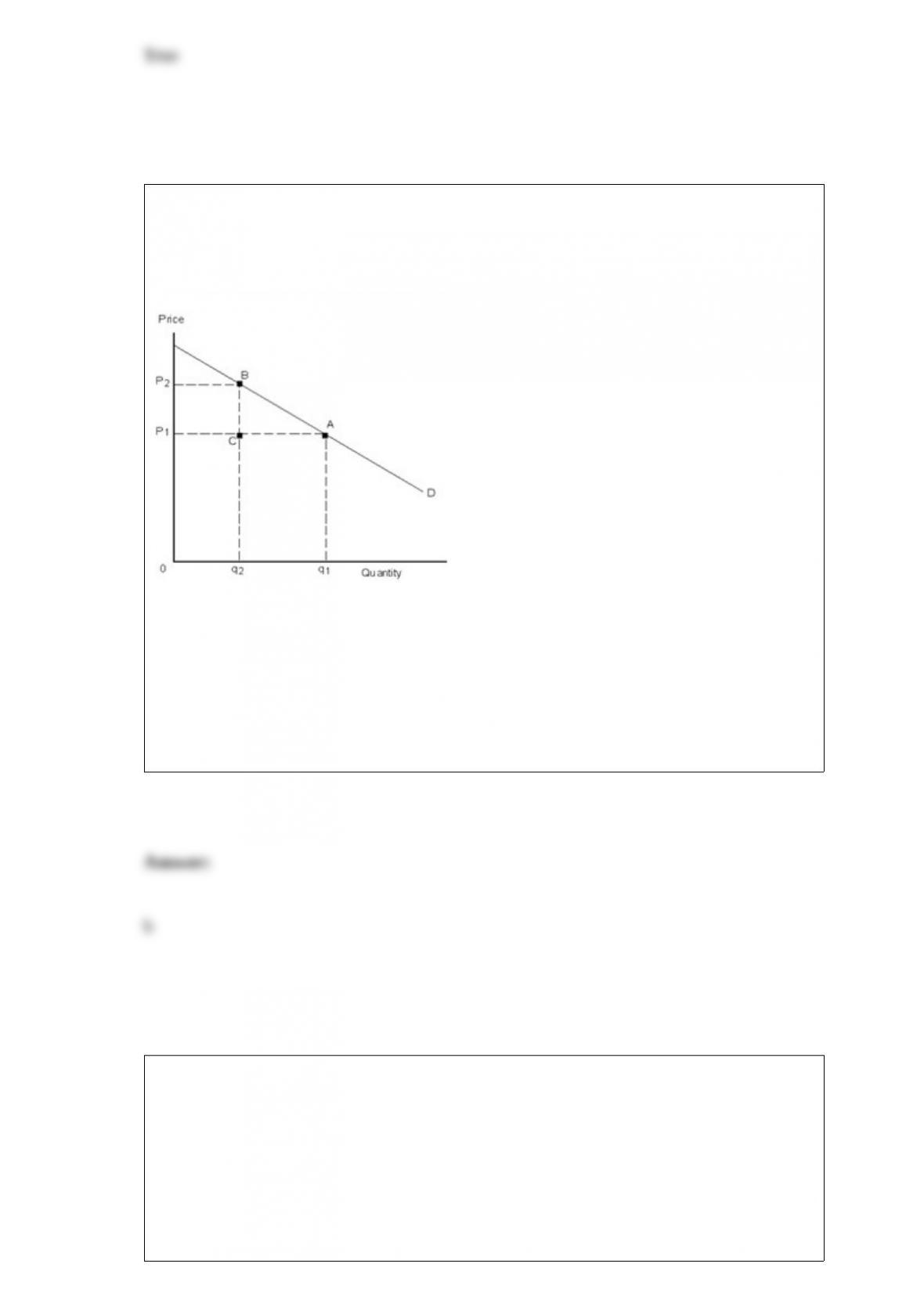
Refer to Exhibit 24-5. What area represents the revenue gained when price goes from
P2 to P1?
Exhibit 24-5
a. P1CBP2
b. q2CAq1
c. 0P1Aq1
d. CBA
Which of the following is characteristic of the monopoly firm?
a. It produces the quantity of output at which marginal revenue equals marginal cost,
MR = MC.
b. It charges a price per unit for its product that is equal to marginal cost.
c. It always earns a profit, because it is a single seller of a product.

d. a and b
e. a and c
A per-unit tax is placed on the production of good Y. Someone who believes that the
producers of the good will end up paying the full tax may be assuming that the good’s
demand curve is
a. elastic.
b. perfectly inelastic.
c. inelastic.
d. perfectly elastic.
e. unit elastic.
If good Z has an income elasticity of 1.0, then demand for good Z is income
__________ and the good is __________.
a. inelastic, normal
b. inelastic, inferior
c. elastic, normal

d. elastic, inferior
e. unit elastic, normal
Candidate X and Candidate Y have a debate. X’s advisers believe that one result of the
debate is that Y will appear to the voters as further to the left than before. This is good
news for X
a. if Y was already left-of-center before the debate.
b. if Y was right-of-center before the debate.
c. no matter what Y’s previous position was.
d. under no circumstances.
If the price of good X falls and the demand for good X is unit elastic, then the
percentage rise in quantity demanded is __________ the percentage fall in price, and
total revenue __________.
a. greater than; rises
b. less than; falls
c. equal to; remains constant
d. greater than; falls

e. less than; rises
Which of the following statements is false?
a. The monopolist faces a horizontal demand curve.
b. For the single-price monopolist, marginal revenue is less than price.
c. For the monopolist, revenue maximization and profit maximization are usually not
the same.
d. The monopolist is a price searcher.
What is the most prominent rationing device you will likely find at your campus
bookstore?
a. dollar price
b. brute force
c. anti-theft tags on the high-priced items
d. none of the above

“In equilibrium, a monopolistic competitor will produce an output level that is less than
the level that would minimize its average total costs.” This is a statement of the
a. law of diminishing returns.
b. law of second best.
c. law of variable proportions.
d. excess capacity theorem.
Productive efficiency implies that
a. all consumers’ wants are satisfied.
b. no advance in technology will occur in the future.
c. the attainable region is greater than the unattainable region.
d. gains are impossible in one area without losses in another.
e. all of the above