
1) A discovery that increases wheat yields per acre helps farmers by increasing both
supply and total revenues.
a.True
b.False
2) Suppose the incomes of buyers in a market for a particular normal good decrease and
there is also a reduction in input prices. What would we expect to occur in this market?
a.Equilibrium price would decrease, but the impact on equilibrium quantity would be
ambiguous.
b.Equilibrium price would increase, but the impact on equilibrium quantity would be
ambiguous.
c.Equilibrium quantity would decrease, but the impact on equilibrium price would be
ambiguous.
d.Equilibrium quantity would increase, but the impact on equilibrium price would be
ambiguous.
3) New oak tables are normal goods. What would happen to the equilibrium price and
quantity in the market for oak tables if the price of maple tables rises, the price of oak
wood rises, more buyers enter the market for oak tables, and the price of the glue used
in the production of the new oak tables increased?
a.Price will fall, and the effect on quantity is ambiguous.
b.Price will rise, and the effect on quantity is ambiguous.
c.Quantity will fall, and the effect on price is ambiguous.
d.Quantity will rise, and the effect on price is ambiguous.
4) Consider the market for university economics professors. Suppose the opportunity
cost of going to graduate school to get a Ph.D. in economics decreases for many
individuals. Suppose it generally takes about five years to get a Ph.D. in economics.
Holding all else constant, in five years the equilibrium quantity of university economics
professors will
a.increase.
b.decrease.
c.not change.
d.It is not possible to determine what will happen to the equilibrium quantity.
5) Which of the following is not an example of a graph of a single variable?
a.a pie chart
b.a bar graph
c.a time-series graph
d.a scatterplot
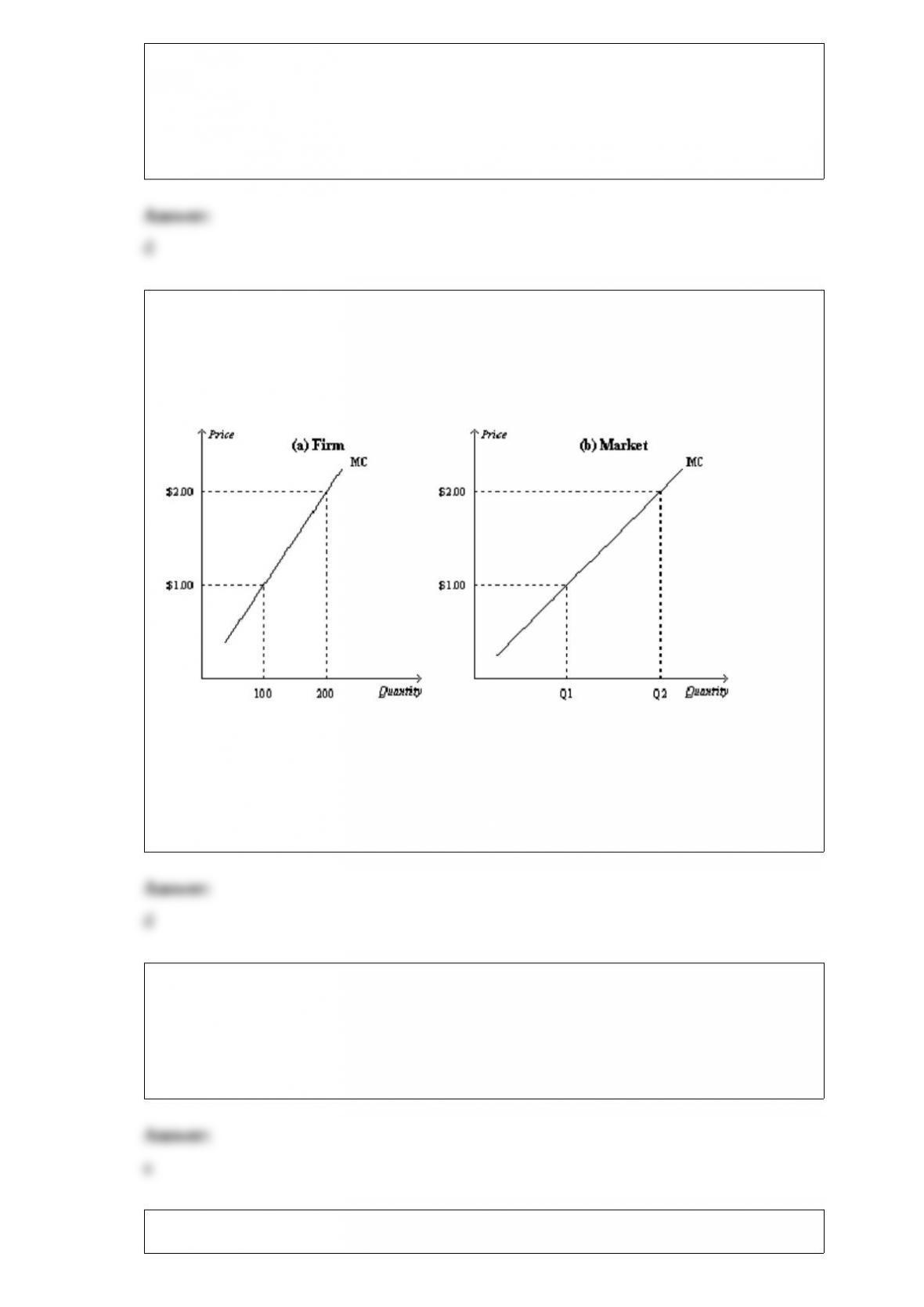
6) Figure 14-9
In the figure below, panel (a) depicts the linear marginal cost of a firm in a competitive
market, and panel (b) depicts the linear market supply curve for a market with a fixed
number of identical firms.
If there are 400 identical firms in this market, what level of output will be supplied to
the market when price is $2.00?
a. 10,000
b. 20,000
c. 40,000
d. 80,000
7) When a firm operates with excess capacity,
a.additional production would lower the average total cost.
b.additional production would increase the average total cost.
c.it must be a perfectly competitive firm.
d.it must be a monopolistically competitive firm.
8) If a monopolist’s marginal costs increase by $1 for all levels of output, then the

monopoly price will
a.rise by $1.
b.rise by more than $1.
c.rise by less than $1.
d.not change, but profits will decrease.
9) Which of the following statements is correct?
a.The benefits that accrue to a monopoly’s owners are equal to the costs that are
incurred by consumers of that firm’s product.
b.The deadweight loss that arises in monopoly stems from the fact that the
profit-maximizing monopoly firm produces a quantity of output that exceeds the
socially-efficient quantity.
c.The deadweight loss caused by monopoly is similar to the deadweight loss caused by
a tax on a product.
d.The primary social problem caused by monopoly is monopoly profit.
10) Sellers respond to a surplus by cutting their prices.
a.True
b.False
11) Assume that a 4 percent decrease in income results in a 6 percent increase in the
quantity demanded of a good. The income elasticity of demand for the good is
a.negative, and the good is an inferior good.
b.negative, and the good is a normal good.
c.positive, and the good is an inferior good.
d.positive, and the good is a normal good.
12) If a tax shifts the demand curve upward (or to the right), we can infer that the tax
was levied on
a.buyers of the good.
b.sellers of the good.

c.both buyers and sellers of the good.
d.We cannot infer anything because the shift described is not consistent with a tax.
13) After much consideration, you have chosen Cancun over Ft. Lauderdale as your
Spring Break destination this year. However, Spring Break is still months away, and
you may reverse this decision. Which of the following events would prompt you to
reverse this decision?
a.The marginal benefit of going to Cancun increases.
b.The marginal cost of going to Cancun decreases.
c.The marginal benefit of going to Ft. Lauderdale decreases.
d.The marginal cost of going to Ft. Lauderdale decreases.
14) Profit-maximizing firms enter a competitive market when existing firms in that
market have
a.total revenues that exceed fixed costs.
b.total revenues that exceed total variable costs.
c.average total costs that exceed average revenue.
d.average total costs less than market price.
15) When price is above marginal cost, selling one more unit at the current price will
increase profit. This concept is known as the
a.income effect.
b.price effect.
c.output effect.
d.cartel effect.
16) To move the allocation of resources closer to the social optimum, policymakers
should typically try to induce firms in an oligopoly to
a.collude with each other.
b.form various degrees of cartels.
c.compete rather than cooperate with each other.
d.cooperate rather than compete with each other.
17) Antipoverty programs funded by taxes on the wealthy are sometimes advocated on
the basis of the benefits principle.
a.True
b.False
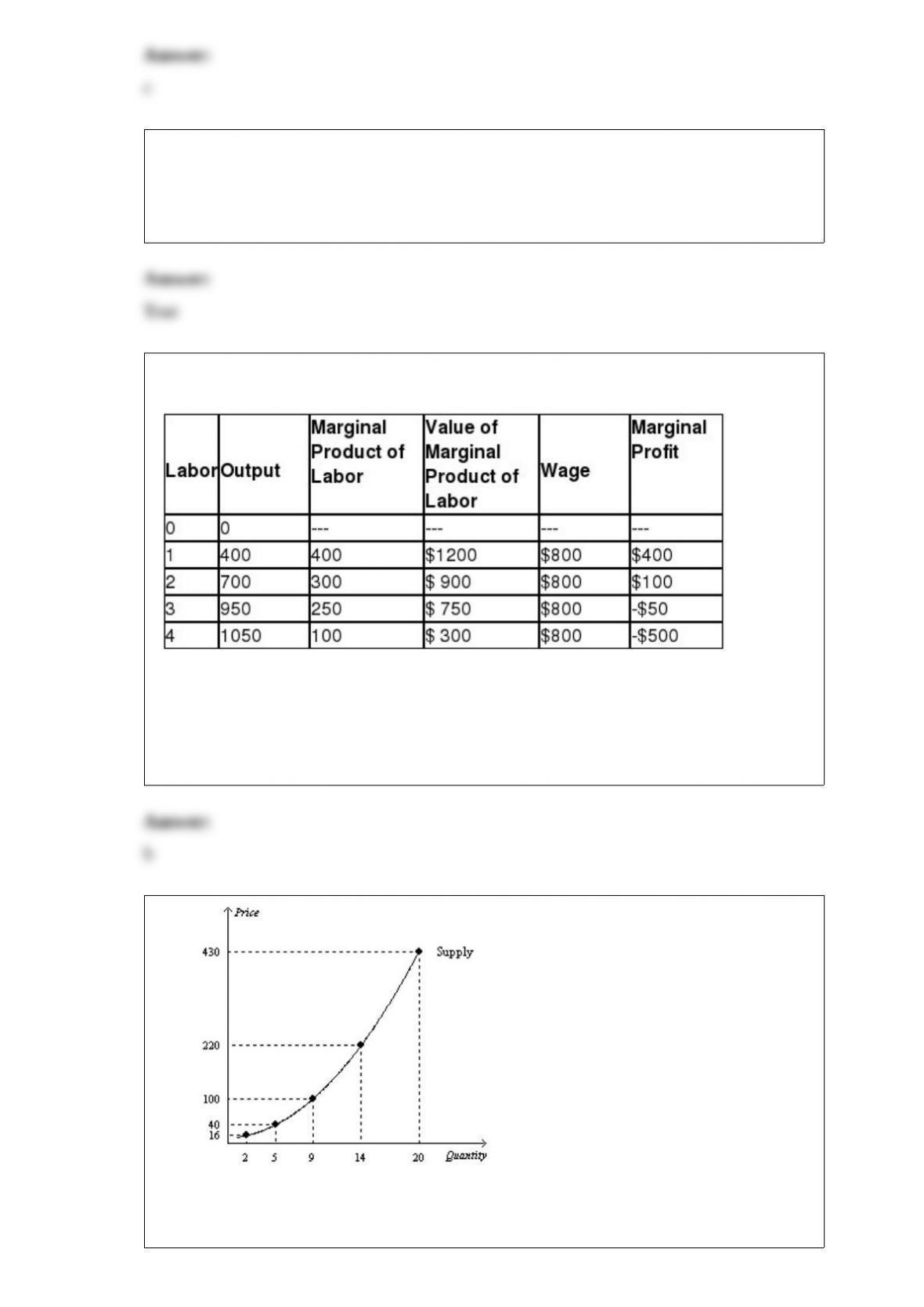
18) Table 18-4
Refer to Table 18-4. How many workers should the firm hire?
a.1
b.2
c.3
d.4
19)
Over which range is the supply curve in this figure the least elastic?
a. $16 to $40
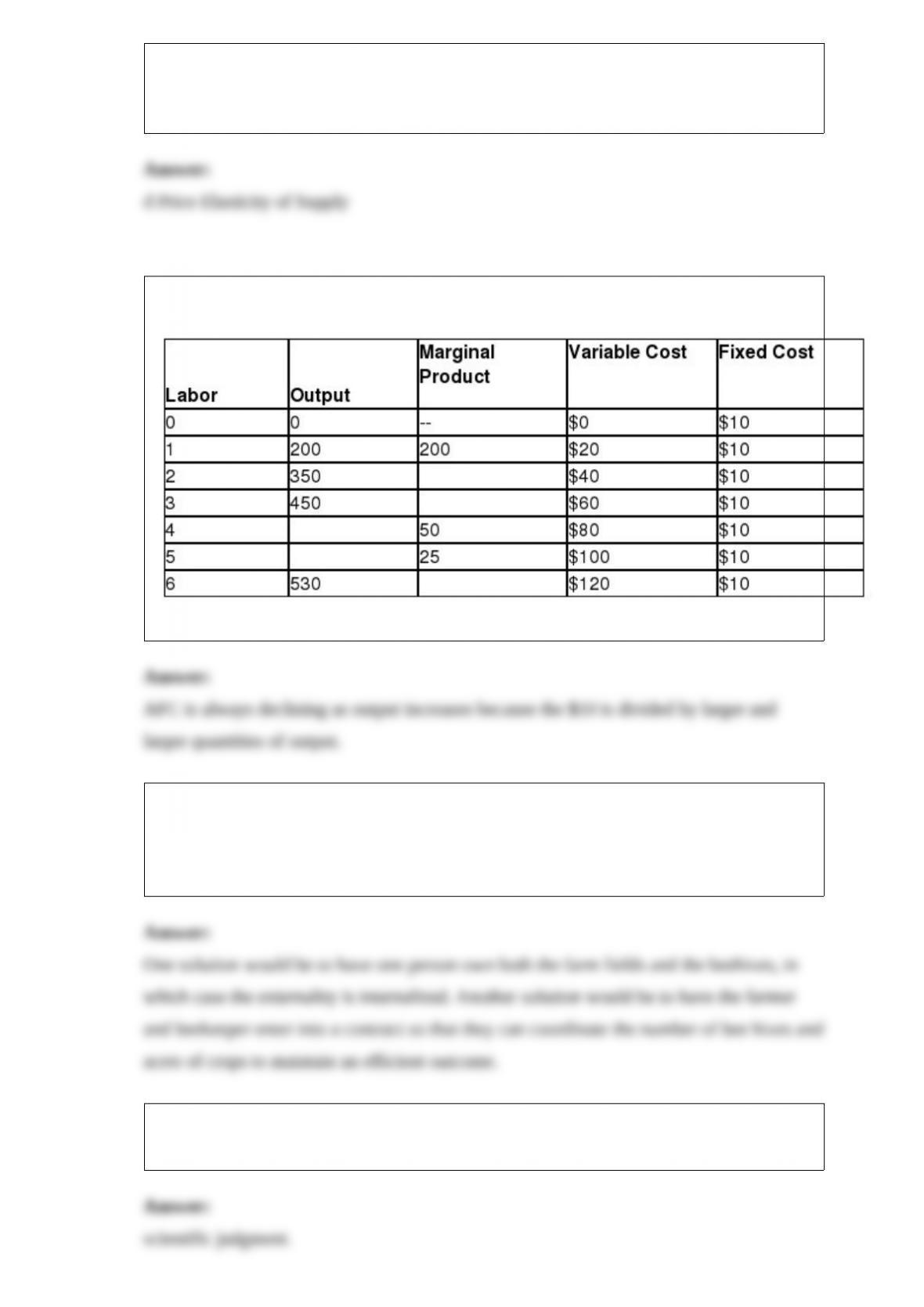
b. $40 to $100
c. $100 to $220
d. $220 to $430
20) Table 13-18
What is the shape of the average-fixed-cost curve?
21) To produce honey, beekeepers place hives of bees in the fields of farmers. As bees
gather nectar, they pollinate the crops in the fields, which increases the yields of these
fields at no additional cost to the farmer. What might be a reasonable private solution to
this externality, and how might the solution be reached?
22) When economists disagree about whether the government should tax a household’s
income or its consumption, they are expressing a difference in

23) If tax revenues from a tax on fried foods are used to pay for healthcare expenses
related to cardio-vascular diseases, the fried foods tax could be justified using the.
24) Figure 8-26
How much is consumer surplus at the market equilibrium?
25) Barb and Jim run a business that sets up and tests computers. Assume that Barb and
Jim can switch between setting up and testing computers at a constant rate. The
following table applies.
Which of the following points would not be on Jim’s production possibilities frontier,
based on a 40-hour week?
a.(0 computers set up, 40 computers tested)
b.(8 computers set up, 32 computers tested)
c.(25 computers set up, 20 computers tested)
d.(30 computers set up, 16 computers tested)

26) What are the four ways that government policymakers can respond to the problem
of monopoly?
27) Mark can produce 24 footballs or 48 basketballs in 8 hours. Maria can produce 64
basketballs in 8 hours. In order for Maria to have a comparative advantage producing
basketballs, the number of footballs she can produce in 8 hours has to be less than .
28) The creation of knowledge is a public good. Because knowledge is a public good,
profit-seeking firms tend to free- ride on the knowledge created by others and, as a
result, devote too few resources to the creation of knowledge. How does the U.S.
government correct for this apparent market failure?