
In the basket of goods that is used to compute the consumer price index, which of the
following categories of consumer spending is the smallest?
a. education & communication
b. apparel
c. medical care
d. recreation
Suppose the number of buyers in a market decreases and a technological advancement
occurs also. What would we expect to happen in the market?
a. Equilibrium price would decrease, but the impact on equilibrium quantity would be
ambiguous.
b. Equilibrium quantity would increase, but the impact on equilibrium price would be
ambiguous.
c. Equilibrium quantity would decrease, but the impact on equilibrium price would be
ambiguous.
d. None of the above is correct.
The combination of President Obama’s strategies and the Federal Reserve’s reaction to
the deep economic downturn in the US in 2008 and 2009

a. intended to reduce unemployment.
b. may lead to excessive inflation over time.
c. resulted in higher taxes and an increased supply of money.
d. Both a and b are correct.
The positive feedback from aggregate demand to investment is called
a. the investment multiplier.
b. the crowding-out effect.
c. the investment accelerator.
d. the crowding-in multiplier.
Figure 2-6
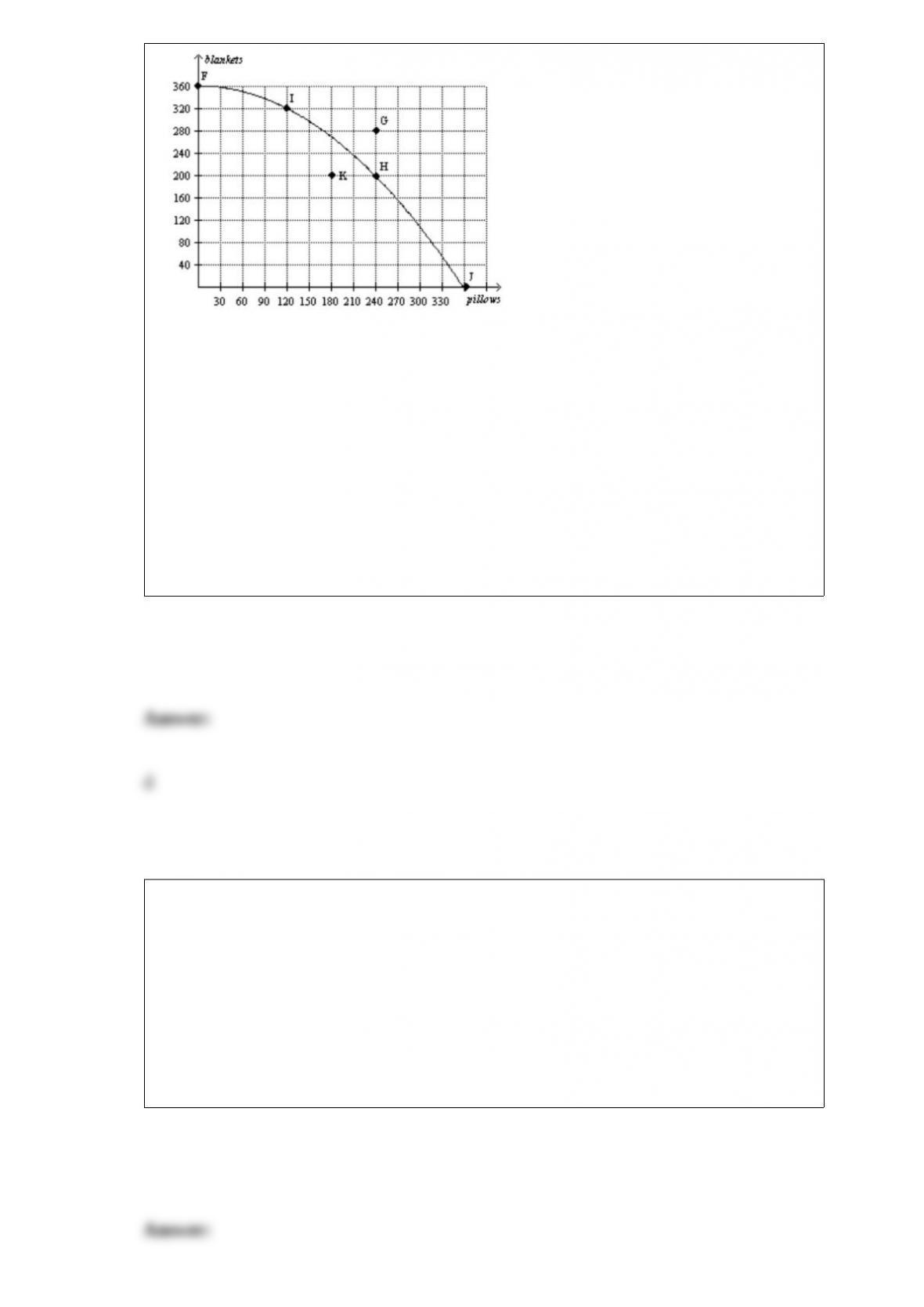
Refer to Figure2-6. If this economy devotes one-half of its available resources to the
production of blankets and the other half to the production of pillows, it could produce
a. 120 pillows and 320 blankets.
b. 180 pillows and 180 blankets.
c. 240 pillows and 200 blankets.
d. We would have to know the details of this economy’s technology in order to
determine this.
Most markets in the economy are
a. markets in which sellers, rather than buyers, control the price of the product.
b. markets in which buyers, rather than sellers, control the price of the product.
c. perfectly competitive.
d. highly competitive.

Suppose the nominal interest rate is 5 percent, the tax rate on interest income is 30
percent, and the after-tax real interest rate is 2.1percent. Then the inflation rate is 2
percent.
a. True
b. False
Jill, a U.S. citizen, uses some euros to purchase a bond issued by a French vineyard.
This exchange
a. decreases U.S. net capital outflow.
b. increases U.S. net capital outflow by more than the value of the bond.
c. increases U.S. net capital outflow by the value of the bond.
d. does not change U.S. net capital outflow.
A country has $20 billion of domestic investment and net capital outflow of $10 billion.
What is saving?
a. $10 billion
b. $30 billion
c. -$20 billion
d. -$30 billion
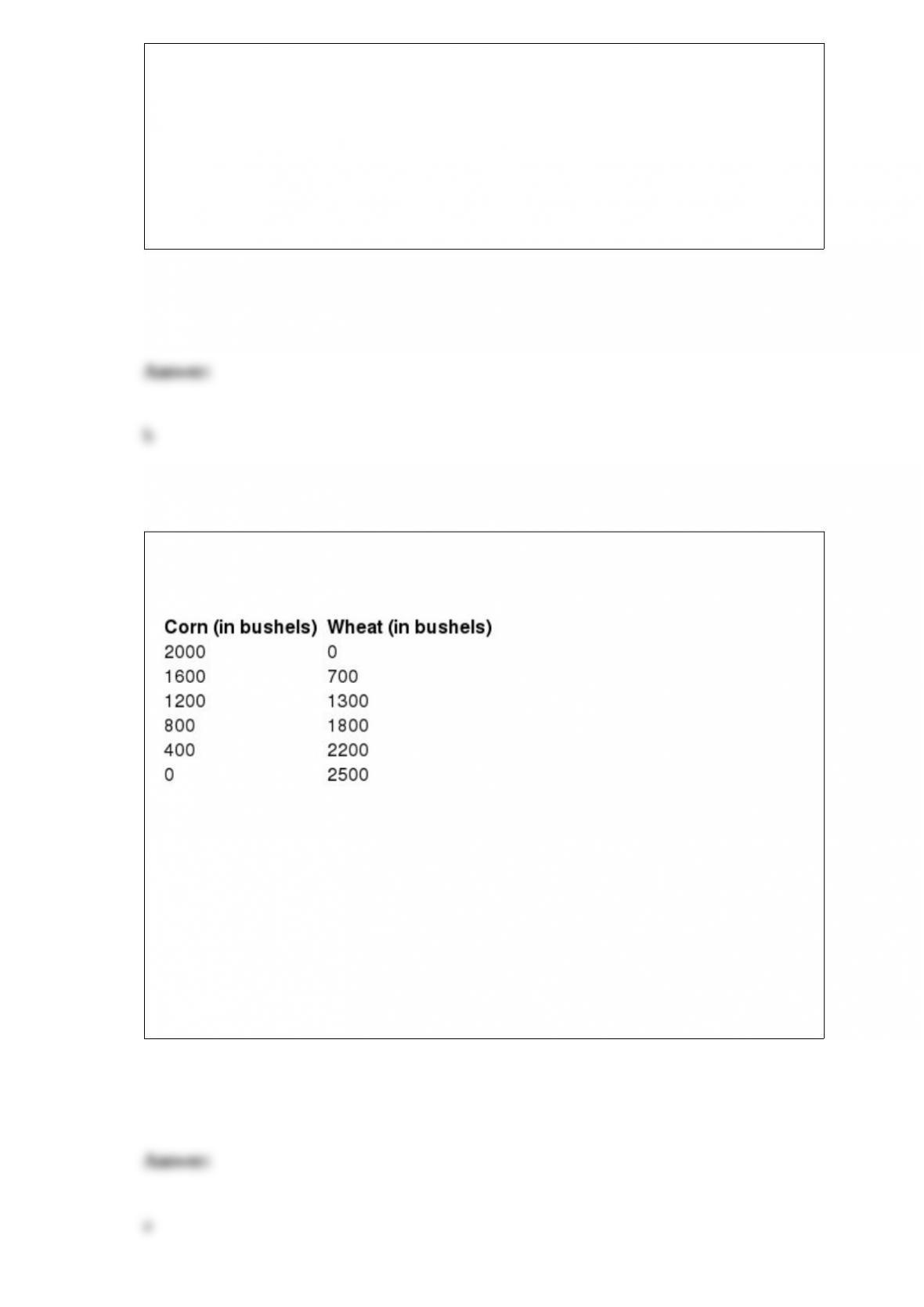
Table 2-5
Refer to Table2-5. Table 2-5 shows one set of production possibilities. Based on the
values in the table, the production possibilities frontier is
a. bowed outward indicating increasing opportunity costs.
b. bowed outward indicating decreasing opportunity costs.
c. a straight line indicating constant opportunity costs.
d. bowed inward indicating increasing opportunity costs.

Mixster Concrete Company is considering buying a new cement truck. The owners and
their accountants decide that this is the profitable thing to do. Before they can buy the
truck, the interest rate and price of trucks change. In which case do these changes
bothmake them less likely to buy the truck?
a. Interest rates rise and truck prices rise.
b. Interest rates fall and truck prices rise.
c. Interest rates rise and truck prices fall.
d. Interest rates fall and truck prices fall.
During recessions declines in investment account for about
a. 1/6 of the decline in real GDP.
b. 1/7 of the decline in real GDP.
c. 1/3 of the decline in real GDP.
d. 2/3 of the decline in real GDP.
According to purchasing-power parity, if two countries have the same price level
because they have the same prices for all goods and services, then which of the

following would equal 1?
a. the real exchange rate, but not the nominal exchange rate
b. the nominal exchange rate, but not the real exchange rate
c. the real exchange rate and the nominal exchange rate
d. neither the real exchange rate nor the nominal exchange rate
Economics is the study of how evenly goods and services are distributed within society.
a. True
b. False
Economics is the study of
a. production methods.
b. how society manages its scarce resources.
c. how households decide who performs which tasks.
d. the interaction of business and government.

Both foreign direct investment and foreign portfolio investment by U.S. residents
increase U.S. net capital outflow.
a. True
b. False
In a market economy, who or what determines who produces each good and how much
is produced?
a. the government
b. lawyers
c. lotteries
d. prices

An economist would be more likely to argue for reducing inflation if she thought that
a. the central bank lacked credibility and if bonds were usually not indexed for
inflation.
b. the central bank lacked credibility and if bonds were usually indexed for inflation.
c. the central bank had credibility and if bonds were usually not indexed for inflation.
d. the central bank had credibility and if bonds were usually indexed for inflation.
If a country has Y > C + I + G, then it has
a. positive net capital outflow and positive net exports.
b. positive net capital outflow and negative net exports.
c. negative net capital outflow and positive net exports.
d. negative net capital outflow and negative net exports.
The invisible hand ensures that economic prosperity is distributed equally.
a. True
b. False

The y-coordinate of an ordered pair specifies the
a. diagonal location of the point.
b. vertical location of the point.
c. horizontal location of the point.
d. quadrant location in which the point is located.
In the long run the primary effect of increasing the quantity of money is higher prices.
a. True
b. False
A U.S. purchase of oil from overseas paid for with foreign currency it already owned
a. increases U.S. net exports, and increases U.S. net capital outflow.
b. increases U.S. net exports, and decreases U.S. net capital outflow.
c. decreases U.S. net exports, and increases U.S. net capital outflow.
d. decreases U.S. net exports, and decreases U.S. net capital outflow.
Frictional unemployment is inevitable because the economy is always changing.
a. True
b. False
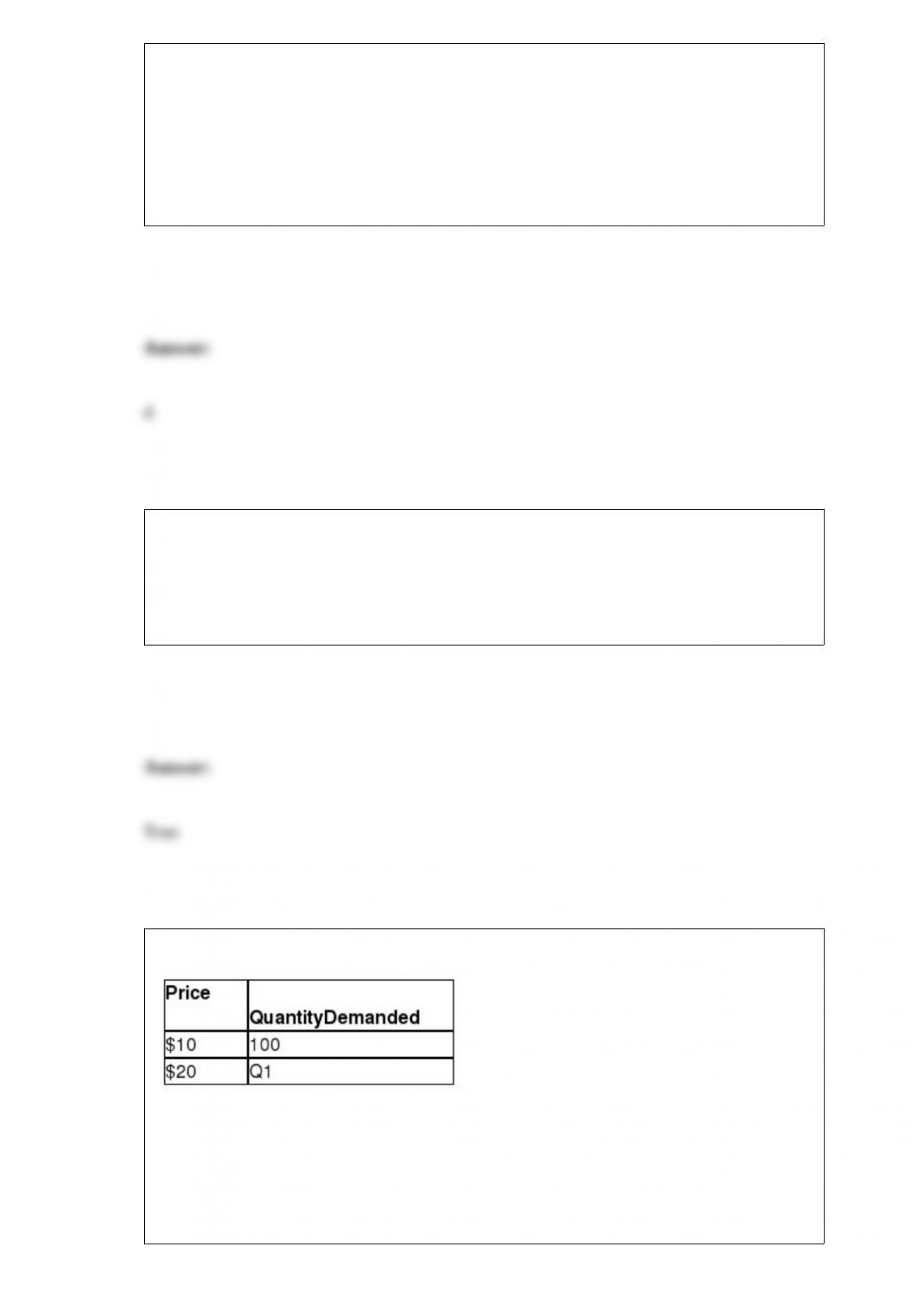
The following table contains a demand schedule for a good.
If the law of demand applies to this good, then Q1 could be
a. 0.
b. 100.

c. 200.
d. 400.
If the exchange rate is 12.5 pesos per U.S. dollar, it is also 1/12.5 U.S. dollars per peso.
a. True
b. False
The Federal Reserve was created in 1913 after a series of bank failures in 1907.
a. True
b. False

A country that made its courts less corrupt and its government more stable would likely
see its standard of living rise.
a. True
b. False
Suppose there are both multiplier and crowding out effects but without any accelerator
effects. An increase in government expenditures would definitely
a. shift aggregate demand right by a larger amount than the increase in government
expenditures.
b. shift aggregate demand right by the same amount as the increase in government
expenditures.
c. shift aggregate demand right by a smaller amount than the increase in government
expenditures.
d. Any of the above outcomes are possible.
Assuming ocrowding-out, investment-accelerator, or multiplier effects, a $100 billion
increase in government expenditures shifts aggregate demand
a. right by more than $100 billion.
b. right by $100 billion.

c. left by more than $100 billion.
d. left by $100 billion.
The scientific method is the dispassionate development and testing of theories about
how the world works.
a. True
b. False
A change in expected inflation shifts
a. the short-run Phillips curve, but not the long run Phillips curve.
b. the long-run Phillips curve, but not the long run Phillips curve.
c. neither the short-run nor the long-run Phillips curve.
d. both the short-run and long-run Phillips curve right.

Economic variables we are most interested in are
a. real variables, but we usually observe nominal variables.
b. nominal variables, but we usually observe real variables.
c. real variables, which we usually observe.
d. nominal variables, which we usually observe.