
1)
In the above diagram, at $40 million of R&D expenditure, the expected rate of return:
A.equals the interest rate cost of funds.
B.is greater than the interest rate cost of funds.
C.is less than the interest rate cost of funds.
D.is negative.
2) immigrants tend to choose countries closer to their country of origin because:
a.bordering countries always have high wage rates.
b.there are fewer beaten paths to nearby countries, and therefore better prospects of
finding a good job.
c.neighboring countries usually speak the same language.
d.migration costs tend to be directly related to distance from the country of origin.
3) excludability:
a.is a characteristics of private goods, but not of public goods.
b.applies only where external benefits exceed external costs.
c.suggest there are certain economic functions from which government must be
excluded.
d.is a fundamental characteristic of public goods.
4) Answer the next question(s) using the following budget information for a
hypothetical economy. Assume that all budget surpluses are use to pay down the public
debt.

Refer to the above data. The public debt declined in year:
A.6.
B.5.
C.4.
D.3.
5) if the demand for bacon is relatively elastic, a 10 percent decline in the price of
bacon will:
a.decrease the amount demanded by more than 10 percent.
b.increase the amount demanded by more than 10 percent.
c.decrease the amount demanded by less than 10 percent.
d.increase the amount demanded by less than 10 percent.
6) which of the following is correct?
a.there is no firm mathematical relationship between marginal utility and total utility.
b.total utility is equal to the change in marginal utility from consuming an additional
unit of a product.
c.if marginal utility is diminishing and is a positive amount, total utility will increase.
d.if marginal utility is diminishing, total utility must also be diminishing.
7) income data that show how total income is distributed as wages, rents, interest, and
profits describe the:
a.functional distribution of income.
b.horizontal distribution of income.
c.personal distribution of income.
d.vertical distribution of income.
8) Which of the following represents the most contractionary fiscal policy?
A.a $30 billion tax cut
B.a $30 billion increase in government spending
C.a $30 billion tax increase
D.a $30 billion decrease in government spending
9) The securities held as assets by the Federal Reserve Banks consist mainly of:
A.corporate bonds.
B.Treasury bills and Treasury bonds.
C.common stock.
D.certificates of deposit.
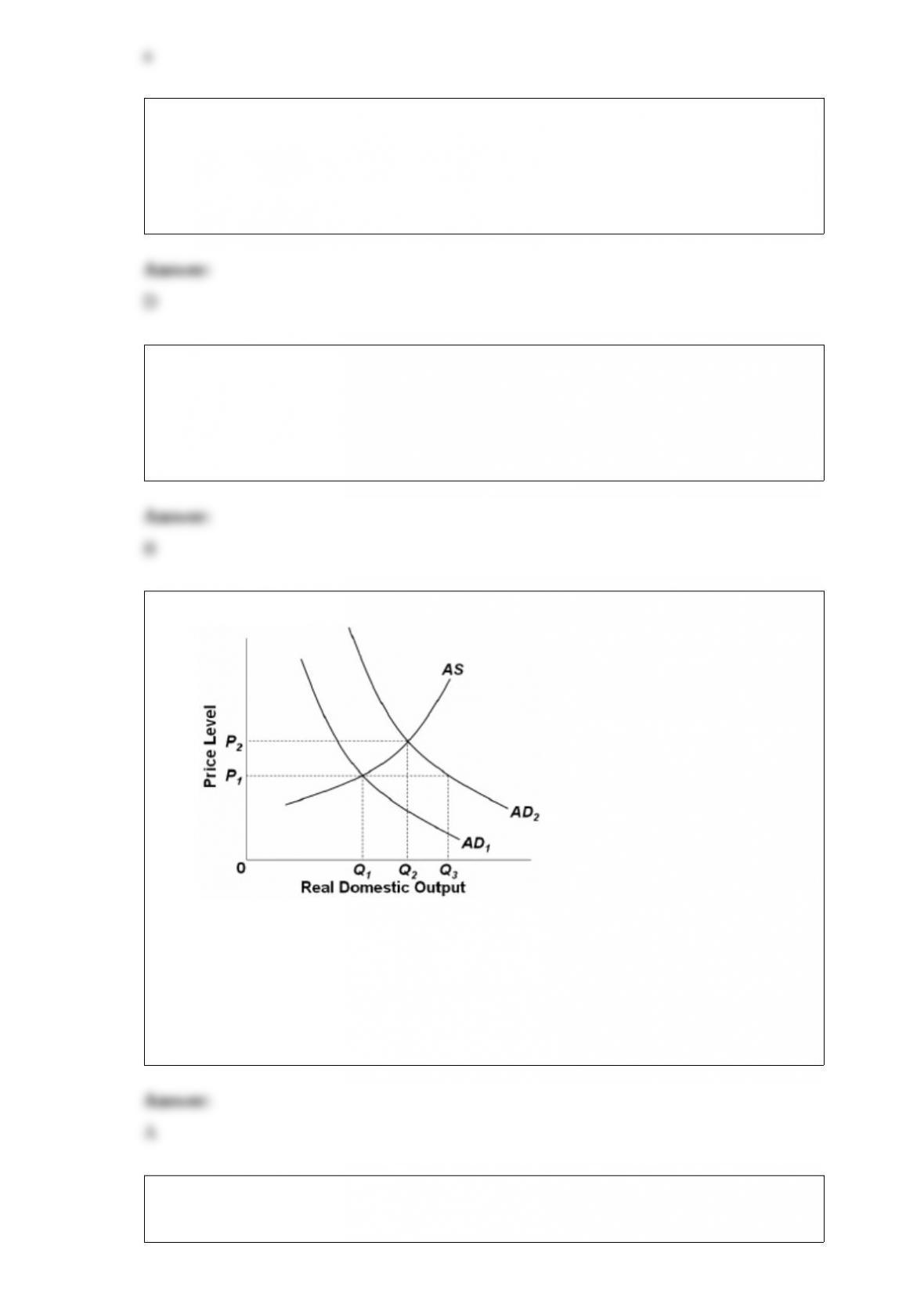
10)
Refer to the above diagram. Suppose that aggregate demand increased from AD1 to
AD2. For the price level to stay constant:
A.the aggregate supply curve would have to shift rightward.
B.the aggregate supply curve would have to shift leftward.
C.real domestic output would have to remain constant.
D.the aggregate supply curve would have to be vertical.
11) under what circumstances will immigration be most likely to equalize wage rates
across countries?

a.immigration laws are strict.
b.immigration is costless and unimpeded.
c.information about job opportunities is limited.
d.skill transferability is low.
12) in which one of the following market models is x-inefficiency most likely to be the
greatest?
a.pure competition
b.oligopoly
c.monopolistic competition
d.pure monopoly
13) What are the macroeconomic implications from the recent productivity
acceleration?
14) What are the basic differences between public choice theory and the economics of
taxation?

15) Distinguish among a stock, a bond, and a mutual fund.
16) What are some of the reasons for the major backflows that occur in most
international migration patterns?

17) How do theories of mainstream macroeconomics and monetarism differ in relation
to monetary policy?
18) Identify how ideas from monetarism and rational expectations have been
incorporated into mainstream thinking about macroeconomics.
19) Explain how the money market responds to a shortage of money or to a surplus of
money.

20) Pollution should be completely eliminated. Evaluate. Support your answer using
MB and MC analysis.
21) To what factors do demographers attribute the decline in birthrates? How has the
economic view of children changed?