
If a country produces only two goods, then it is not possible to have a comparative
advantage in the production of both those goods.
The United States has a closed economy.
Contractionary fiscal policy involves decreasing government purchases or increasing
taxes.
A firm might prefer to choose a salary system rather than a commission or piece-rate
system of compensation when there are concerns about output quality.

When the Federal Reserve increases the money supply, people spend more because they
now have more money.
Perfectly competitive industries tend to produce low-priced, low-technology products.
When the majority of voters have preferences very different from those of the median
voter, then the median voter theorem will lead to accurate predictions of the outcomes
of elections.
All else equal, as the price of a product falls, the quantity supplied decreases.

Examining the conditions that could lead to a recession in an economy is an example of
macroeconomics topic.
If the demand for a product is elastic, the quantity demanded changes by a smaller
percentage than the percentage change in price.
An increase in the price level in the United States will reduce exports and increase
imports.
In absolute value, the tax multiplier is greater than the government purchases multiplier.

Those who favor changes in the market for health care that would make it more like the
markets for other goods and services favor what are generally known as market-based
reforms.
An increase in the interest rate should ________ the demand for dollars and the value of
the dollar, and net exports should ________.
A) decrease; decrease
B) decrease; increase
C) increase; decrease
D) increase; increase
E) increase; not change
If the price of milk was $1.25 a gallon and it is now $2.25 a gallon, what is the
percentage change in price?
A) 4.4 percent
B) 8 percent
C) 44 percent
D) 80 percent
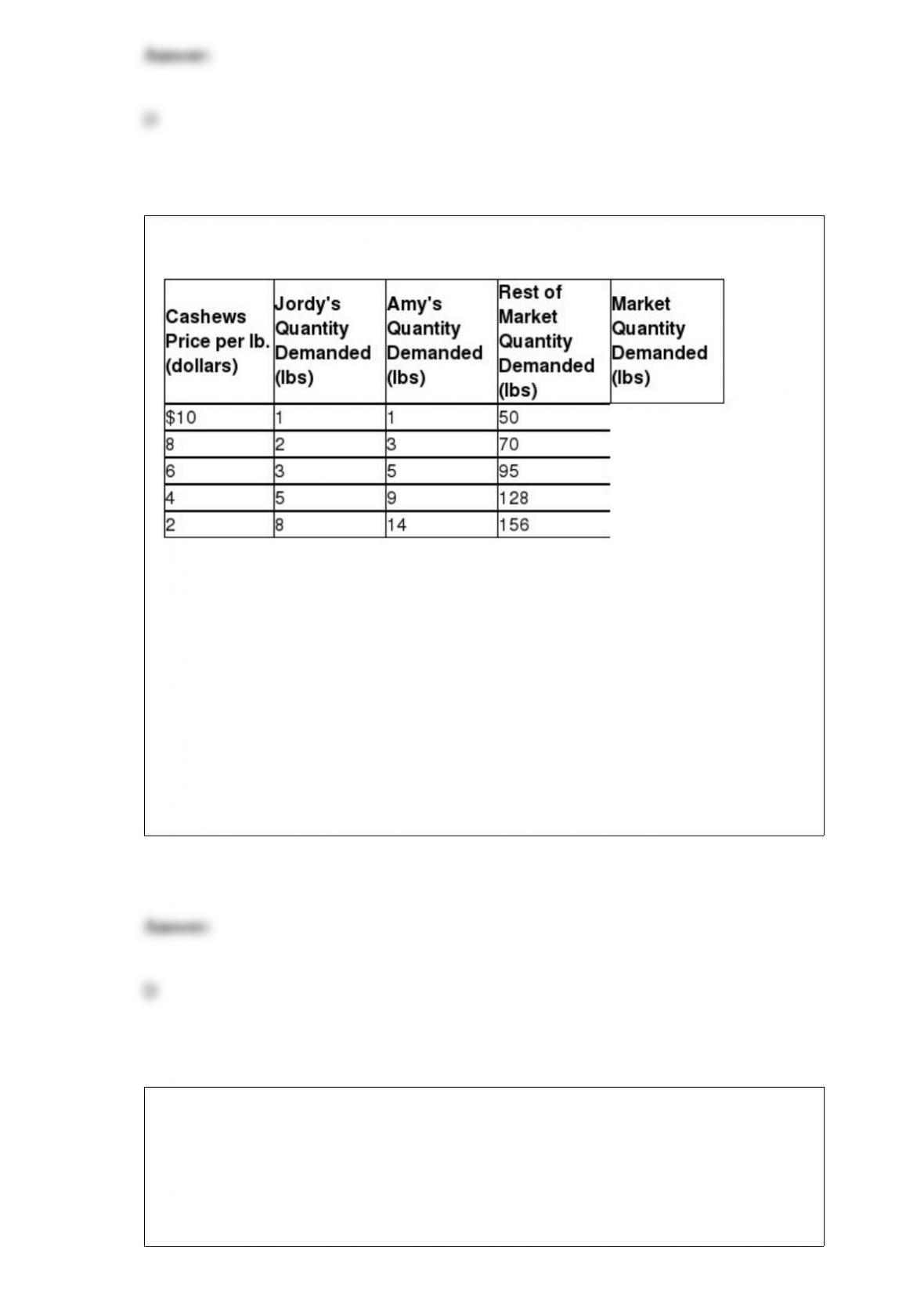
Table 3-2
The table above shows the demand schedules for cashews of two individuals (Jordy and
Amy) and the rest of the market. At a price of $10, the quantity demanded in the market
would be
A) 2 lbs.
B) 48 lbs.
C) 50 lbs
D) 52 lbs.
What is the formula you should use to determine a bank account’s future value in one
year?
A) Future value equals the present value plus the rate of interest.
B) Future value equals the present value minus the rate of interest.

C) Future value equals the present value multiplied by one plus the rate of interest in
decimals.
D) Future value equals the present value divided by one plus the rate of interest in
decimals.
Suppose Mexico and the United States are on the gold standard. If there is a half an
ounce of gold in the dollar, and one quarter an ounce of gold in the peso, then the
exchange rate is
A) $1 = 2 pesos.
B) $1 = 4 pesos.
C) $1 = 1/2 peso.
D) $1 = 1/4 peso.
E) $0.50 = 1/2 peso.
How much is a bond that pays $20 in coupon payments for 4 years and $1,000 at the
end of the fourth year worth if the interest rate is 5%?
A) $822.70
B) $893.62
C) $1,070.92

D) $1,080
China began pegging its currency, the yuan, to the dollar in 1994. Because the yuan was
________ at the pegged exchange rate, the Chinese government increased its reserves
of ________ as the government purchased more ________ to maintain the pegged
exchange rate.
A) undervalued; dollars; dollars
B) undervalued; yuan; yuan
C) overvalued; yuan; yuan
D) overvalued; dollars; dollars
Which of the following does not hold true for a perfectly competitive firm in long-run
equilibrium?
A) Its economic profit will be zero.
B) It will minimize average total cost.
C) It will charge a price equal to marginal cost.
D) Marginal cost will be minimized.

If an increase in investment spending of $20 million results in a $200 million increase
in equilibrium real GDP, then
A) the multiplier is 0.1.
B) the multiplier is 1.
C) the multiplier is 10.
D) the multiplier is 100.
A monopolistically competitive firm is producing an output level where marginal
revenue is greater than marginal cost. What should this firm do to increase its profit or
reduce its losses?
A) The firm should raise its price.
B) The firm should decrease its fixed costs.
C) The firm should increase its implicit costs.
D) The firm should lower its price.
Since 1950, expansions in the United States have become ________, while recessions

have become ________.
A) longer; longer
B) shorter; shorter
C) shorter; longer
D) longer; shorter
Suppose the supply of bicycles is price elastic. This means that
A) consumers will respond significantly to an increase in the quantity supplied of
bicycles.
B) suppliers will increase the quantity supplied of bicycles, but not immediately.
C) suppliers face many substitutes for bicycles.
D) suppliers will respond significantly to changes in the price of bicycles.
Not enforcing property rights in an economy will
A) cause the market system to work efficiently.
B) not change the level of investment.
C) lower the level of investment.
D) raise the level of investment.

In 2004, hurricanes damaged a large portion of Florida’s orange crop. As a result of this,
many orange growers were not able to supply fruit to the market. At the pre-hurricane
equilibrium price (i.e., at the initial equilibrium price), we would expect to see
A) a surplus of oranges.
B) the quantity demanded equal to the quantity supplied.
C) a shortage of oranges.
D) an increase in the demand for oranges.
Which of the following would cause both the equilibrium price and equilibrium
quantity of barley (assume that barley is an inferior good) to increase?
A) an increase in consumer income
B) a drought that sharply reduces barley output
C) a decrease in consumer income
D) unusually good weather that results in a bumper crop of barley

A stock market boom which causes stock prices to rise should cause
A) a decrease in consumption spending.
B) an increase in consumption spending.
C) a decrease in wealth.
D) a decrease in net export spending.
A bond is a financial security that represents
A) ownership in a corporation.
B) the portion of profits paid to shareholders.
C) the interest rate paid on a share of stock.
D) a promise to repay a fixed amount of funds.
The way in which a corporation is structured and the impact a corporation’s structure
has on the firm’s behavior is referred to as
A) corporate taxation.

B) structure composition theory.
C) structural behavior.
D) corporate governance.
Assume that the medical screening industry is perfectly competitive. Consider a typical
firm that is making short-run losses. Suppose the medical screening industry runs an
effective advertising campaign which convinces a large number of people that yearly
CT scans are critical for good health. How will this affect a typical firm that remains in
the industry?
A) The firm’s supply curve shifts right and its marginal revenue curve shifts upwards as
the market price rises and ultimately the firm starts making profits.
B) The firm’s marginal revenue curve and average cost curve shift upwards in response
to the increase in market price and advertising expenditure. The firm increases output
until it starts breaking even.
C) The marginal revenue curve shifts upwards, the firm’s output increases along its
marginal cost curve, it expands production and eventually starts making profits.
D) The marginal revenue curve shifts upwards, the firm’s output increases along its
marginal cost curve, it expands production until it breaks even.
The government of Bassaland is looking for new revenue sources. It is considering
imposing an excise tax on two goods: palm wine and diapers. If the price elasticity of
demand for the goods are -0.47 and -1.89 respectively, which good should it tax if the
goal is to raise revenue? If the government wants to tax only one good, which good
should it tax if the goal is to discourage consumption? Explain your answer.

How does the study of microeconomics differ from that of macroeconomics? Give one
example each of an issue studied in microeconomics and in macroeconomics.
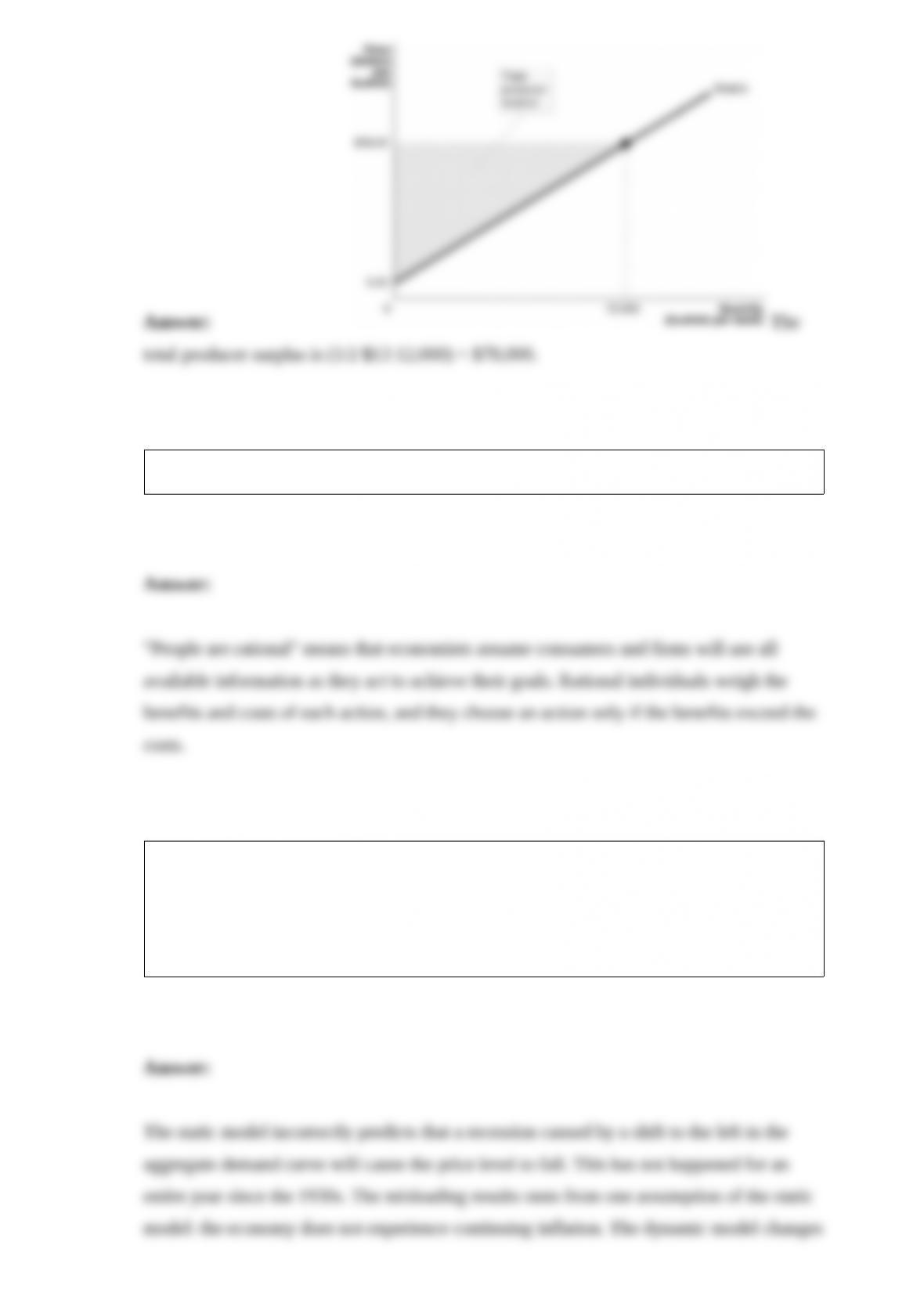
Assume the market price for tangerines is $18.00 per bushel. At the market price,
tangerine growers are willing to supply a quantity of 12,000 bushels per week. The
quantity supplied drops to zero when the price falls to $5.00 per bushel. Construct a
graph showing this data, calculate the total producer surplus in the market for
tangerines, and show the total producer surplus on the graph.
Explain the economic assumption that “people are rational.”
Explain how the static aggregate demand and aggregate supply model gives us
misleading results about the price level, particularly with respect to decreases in
aggregate demand. Describe how the aggregate demand curve is different in the
dynamic model as compared to the static model. Describe how potential GDP is
different in the dynamic model as compared to the static model.
How do economists generally rate the Fed’s performance in the 1980s, 1990s, and the
early 2000s? Has the public been supportive of their policies? Is there anything on the
horizon for the Fed that might cause the public concern?
What is meant by productive efficiency? How does a perfectly competitive firm achieve
productive efficiency?
Ronald Coase is famous for the Coase Theorem, which is based on the premise that
there is an economically efficient level of pollution reduction. Many economists believe
that the tradable emissions allowance program that has been used to deal with the
problem of acid rain has been successful in reducing emissions of sulfur dioxide in an
economically efficient manner. Why isn’t this program an example of the Coase
Theorem?
Discuss the correct and incorrect economic analysis in the following statements. “If a
disease kills a large number of turkeys, the supply of turkeys will decrease. This will
result in a price increase, which will then cause the supply of turkeys to increase.”