1) Per capita water use in the United States has steadily increased since 1973.
2) the federal government in 2006 enacted limits on “pain and suffering” awards on
medical malpractice lawsuits against physicians.
3) If the reserve requirement is 20 percent, the monetary multiplier will be 4.
4) The MRP of labor curve is the labor demand curve.
5) the demand for health care is highly elastic with respect to both price and income.
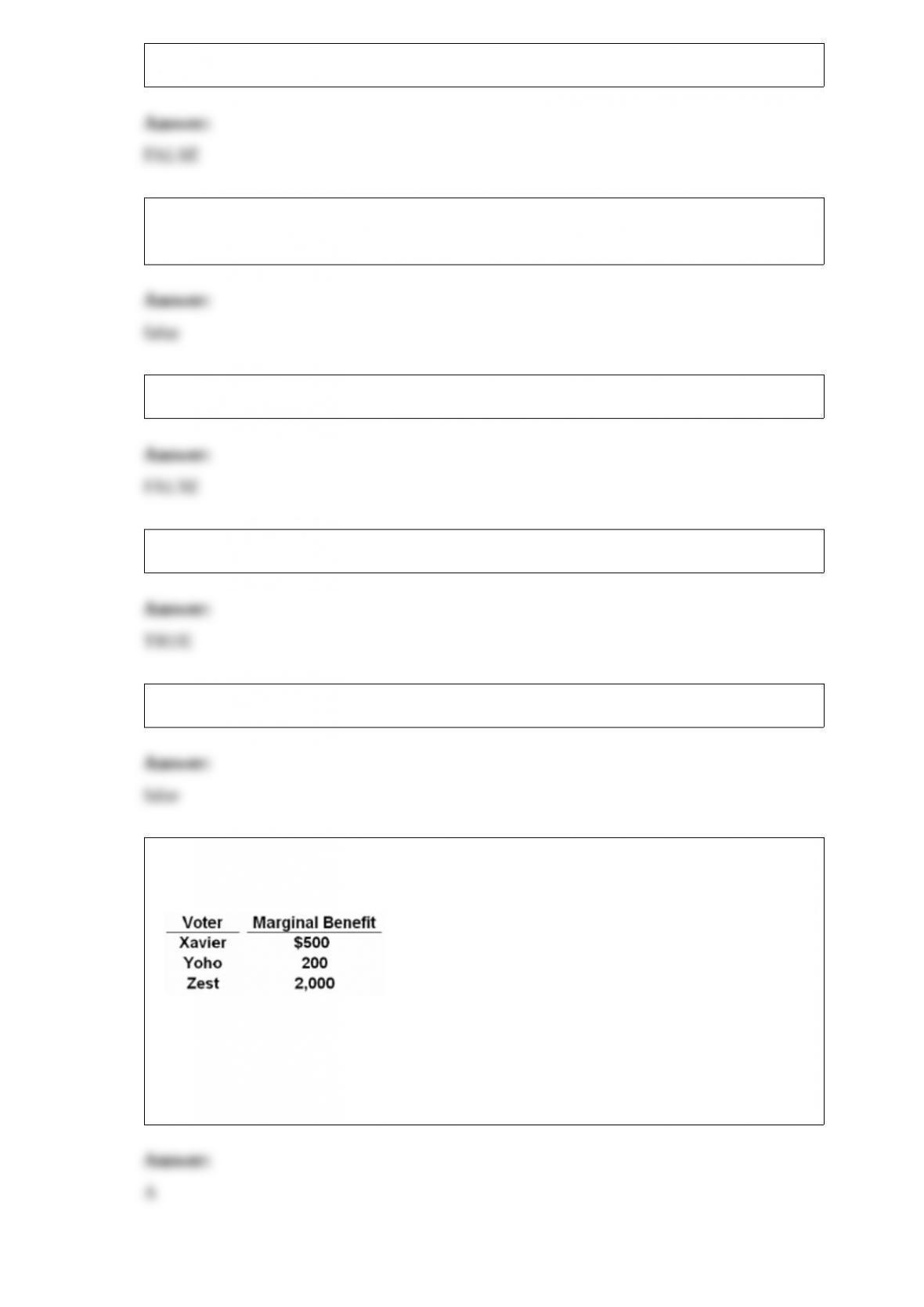
6) The following table shows the marginal benefit that a particular public project will
provide to each of the three members of a community. No vote trading is allowed.
If the tax cost of this proposed project is $600 per person, a majority vote will:
A.defeat this project and resources will be underallocated to it.
B.defeat this project and resources will be allocated efficiently.
C.pass this project and resources will be overallocated to it.
D.defeat this project and resources will be overallocated to it.
7) The trading of votes by elected officials to secure favorable outcomes is called:
A.splitting the difference.
B.social engineering.
C.logrolling.
D.grandstanding.
8) People’s incomes are relatively low when they are young, reach a peak in middle age,
and then decline. This fact helps explain:
A.the wide variations of Gini ratios among nations.
B.the equality-efficiency tradeoff.
C.why the lifetime distribution of income is more equal than the distribution in any
given year.
D.why the lifetime distribution of income is less equal than the distribution in any given
year.
9) “Vote for my special local project and I will vote for yours.” This political technique:
A.illustrates the paradox of voting.
B.often accompanies pork-barrel politics.
C.illustrates the median voter model.
D.undermines the benefits-received principle.
10)
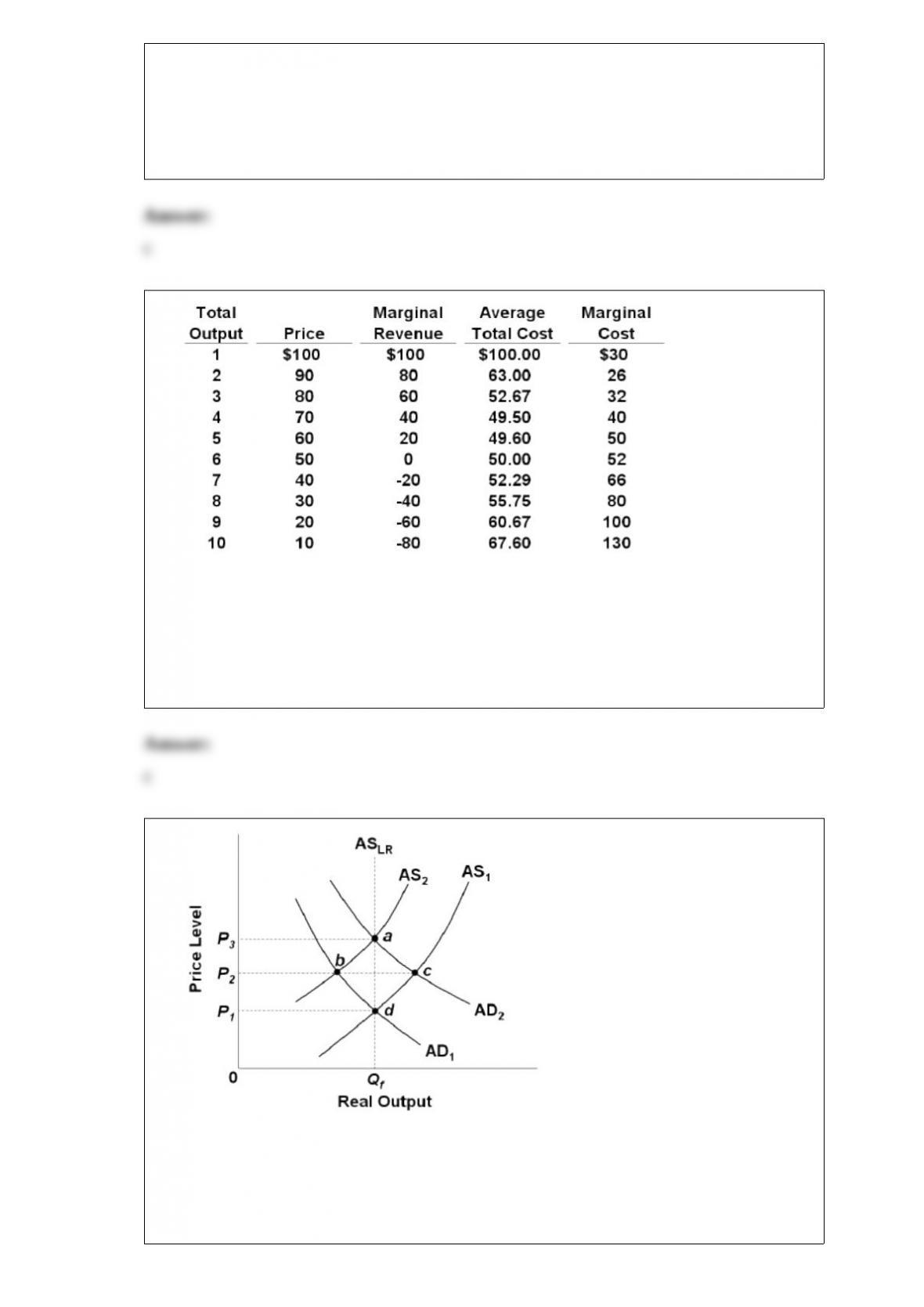
the shift of the budget line from cd to ab in the above figure is consistent with:
a.decreases in the prices of both m and n.
b.an increase in the price of m and a decrease in the price of n.
c.a decrease in money income.
d.an increase in money income.
11)
refer to the above data for a nondiscriminating monopolist. at its profit-maximizing
output, this firm will be operating in the:
a.perfectly elastic portion of its demand curve.
b.perfectly inelastic portion of its demand curve.
c.elastic portion of its demand curve.
d.inelastic portion of its demand curve.
12)
Refer to the above diagram. The initial aggregate demand curve is AD1 and the initial
aggregate supply curve is AS1. In the long run, demand-pull inflation is best shown as:
A.a shift of aggregate demand from AD1 to AD2 followed by a shift of aggregate
supply from AS1 to AS2.
B.a move from d to b to a

C.a shift of aggregate supply from AS1 to AS2 followed by a shift of aggregate demand
from AD1 to AD2.
D.a move from a to d
13) which of the following lists includes only capital resources (and therefore no labor
or land resources)?
a.an ice arena; a professional hockey player; hockey uniforms.
b.the owner of a new startup firm; a chemistry lab; a researcher.
c.a hydroelectric dam; water behind the dam; power lines.
d.autos owned by a car rental firm; computers at the car rental agency; the vans that
shuffle rental customers to and from the airport.
14) The velocity of money measures the:
A.proportion of the money supply held as an asset.
B.ratio of the transactions demand to the asset demand for money.
C.average annual rate of increase in the money supply.
D.number of times per year the average dollar is spent on final goods and services.
15) suppose the price of a product rises and the total revenue of sellers increases.
a.it can be concluded that the demand for the product is elastic.
b.it can be concluded that the supply of the product is elastic.
c.it can be concluded that the supply of the product is inelastic.
d.no conclusion can be reached with respect to the elasticity of supply.
16) If Congress adjusted the U.S. tax system so that the MPC was reduced, the
A.economy would become more inflation prone.
B.economy would become less stable.
C.stability of the economy would be unaffected.
D. economy would become more stable.
17) Farm programs such as those of the United States and the European Union:
A.encourage the United States and the European Union to use tariffs and quotas to
restrict agricultural imports.
B.cause United States and European Union farmers to produce less than domestic
consumers want to purchase.
C.increase world market prices for agricultural products.
D.raise farm output in developing nations.
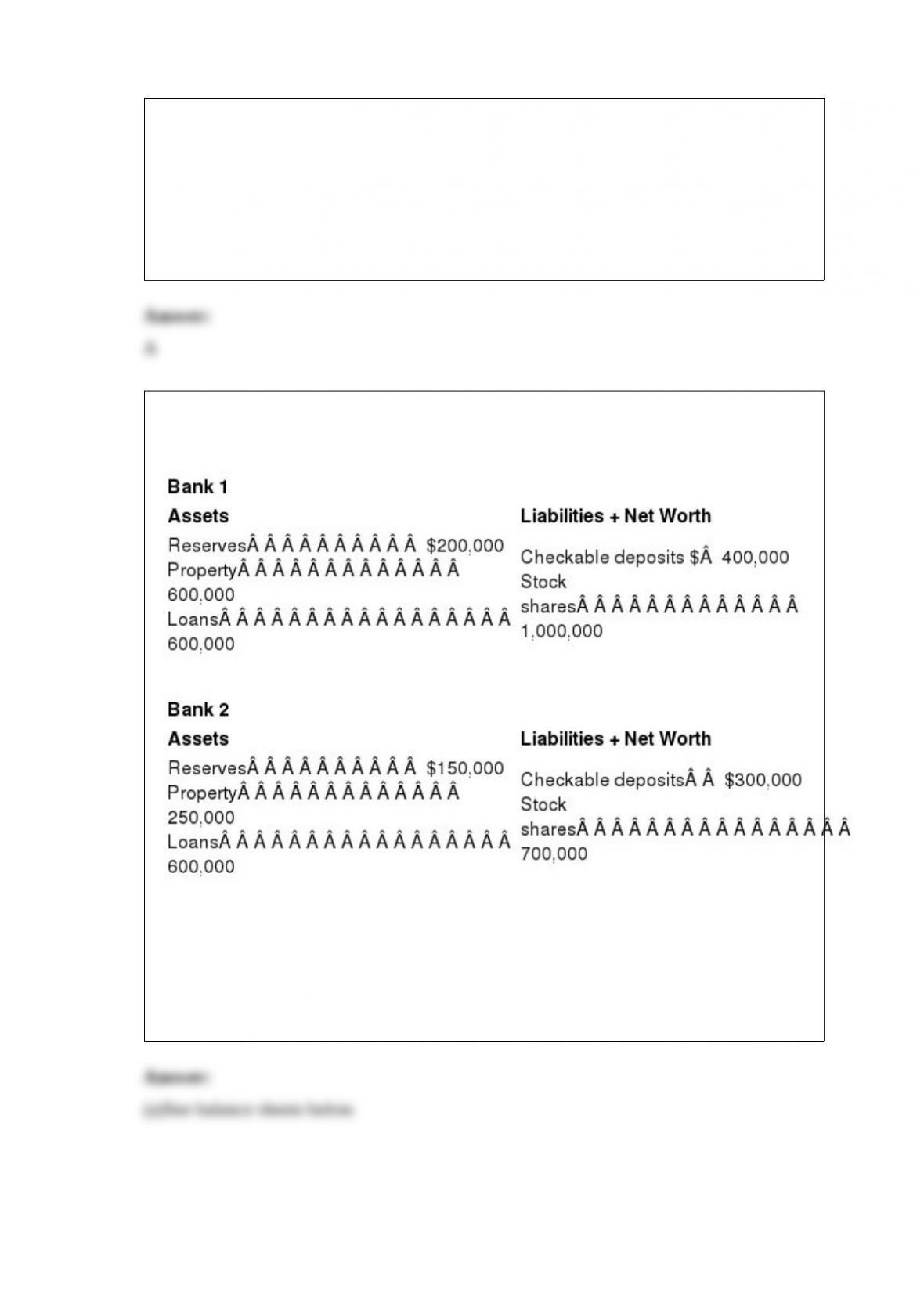
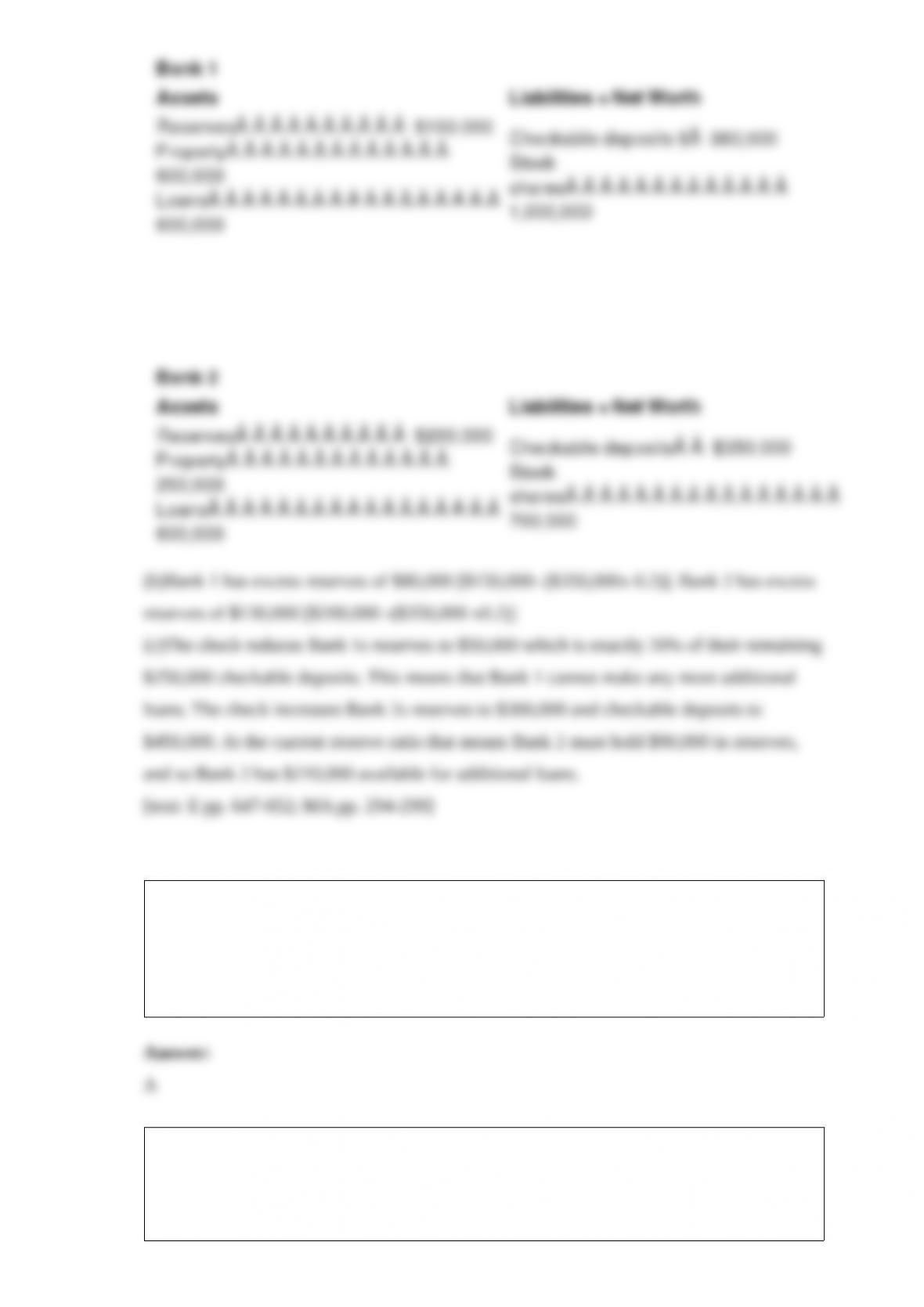
18) Jack deposits his money at Bank 1, while Maria deposits her money at Bank 2.
Balance sheets for each bank are listed below.
(a)What will the banks balance sheets look like when Jack writes a $50,000 check to
Maria and the check clears?
(b)The reserve ratio is 20%. What are each banks excess reserves after the check clears
in (a)?
(c)How many additional loans can each bank make when Jack writes Maria another
check for $100,000?
19) If an exclusive union is successful in restricting the supply of labor, the:
A.wage rate will rise.
B.the quantity of labor demanded will rise.
C.the number of job opportunities in the firm or industry will increase.
D.the demand for labor curve will shift leftward.
20) Other things equal, economists would prefer:
A.free trade to tariffs and tariffs to import quotas.
B.free trade to import quotas and import quotas to tariffs.
C.import quotas to tariffs and tariffs to voluntary export restrictions.
D.import quotas to free trade and free trade to tariffs.
21) Distinguish between the nominal and real rates of interest using an example.
22) What are five reasons for the downward price-level inflexibility, especially as it
pertains to wages and prices?
23) Monopolistic firms will always be against regulation. Evaluate.

24) Assume that in year 1 an economy produces 1000 units of output and they sell for
$100 a unit, on average. In year 2, the economy produces the same 1000 units of output,
and sells it for $110 a unit, on average. Use year 1 prices to calculate real GDP in Year 1
and Year 2. What happened to real GDP between years 1 and 2? Why?
25) Describe the economic effects of occupational segregation on the wages of women
and minorities. How does this type of segregation affect the domestic output of the
economy?