The Athenian Theatre sells play tickets for the same play at different prices: a lower
price to those who opt for the seats at the back of the theatre and a higher price for those
who purchase seats in the front, around the stage. Which of the following statements is
true?
A) This is an example of product differentiation but not price discrimination.
B) The theatre practices first-degree price discrimination by setting prices based on
willingness to pay.
C) Since the cost of producing the play does not change with the seating configuration,
this is evidence of price discrimination based on market segmentation.
D) Charging two different prices is an effective way to avoid an excess demand for play
tickets; the higher price lowers quantity demanded to some extent.
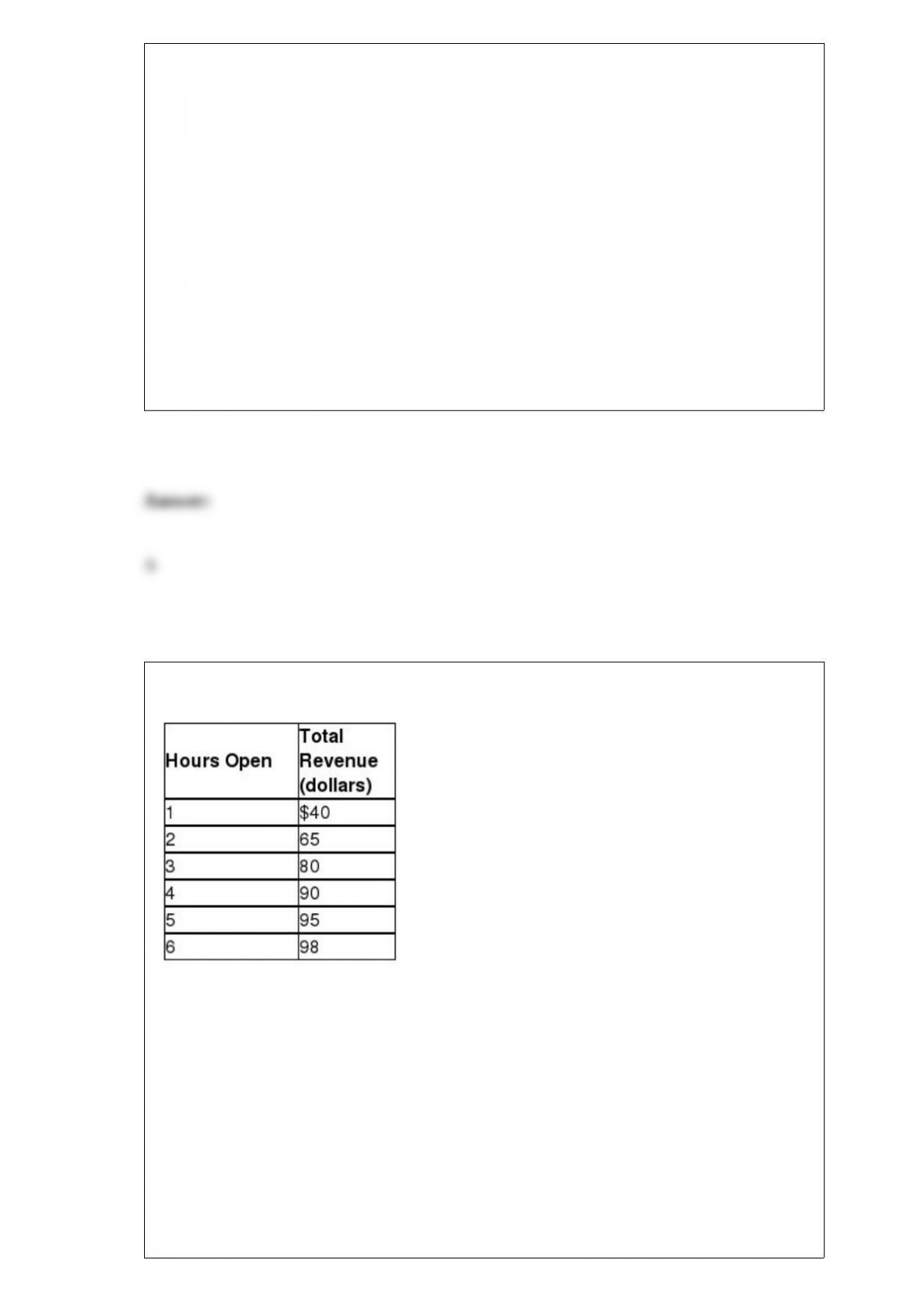
Table 1-2
Julius runs a small tailor shop in the city of Bloomfield. He is debating whether he
should extend his hours of operation. Julius figures that his sales revenue will depend
on the number of hours the tailor shop is open as shown in the table above. He would
have to hire a worker for those hours at a wage rate of $18 per hour. What is Julius’s
marginal cost if he decides to stay open for three hours instead of two hours?
A) $0
B) $18
C) $54

D) $65
Allocative efficiency best explains ________, and productive efficiency best explains
________.
A) how something will be produced; when something will be produced
B) when something will be produced; why something will be produced
C) why something will be produced; what will be produced
D) what will be produced; how something will be produced
How is a stock’s price-earnings ratio found?
A) by dividing the dividend by the closing price of the stock
B) by dividing the dividend by the firm’s earnings per share
C) by dividing current market price of the stock by the firm’s earnings per share
D) by subtracting the firm’s earnings per share from the closing price of the stock

The Coffee Nook, a small cafe near campus, sells cappuccinos for $2.50 and Russian
tea cakes for $1.00 each. What is the opportunity cost of buying a Russian tea cake?
A) 2 1/2 cappuccinos
B) 2/5 of a cappuccino
C) $2.50
D) $1.00
A patent grants an inventor exclusive rights to a product for how long?
A) 14 years
B) 17 years
C) 20 years
D) the lifetime of the product
An explanation for the productivity slowdown from 1974 through 1995 is
A) measurement problems.
B) creative destruction.
C) a decline in oil prices.
D) an increase in labor quality.
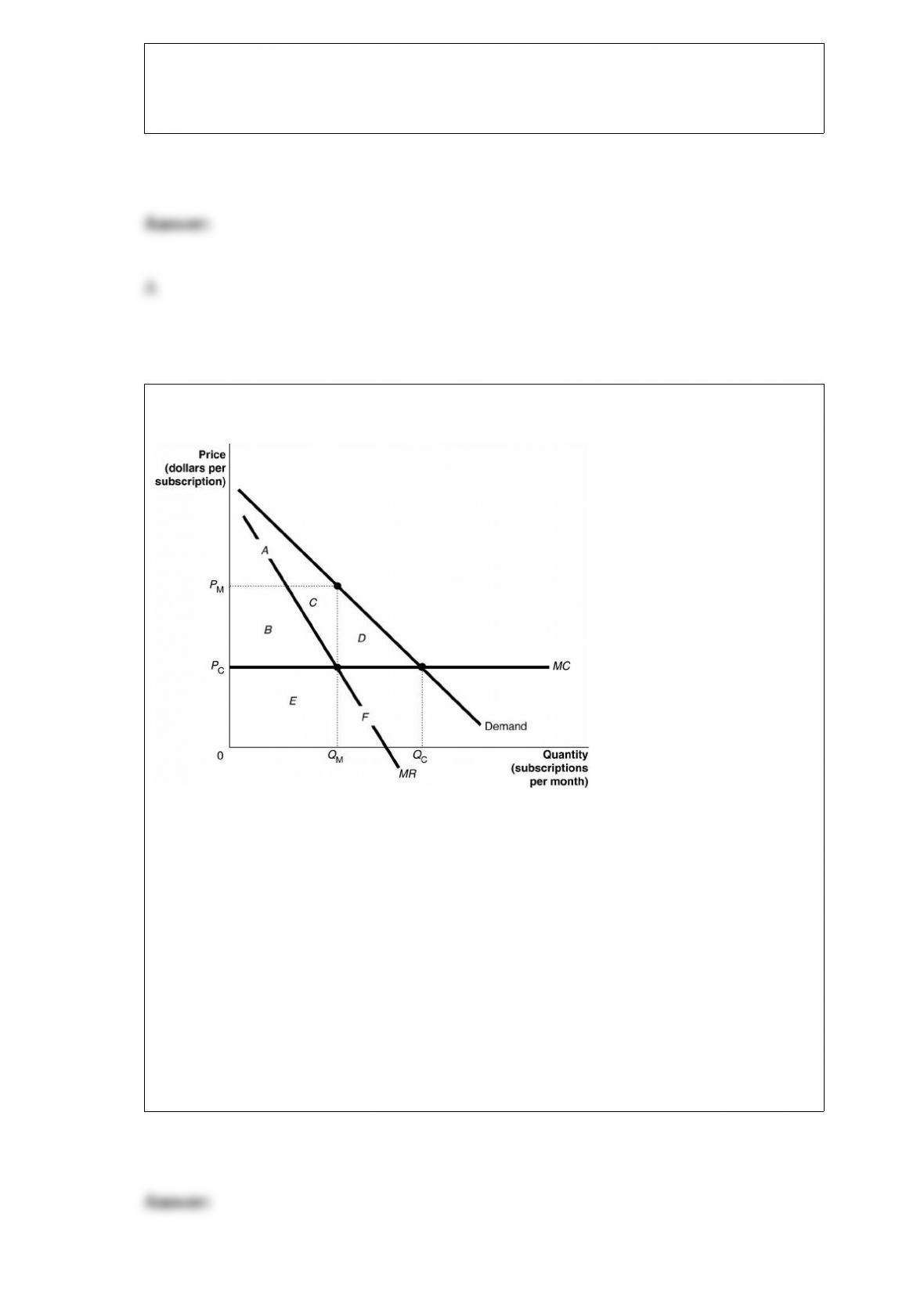
Figure 15-11
In 2011, Verizon was granted
permission to enter the market for cable TV in Upstate New York, ending the virtual
monopoly that Time Warner Cable had in most local communities in the region. Figure
15-11 shows the cable television market in Upstate New York. Following the entry of
Verizon, the subscription price falls from PM to PC. What is the increase in consumer
surplus as a result of this change?
A) the area A + B + C
B) the area B + C
C) the area D + F
D) the area B + C + D

A grocery store sells a bag of potatoes at a fixed price of $2.30. Which of the following
is a term used by economists to describe the money received from the sale of an
additional bag of potatoes?
A) marginal revenue
B) gross earnings
C) pure profit
D) marginal costs
E) net benefit
All of the following occur whenever a government taxes a product except
A) the quantity consumed of that product falls.
B) the price of that product rises.
C) the marginal benefit of the last unit sold exceeds the marginal cost of producing it.
D) there will be no excess burden if the government’s tax revenue is sufficiently large to
offset the deadweight loss.

Frieda is at her local florist to buy a dozen roses. She is willing to pay $75 for the roses,
and buys them for $75. Frieda’s consumer surplus from the purchase is
A) $150.
B) $75.
C) $37.50.
D) $0.