
1) the optimal level of immigration occurs where marginal benefit is at its greatest.
2) an increase in quantity supplied might be caused by an increase in production costs.
3) economic models of illegal immigration suggest that domestic-born workers avoid
certain types of work more because the inflow of immigrants has reduced wages, rather
than because the work is unpleasant.
4) When commercial banks retire outstanding loans, the supply of money is increased.
5) indifference analysis assumes that utility is numerically measurable.
6) An advantage of direct foreign investment (compared to foreign loans) is that
management skill and technological knowledge often accompany such capital flows.
7) an example of a public good is cable television.
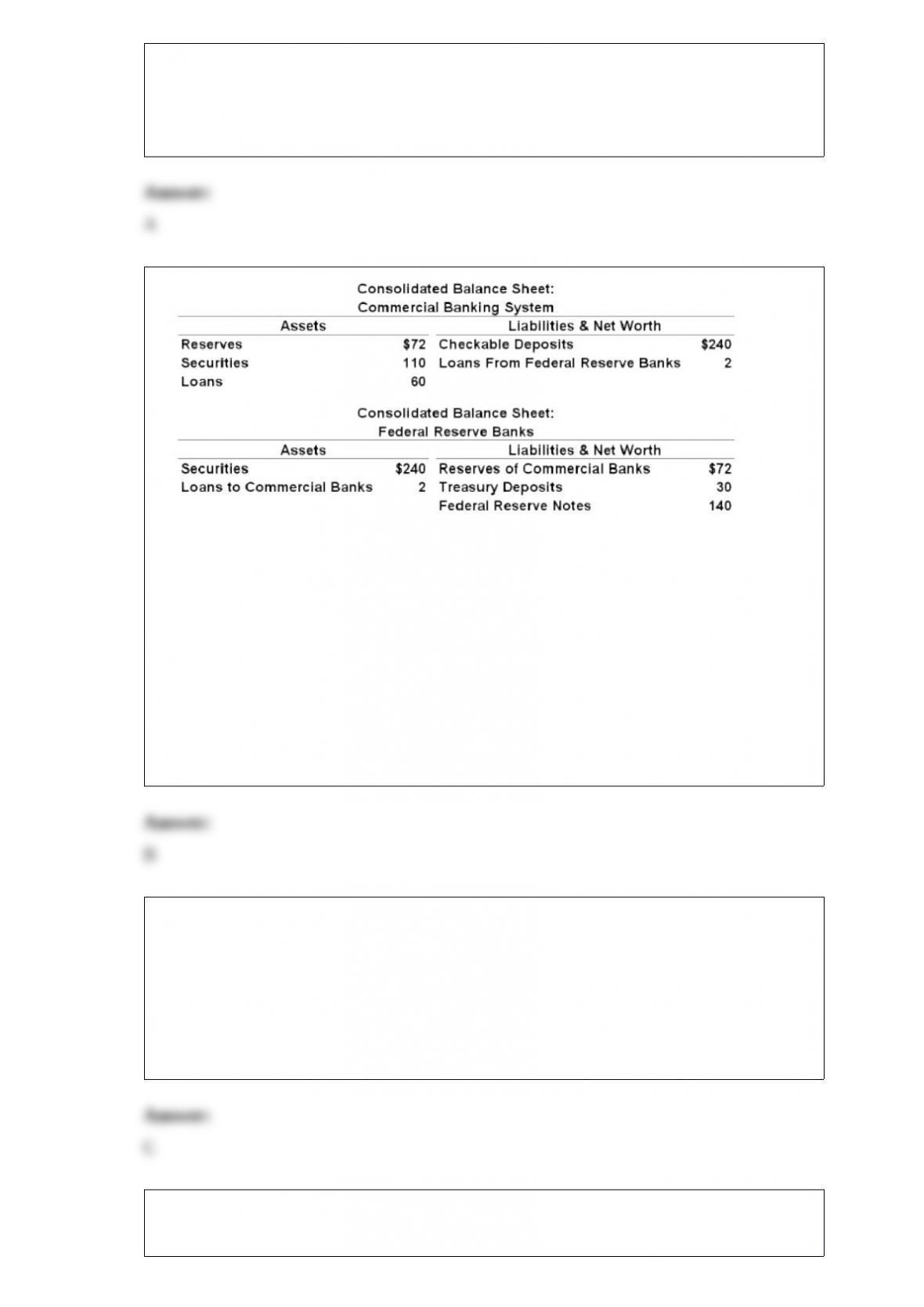
8) The commercial banking system borrows from the Federal Reserve Banks. As a
result, the checkable deposits:
A.of commercial banks are unchanged, but their reserves increase.
B.and reserves of commercial banks both decrease.
C.of commercial banks are unchanged, but their reserves decrease.
D.and reserves of commercial banks are both unchanged.
9)
Refer to the above balance sheets and assume the reserve ratio is 25%. Suppose the
Federal Reserve Banks sell $2 in securities directly to the commercial banks. As a result
of this transaction the supply of money:
A.will decrease by $2, but the money-creating potential of the commercial banking
system will not be affected.
B.is not directly affected, but the money-creating potential of the commercial banking
system will decrease by $8.
C.will directly increase by $2 and the money-creating potential of the commercial
banking system will decrease by an additional $8.
D.will directly increase by $2 and the money-creating potential of the commercial
banking system will increase by an additional $8.
10) Suppose lawyers seek legislation to limit the use of computer software that enables
people to use their personal computers to self-prepare their own wills, trusts, and other
legal documents. This is an example of:
A.logrolling.
B.the principal-agent problem.
C.rent-seeking behavior.
D.limited and bundled choices.
11) the more time consumers have to adjust to a change in price:
a.the smaller will be the price elasticity of demand.

b.the greater will be the price elasticity of demand.
c.the more likely the product is a normal good.
d.the more likely the product is an inferior good.
12) Because of the free-rider problem:
A.the market demand for a public good is overstated.
B.the market demand for a public good is nonexistent or understated.
C.government has increasingly yielded to the private sector in producing public goods.
D.public goods often create moral hazard and adverse selection problems.
13) The Celler-Kefauver Act of 1950:
A.outlawed price fixing.
B.amended the Sherman Act.
C.amended the Clayton Act.
D.created the Civil Aeronautics Board (CAB).
14) digital cameras and memory cards are:
a.substitute goods.
b.complementary goods.
c.independent goods.
d.inferior goods.
15) street entertainers generally have a difficult time making large incomes from their
performances because they:
a.are not sufficiently talented.
b.provide public goods and therefore face free-rider problems.
c.fail to attract audiences.
d.tend to lack marketing skills.
16) Suppose a commercial banking system has $100,000 of outstanding checkable
deposits and actual reserves of $35,000. If the reserve ratio is 20 percent, the banking
system can expand the supply of money by the maximum amount of:
A.$122,000.
B.$175,000.
C.$300,000.
D.$75,000.
17)
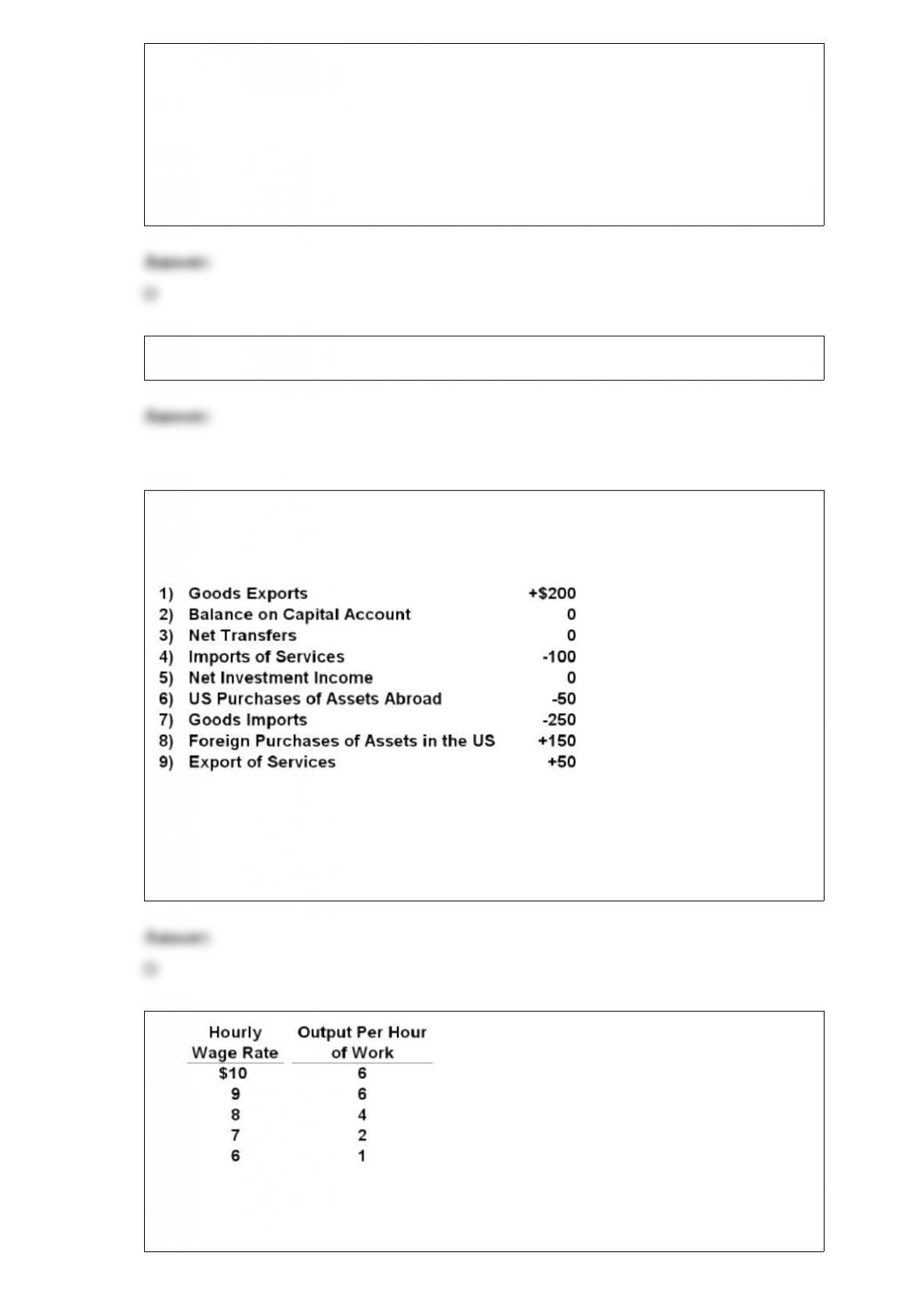
18) The plus items below are “export-type” entries and the minus items are
“import-type” entries in the balance of payments for the hypothetical country of Zippo.
Refer to the above information. Zippo has:
A.a current account surplus.
B.a financial account deficit.
C.a trade surplus on goods and services.
D.neither a balance of payments deficit nor a surplus.
19)
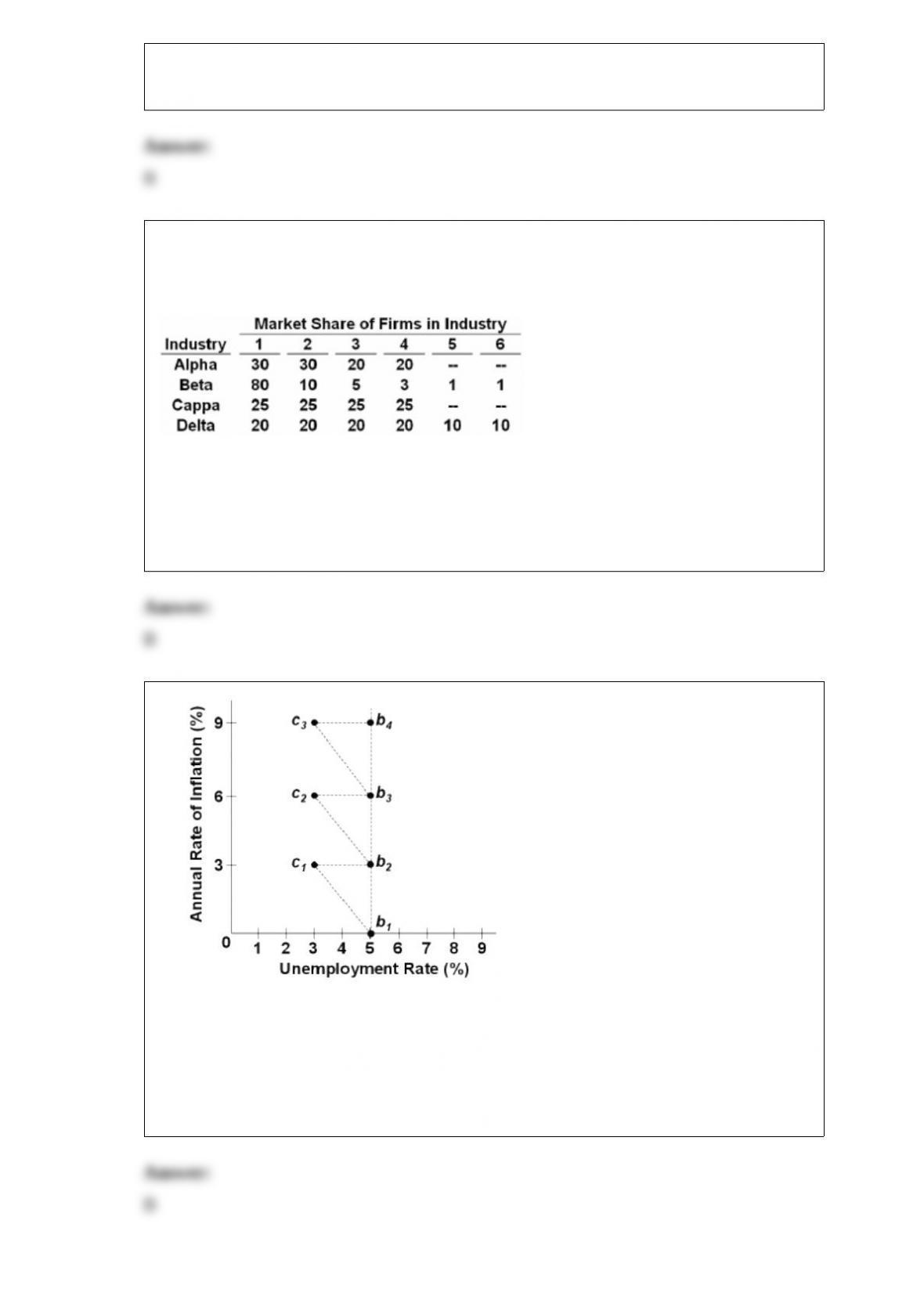
Refer to the above table. The efficiency wage is:
A.$10.
B.$9.
C.$8
D.$6.
20) The basis of the following table shows market shares of firms in hypothetical
industries. Assume these are distinct industries with no buyer-seller relationships or
competition among them.
Refer to the above table. A merger between Firm 2 and Firm 3 in Alpha would be a:
A.vertical merger.
B.horizontal merger.
C.diagonal merger.
D.conglomerate merger.
21)
Refer to the above diagram and assume the economy is initially at point b1. Which of
the following movements is consistent with the traditional Phillips Curve?
A.the movement from b1 to b2
B.the movement from b1 to c1
C.the movement from c1 to b2
D.the movement from b2 to b1
22)
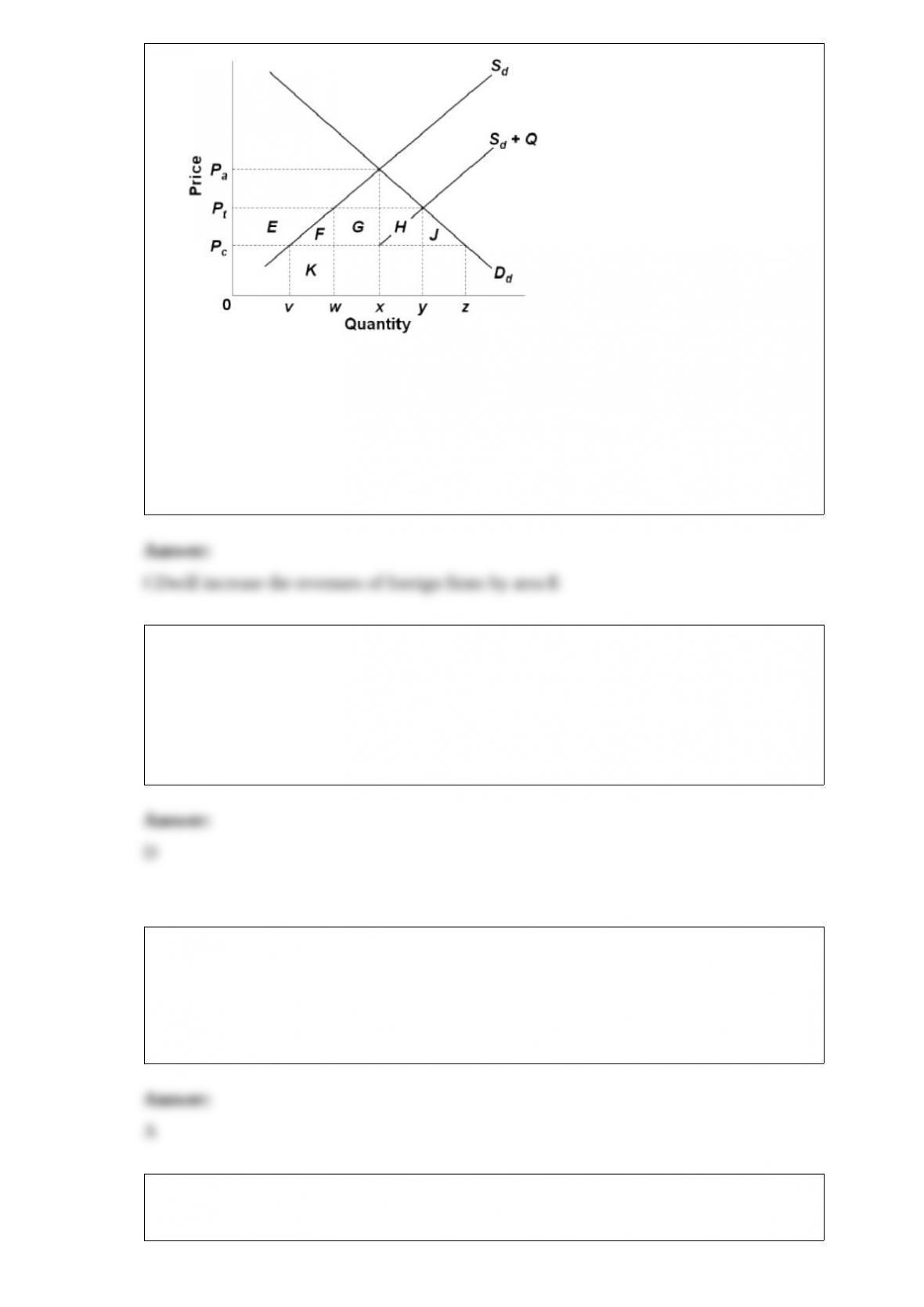
Refer to the above diagram, where Sd and Dd are the domestic supply and demand for a
product and Pc is the world price of that product. Sd + Q is the product supply curve
after an import quota is imposed. Assuming there is no tariff, the import quota:
A.will increase United States Treasury revenue by areas G + H
B.will increase United States Treasury revenue by areas E + F + G + H + J
C.may either increase or decrease the total revenues of foreign producers, depending on
the elasticity of domestic demand.
23) In 1993 the Federal government boosted income tax rates. In the seven years that
followed:
A.tax revenues fell slightly.
B.productivity growth slowed.
C.the unemployment rate increased.
D.tax revenues expanded rapidly.
24) Which of the following is an example of a public good?
A.a weather warning system
B.a television set
C.a sofa
D.a bottle of soda
25) The purpose of a restrictive monetary policy is to:
A.alleviate recessions.

B.raise interest rates and restrict the availability of bank credit.
C.increase aggregate demand and GDP.
D.increase investment spending.
26) an increase in product price will cause:
a.quantity demanded to decrease.
b.quantity supplied to decrease.
c.quantity demanded to increase.
d.the supply curve to shift to the left.
27) assume the price of product y (the quantity of which is on the vertical axis) is $15
and the price of product x (the quantity of which is on the horizontal axis) is $3. also
assume that money income is $60. the absolute value of the slope of the resulting
budget line:
a.is 5
b.is 1/5
c.is 4
d.is 20
28) Describe the relationship shown by the investment demand curve.
29) List the various causes of income inequality in the United States.
30) Explain the two different ways of looking at GDP.
31) How could you use the Coase theorem to predict what would happen when smoke
from a factory created dirty air and slightly acid rain for all the residents in the area in a
one-mile radius of the plant?
32) Why arent the tools of product market analysis directly applicable to the resource
market?
33) Why are horizontal mergers more likely to be opposed than vertical and
conglomerate mergers?
34) What were the two basic means of control by government as substitute for, or to
supplements to, market forces in monopolized industries?
35) Why is there emphasis on nonprice competition in oligopoly?
36) What are negative externalities and positive externalities? How do they affect
supply and demand curves?