
The economic model of consumer behavior predicts that
A) consumers will try to earn as much income as they can over their lifetimes.
B) consumers will choose to buy the combination of goods and services that make them
as well off as possible from those combinations that their budgets allow them to buy.
C) consumers will try to accumulate as many goods and services as they can before
they die.
D) consumers divide their time between consumption and leisure activities in order to
maximize social welfare.
Assume weak growth in aggregate demand keeps the economy below potential GDP, so
unemployment rises but inflation falls. This explains the ________ slope of the
short-run Phillips curve.
A) positive
B) negative
C) zero
D) infinite
In economics, the study of the decisions of firms in industries where the profits of each
firm depend on its interactions with other firms is called
A) decision theory.

B) game theory.
C) market structure analysis.
D) profit analysis.
If the percentage increase in price is 15 percent and the value of the price elasticity of
demand is -3, then quantity demanded
A) will increase by 45 percent.
B) will increase by 5 percent.
C) will decrease by 45 percent.
D) will decrease by 5 percent.
Which of the following describes a difference between the marginal revenue and
demand curves of a perfectly competitive firm and a monopolistically competitive firm?
A) The perfectly competitive firm’s marginal revenue and demand curves are the same;
the marginal revenue curve of a monopolistically competitive firm lies above its
demand curve.
B) The perfectly competitive firm’s marginal revenue and demand curves are the same;
the marginal revenue curve of a monopolistically competitive firm lies below its
demand curve.
C) The monopolistically competitive firm’s marginal revenue and demand curves are
the same; the marginal revenue curve of a perfectly competitive firm lies below its

demand curve.
D) The marginal revenue curve of a monopolistically competitive firm lies below its
demand curve; the marginal revenue curve of a perfectly competitive firm lies above its
demand curve.
An increase in Social Security payments will
A) increase consumption spending.
B) increase investment spending.
C) increase government spending.
D) increase export spending.
Which of the following is the best example of a short-run adjustment?
A) A local bakery purchases another commercial oven as part of its capacity expansion.
B) Your local Wal-Mart hires two more associates.
C) Smith University completed negotiations to acquire a large piece of land to build its
new library.
D) Toyota builds a new assembly plant in Texas.

Since 2000, the Fed uses ________ to measure inflation.
A) the index of leading economic indicators
B) the personal consumption expenditures index
C) the consumer price index
D) the GDP deflator
E) the producer price index
The three fundamental questions that any economy must address are:
A) What will be the prices of goods and services; how will these goods and services be
produced; and who will receive them?
B) What goods and services to produce; how will these goods and services be produced;
and who receives them?
C) Who gets jobs; what wages do workers earn; and who owns what property?
D) How much will be saved; what will be produced; and how can these goods and
services be fairly distributed?

Robert Lucas, a Nobel laureate in economics, argues that there are increasing returns to
A) knowledge capital.
B) physical capital.
C) financial capital.
D) human capital.
A country with no trade and no borrowing and lending relationships with other
countries is known as a(n)
A) planned economy.
B) market economy.
C) open economy.
D) closed economy.
The Aluminum Company of America (Alcoa) had a monopoly until the 1940s because
A) it was a public enterprise.
B) it had a patent on the manufacture of aluminum.
C) the company had a secret technique for making aluminum from bauxite.
D) it had control of almost all the available supply of bauxite.
As word processing on personal computers expanded, sales of typewriters began to
disappear. Which of Porter’s competitive forces does this event demonstrate?
A) the threat of competition from new entrants
B) bargaining power of suppliers
C) bargaining power of buyers
D) competition from substitute goods or services
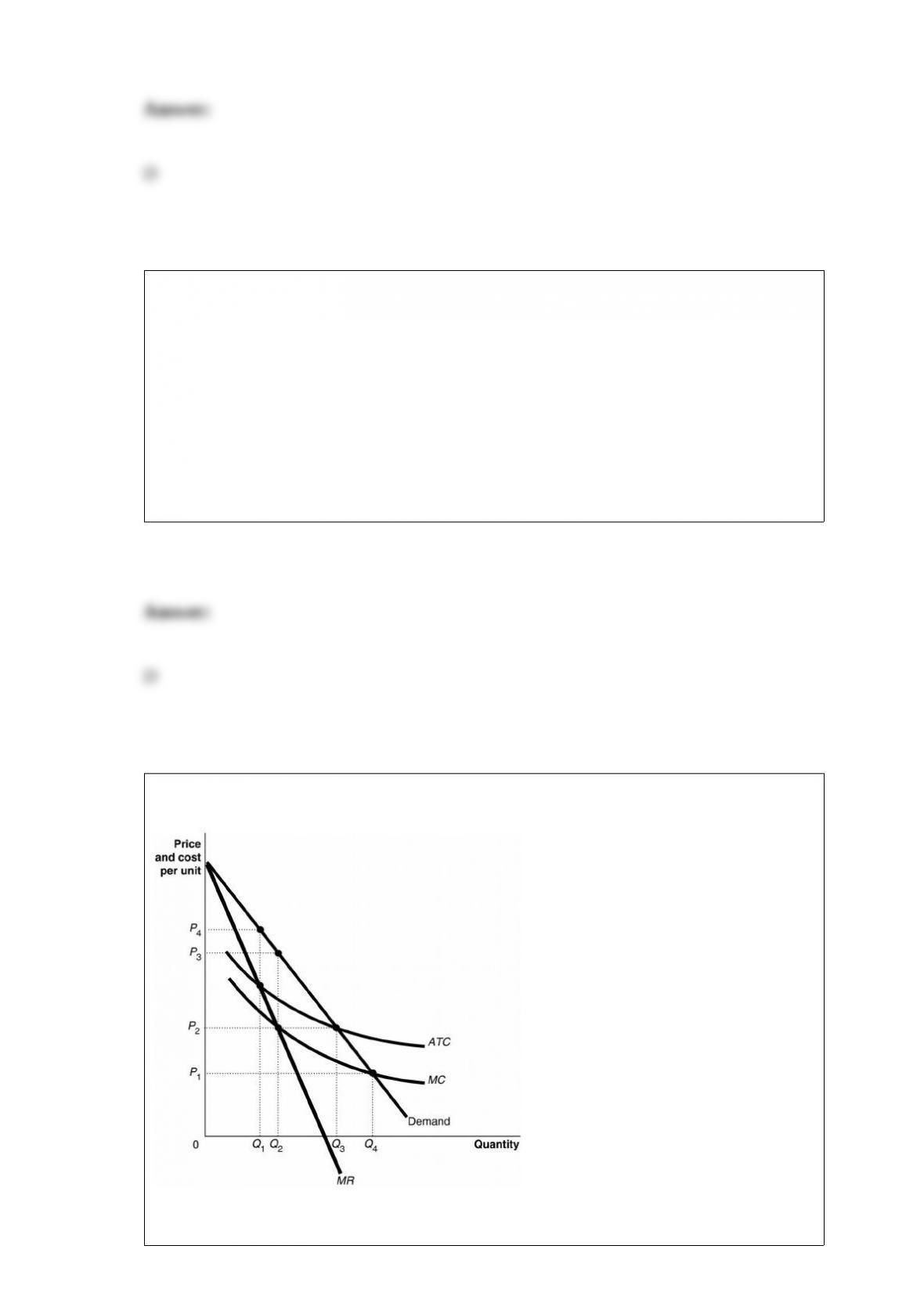
Figure 15-15
Figure 15-15 shows the cost and demand curves for the Erickson Power Company. Why

won’t regulators require that Erickson Power produce the economically efficient output
level?
A) because there is insufficient demand at that output level
B) because at the economically efficient output level, the marginal cost of producing the
last unit sold exceeds the consumers’ marginal value for that last unit
C) because Erickson Power will earn zero profit
D) because Erickson Power will sustain persistent losses and will not continue in
business in the long run
Which of the following statements about the underground economy is true?
A) The underground economy in developing countries amounts to less than 10% of
measured GDP.
B) Most transactions that occur in the underground economy are included in the
calculation of GDP.
C) Excluding underground economy production from measured GDP causes errors in
GDP growth estimates in the long run.
D) Income that is earned but not reported as income for tax purposes is included in the
calculation of GDP.
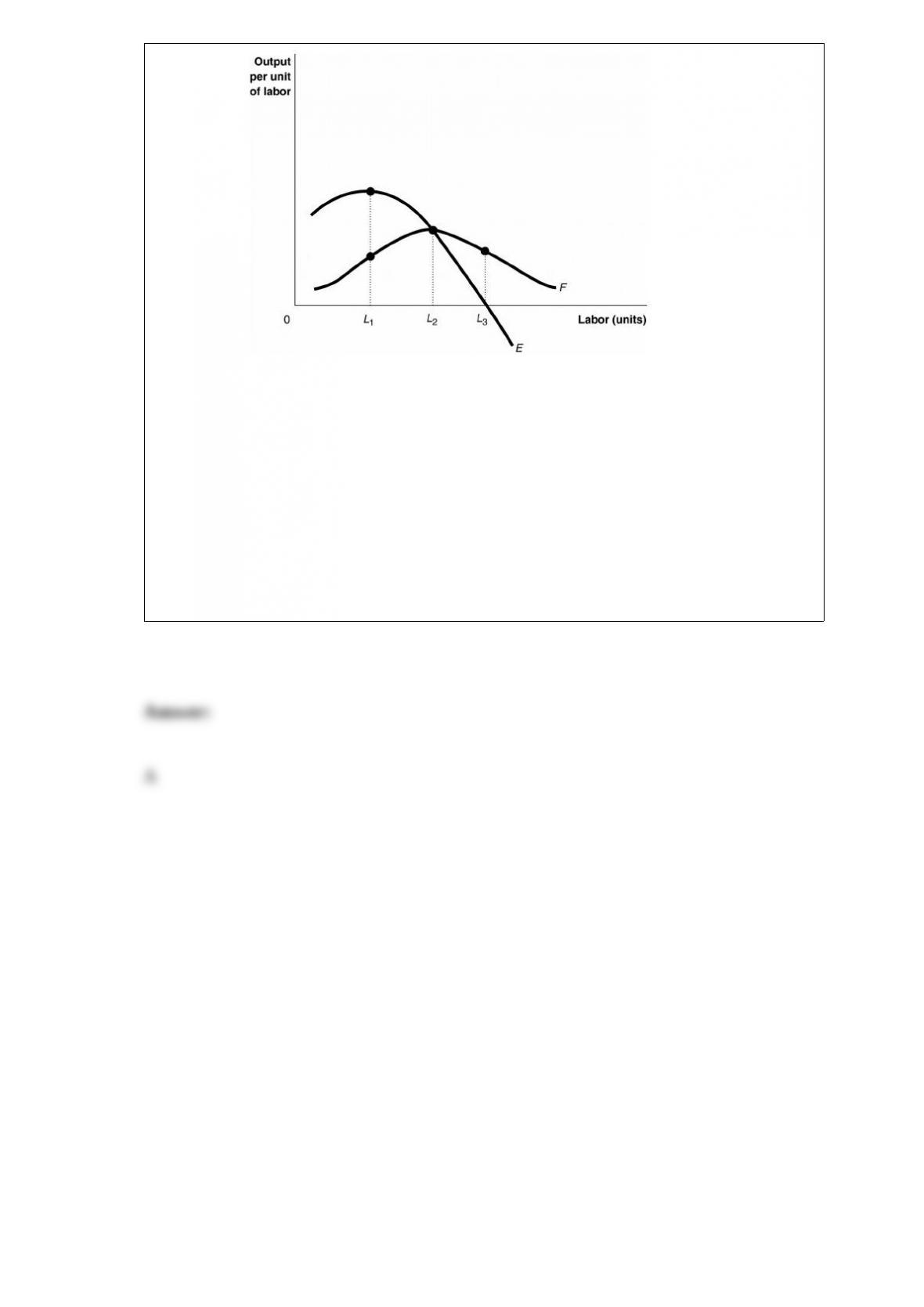
Figure 11-2
Diminishing returns to labor set in
A) after L1.
B) after L2.
C) after L3.
D) immediately.