Assume that production from an electric utility caused acid rain. If the government
imposed a tax on the utility equal to the cost of the acid rain, the government’s action
would
A) externalize the externality.
B) result in a marginal social benefit greater than the marginal cost of the electricity.
C) be an example of supply side economic policy.
D) internalize the externality.
The advice to “retrain” would be most appropriate for which of the following types of
unemployment?
A) frictional unemployment
B) structural unemployment
C) cyclical unemployment
D) core unemployment
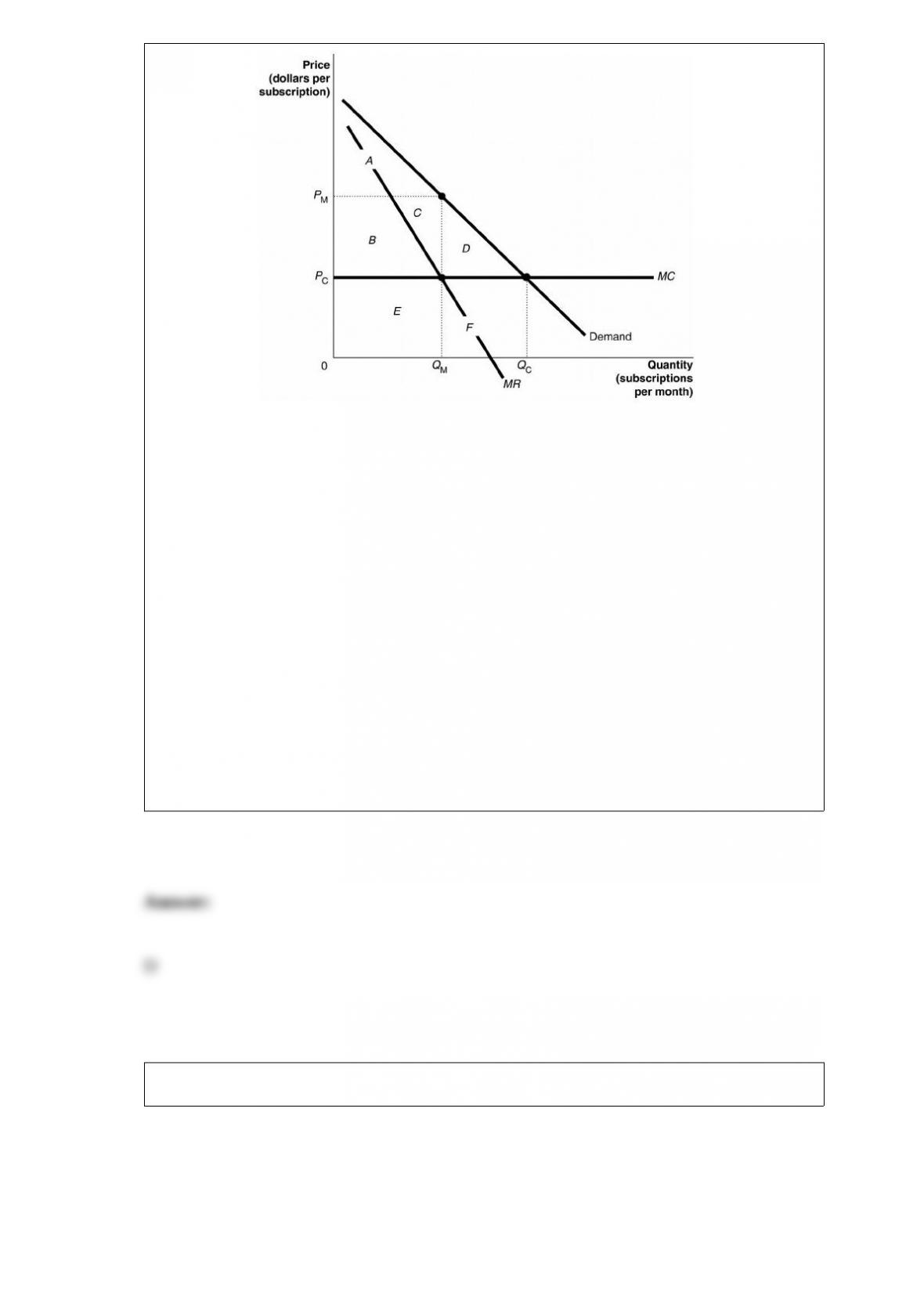
Figure 15-11 In 2011,
Verizon was granted permission to enter the market for cable TV in Upstate New York,
ending the virtual monopoly that Time Warner Cable had in most local communities in
the region. Figure 15-11 shows the cable television market in Upstate New York.
Suppose the local government imposes a $2.50 per month tax on cable companies.
What happens to the price charged by the cable company following the imposition of
this tax?
A) The price rises from PMto (PM+ $2.50).
B) The price rises from PM but it increases by an amount less than $2.50.
C) The price rises from PM but it increases by an amount greater than $2.50 to reflect
the monopoly’s markup.
D) The price remains at PM.
Table 9-16
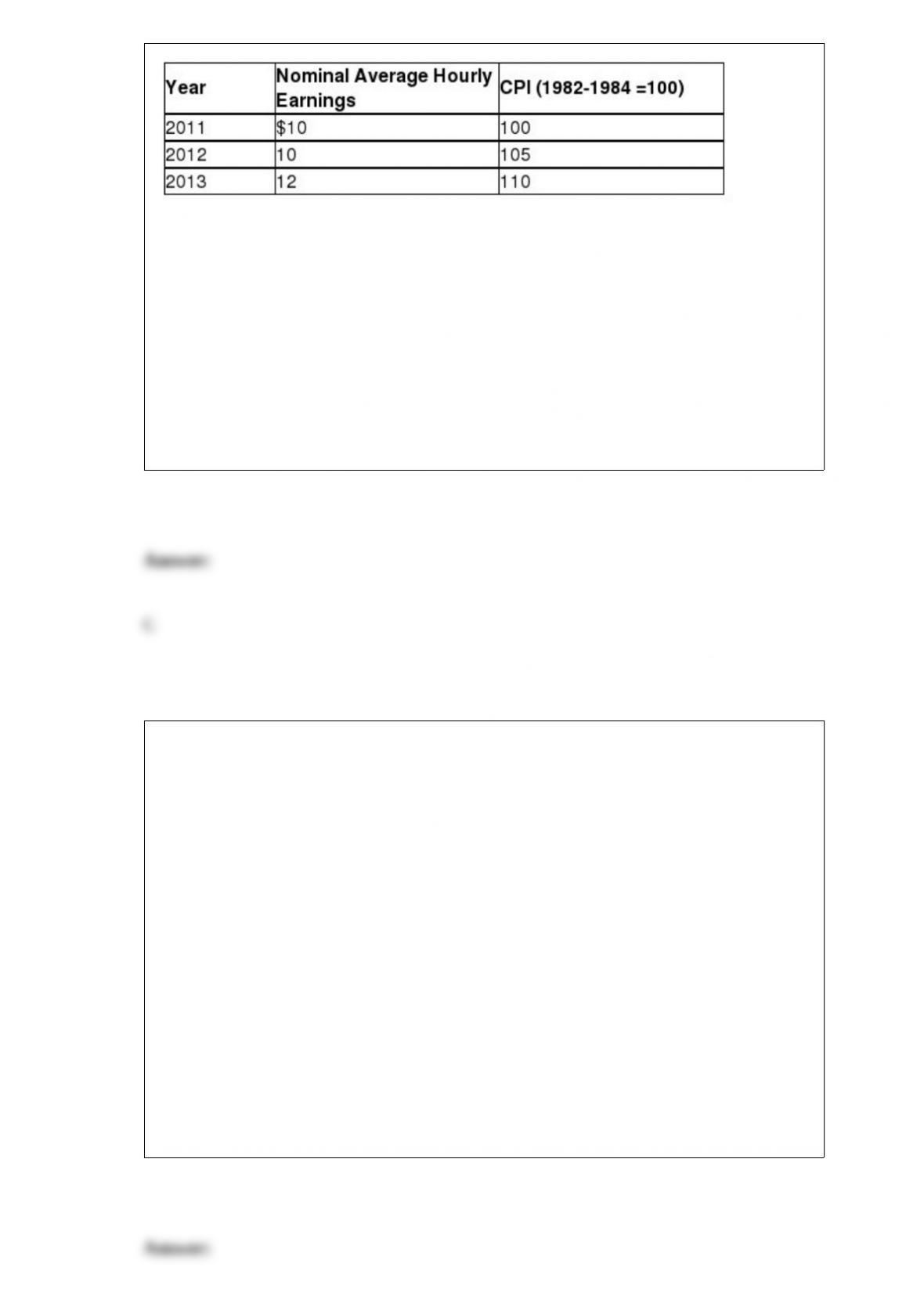
Looking at the table above, real wages ________ from 2011 to 2012, and real wages
________ from 2012 to 2013.
A) rose; rose
B) rose; fell
C) fell; rose
D) fell; fell
Two stores – Lazy Guys and Ralph’s Recliners – are located in the same city. Both stores
buy recliner chairs from the same manufacturer at the same price and both stores are
about the same size, so that the fixed costs of production for both stores are the same.
Ralph’s Recliners sells more recliners per month and Ralph’s has a lower average total
cost of production. Which of the following can explain why the average total cost of
production is lower for Ralph’s Recliners?
A) Because Ralph’s Recliners sells more output its average fixed costs are lower than
Lazy Guy’s average fixed cost.
B) The rent Lazy Guys pays for its building is greater than the rent paid by Ralph’s
Recliners.
C) Ralph’s explicit costs are less because Ralph owns the land on which his building is
located. Lazy Guy must make lease payments for the land on which its store is located.
D) The price of recliners charged by Ralph’s is greater than the price charged by Lazy
Guys.
The rate of interest banks charge other banks for overnight loans of reserves is the
A) discount rate.
B) prime rate.
C) federal funds rate
D) real rate.
Gross national product is defined as
A) the value of final goods and services produced within the United States.
B) the value of final goods and services produced outside of the United States.
C) the value of final goods and services produced by residents of the United States even
if the production takes place outside of the United States.
D) the value of final goods and services produced within the United States, by United
States residents.
To reduce the bias in the consumer price index, the Bureau of Labor Statistics
A) updates the market basket every two years, rather than every 10 years.
B) updates the market basket every 10 years, rather than every two years.
C) incorporates substitutions by consumers when prices of specific products rise
rapidly.
D) incorporates substitutions by consumers when prices of specific products fall
rapidly.
Establishing a state employment agency that speeds up the process of matching
unemployed workers with unfilled jobs is an attempt to lower
A) frictional unemployment.
B) structural unemployment.
C) cyclical unemployment.
D) seasonal unemployment.
E) unnatural unemployment.
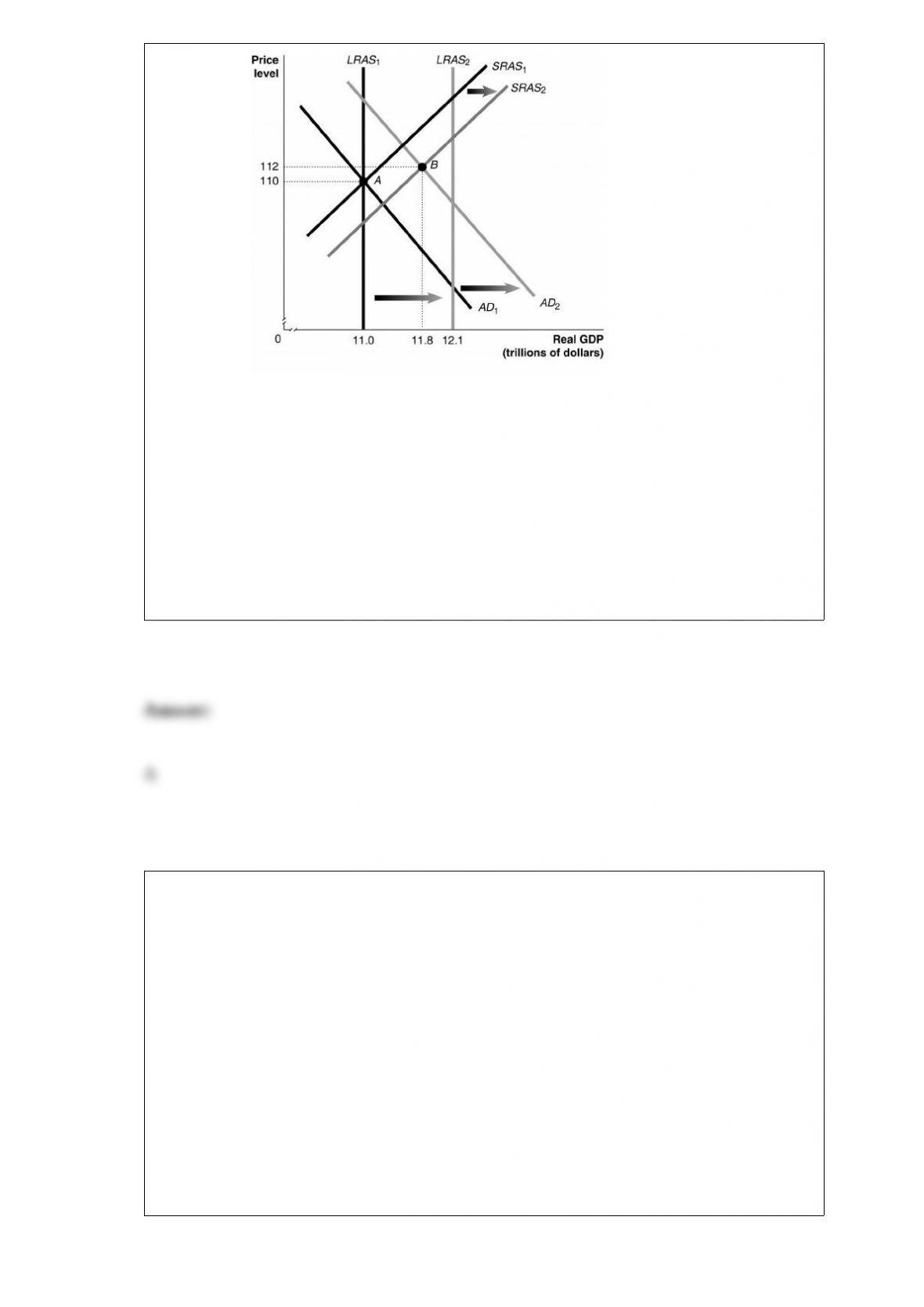
Figure 24-4
Given the economy is at point A in year 1, what will happen to the price level in year 2?
A) It will rise.
B) It will fall.
C) It will remain constant.
D) not enough information to answer the question
What actions could the Federal Reserve take to achieve consistent growth in real GDP
at 4 percent per year?
A) The Fed could increase in the growth rate of the money supply by 1% each year
until the inflation rate was exactly equal to 4 percent.
B) The Fed could maintain a growth rate of the money supply of 4 percent, regardless
of whether inflation was rising or falling in the economy.
C) The Fed could follow contractionary monetary policy that would reduce the federal
funds rate to zero so investment will rise consistently.
D) The Fed has no direct control over real GDP in the long run, so there are no actions
it could take to achieve that goal.
Sally quit her job as an auto mechanic earning $50,000 per year to start her own
business. To save money she operates her business out of a small building she owns
which, until she started her own business, she had rented out for $10,000 per year. She
also invested her $20,000 savings (which earned a market interest rate of 5% per year)
in her business. You are given the following information about the first year of her
operations. Total revenue $120,000
Cost of labor 40,000
Cost of materials 15,000
Equipment rental 5,000 a. Calculate her economic costs.
b. Calculate her accounting costs.
c. Calculate her implicit costs.
d. Sally tells you that she would really like to move to a location closer to town but she
decided against it because “right now I don’t pay any rent and it will cost me $10,000 a
year to rent near town.” Do you agree with her reasoning?
Who controls a sole proprietorship?
A) owner
B) stockholders
C) bondholders
D) employees