
Demand shifts due to changes in price.
a. True
b. False
The accounting relationship between the budget deficit and the trade deficit may be
expressed as ____.
a. G + T = (S + I) + (X − IM)
b. G − T = (S + I) + (X + IM)
c. (X – IM) = (S – I) − (G – T)
d. (X – IM) = (S + I) − (G – T)
Higher production indifference curves correspond to larger amounts of one input in
relation to a second input.
a. True
b. False

Fiat money has value because it
a. is backed by gold.
b. can be used to buy goods and services.
c. can be exchanged for precious metals at a fixed price.
d. can be divided into smaller units.
e. All of the above are correct.
The existence of an inflationary gap should cause
a. wages to fall.
b. prices to fall.
c. unemployment to rise.
d. net exports to rise.

Wastes impose costs upon the community if they are
a. solid.
b. liquid.
c. gaseous.
d. any of the above.
The one feature of capital that makes it unlike most inputs is that it is
a. durable.
b. productive.
c. an economic good.
d. used to produce only consumer goods.
Figure 3-2
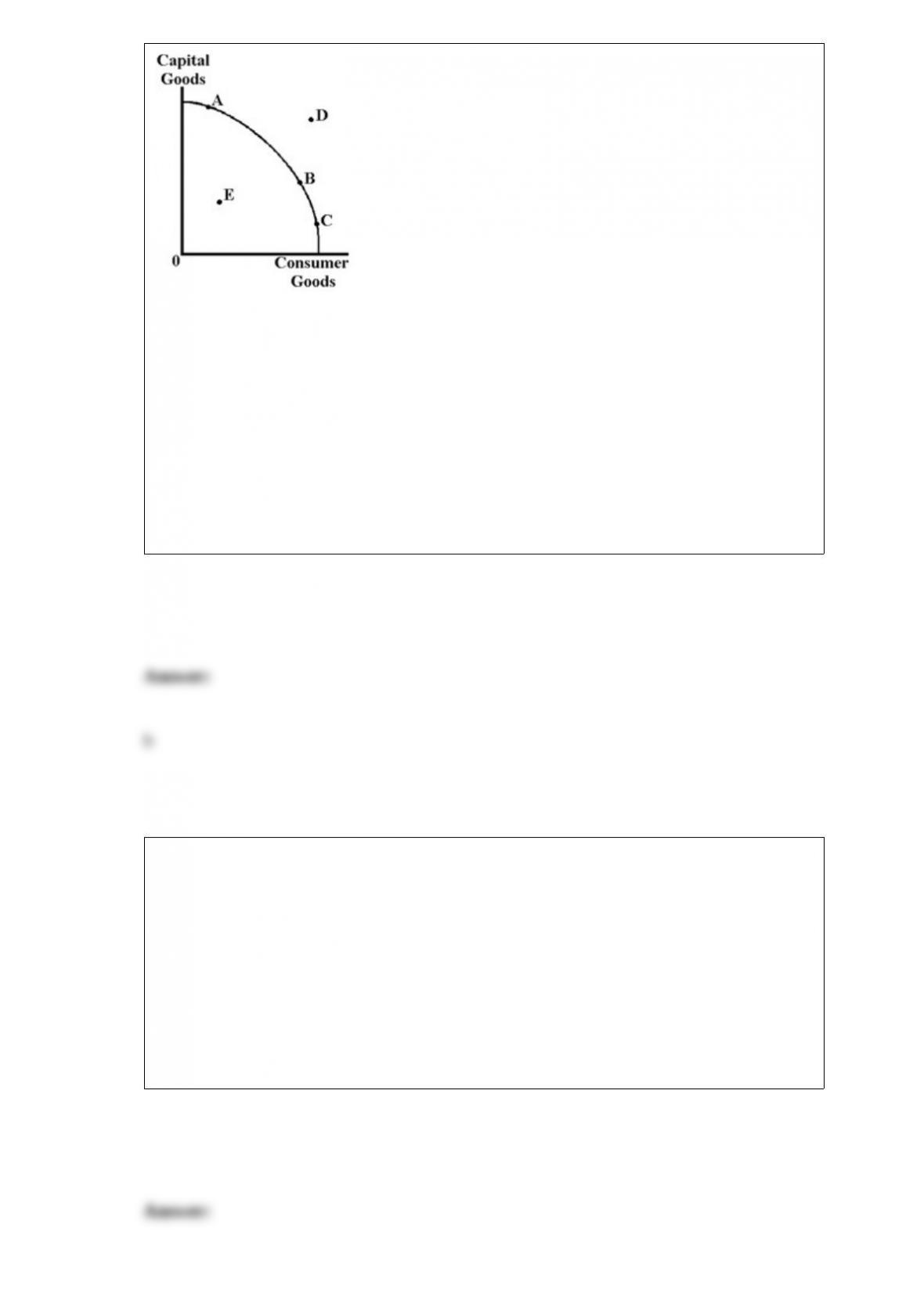
In Figure 3-2, the production possibilities frontier has a bowed-out shape because of the
law of
a. decreasing costs.
b. increasing costs.
c. demand.
d. comparative advantage.
The law of diminishing marginal utility explains why
a. most individual demand curves are straight lines.
b. the consumer’s optimal purchase is at the tangency of an indifference curve and the
budget line.
c. most individual demand curves slope downward.
d. marginal utility falls when total utility falls.

An example of a beneficial externality is
a. airport noise.
b. a blooming curbside bed of violets.
c. pollution of a fishing lake.
d. freeway congestion.
During the financial crisis of 2007-2009 the interest rate on mortgage-backed securities
had
a. increased and the Treasury interest rate had risen.
b. increased and the Treasury interest rate had fallen.
c. decreased and the Treasury interest rate had risen.
d. decreased and the Treasury interest rate had fallen.
Which of the following characteristics of perfect competition does not apply in

monopolistic competition?
a. free entry and exit
b. homogeneous products
c. numerous participants
d. perfect information
Economists assume that business firms attempt to maximize their profits.
a. True
b. False
Prohibiting price increases in situations of true scarcity
a. prevents the market mechanism from reallocating resources more efficiently.
b. discourages production.
c. may lead to extreme shortages of vitally needed products.
d. All of the above are correct.

Two goods are substitutes if a decrease in the price of one raises the quantity demanded
of the other.
a. True
b. False
The poorest countries in Africa have some of the highest growth rates, thus proving the
convergence hypothesis.
a. True
b. False
If the Fed reduces the required reserve ratio,
a. excess reserves will increase.

b. excess reserves will decrease.
c. total reserves will increase.
d. total reserves will decrease.
Nonconsumption spending accounts for roughly what percent of total output of goods
and services?
a. 20%
b. 30%
c. 40%
d. 60%
If a monopoly firm reduced the price of its product, which of following must have been
true?
a. MR > MC
b. MR < MC
c. MR > AR
d. MC > AR

A cartel is
a. a group of firms promoting competition.
b. most common in monopolistic competition.
c. a collusive group of firms.
d. no longer possible in our global economy.
Monopolies are always large firms with great economies of scale.
a. True
b. False

An economic model is a realistic depiction of the operation of the economy.
a. True
b. False
The U.S. government
a. intervenes to prevent the monopolization of any market.
b. forbids the creation of legal impediments to entry into any market.
c. intervenes to prevent the monopolization of some markets and actively encourages
the monopolization of others.
d. encourages the permanent monopolization of all markets in which the monopolist has
technical superiority over potential competitors.
Many economists believe that stabilization policy should be limited in scope until
a. Keynesians and monetarists agree on policy.
b. inflation is brought under control.
c. the economy is operating near capacity.
d. forecasting becomes more reliable.

According to Baumol and Blinder, recognition of the usefulness of markets
a. labels a person as an apologist (defender) of capital.
b. extends to some socialist countries, for example, China.
c. should make totally free markets good for any society.
d. makes one a radical.
A fixed exchange rate system encourages speculators to attack weaker currencies.
a. True
b. False

A currency depreciation will put upward pressure on the price level.
a. True
b. False
Expansionary fiscal and monetary policy from 2008 to 2010, took the risk of being
inflationary for the sake of avoiding additional unemployment.
a. True
b. False
In the long run, a perfectly competitive firm earns no accounting profits.
a. True
b. False

A large government faces a production possibilities frontier much like a business firm
does.
a. True
b. False
The estimate of potential GDP would decrease if
a. the rate of capital depreciation increased.
b. the labor force decreased.
c. the price level grew.
d. All of the above would increase potential GDP.
The wages of professional athletes
a. are related to demand for their services.
b. include substantial economic rents.
c. are high because of scarcity.

d. All of the above are true.
Comparing international trade with trade among the different states of the United States
shows that
a. the logic of international trade is quite different from that of intranational trade.
b. the basic reasons for trade are equally applicable within a country or among
countries.
c. there is no need to study international trade as a special subject.
d. All of the above are correct.
If employees and employers always accurately predict inflation, what is the shape of the
Phillips curve?
a. It is horizontal in the short and long run.
b. It is vertical in the short and long run.
c. It is vertical in the short run and upward sloping in the long run.
d. It is downward sloping in the short run and vertical in the long run.
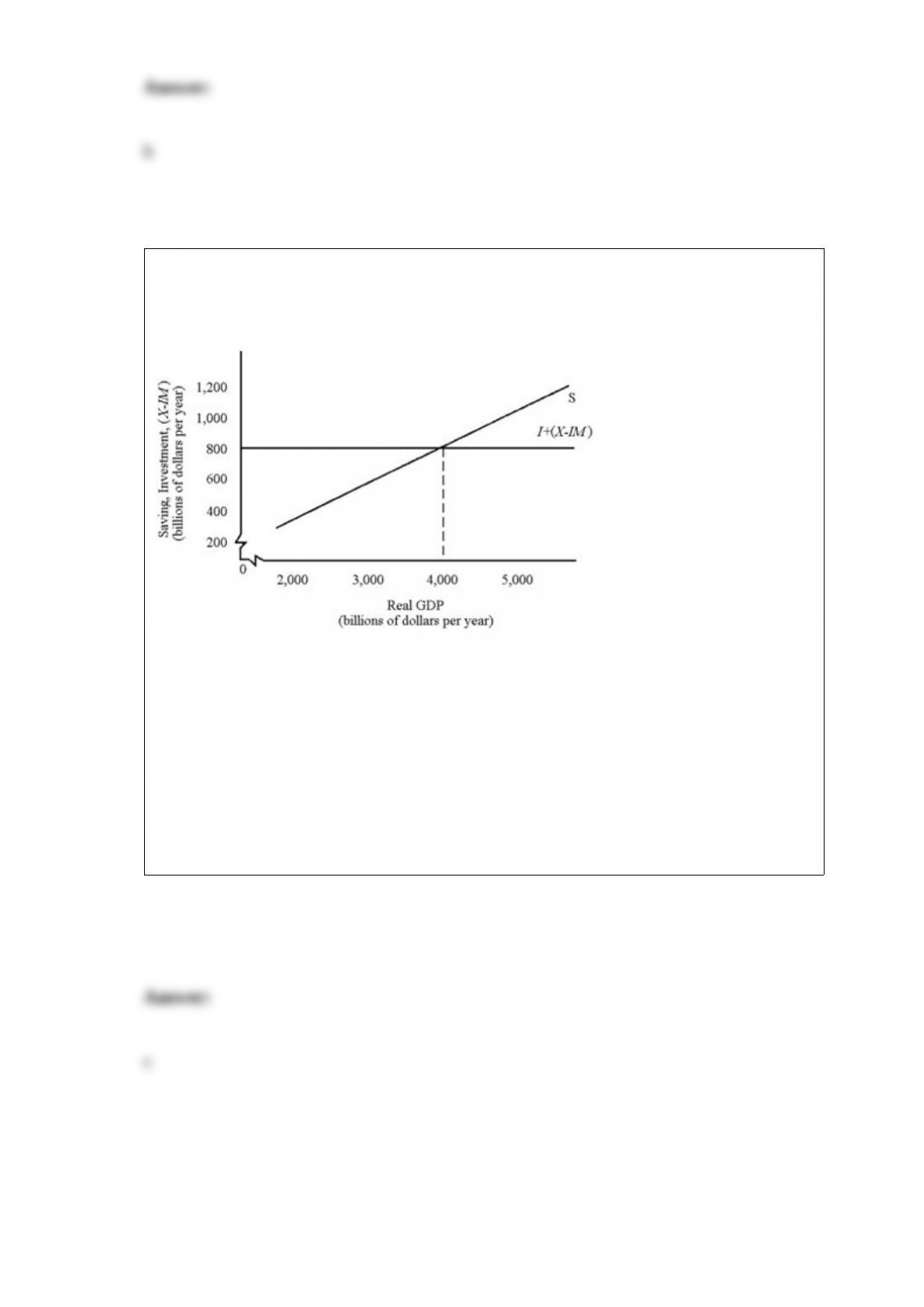
Figure 9-3
In Figure 9-3, at $5,000 billion GDP, inventories will be
a. falling, signaling businesses to increase production.
b. accumulating, signaling businesses to increase production.
c. accumulating, signaling businesses to cut production.
d. falling, signaling businesses to cut production.