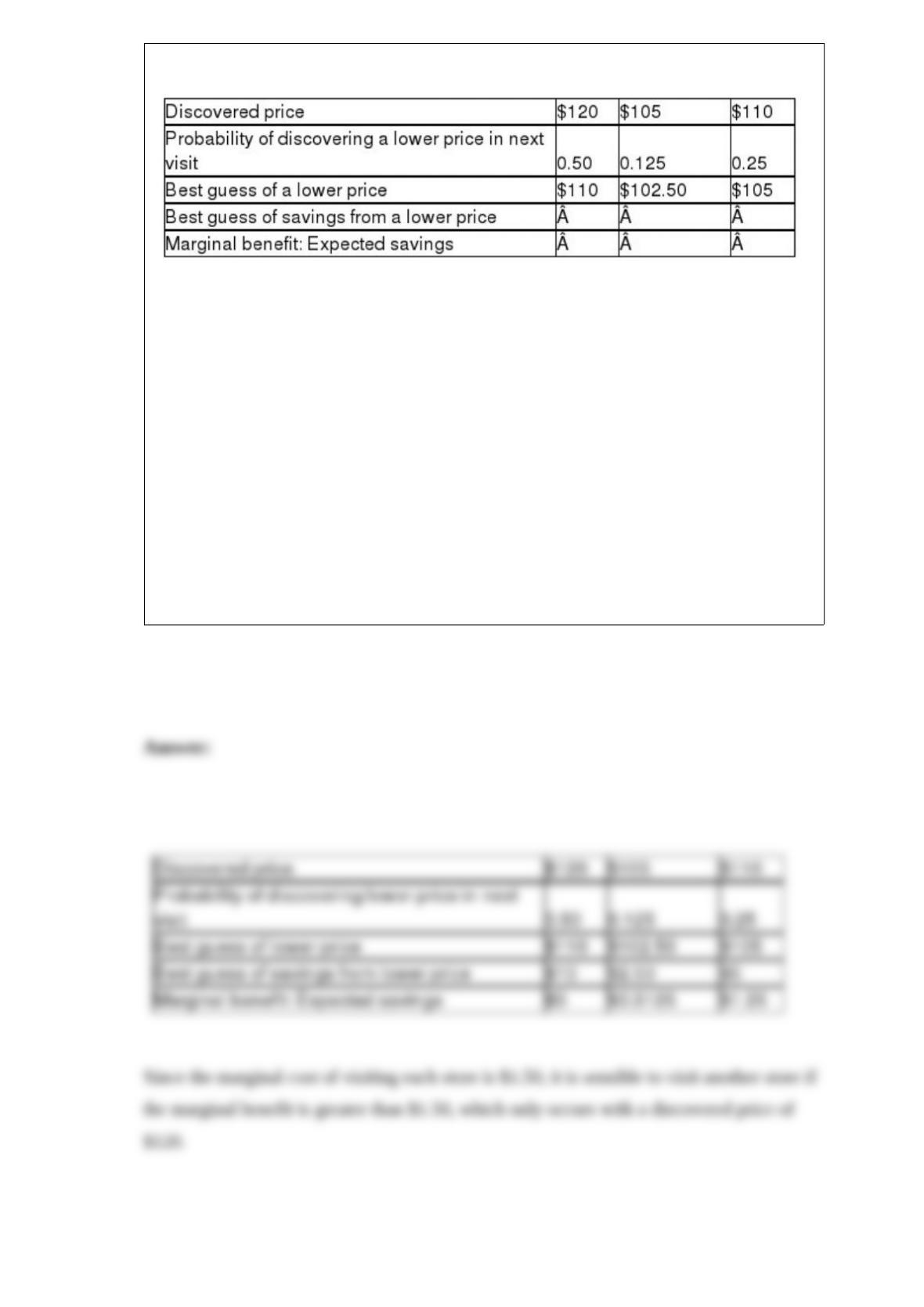
Table 14.5
Table 14.5 contains data on the marginal benefit of searching for a lower price for a
digital camera.
The price of the camera ranges from $100 at the lowest price store to $140 at the
highest price store.
For any randomly selected store, any price from the low price to the high price is
equally likely.
The marginal cost of visiting each store is constant at $1.50 per visit.
Refer to Table 14.5 and fill in the missing values. At which discovered price or prices
would the consumer find it sensible to visit another store in an effort to find a lower
price?
Which of the following is a long-run adjustment?
A) A firm lays off two workers.
B) Two firms exit the asbestos removal industry.
C) A manufacturer increases its purchase of raw materials.
D) A farmer buys twice her usual amount of herbicide.
If the price elasticity of supply is equal to zero and the price were to rise, the quantity
supplied would:
A) decrease slightly.
B) fall to zero.
C) not change.
D) increase.
Imagine two countries, Zorba and Anduluvia. Zorba is producing everything at a lower
resource cost than Anduluvia. If the two countries trade what is the reason?
Consumers do not have a strong preference for the output of one seller over that of
another in a perfectly competitive market because:
A) there a large number of firms in the market.
B) the firms sell a standardized product.
C) there are no barriers to entry.
D) an individual firm has control over price.
Using supply and demand analysis, the increase in the price of ice cream can be
illustrated as:
A) a leftward shift in the supply curve for ice cream caused by more expensive
ingredients.
B) a rightward shift in the supply curve for ice cream caused by more expensive
ingredients.
C) a leftward shift in the demand curve for ice cream caused by more expensive
ingredients.
D) a rightward shift in the demand curve for ice cream caused by more expensive
ingredients.

If a regulatory agency mandates that a natural monopoly charge a price equal to its
average cost:
A) the firm will eventually exit the industry.
B) the firm will earn economic profits greater than zero.
C) other firms will find it profitable to enter this industry.
D) the firm will earn economic profits equal to zero.
Which of the following is an external cost generated by the use of automobiles?
A) Congested highways impose a time cost on travelers.
B) motor-vehicle accidents
C) air pollutants
D) all of the above
When deciding whether to engage in an activity or how much to do, people should
follow:
A) the principle of microeconomics.
B) the principle of macroeconomics.
C) the marginal principle.
D) the law of supply and demand.
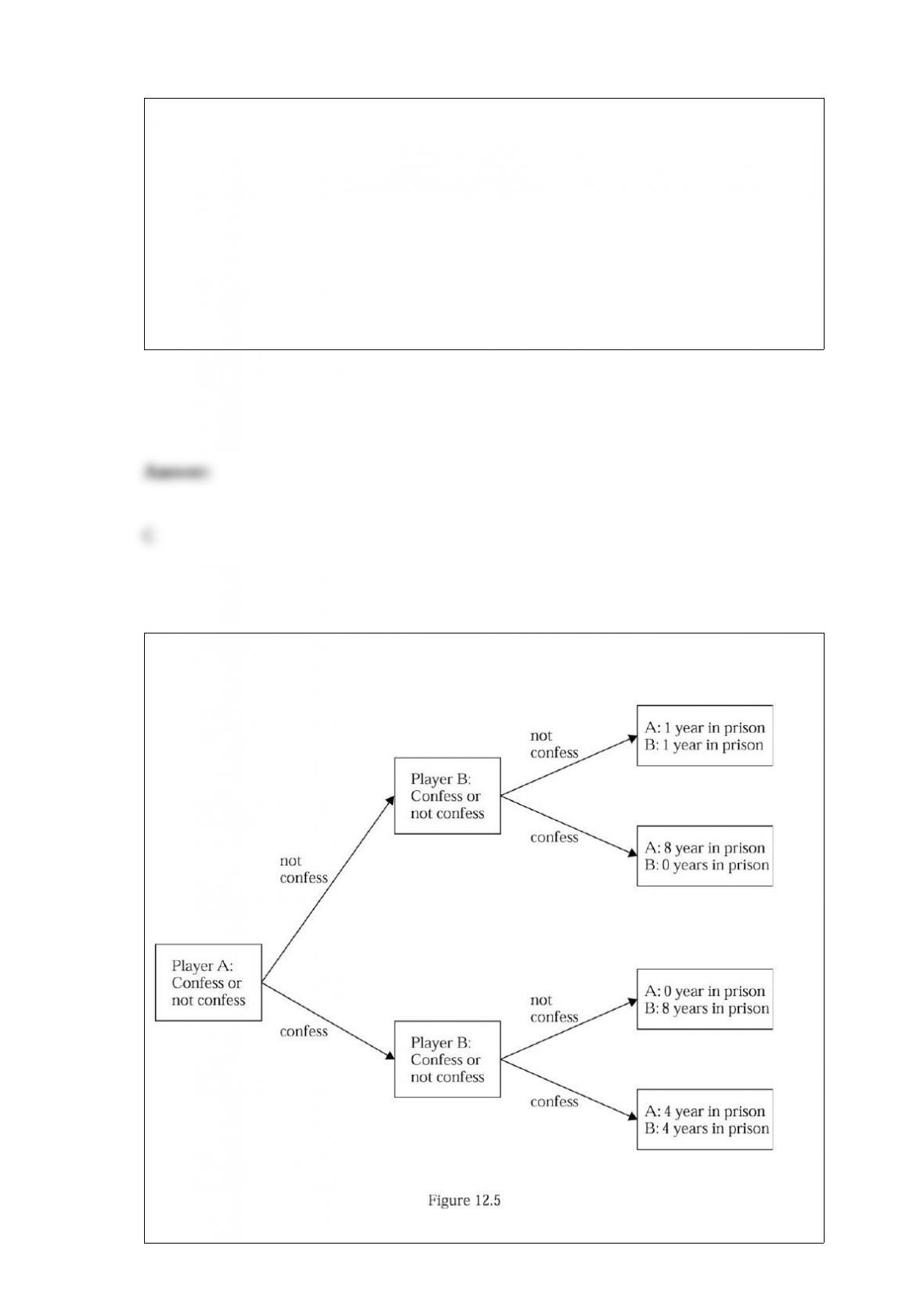
Consider Figure 12.5. If player B confesses and player A does not, then:

A) both players spend 4 years in jail.
B) both players spend 1 year in jail.
C) player A spends 0 years in jail, and player B spends 8 years in jail.
D) player A spends 8 years in jail, and player B spends 0 years in jail.
Import bans, import quotas, voluntary export restraints, and tariffs on goods all:
A) increase equilibrium quantity and prices.
B) decrease equilibrium quantity and prices.
C) increase equilibrium quantities, but decrease prices.
D) decrease equilibrium quantities, but increase prices.
Figure 14.2 represents the market for used cameras. Suppose buyers are willing to pay
$125 for a plum (high-quality) used camera and $25 for a lemon (low-quality) used
camera. If buyers believe that 50% of used cameras in the market are lemons (low
quality), what fraction of used cameras sold will actually be lemons (low quality)?
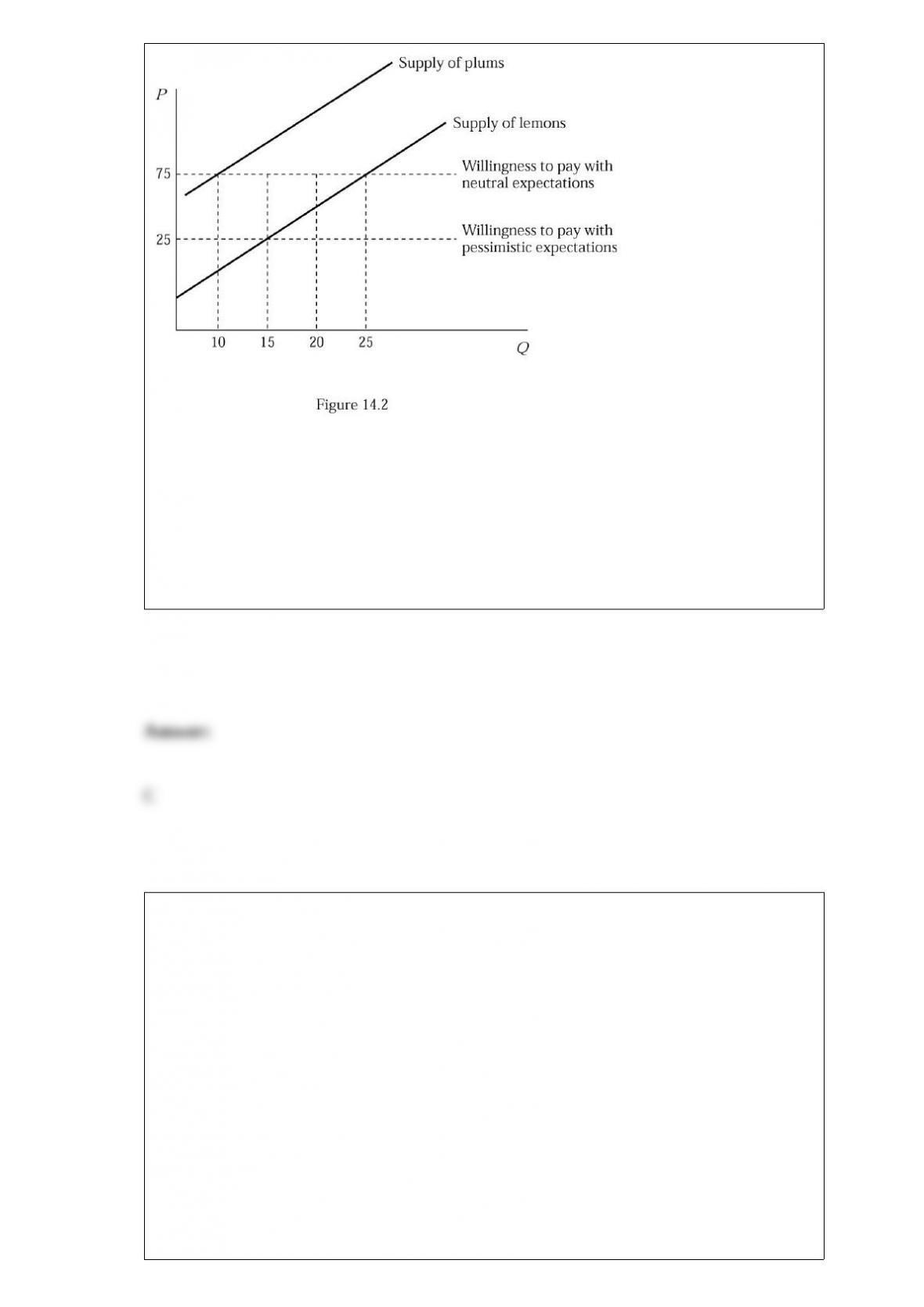
A) 10/25
B) 10/35
C) 25/35
D) All of the cameras sold will be lemons.
Additional Application
From 1992 to 2003 the number of milk producers in Florida has fallen from 300 to 190.
In those same 10 years the number of dairy farms nationwide has decreased by more
than 44,000. Why? The market price in a perfectly competitive industry is not
determined by the individual sellers, but rather the market supply and demand. While
the Florida dairy industry might not be “perfectly” competitive due to the certain USDA
policies, its behavior does approximate one. If prices are not high enough to maintain
some level of normal profit, firms will leave the industry. And this is what has been
happening in the dairy industry. In the months after September 11, 2001 the demand for
milk fell, causing the price of 100 pounds of milk to decrease from about $19 to about
$14, a 25-year low. In addition to falling prices, the costs of operating dairy farms have
risen. Increased property taxes and environmental compliance permits have made dairy
farming less viable. The average dairy farm in Florida is small with only about 700

cows. This further prevents a single supplier from being able to influence the market
price. Many farmers view this business as a family operation and one they would like to
pass on to their children. But continued low milk prices and profits make the likelihood
of such an inheritance unlikely.
Greg C. Bruno. “Milk Industry Turns Sour,” The Gainesville Sun, January 22, 2004, pp.
1, 4.
In the long run, what will occur in a perfectly competitive industry that is incurring
losses?
A) The government will subsidize the industry so that this never occurs.
B) Some firms will leave the industry, supply will decrease, and losses will disappear.
C) Some buyers will leave the market, demand will decrease, and price will rise.
D) Some firms will enter the industry, supply will increase, and losses will disappear.
Which of the following situations will arise in the domestic market following the
imposition of a tariff?
A) imports decrease, domestic production increases, prices increase
B) imports increase, domestic production increases, prices increase
C) imports increase, domestic production decreases, prices decrease
D) imports decrease, domestic production increases, prices decrease

As punishment to Europe for refusing to remove their ban on U.S. and Canadian
hormone-treated beef, the WTO allowed the U.S. and Canada:
A) to ban only European beef from entering their countries.
B) to ban all goods and services imported from Europe.
C) impose retaliatory tariffs on a wide range of European products.
D) impose retaliatory quotas on a wide range of European products.
A simple rule for dealing with a complex situation which provides a “fast and frugal”
decision is a:
A) present bias.
B) dopamine reaction.
C) heuristic.
D) cognitive response.
The real-nominal principle states that:
A) people respond more to explicit, or real, costs than to implicit costs.

B) people respond more to implicit costs than to explicit costs.
C) what matters to people is the face value of money or income.
D) what matters to people is the purchasing power of money or income.
Suppose that a coffee shop faces a demand curve that is liner and that the current price
for its cup of coffee is set at a point where the price elasticity is 1.2. If the local dry
cleaner shop increases the price per garment:
A) the demand becomes more elastic and the total revenue decreases.
B) the demand becomes less elastic and the total revenue decreases.
C) the demand becomes less elastic and the total revenue increases.
D) the demand becomes more elastic and the total revenue increases.
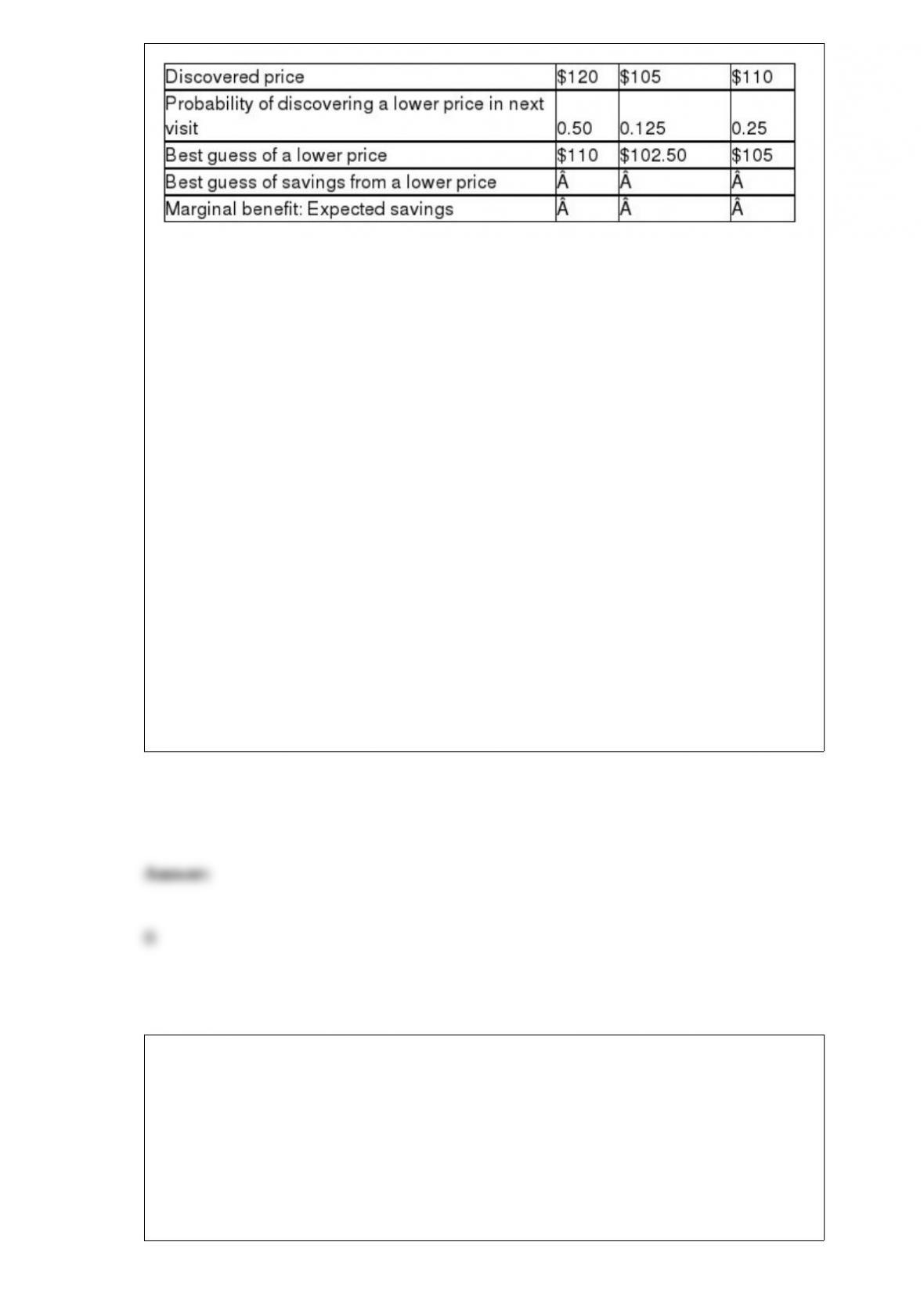
Table 14.5
Table 14.5 contains data on the marginal benefit of searching for a lower price for a
digital camera.
The price of the camera ranges from $100 at the lowest price store to $140 at the
highest price store.
For any randomly selected store, any price from the low price to the high price is
equally likely.
The marginal cost of visiting each store is constant at $1.50 per visit.
Refer to Table 14.5. At the discovered price of $105, the best guess of savings from a
lower price is:
A) $1.25.
B) $2.50.
C) $3.75.
D) $5.
Why does the government’s role of enforcing contracts facilitate exchange?
A) Enforcing contracts allows people to trade with confidence that the contracts they
enter will be met.
B) Enforcing contracts guarantees consumers that the government will bail them out in
case the seller does not fulfill his end of the contract.
C) Enforcing contracts guarantees sellers that the government will bail them out in case
the buyer does not fulfill his end of the contract.
D) Enforcing the contract effectively makes the government the seller’s partner in the
business.
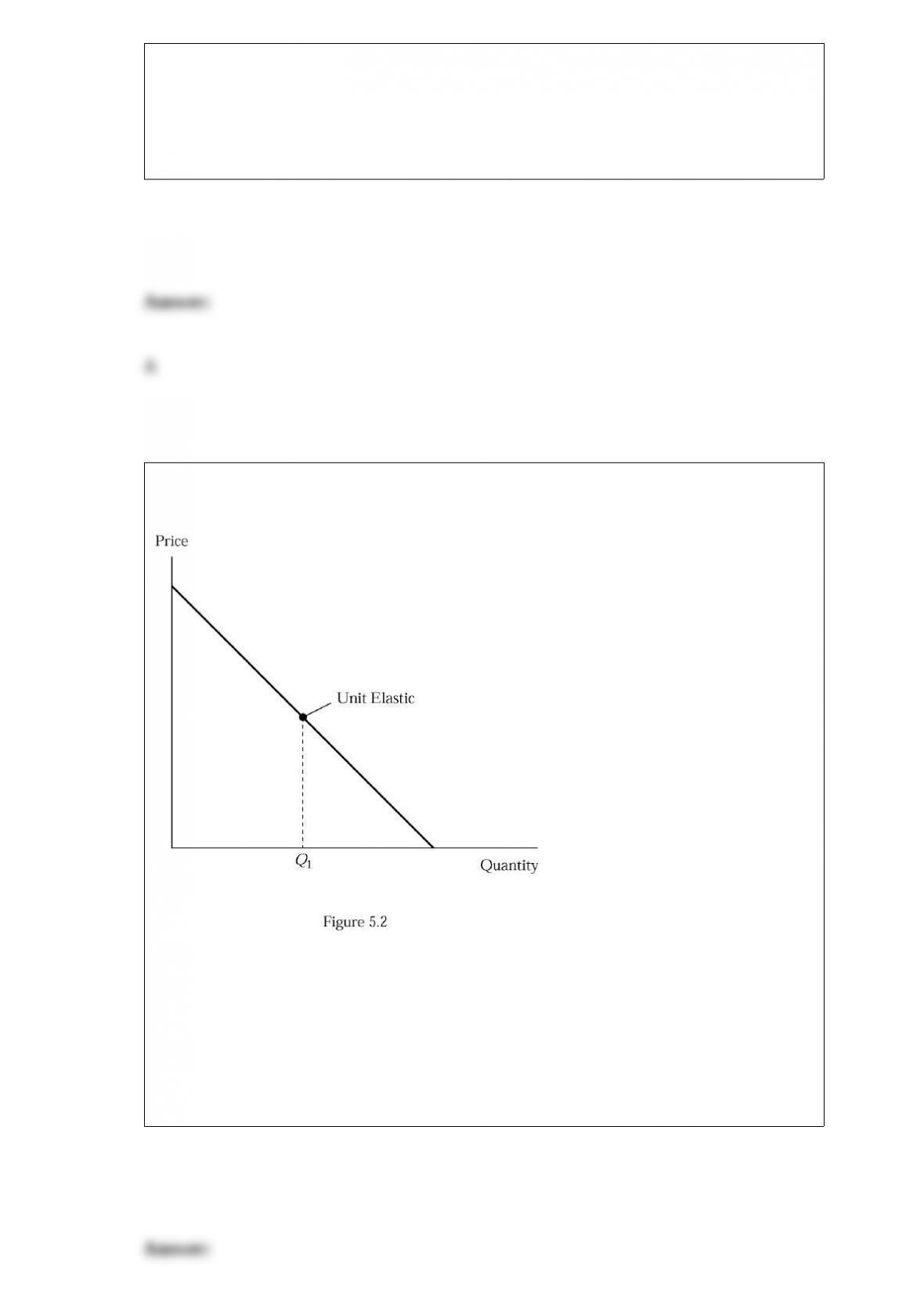
In Figure 5.2 at quantities smaller than Q1:
A) total revenue is falling.
B) price elasticity is greater than 1.
C) price and total revenue are directly related.
D) all of the above

If Italy can produce grapes at a lower opportunity cost than any other nation, Italy is
said to have a(n) ________ in the production of grapes.
A) autarky
B) absolute advantage
C) comparative disadvantage
D) comparative advantage
Suppose that David buys the same number of energy drinks every weekend no matter
what happens to the price of the energy drinks. What does this suggest about David’s
demand for energy drinks?
A) It is elastic.
B) It is perfectly inelastic.
C) It is unitary elastic.
D) It is not something that can be characterized without knowing the prices of the
energy drinks.
The phenomenon which occurs when markets do not produce the most efficient
outcome on their own is known as:
A) public goods.
B) imperfect information.
C) market failure.
D) economic certainty.
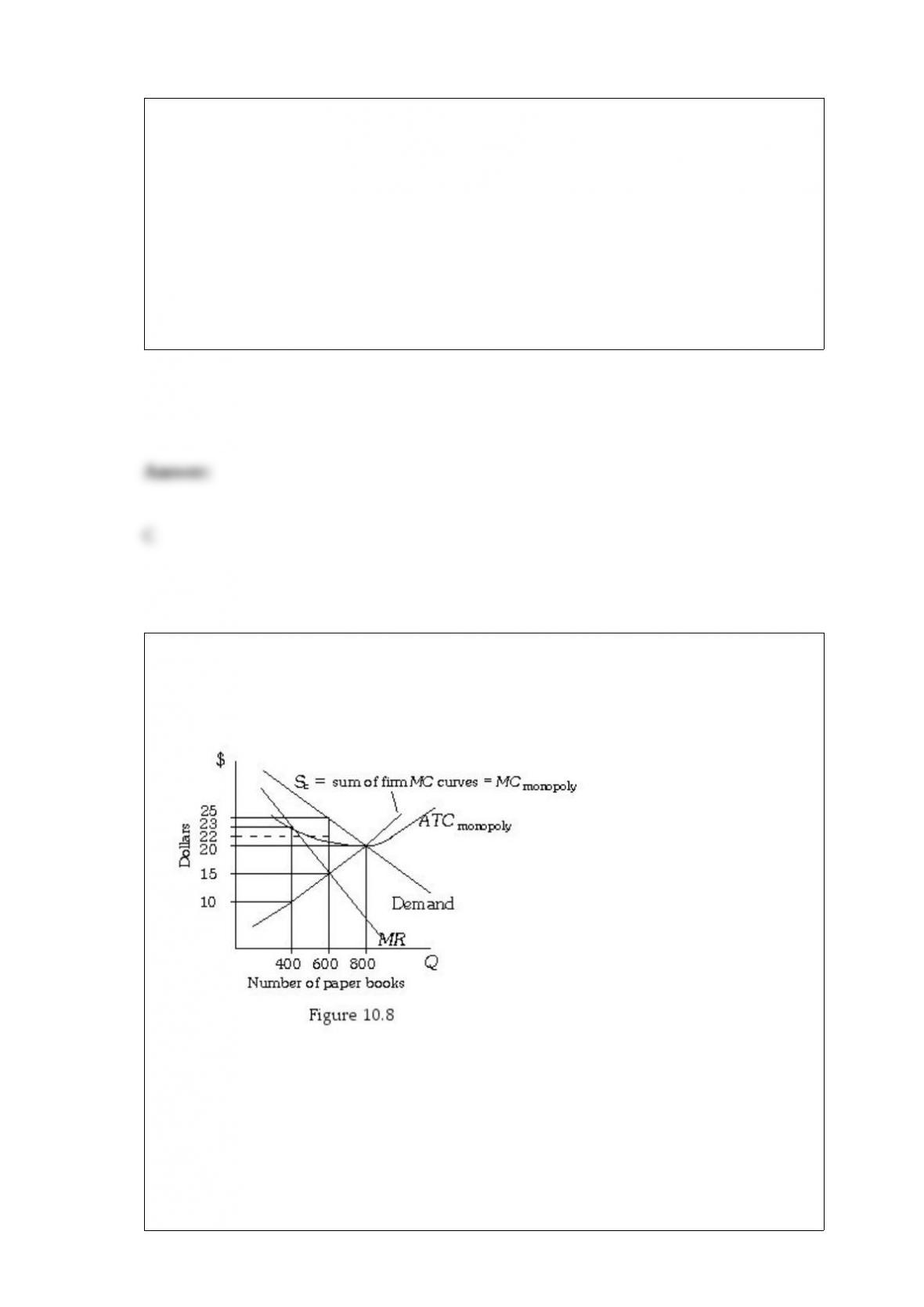
Refer to Figure 10.8. If the paper books industry becomes monopolized, the
profit-maximizing price will be ________ and the profit-maximizing quantity will be
________ units.
A) $25; 600
B) $23; 400
C) $20; 800
D) $10; 400
If Sara receives a pay increase from $15 to $16 an hour and she chooses to:
A) work more, then the income effect is equal to the substitution effect.
B) take more vacation, then the income effect is weaker than the substitution effect.
C) take more vacation, then the income and substitution effects are working in the same
direction with regard to leisure because it is a normal good.
D) work more, then the substitution effect for leisure demand is stronger than the
income effect.
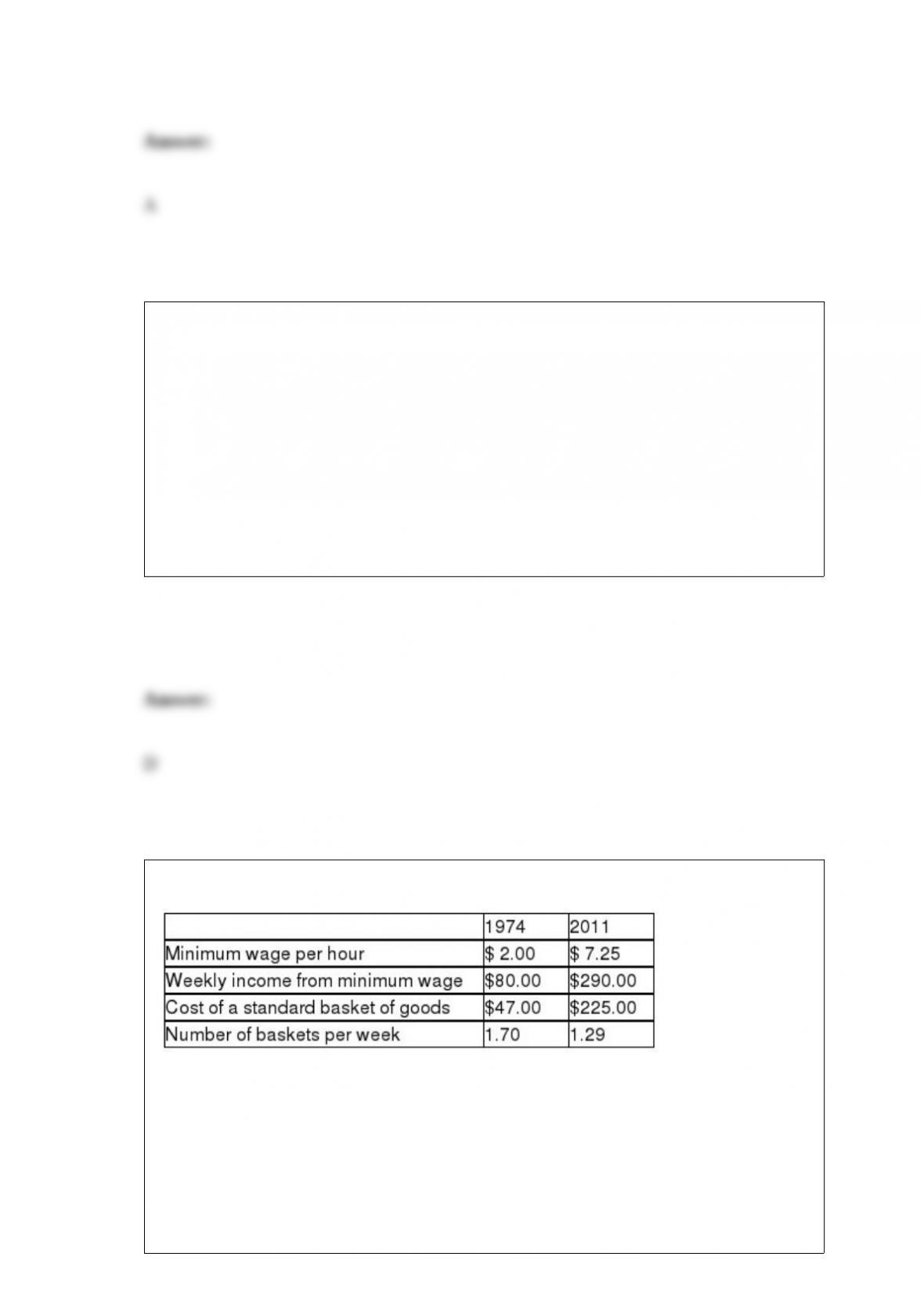
Table 2.5
By what percentage did the federal minimum wage increase from 1974 to 2011?
A) 72.41 percent
B) 262.5 percent

C) 362.5 percent
D) 525.0 percent
In a two-person, repeated game, a tit-for-tat strategy starts with:
A) non-cooperation and then each player follows his or her own self-interest.
B) non-cooperation and then each player cooperates only if the other player cooperates.
C) cooperation and then each player follows his or her own self-interest.
D) cooperation and then each player repeats the other player’s previous move.
Lettuce and spinach are substitute goods. All else equal, if a spinach beetle destroys half
of the nation’s spinach crop, we predict that the equilibrium price of lettuce will
________ and the equilibrium quantity of spinach will ________.
A) rise; rise
B) rise; fall
C) fall; rise
D) fall; fall

In the absence of government involvement, the problem that public goods impose on a
market system is that:
A) too little of the good is produced.
B) too much of the good is produced.
C) resources are wasted in the production of public goods.
D) firms will earn large profits when producing these goods.
According to the Application, what determines the price of a meteorite?
A) age
B) rarity
C) color
D) similarity to earth rocks

When a person’s expressed valuation of a product is affected by the numbers in her
head, this is an important implication of:
A) mental accounting.
B) the decoy effect.
C) bundling.
D) the anchoring effect.
A distinguishing feature of a public good is that it:
A) is not possible to exclude people who don’t pay for the public good.
B) is possible to exclude people who pay for the public good.
C) may have external costs.
D) is provided by the government.
A public good is a good that:
A) is consumed by a single person or household.
B) cannot be used by private citizens.

C) is available for everyone to consume, regardless of who pays.
D) is provided by the government.