1)
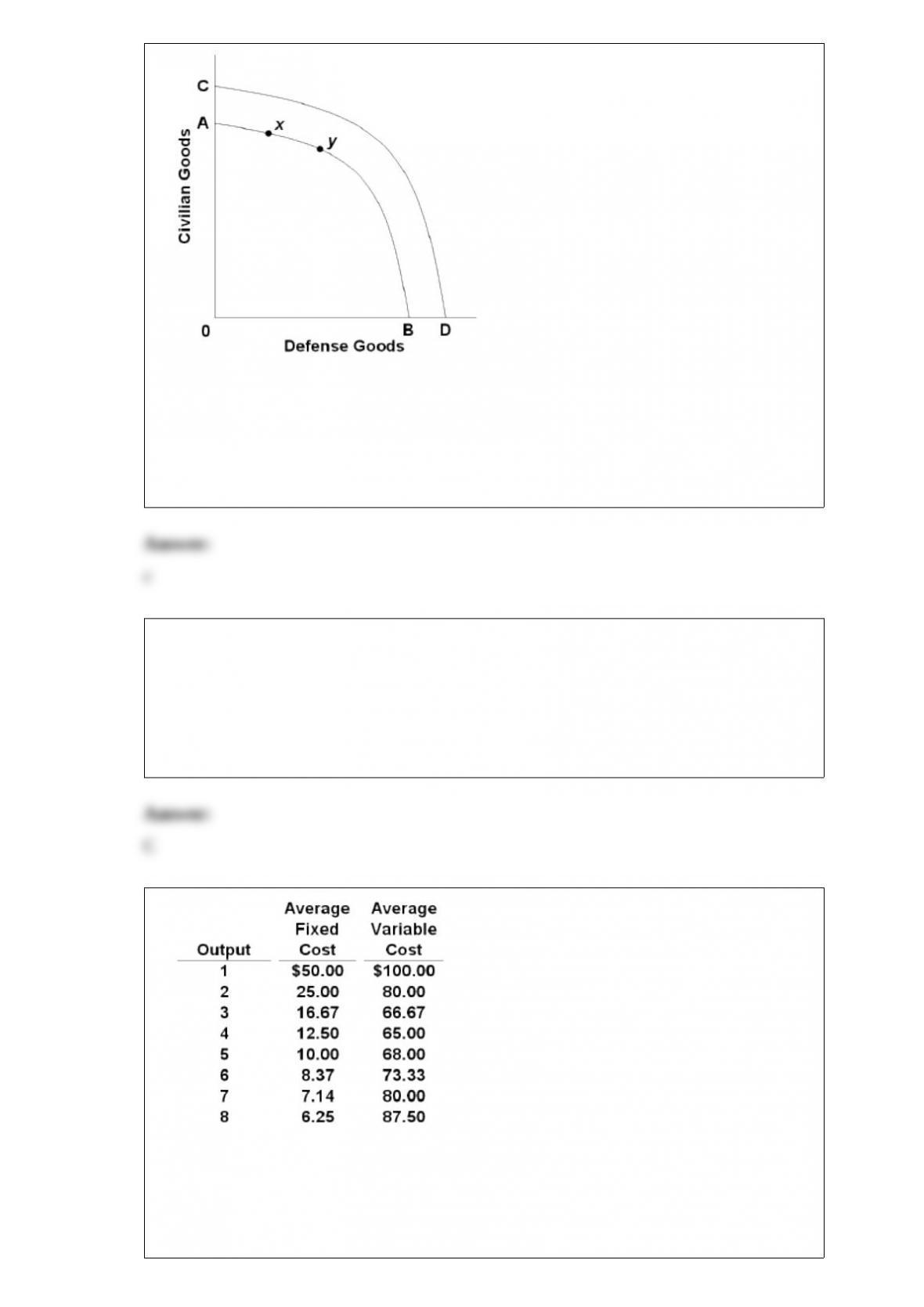
(consider this) refer to the above diagram. the u.s. response to the events of september
11, 2001, is illustrated by the:
a.shift of the production possibilities curve from cd to ab.
b.shift of the production possibilities curve from ab to cd.
c.move from x to y on production possibilities curve ab.
d.move from y to x on production possibilities curve ab.
2) At the $180 billion equilibrium level of income, saving is $38 billion in a private
closed economy. Planned investment must be:
A.$138 billion.
B.$126 billion.
C.$38 billion.
D.$180 billion.
3)
refer to the above data. if the firm decided to increase its output from 6 to 7 units, its
total costs would rise by:
a.$87.14.
b.$80.00.
c.$6.67.

d.$120.00.
4) If the supply of a product is perfectly elastic and demand is downsloping, an excise
tax of $2 per unit will increase price by:
A.more than $2.
B.less than $2.
C.$2 and increase equilibrium output.
D.$2 and reduce equilibrium output.
5) “essential” water is cheaper than “nonessential” diamonds because:
a.new industrial uses for diamonds have been discovered.
b.the supply of water is great relative to demand and the supply of diamonds is small
relative to demand.
c.although the total utility of diamonds is greater, their marginal utility is small.
d.the supply of diamonds is great relative to demand and the supply of water is small
relative to demand.
6) the north american free trade agreement (nafta):
a.resulted from gatt negotiations at the uruguay round.
b.established a free trade zone encompassing canada, mexico, and the united states.
c.is also known as the reciprocal trade act.
d.permits the former republics of the soviet union to export goods duty free to north
america.
7) Recessions have contributed to the public debt by:
A.reducing national income and therefore tax revenues.
B.increasing real interest rates.
C.increasing the international value of the dollar.
D.increasing national saving.

8) In terms of aggregate supply, a period in which nominal wages and other resource
prices are fully responsive to price-level changes is called the:
A.long run.
B.short run.
C.immediate market period.
D.very long run.
9) Monetarists and rational expectations theorists generally agree that:
A.the Federal Reserve should adhere to a monetary rule.
B.the rate of interest and the price of bonds are positively or directly related.
C.the money supply cannot be measured and therefore cannot be controlled by the
Federal Reserve.
D.prices and wages are inflexible downward.
10) The view that excessive growth of the money supply over long periods leads to
inflation:
A.is accepted by the monetarists but not by mainstream macroeconomists.
B.is the main contribution of the rational expectations theory.
C.had been absorbed into the mainstream of macroeconomics.
D.is known as the monetary rule.
11) Assuming a competitive resource market, a firm is hiring resources in the
profit-maximizing amounts when the:
A.firm’s total outlay on resources is minimized.
B.marginal revenue product of each resource is equal to its price.
C.price of each resource employed is the same.
D.marginal revenue product of the last unit of each resource hired is the same.
12) about ________ of recent annual population growth in the united states is the result
of immigration.
a.one-tenth

b.one-fifth
c.one-third
d.one-half
13) in performing its stabilization function, it may be appropriate for the nation’s central
bank (the federal reserve in the united states) to take actions to:
a.increase taxes to reduce inflation.
b.increase interest rates to reduce inflation.
c.reduce government spending to reduce inflation.
d.increase subsidies to businesses to reduce unemployment.