
If a firm in Thailand borrows dollars from a U.S. bank, its interest payments on the loan
in bahts will decrease if the baht appreciates against the dollar.
Answer:
If the demand for a product increases and the supply of the same product decreases, the
equilibrium price will increase.
Answer:
An increase in the unemployment rate may be represented as a movement from a point
on the production possibilities frontier to a Different point on the frontier.
Answer:
An appropriate fiscal policy response when aggregate demand is growing at a slower
rate than aggregate supply is to cut taxes.
Answer:

If the rate of growth in real GDP exceeds the rate of growth in the money supply, the
quantity theory of money predicts a price deflation.
Answer:
Contractionary monetary policy should increase foreign financial investment in the
United States.
Answer:
When there are few substitutes available for a good, demand tends to be relatively
inelastic.
Answer:
A depreciation of a country’s currency always lowers the domestic firm’s profits.
Answer:

Most pharmaceutical firms selling prescription drugs continue to earn economic profits
long after the patents on the prescription drugs expire because they have established a
strong foothold in the market.
Answer:
One drawback of the patent system is that firms must disclose to the public information
about the product or process.
Answer:
An example of a factor of production is
A) a bottle of wine produced by a vineyard.
B) a vintner hired by a vineyard.
C) a loan granted to a vineyard.
D) the wine exported by a vineyard.
Answer:

Firms in perfectly competitive industries are unable to control the prices of the products
they sell and earn a profit in the long run. Which of the following is one reason for this?
A) Owners of perfectly competitive firms realize that their short-run profits are
temporary. Therefore, they either sell their businesses or develop other products that
will earn short-run profits.
B) Firms in perfectly competitive industries can use advertising in the short run to
persuade consumers that their products are better than those of other firms. But
eventually consumers realize that all of the firms sell virtually identical products.
C) Firms from other countries are able to produce similar products at lower costs.
D) Firms in these industries sell identical products.
Answer:
The circular flow diagram shows that
A) the value of total income is equal to the total value of expenditures on final goods
and services.
B) firms pay households wages, and households receive transfer payments from firms.
C) households spend all their income on goods and services.
D) GDP will be less than the total value of expenditures on final goods and services in
the economy.
Answer:
The interest payment on a bond is called
A) the coupon payment.
B) principal.
C) the interest rate.
D) the face value.
Answer:
A study conducted by Alberto Alesina and Lawrence Summers concluded that countries
with ________ had lower inflation rates than countries with ________.
A) low rates of unemployment; high rates of unemployment
B) a large government debt; little to no government debt
C) no private banking system; an independent banking system
D) highly independent central banks; central banks that have little independence
Answer:
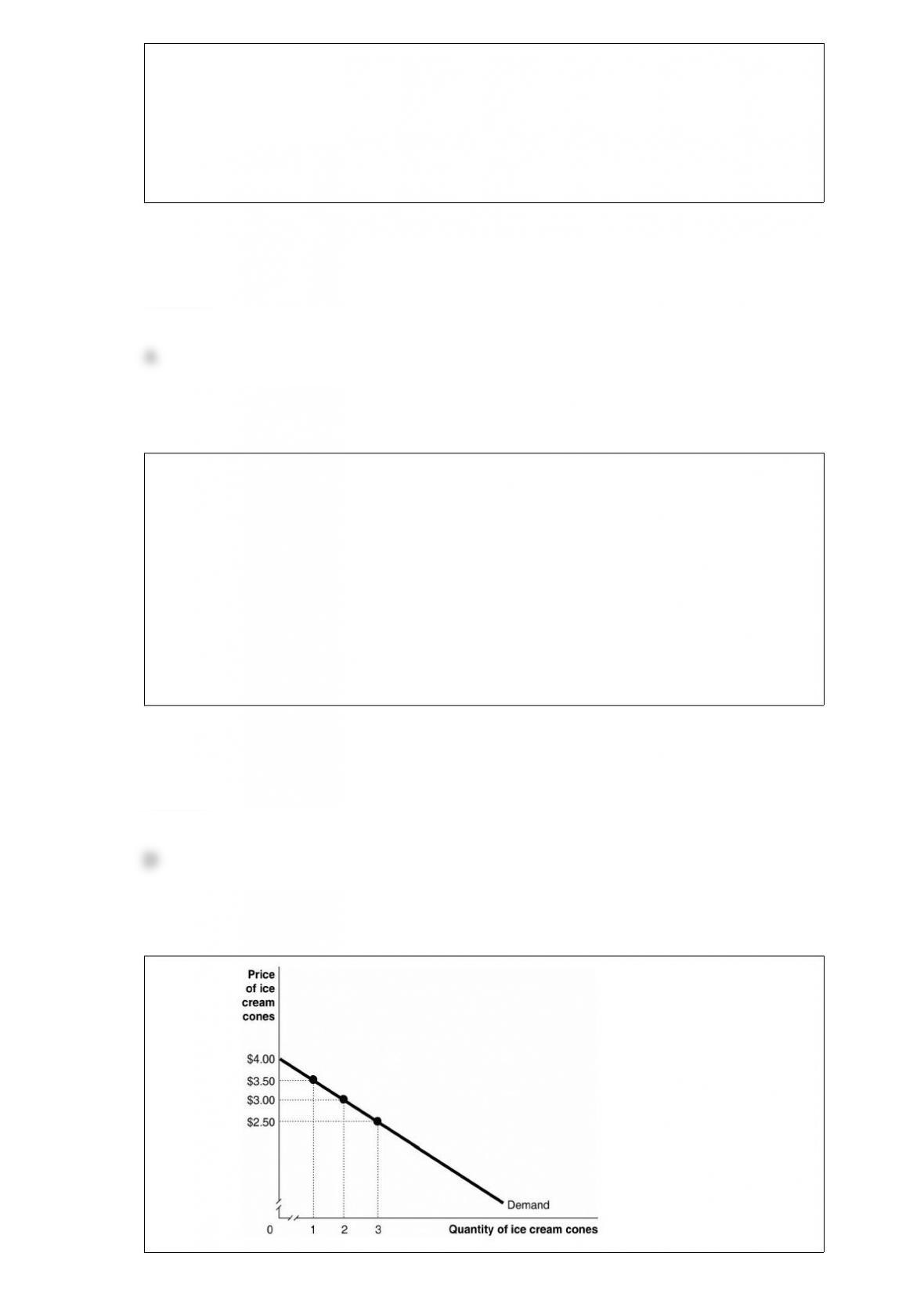
Figure 4-3 Figure 4-3 shows Kendra’s
demand curve for ice-cream cones.
What is the total amount that Kendra is willing to pay for 3 ice cream cones?
A) $2.50
B) $7.50
C) $9.00
D) $13.50
Answer:
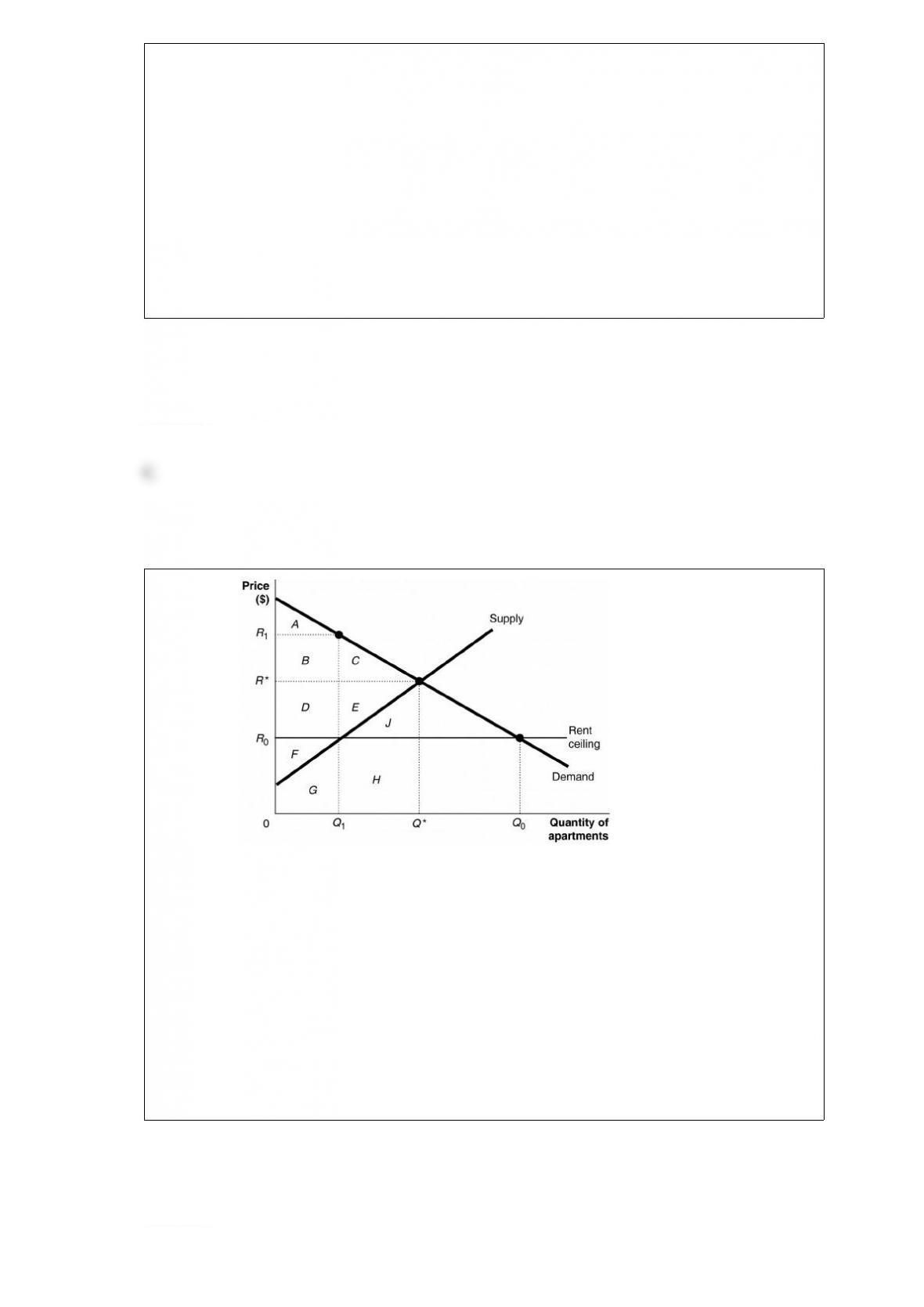
Figure 4-5 Figure 4-5 shows the
market for apartments in Bay City. Recently, the government imposed a rent ceiling at
R0. Suppose that instead of a price ceiling, the government imposed a price floor of R1.
What is the area representing consumer surplus after the imposition of the price floor?
A) A
B) A+ B + D
C) C + E
D) B + C + D + E
Answer:
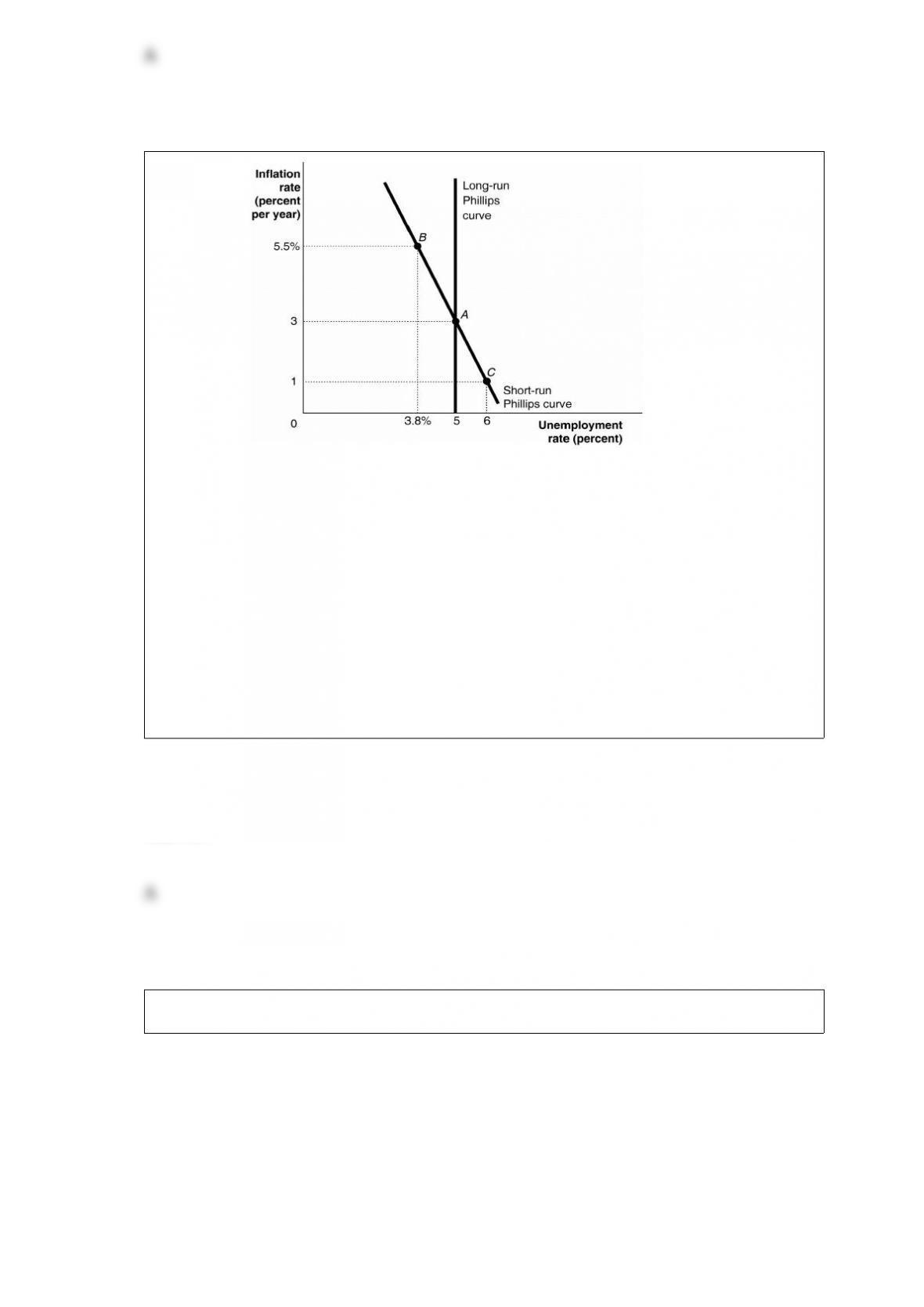
Figure 28-2
Suppose the economy is at point B in the figure above. Which of the following is true?
A) The expected rate of inflation is 3%.
B) The natural rate of unemployment is 3.8%.
C) The current unemployment rate is 5%.
D) The economy is producing at potential GDP.
E) Expected inflation and actual inflation are the same.
Answer:
Figure 2-4
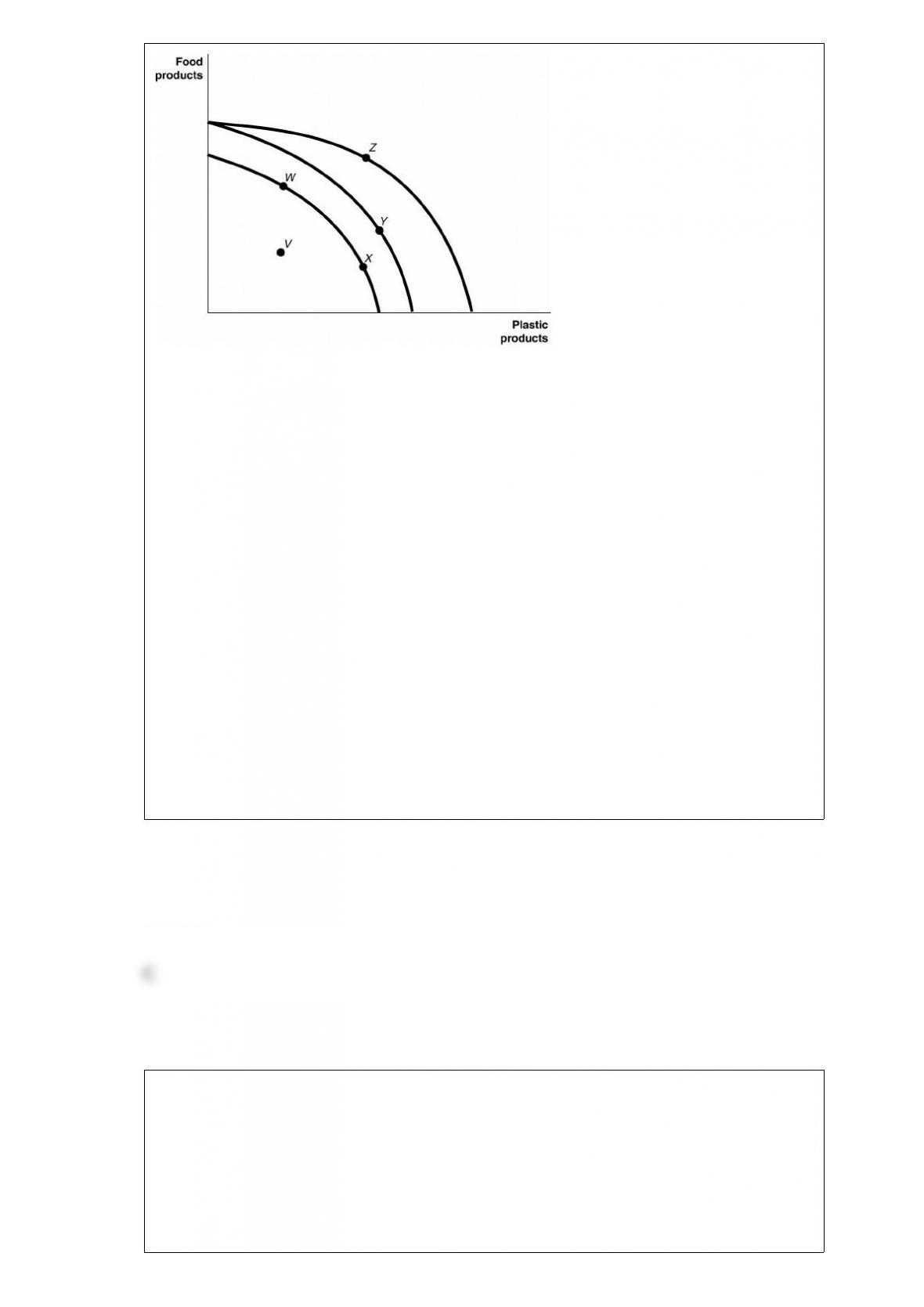
Figure 2-4 shows various points on three different production possibilities frontiers for
a nation. Consider the following events:
a. a reduction in the patent protection period to no more than 2 years
b. a war that destroys a substantial portion of a nation’s capital stock
c. the lack of secure and enforceable property rights system Which of the events listed
above could cause a movement from W to V?
A) a only
B) a and b only
C) a and c only
D) b and c only
E) a, b, and c
Answer:
An increase in the price level results in a(n) ________ in the quantity of real GDP
demanded because ________.
A) decrease; a higher price level reduces consumption, investment, and net exports.
B) increase; a higher price level reduces consumption, investment, and net exports.
C) decrease; a higher price level increases consumption, investment, and net exports.
D) increase; a higher price level increases consumption, investment, and net exports.
Answer:
Both the perfectly competitive firm and the monopolistically competitive firm produce
at the output where marginal revenue equals marginal cost (MR = MC) but only the
perfectly competitive firm achieves allocative efficiency. Explain why this is the case.
Answer:
Table 8-22
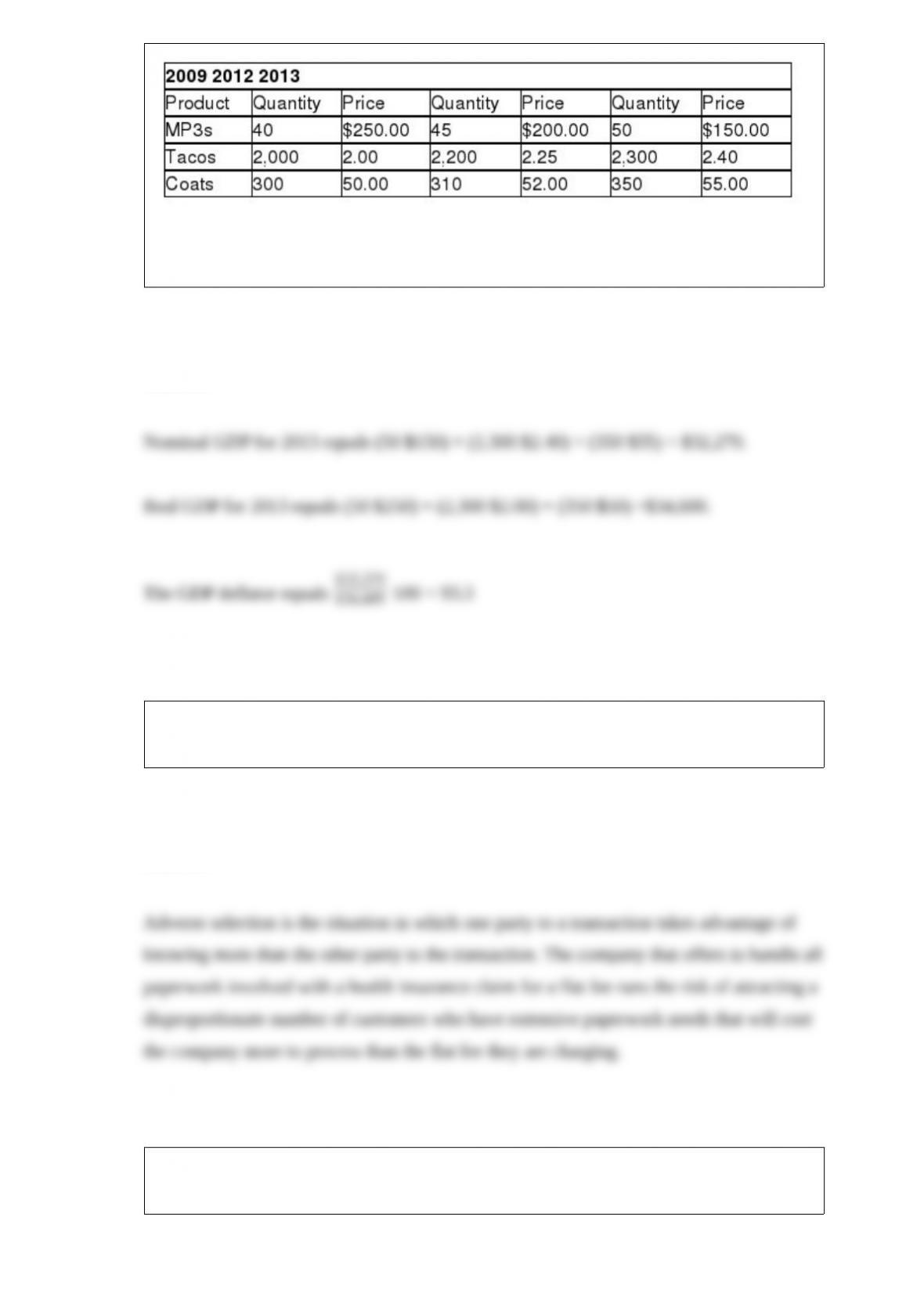
Consider the data above for a simple economy: Using 2009 as the base year, calculate
nominal GDP, real GDP, and the GDP deflator for 2013. Show your work.
Answer:
How might a company that offers to handle all paperwork involved with a health
insurance claim for a flat fee face the problem of adverse selection?
Answer:
How does government support of health and education programs foster economic
growth?
Answer:
Suppose you hit a progressive jackpot on a slot machine in a casino in Atlantic City and
are given the choice of the following prizes: Prize 1: $150,000 to be received right
away, with three additional payments of $150,000 to be received each year for the next
three years. Prize 2: $500,000 to be received right away. If the interest rate is 5 percent,
what is the present value of each prize?
Answer:
People complain that inflation increases the cost of goods and services and therefore
reduces their purchasing power. If inflation and income grow at the same rate, is this
complaint valid? Explain carefully.
Answer: