1) under a system of national health insurance:
a.the federal government would provide a basic health care package to all citizens at no
direct cost.
b.health care would be financed out of tax revenues.
c.government could negotiate to reduce the fees charged by doctors and hospitals.
d.all of these might be done.
2) Proponents of inflation targeting generally think that:
A.the economy will have fewer, shorter, and less severe business cycles if the Fed holds
the rate of inflation to low, targeted levels from year to year.
B.low interest rates are inflationary and high interest rates are deflationary.
C.fiscal policy is more effective in stabilizing the economy than monetary policy.
D.the Fed should strive to achieve zero inflation.
3) on a per unit basis economic profit can be determined as the difference between:
a.marginal revenue and product price.
b.product price and average total cost.
c.marginal revenue and marginal cost.
d.average fixed cost and product price.
4)
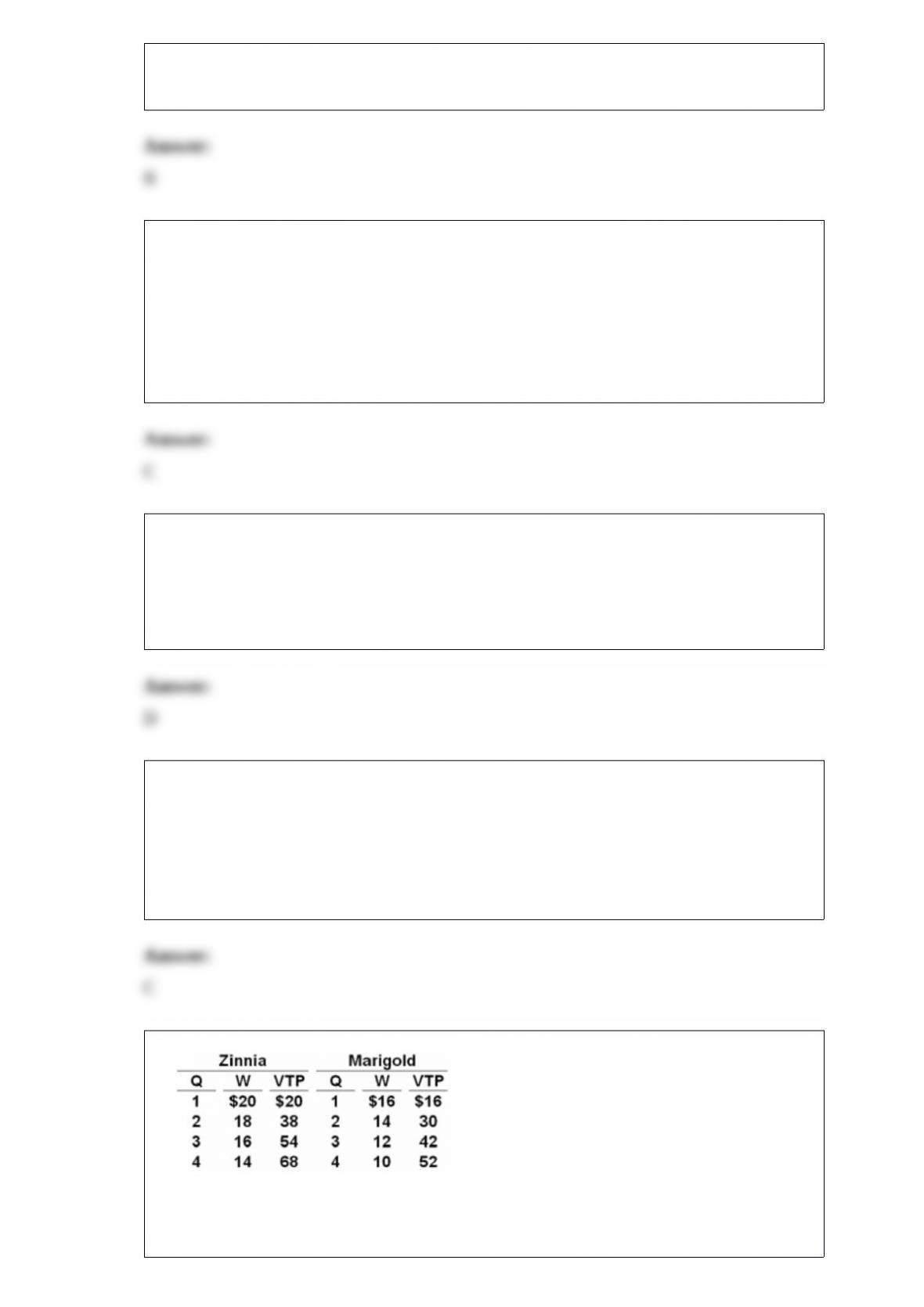
Refer to the above diagram in which S is the before-tax supply curve and St is the
supply curve after an excise tax is imposed. The total amount of the tax paid by
producers is shown by area(s):
A.A + B + F.
B.C only.
C.A + B + C.
D.E + F.
5) Marginal revenue product (MRP) of labor refers to the:
A.increase in total revenue resulting from the sale of an additional unit of output.
B.amount by which a firm’s total resource cost increases when it employs one more unit
of labor.
C.increase in total revenue resulting from the hire of one more unit of labor.
D.price at which additional units of labor can be employed in a monopsonized labor
market.
6) Economists object to exchange controls because they:
A.reduce efficiency by distorting the pattern of international trade.
B.limit consumer choice.
C.lead to the development of black markets for foreign exchange.
D.do all of these.
7) If the MPS is .25 and the economy has a recessionary expenditure gap of $5 billion,
then equilibrium GDP is:
A.$5 billion below the full-employment GDP.
B.$5 billion above the full-employment GDP.
C.$20 billion below the full-employment GDP.
D.$20 billion above the full-employment GDP.
8)
symbols: q = number of workers demanded; w = wage rate; and vtp = value of the
cumulative total product (output) of the particular number of workers.
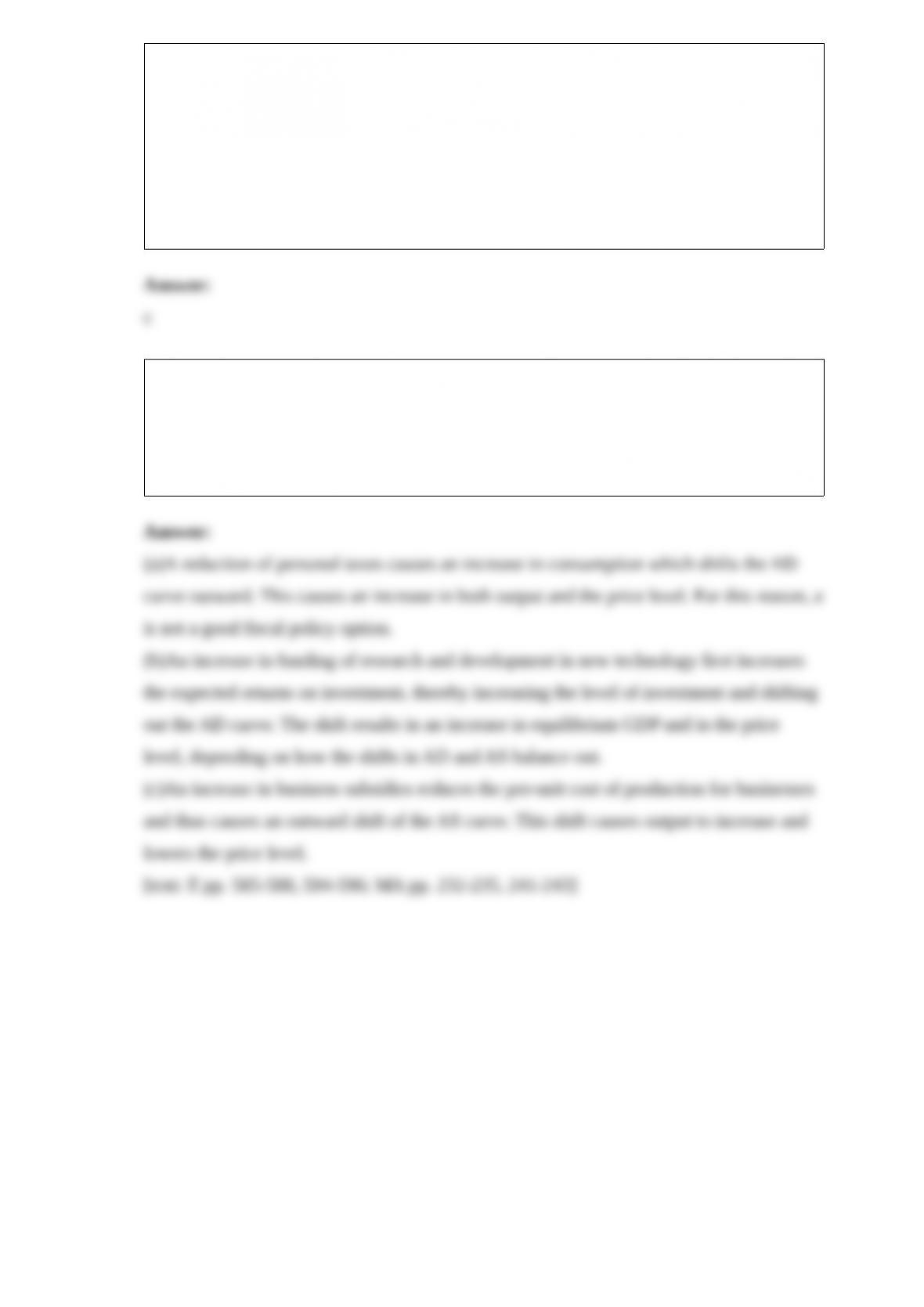
assumptions: (1) the current wage in zinnia is $20 and the current wage in marigold is
$12; (2) full employment exists in both countries.
refer to the above data, symbols, and assumptions. if migration is costless and
unimpeded:
a.no migration will occur.
b.migration will cause the wage in marigold to fall.
c.2 workers will move from marigold to zinnia.
d.4 workers will move from marigold to zinnia.
9) How would the following developments affect aggregate demand or aggregate
supply?
(a)A reduction personal income taxes.
(b)More funding for research and development in new technologies.
(c)An increase in business subsidies.
10)
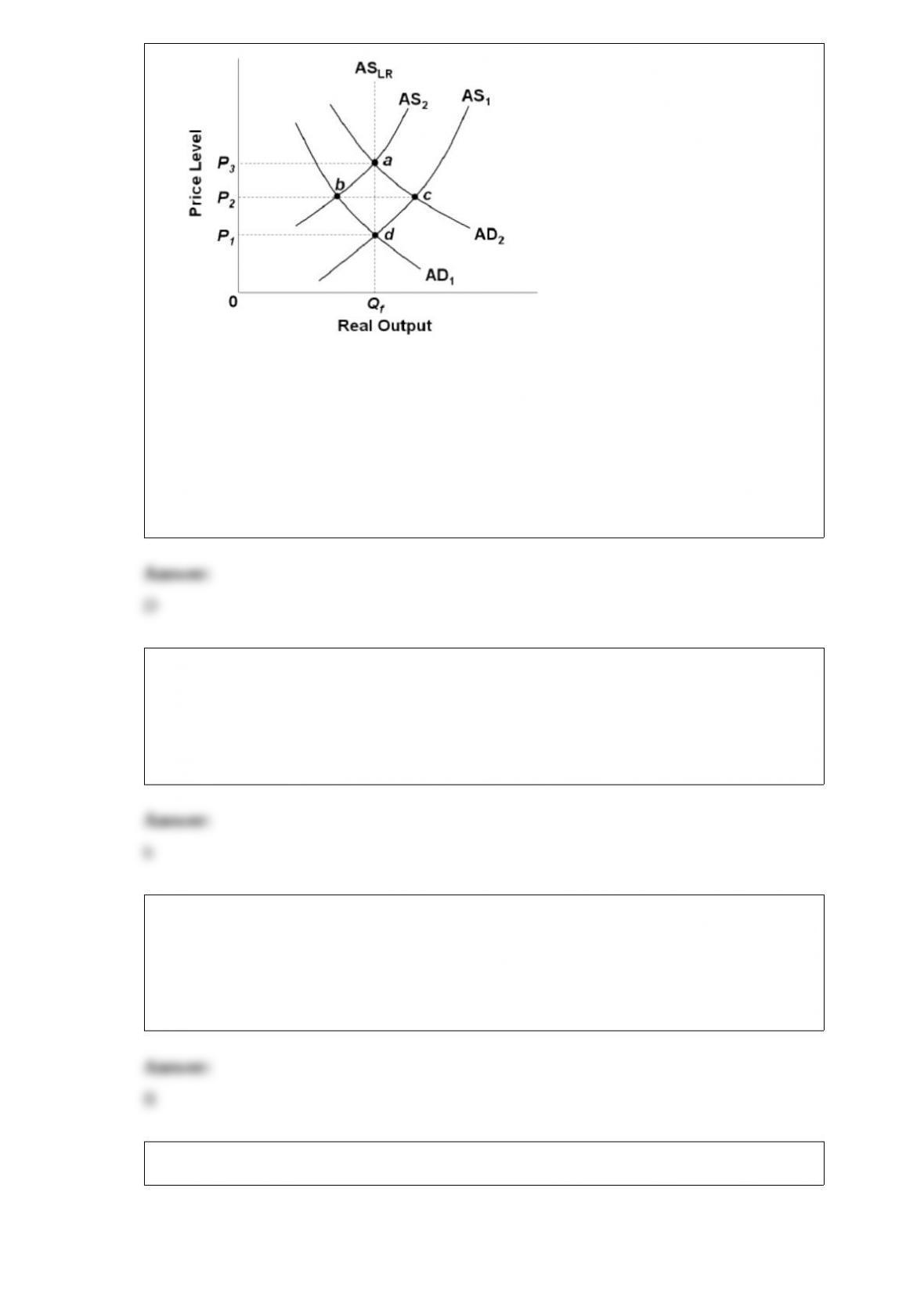
Refer to the above diagram. The initial aggregate demand curve is AD1 and the initial
aggregate supply curve is AS1. If government offsets the decline in real output resulting
from short-run cost-push inflation by increasing aggregate demand from AD1 to AD2:
A.real output will rise above Qf.
B.the price level will rise from P1 to P2.
C.it is possible that aggregate supply will shift rightward from AS2 because nominal
wage demands will rise.
D.the price level will rise from P2 to P3.
11) specialization in production is economically beneficial primarily because it:
a.allows everyone to have a job which they like.
b.permits the production of a larger output with fixed amounts of resources.
c.facilitates trade by bartering.
d.guarantees full employment.
12) The key policy target in the Taylor rule is the:
A.money supply.
B.Federal funds interest rate.
C.average tax rate.
D.full-employment budget.
13)
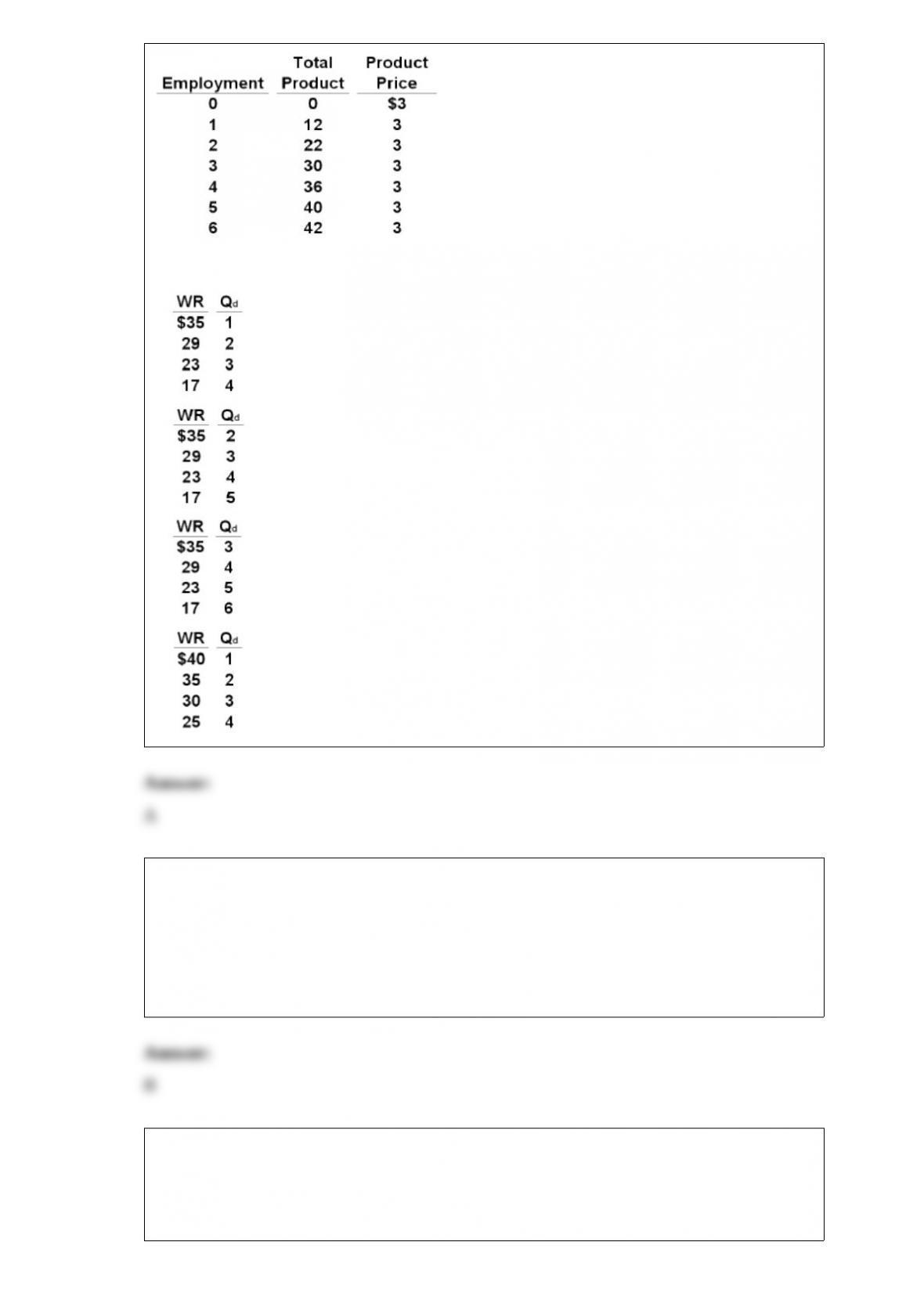
Refer to the above data. Which of the following best represents the labor demand
schedule for this firm?
A.
B.
C.
D.
14) “Farm products” are generally produced in more ___________ markets, while
“food products” tend to be sold in markets that are more ____________.
A.monopolistic; competitive
B.competitive; oligopolistic
C.oligopolistic; competitive
D.oligopolistic; monopolistic
15) if a regulatory commission wants to establish a socially optimal price for a natural
monopoly, it should select a price:
a.at which the marginal cost curve intersects the demand curve.
b.at which marginal revenue is zero.
c.at which the average total cost curve intersects the demand curve.
d.which corresponds with the equality of marginal cost and marginal revenue.
16) The equilibrium interest rate:
A.allocates the available supply of loanable funds to investment projects that have high
enough rates of return to justify the borrowing.
B.rises when the supply of loanable funds increases.
C.is the price paid for the use of any resource.
D.affects the size of total output but not the composition of that output.