Economists have not found a way to predict when recessions will begin and end.
An increase in net foreign investment is possible through a decrease in national saving
or a decrease in domestic investment.
When a firm experiences negative technological change it can produce the same output
with fewer inputs.
Over the last three decades in the United States, services have become a smaller
fraction of GDP relative to goods.
If a country is producing efficiently and is on the production possibilities frontier,
producing more of one good would result in a movement along the frontier.
Rent control is an example of a price floor.
For a downward-sloping demand curve, marginal revenue decreases as quantity sold
increases.
Economists do not think it is possible to compare the relative utility that two people get
from consuming an additional unit of a particular good.
If currency speculators decide that the value of the dollar should rise in the future
relative to the yen, this will increase the demand for dollars and decrease the supply of
dollars.
When potential GDP increases, long-run aggregate supply also increases.
The relative price of a country’s goods and services in terms of foreign goods and
services is the real exchange rate.
A monopolistic competitor does not earn profits in the long run unless it can
successfully differentiate its product in the minds of its consumers.
A perfectly competitive firm in a constant-cost industry produces 1,000 units of a good
at a total cost of $50,000. If the prevailing market price is $48, the number of firms and
the industry’s output will decrease in the long run.
The Bretton Woods system was established in 1944 and remained in place until the
early 1970s.
Suppose the Fed pursues a policy that leads to higher interest rates in the United States.
How will this policy affect real GDP in the short run if the United States is an open
economy? This policy
A) reduces investment spending, consumption spending and net exports, all of which
reduce GDP.
B) reduces investment spending and consumption spending, both of which reduce GDP.
Net exports rise which increases GDP.
C) reduces investment spending and consumption spending, both of which reduce GDP.
Net exports fall which increases GDP.
D) increases investment spending, consumption spending, and net exports, all of which
increase GDP.
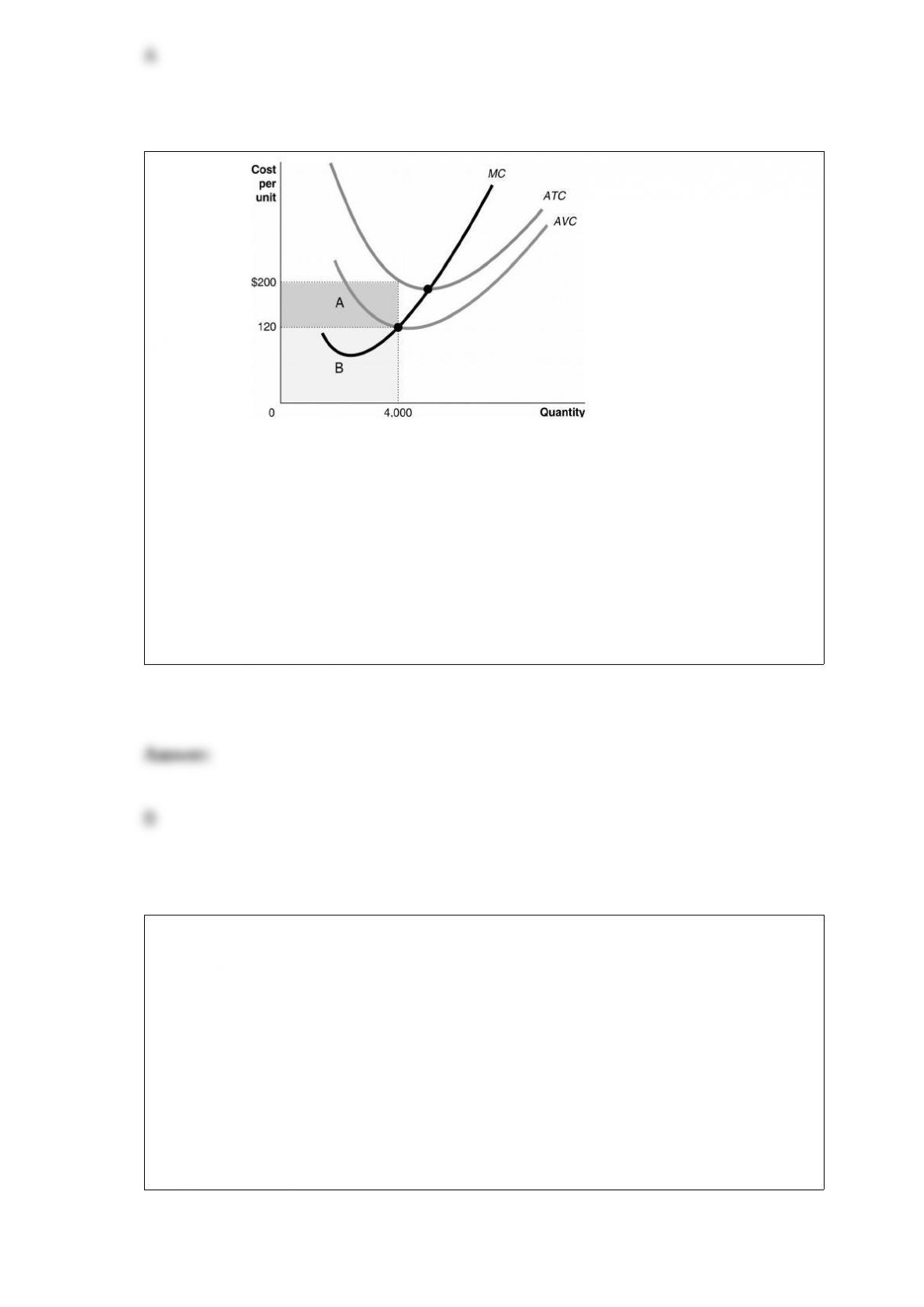
Figure 12-8
Suppose the firm produces 4,000 units. What does the shaded area labeled B represent?
A) the firm’s economic loss
B) total variable cost
C) average variable cost
D) total fixed cost
Which of the following firms is most likely to use cost-plus pricing?
A) A firm that makes one product.
B) A firm that sells one product and has a sizable research and development budget.
C) A firm that makes several products and has a sizable research and development
budget, the cost of which cannot be easily assigned to each product.
D) A firm that makes many products but has a small research and development budget,
the cost of which can be easily assigned to the different product lines.

On the long-run aggregate supply curve,
A) a decrease in the price level decreases the level of potential GDP.
B) a decrease in the price level increases the aggregate quantity of GDP supplied.
C) a decrease in the price level decreases the aggregate quantity of GDP supplied.
D) a decrease in the price level has no effect on the aggregate quantity of GDP supplied.
Assume that both the demand curve and the supply curve for MP3 players shift to the
right but the supply curve shifts more than the demand curve. As a result
A) both the equilibrium price and quantity of MP3 players will decrease.
B) the equilibrium price of MP3 players will decrease; the equilibrium quantity will
increase.
C) the equilibrium price of MP3 players may increase or decrease; the equilibrium
quantity will decrease.
D) the equilibrium price of MP3 players will increase; the equilibrium quantity will
decrease.
In 2013, Caterpillar laid off employees who produced mining machinery at its South
Milwaukee plant. The laid-off employees who were not able to find jobs at another
factory due to a permanent decline in demand in the mining industry would be
considered
A) structurally unemployed.
B) frictionally unemployed.
C) seasonally unemployed.
D) cyclically unemployed.
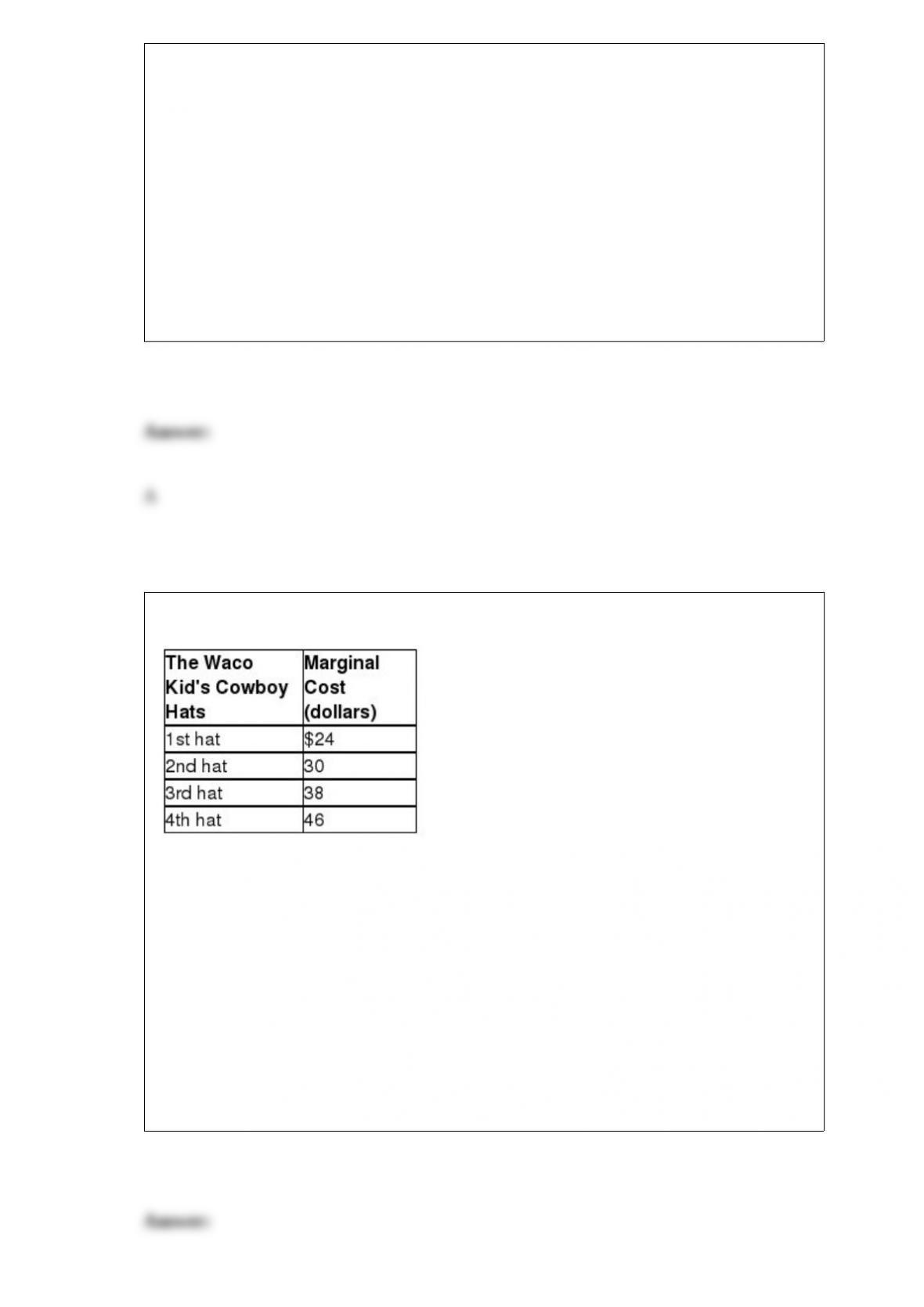
Table 4-3
The table above lists the marginal cost of cowboy hats by The Waco Kid, a firm that
specializes in producing western wear. If the market price of cowboy hats is $35, The
Waco Kid will produce
A) 1 hat.
B) 2 hats.
C) 3 hats.
D) 4 hats.
What do the highest stock price and the lowest stock price over the previous year
indicate?
A) Add them together and divide by two to get the stock’s current market price.
B) What the stock’s price-earnings ratio is
C) How volatile the stock’s market price has been
D) They generate the dividend yield.
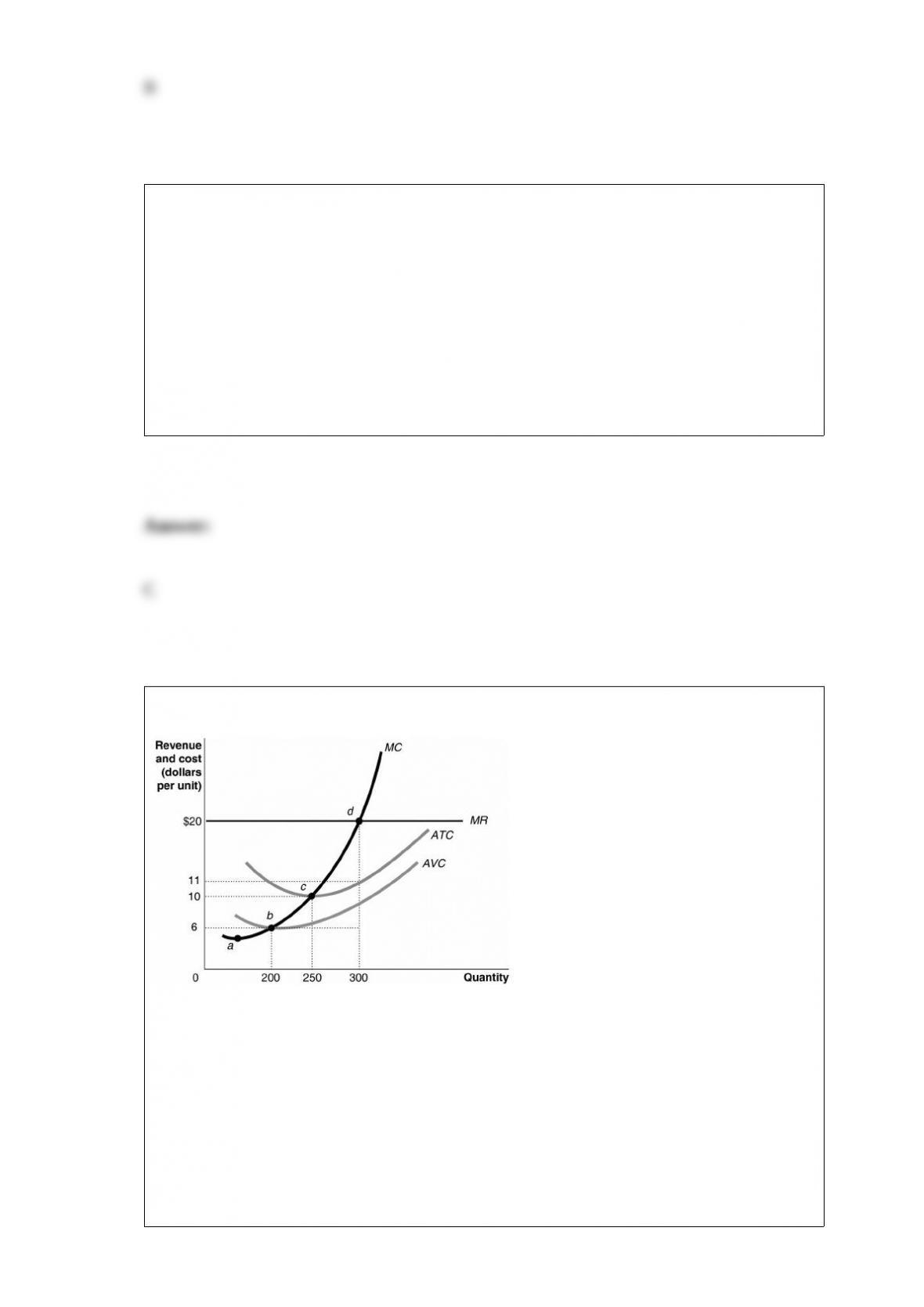
Figure 12-10
At the profit-maximizing output level, the firm earns
A) zero economic profit.
B) a profit of $600.
C) a profit of $1,200.
D) a profit of $2,700.
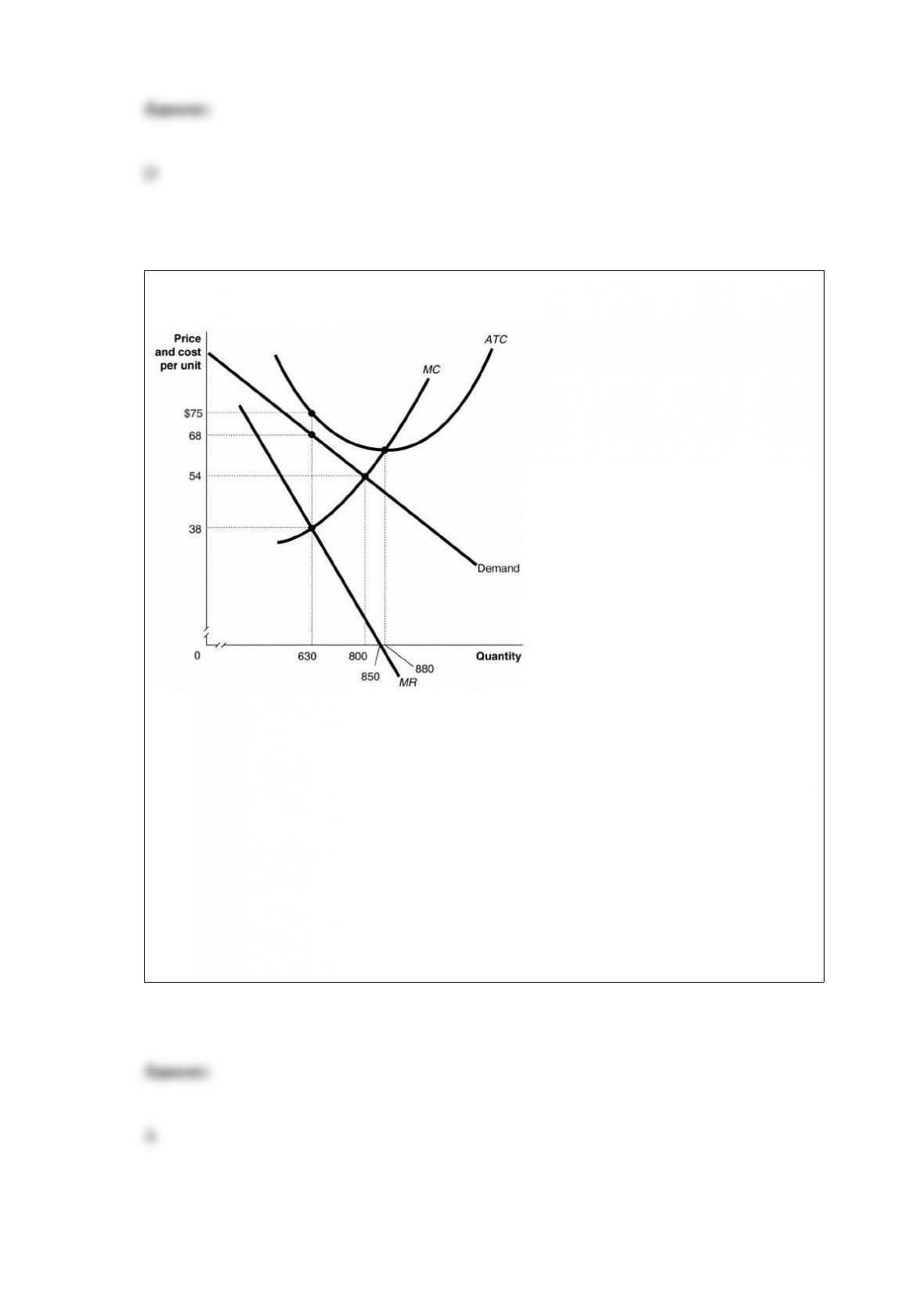
Figure 15-3
Figure 15-3 above shows the demand
and cost curves facing a monopolist.
Suppose the monopolist represented in the diagram above produces positive output.
What is the profit-maximizing/loss-minimizing output level?
A) 630 units
B) 800 units
C) 850 units
D) 880 units
Government intervention in agricultural markets in the U.S. began in the
A) 1920s.
B) 1930s.
C) 1950s.
D) 1970s.
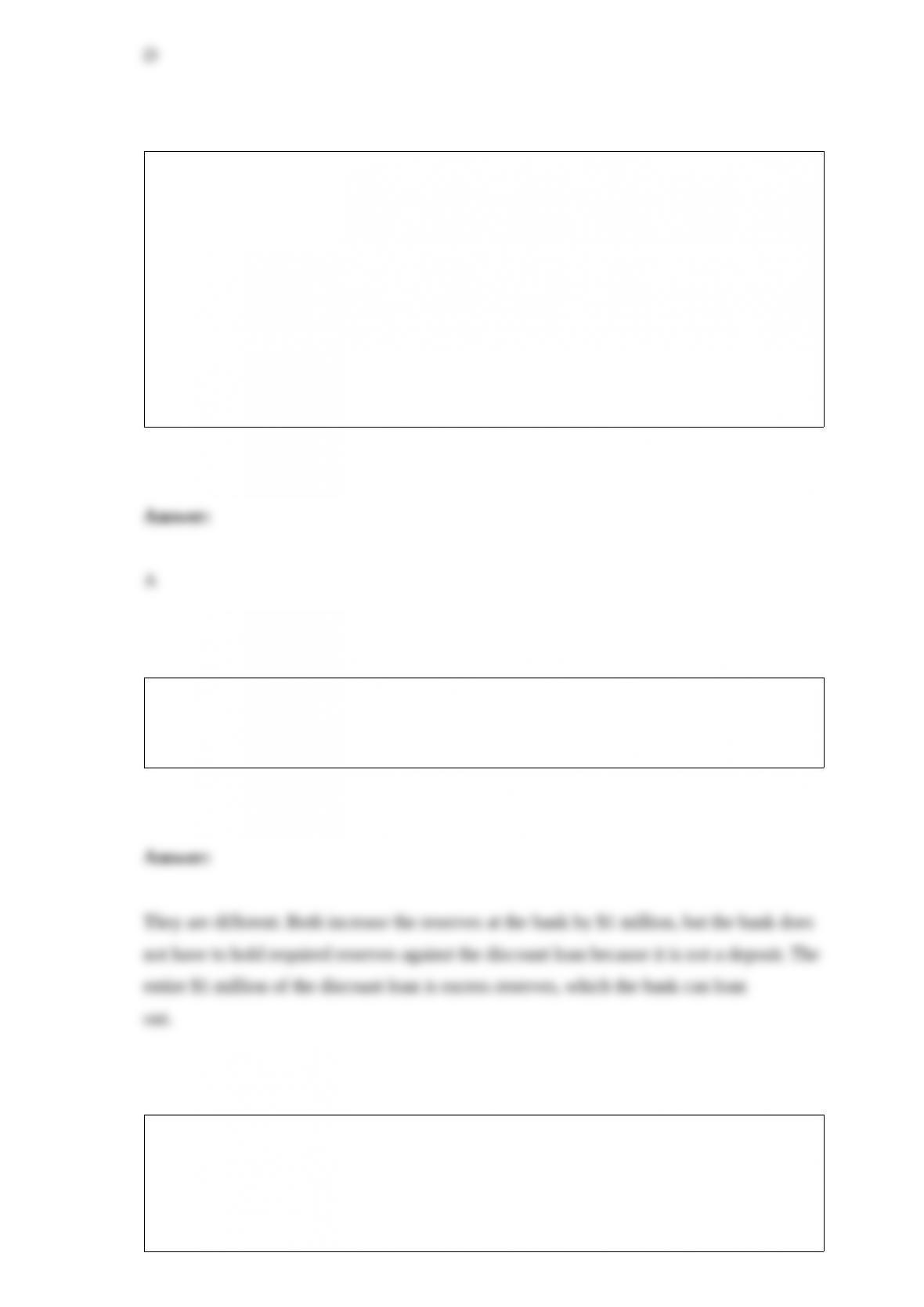
Figure 17-1
Figure 17-1 shows the
marginal revenue product for Dale’s Hand-Sewn Doilies, a producer of linen doilies. If
the wage rate is $40, how many workers should Dale hire?
A) 6 units
B) 5 units
C) 4 units
D) 3 units
According to a study by economists Raymond Fisman and Edward Miguel, as the
________ increases, so does the number of parking violations by the country’s United
Nations delegates.
A) level of corruption in a country
B) population of a country
C) per capita income of a country
D) rate of investment in a country
Would the maximum loan that a bank can make be different when receiving a discount
loan from the Federal Reserve of $1 million versus receiving a checking account
deposit of $1 million? Explain why or why not.
Use the dynamic aggregate demand and aggregate supply model and start with Year 1 in
a long-run macroeconomic equilibrium. For Year 2, graph aggregate demand, long-run
aggregate supply, and short-run aggregate supply such that the condition of the
economy will induce the president and the Congress to conduct expansionary fiscal
policy. Briefly explain the condition of the economy and what the president and the
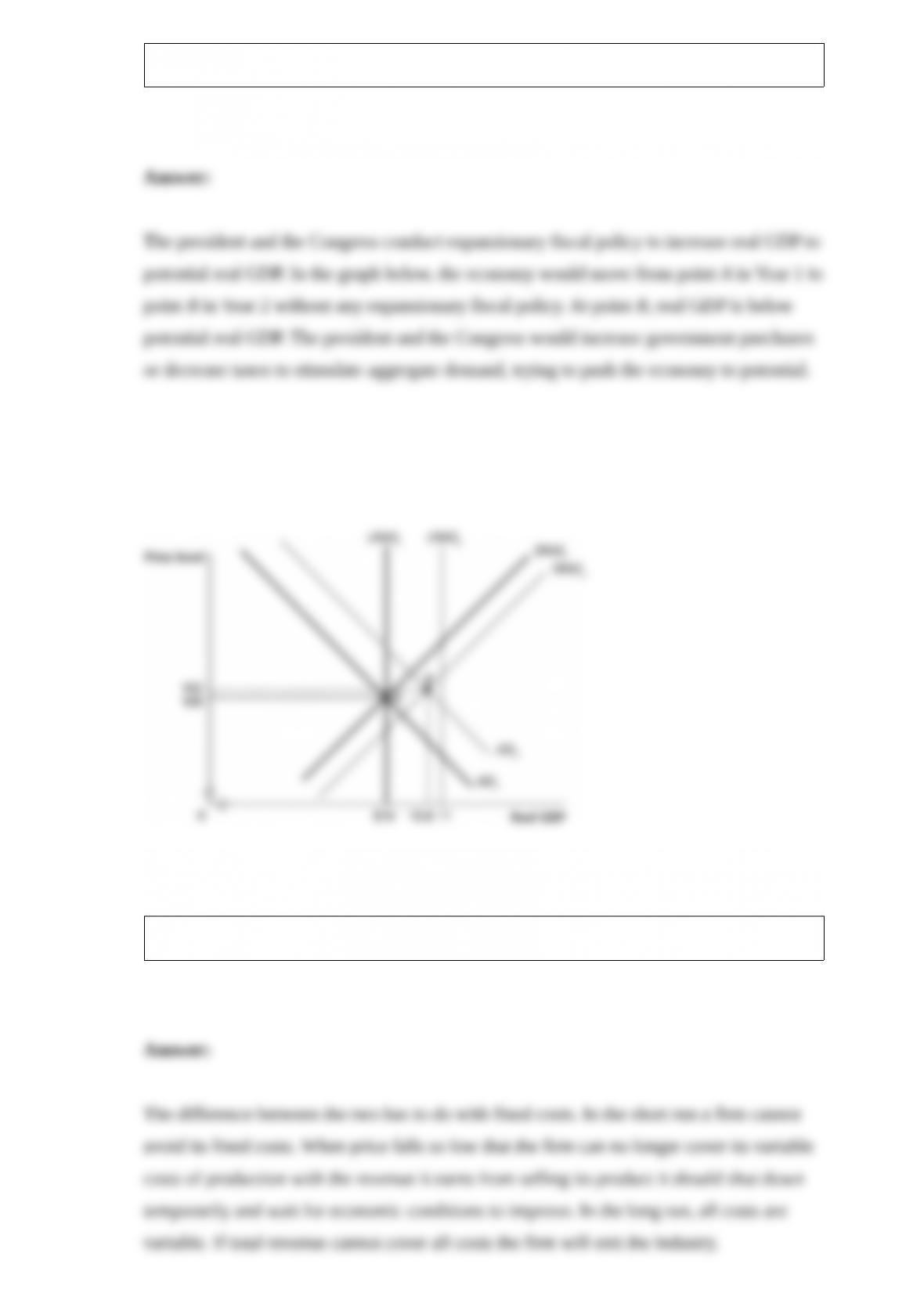
Congress are attempting to do.
What is the difference between ‘shutting down temporarily” and “exiting the industry”?
Explain the significance of brand management to a firm that has differentiated its
product. Comment specifically on the importance of obtaining a trademark.
You are the manager of a theater. At present the theater charges the same admission
price of $8 to all customers, regardless of age. You propose a two-tier pricing scheme:
$5 for children under the age of 12 and $10 for adults. You tell your supervisor that
your proposal is likely to increase revenues. What must be true about the price elasticity
of demand if your proposal is to achieve its goal of raising revenue? Explain your
answer.
Describe how a lender can lose during inflation if the inflation is unanticipated and the
loan is a fixed-interest-rate loan. How would a variable-interest-rate loan (one that
adjusts over the contract period) eliminate these loses?
Using a supply and demand graph, illustrate the market for rent-controlled apartments
with the following data: Equilibrium rent without rent control: $1,500
Rent with rent control: $700
Quantity of apartments demanded with rent control: 50,000
Quantity of apartments supplied with rent control: 20,000 What is the value of the
initial shortage of apartments with rent control? Now assume rent control leads to a
reduction in the supply of apartments, and the new quantity supplied is now 15,000.
Illustrate this on your graph. What is the value of the shortage of apartments following
the decrease in supply?
How does a public good Differ from a quasi-public good? In your answer give an
example of each type of good.