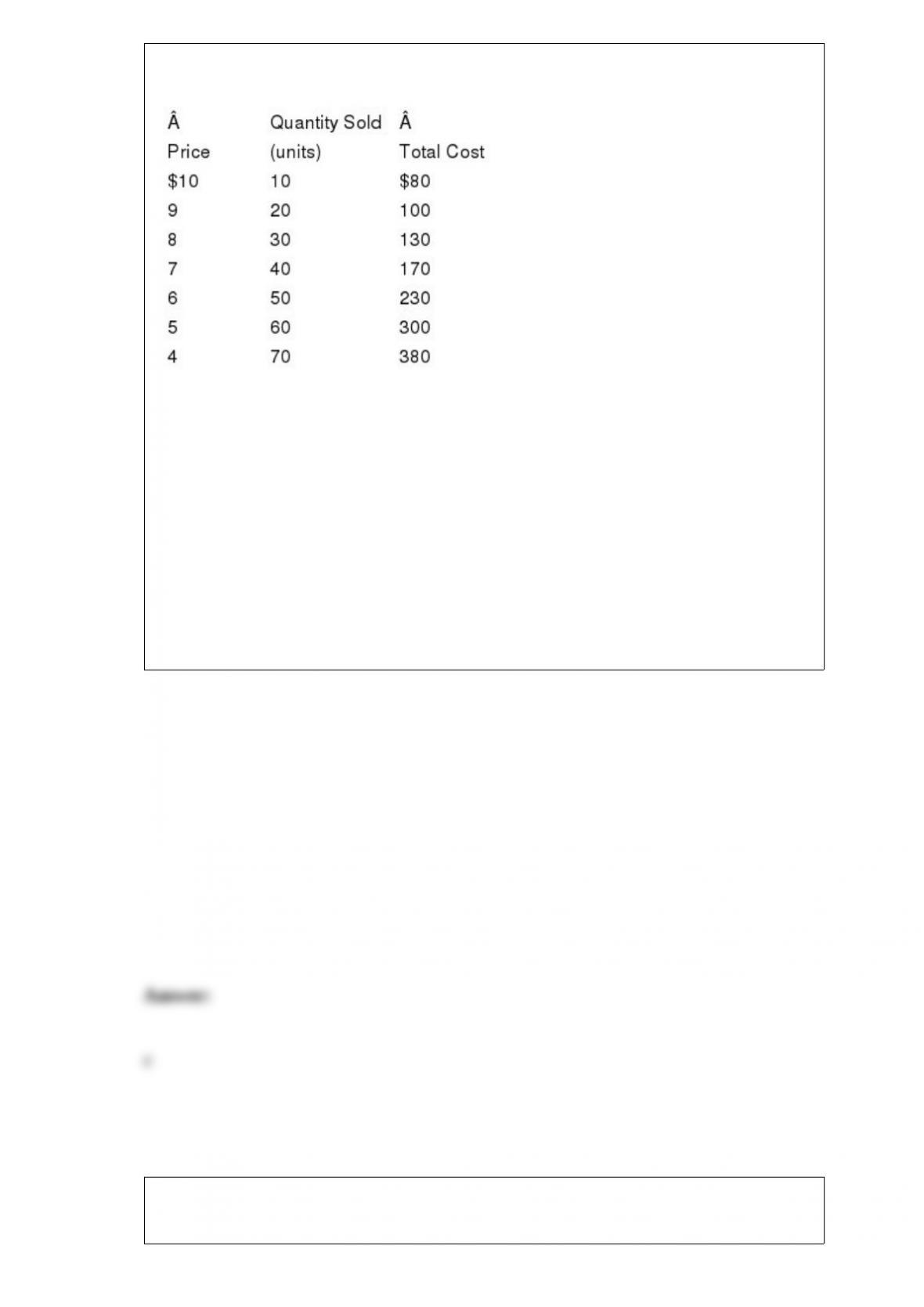
Exhibit 24-9
The reason we know the firm represented in the exhibit is a price searcher and not a
price taker is because
a. its total costs rise as more output is produced and sold.
b. it has to lower price to sell additional units of its good.
c. marginal revenue is not constant for all given levels of output.
d. at some levels of output it earns negative profit.
e. b and c
If the government increased licensing requirements for beauty salons, the supply curve
for salon services would shift to the left.

a. True
b. False
Costs that do not change with output are called __________ costs.
a. marginal
b. average
c. fixed
d. variable
A monopolist practicing (perfect) price discrimination has
a. a larger deadweight loss triangle than a single-price monopolist has.
b. the same deadweight loss triangle as a single-price monopolist.
c. a deadweight loss triangle one-half the size of what it would be with uniform pricing.
d. no deadweight loss triangle.
Exhibit 38-1

The coupon rate for bond E is
a. 37.5 percent.
b. 0.38 percent.
c. 0.45 percent.
d. 9.0 percent.
e. none of the above
The Wheeler-Lea Act of 1938
a. made interlocking directorates illegal.
b. set up the Federal Trade Commission (FTC) to deal with “unfair methods of
competition.”
c. made monopolization of trade a misdemeanor.
d. prohibited suppliers from offering special discounts to large chain stores without
offering them to everyone else.
e. empowered the FTC to deal with false and deceptive acts or practices.

If the minimum wage law sets a wage floor below the equilibrium wage in the market
for unskilled labor, then the
a. minimum wage will create a surplus of unskilled labor.
b. minimum wage will create a shortage of unskilled labor.
c. minimum wage will not impact the unskilled labor market.
d. unskilled labor market will change, but we cannot be certain how.
Which of the following is an example of an externality that has been internalized?
a. Acid rain, originating in the United States, destroys Canadian forests.
b. Robert Frost breathes the air that has been polluted by the emissions of a nearby steel
plant.
c. Erica Evans, a beekeeper, decides to keep more bees because her neighbor, an
orchard owner, has agreed to compensate her for the bees’ pollination of the orchard.
d. Miguel Sanchez, a concert pianist, rehearses Beethoven’s “Moonlight Sonata” and his
neighbors enjoy the “free concert.”
e. all of the above
Which of the following would not result from a price ceiling (set below the equilibrium
price)?
a. a shortage
b. fewer exchanges
c. an increase in supply
d. nonprice rationing devices

If people value clean air over dirty air, and if the air in city A is cleaner than the air in
city B (by a wide margin), then we would expect that ____________________, all else
equal between the two cities.
a. comparable houses in the two cities will sell for the same price.
b. comparable house in A will be more expensive than comparable house in B.
c. comparable house in B will be more expensive than comparable house in A.
d. There is not enough information to answer the question.
Which of the following statements is true?
a. If the marginal cost curve is above the AFC curve, the AFC curve must be rising.
b. Average total cost equals average variable cost minus average fixed cost.
c. As output increases, the average variable cost curve gets closer to the average total
cost curve.
d. The AFC curve is horizontal as output increases.
If price elasticity of supply is greater than 1, it means that the percentage change in
quantity supplied is
a. less than the percentage change in price.
b. greater than the absolute change in price.
c. greater than the percentage change in price.

d. equal to the absolute change in price.
The economy is currently on its production possibilities frontier (PPF). A politician says
that it is possible to get more of everything—more infrastructure, more schools, more
national defense, more spending on social programs, and so on. The politician is
a. correct if he is assuming a rightward-shifting PPF.
b. incorrect if he is assuming a rightward-shifting PPF.
c. incorrect if he is assuming a PPF that does not change.
d. correct if he is assuming a PPF that does not change.
e. a and c
Situation 27-2 A company is trying to decide whether it should produce good Y in the
U.S. or in Mexico.Suppose a U.S. worker earns $12 per hour and a worker in Mexico
earns $4 per hour.Also suppose that the marginal physical product (MPP) of the U.S.
worker is 10 units of good Y and the MPP of the Mexican worker is 5 units of good Y.
The output produced per $1 of cost in the Mexico. is
a. 1.25 units of good Y.
b. 0.80 units of good Y.
c. 9.0 units of good Y.
d. 1.0 units of good Y.
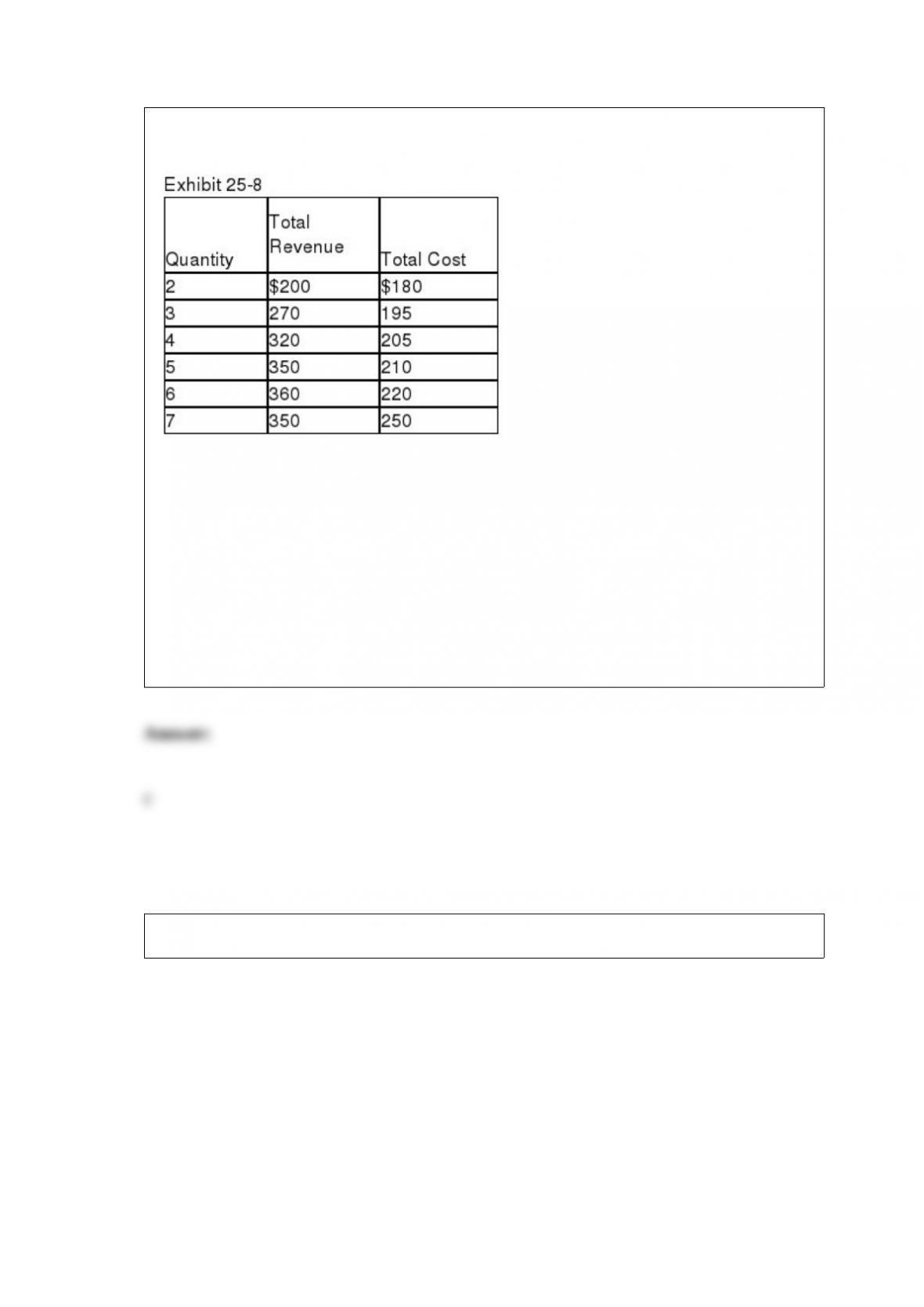
The maximum profits earned by a monopolistic competitive firm will be
a. $115.
b. $75.
c. $140.
d. $100.

The marginal cost of the last unit produced at the profit-maximizing output level equals
a. $10.
b. $40.
c. $20.
d. $5.
Suppose the optimal amount of X is 100 units and that the market provides 123 units.
This situation is descriptive of
a. externality provision.
b. market failure.
c. asymmetric information.
d. a public goods problem.
e. the free-rider dilemma.
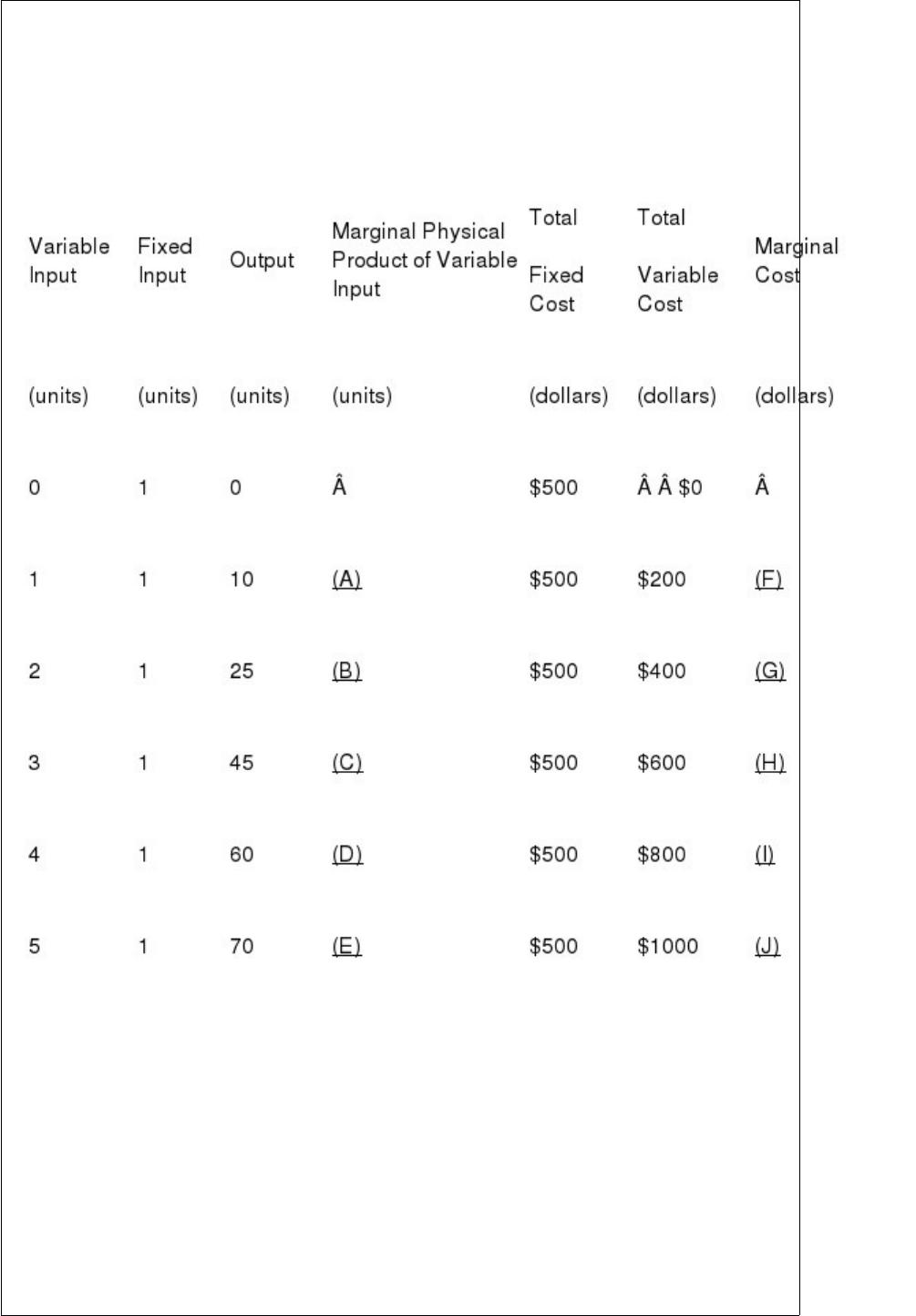
Exhibit 22-3
The marginal physical product figures in blanks (B) and (C) are, respectively,
a. 10 and 15.
b. 15 and 20.
c. 20 and 15.
d. 15 and 10.
e. 10 and 10.

The existence of substitutes for a good and the percentage of one’s budget spent on the
good are among the factors that determine how elastic the demand for the good will be.
a. True
b. False
Someone says, “Even though the equilibrium wage rate is $8 an hour in the unskilled
labor market, if we impose a minimum wage of $10 an hour, no one currently working
will lose his or her job.” This person must believe that the
a. demand curve for unskilled labor is vertical.
b. demand curve for unskilled labor is downward-sloping.
c. supply curve for unskilled labor is downward-sloping.
d. supply curve for unskilled labor is horizontal.
e. none of the above.