
If Americans demand goods produced in Mexico, it leads to a demand for Mexican
pesos and a supply of U.S. dollars on the foreign exchange market.
a. True
b. False
If a labor union tries to reduce the availability of substitutes for the product it sells, it is
attempting to affect the __________ for labor. But if it tries to increase substitute factor
prices, it is attempting to affect the __________ labor.
a. elasticity of demand; supply of
b. demand; elasticity of demand for
c. elasticity of demand; demand for
d. demand; supply of
e. none of the above
Refer to Exhibit 28-4. If a labor union successfully organizes the labor market and sets
the wage rate at W4, the amount of unemployment in this market will be equal to
Exhibit 28-4

a. Q4 – Q3.
b. zero.
c. Q3 – Q1.
d. Q2 – Q3.
e. Q4 – Q1.
Refer to Exhibit 24-4.What dollar amounts go in blanks (A), (B), (C), (D), and (E),
respectively?
Exhibit 24-4
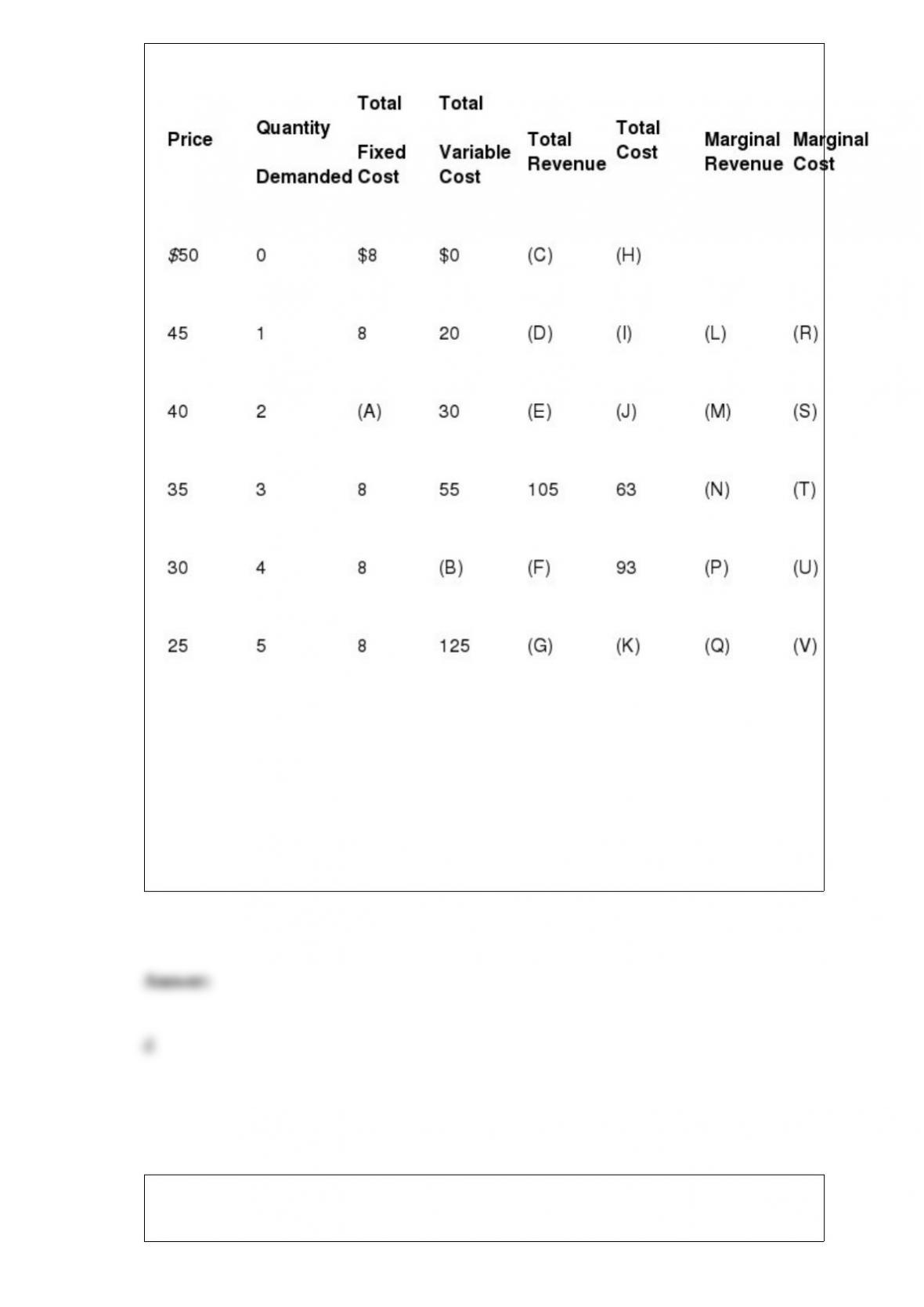
a. $8; $60; $0; $10; and $130
b. $8; $70; $50; $30; and $10
c. $25; $10; $10; $30; and $50
d. $8; $85; $0; $45; and $80
Simple majority rule will almost always generate efficient outcomes.

a. True
b. False
Which of the following statements is true?
a. A monopolist can charge whatever price it wants without losing any customers, by
virtue of its monopoly position.
b. A monopolist can always increase its profits by increasing its price.
c. In the monopoly market structure, there are low barriers to entry.
d. A monopolist is assured of positive economic profits.
e. none of the above
Refer to Exhibit 4-9.Suppose that the government imposes a price ceiling at a price of
$13._________ units would be exchanged at the equilibrium price and ____________
units would be exchanged with the price ceiling in effect.
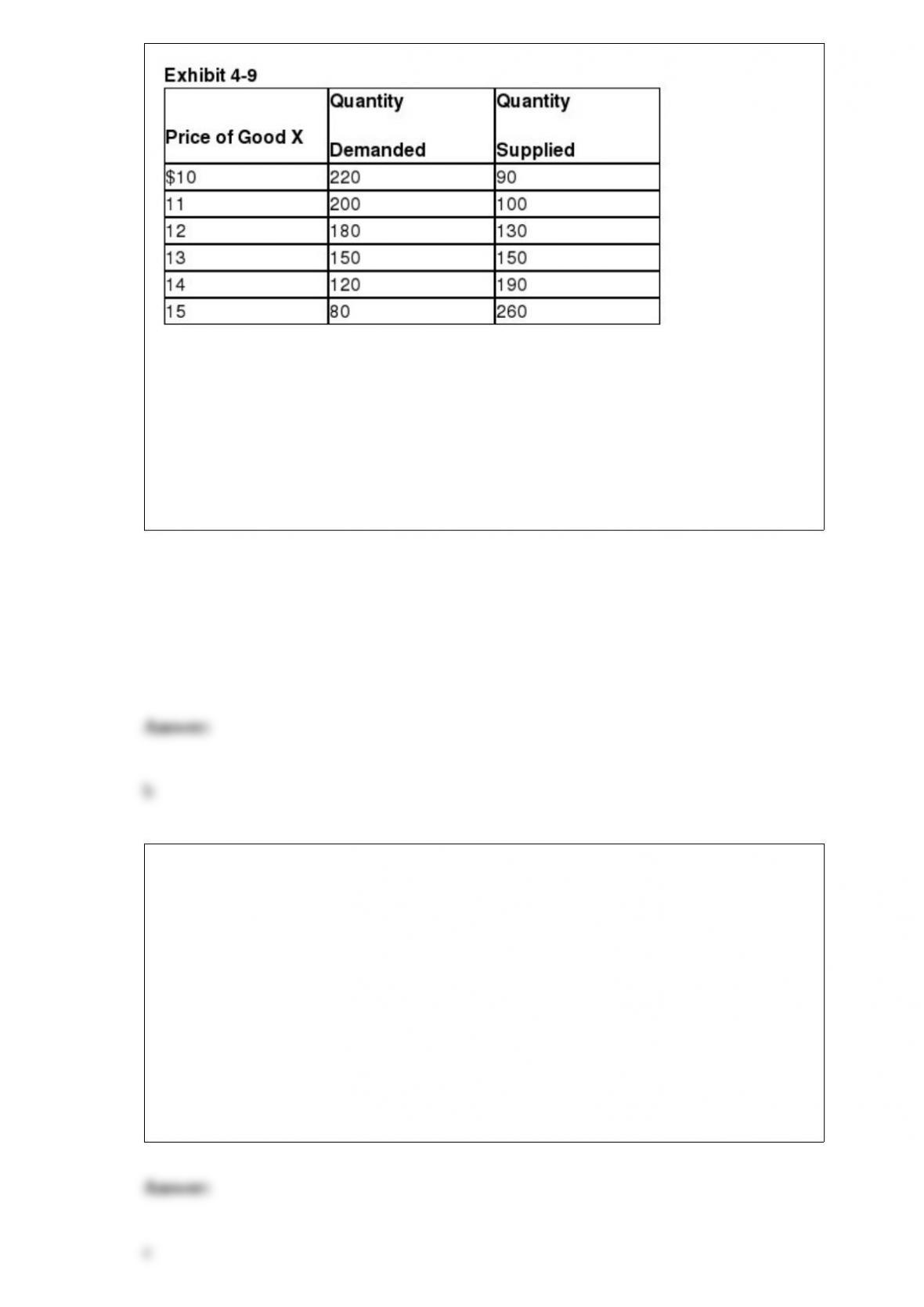
a. 150; 220
b. 150; 150
c. 110; 180
d. 150; 90
If a monopolistic competitive firm raises its price, then
a. it should expect to lose all of its customers because there are many other sellers of the
product.
b. this is a trick question because the firm does not have the ability to change its price.
c. it should expect to lose some, but not all, of its customers.
d. it will be able to increase its profits.
e. it can sell all it wants because it faces a horizontal demand curve.
Working alone, a person who shirks receives __________ the benefits of shirking and
pays __________ the costs of shirking.
a. all; only some of
b. only part of; all
c. all; all
d. only part of; only part of
e. none of the above
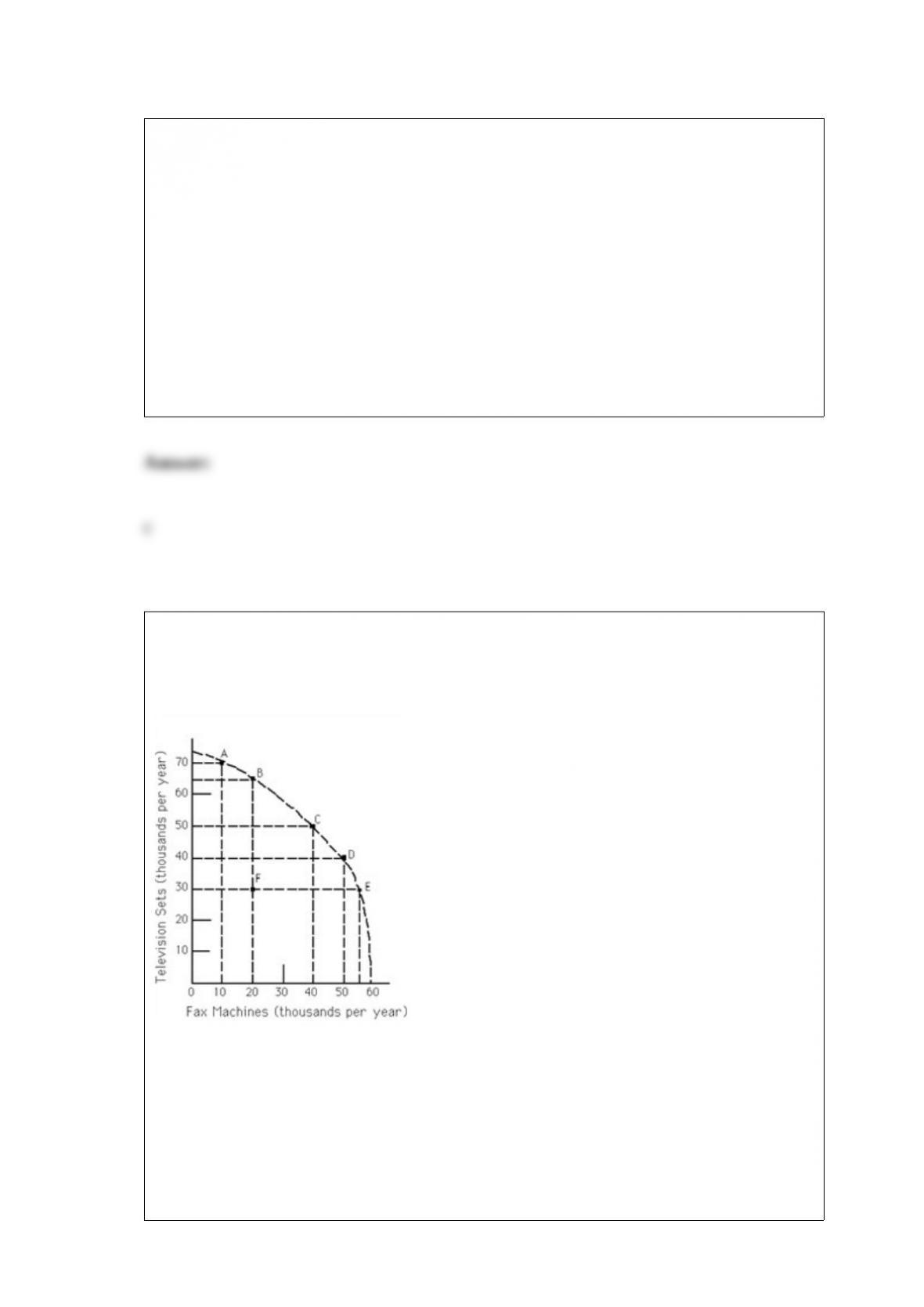
Refer to Exhibit 2-5. “In order to produce one more television set, we must forfeit the
production of one fax machine.” This statement describes a movement from
Exhibit 2-5
a. point C to point D.
b. point D to point E.
c. point E to point F.
d. point E to point D.
e. point D to point C.

Social media, such as the online social networking portal Meetup, have increased the
likelihood of people forming social tribes by reducing the transaction costs associated
with forming such groups.
a. True
b. False
Suppose that prices in the United States rise relative to prices in Japan. We expect that
a. the dollar will appreciate and the yen will depreciate.
b. the dollar will depreciate and the yen will appreciate.
c. both the dollar and the yen will appreciate.
d. both the dollar and the yen will depreciate.
Which of the following statements is false?
a. Capital consists of produced goods that can be used as inputs for further production.
b. The terms resources, inputs, and factors of production are synonyms.
c. Labor consists of the physical, but not mental, talents of people who contribute to the
production process.
d. Entrepreneurship is one of the four categories of resources.
e. The resource category land includes natural resources, such as minerals, forests,
water, and unimproved land.
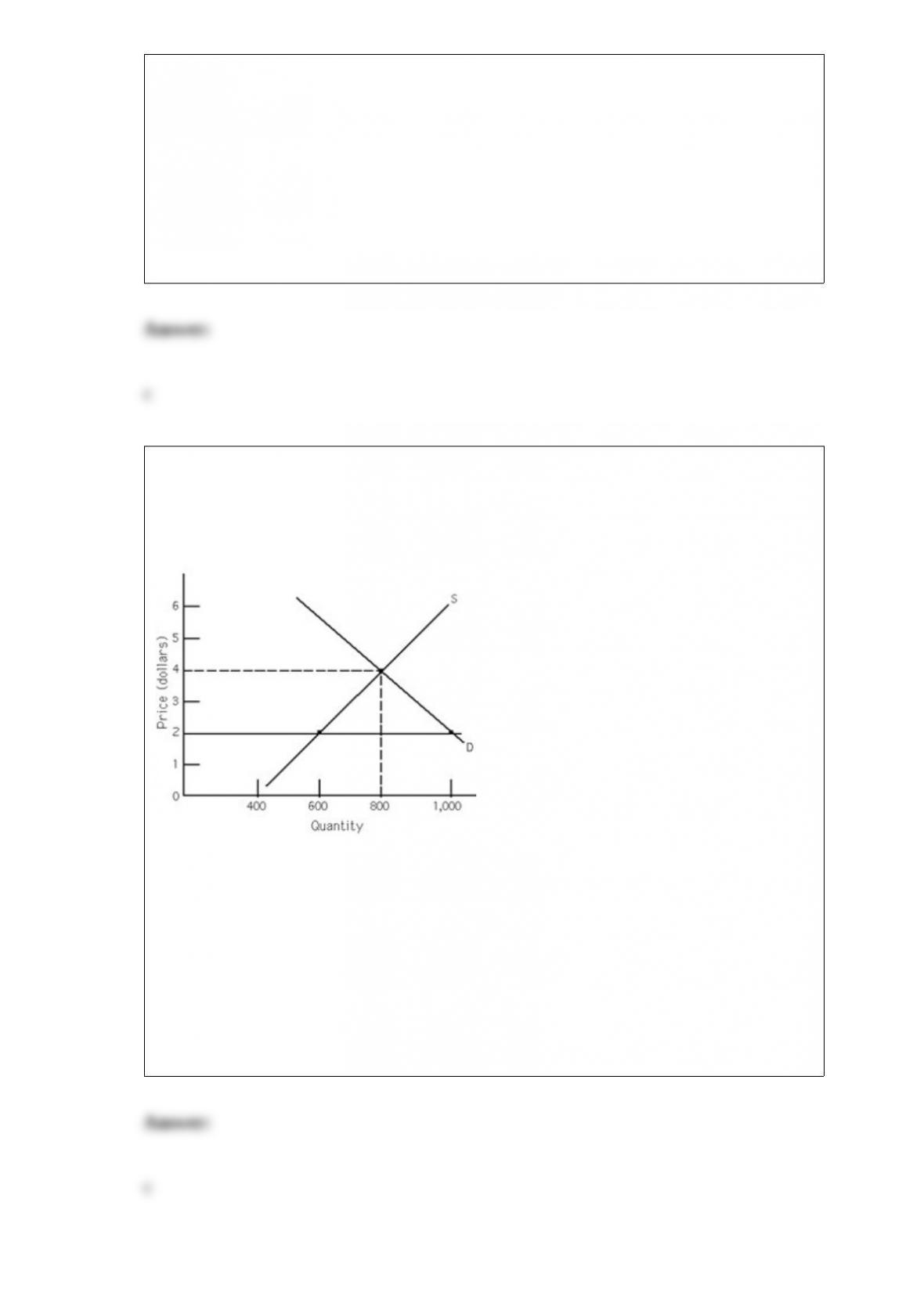
Exhibit 4-2 represents the orange juice market. The horizontal line represents a price
ceiling imposed by the government. Which of the following is true?
Exhibit 4-2
a. At equilibrium, the quantity demanded is 700 units.
b. At the price ceiling, there is a surplus of orange juice.
c. The quantity supplied at the price ceiling will equal the quantity exchanged.
d. The quantity demanded at the price ceiling will equal the quantity supplied.
e. The quantity demanded at the price ceiling will equal the quantity exchanged

Consider the following combinations of guns and butter that can be produced: 0 guns,
20,000 units of butter; 5,000 guns, 15,000 units of butter; 10,000 guns, 10,000 units of
butter; 15,000 guns, 5,000 units of butter; 20,000 guns, 0 units of butter. The PPF
between guns and butter is
a. a downward-sloping bowed-out curve.
b. a downward-sloping straight line.
c. an upward-sloping straight line.
d. It is impossible to answer this question without knowing which good would be
plotted on the vertical axis.
A firm that is a price taker will not sell any of its product for less than the equilibrium
price because
a. it is against the law to do this.
b. it can sell all it can produce at the equilibrium price.
c. this would invite competition from outside the market and end up reducing the profits
of the firm.
d. this would be breaking the cartel agreement that price-taker firms often enter into.
e. none of the above
Unions typically argue that state right-to-work laws
a. are unfair.
b. constrain unions’ abilities to control the supply of labor in a market.
c. are inconsistent with the Taft-Hartley Act.
d. legalize union shops.
If the supply of and demand for a product decrease at the same time, then equilibrium
a. quantity and equilibrium price must both decline.
b. quantity must decline, but equilibrium price may either rise, fall, or remain
unchanged.
c. price must fall, but equilibrium quantity may either rise, fall, or remain unchanged.
d. quantity must fall and equilibrium price must rise.
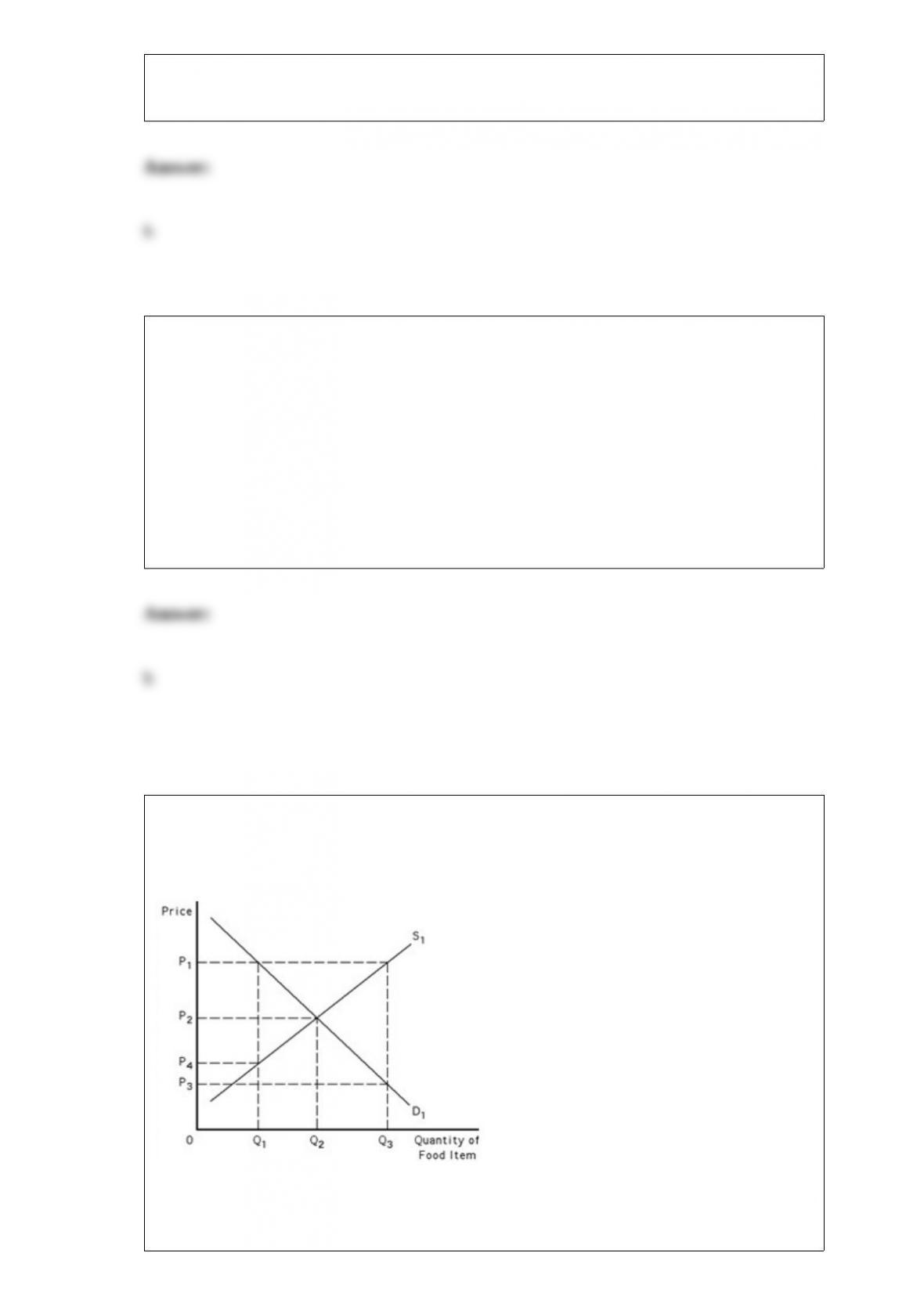
Refer to Exhibit 39-9. Under a price support program, with the price support set at P1,
consumers will end up paying a price of
Exhibit 39-9
a. P1.
b. P2.
c. P3.
d. P4.
e. There is not enough information to answer the question.
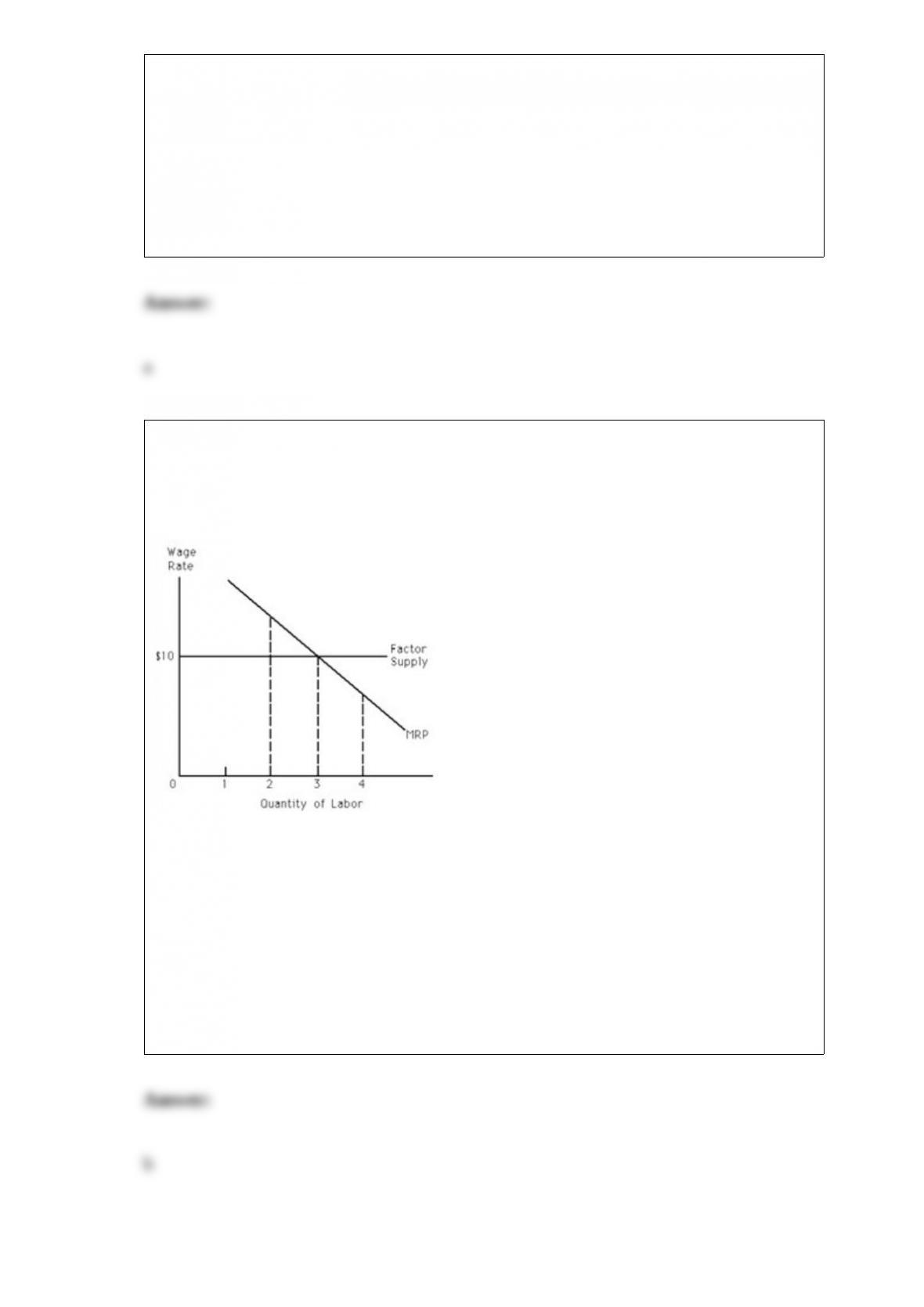
Refer to Exhibit 27-4. In evaluating the marginal cost and revenue of hiring additional
units of labor, the firm will not hire
Exhibit 27-4
a. the second worker.
b. the fourth worker.
c. labor up to the point where MRP equals the market price of the input.
d. labor up to the point where MRP = MFC.
e. both c and d