
Examining the conditions that could lead to economic growth is an example of
macroeconomic topic.
A characteristic of the long run that is not available in the short run is that a firm is free
to vary its output.
In a two-good, two country world, if one country has an absolute advantage in the
production of both goods, it cannot benefit by trading with the other country.
Maintaining a strong dollar in international currency markets is not one of the four
monetary policy goals of the Fed listed in the textbook.

An oligopolistic industry is characterized by a few large firms acting independently.
The government makes all economic decisions in a market economy.
An appropriate fiscal policy response when aggregate demand is growing at a faster rate
than aggregate supply is to decrease the money supply.
The government makes all economic decisions in a mixed economy.

A doctor pursuing his own interests rather than the interests of his patients is an
example of the principal-agent problem.
The four-firm concentration ratio of the aircraft industry is over 80 percent. Most
economists would consider this industry an oligopoly.
If real GDP per capita in the United States is $8,000 in 2013, and if real GDP per capita
is $12,000 in 2023, what is the total percent change in the growth rate of GDP per
capita between 2013 and 2023?
A) 3.33%
B) 5%
C) 33%
D) 50%

Eighty-five percent of all firms employ ________ workers.
A) only one or two
B) fewer than 20
C) 50 or more
D) over 100
Gross national product, GNP, of the United States is the market value of all final goods
and services
A) produced within the United States.
B) consumed within the United States.
C) produced by citizens of the United States anywhere in the world.
D) consumed by citizens of the United States anywhere in the world.
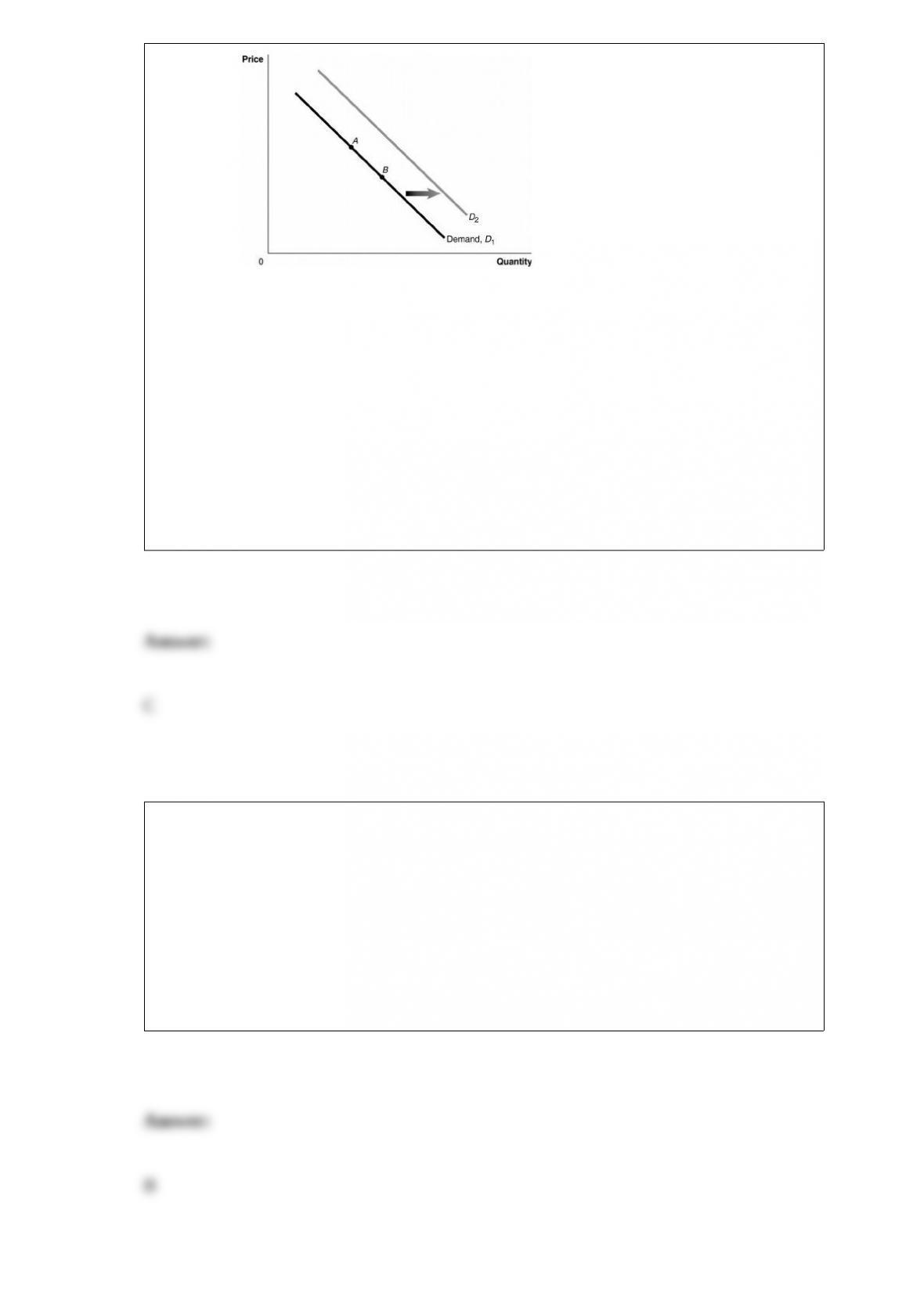
Figure 3-1
If the product represented is a normal good, an increase in income would be represented
by a movement from
A) A to B.
B) B to A.
C) D1 to D2.
D) D2 to D1.
Which of the following is an advantage of starting a new business as a proprietorship?
A) The owner has limited personal liability.
B) A proprietorship has few government rules and regulations to comply with.
C) Business profits are not taxed.
D) A proprietorship can easily attain additional funding.

Phil Harrison is a welder who works on skyscrapers and extension bridges. Phil’s
brother William is also a welder but he works in a manufacturing plant where he does
all of his welding on ground level. Which of the following would not explain why Phil
earns a higher wage than his brother?
A) cognitive dissonance
B) Phil has greater experience as a welder than his brother has.
C) Phil’s marginal revenue product is greater than William’s marginal revenue product.
D) Phil’s job is more hazardous than William’s job.
Article Summary. According to the Office for National Statistics in the United
Kingdom, productivity in the UK in 2012 was well below the average of the G7
countries, only faring better than Japan. The G7 is a group of the seven most
industrialized countries, and includes Canada, France, Germany, Italy, Japan, the
United Kingdom, and the United States. Compared to the G7 average, the UK was
16% less productive per hour worked, and output was 19% worse when measured
on a per worker basis. The productivity gap was the largest for the UK since 1994.
Worker productivity has increased in all of the G7 nations except for the UK since
2007, where it has fallen by two percentage points. The most productive workers
were in the United States, where workers were 29 percentage points more
productive per hour worked than in the UK. Source: “UK workers much less
productive than others in the G7,” Guardian, September 18, 2013. Unlike in the
UK, labor productivity in the other G7 nations has increased since 2007. An increase in
labor productivity
A) will increase the labor force participation rate.
B) allows the average consumer to increase consumption.
C) will create short-run, but not long-run, economic growth.
D) will increase output and decrease wages in the long run.

Two of the firms involved in the accounting scandals of the early 2000s were
A) Arthur Anderson and NBC.
B) Western Digital and General Motors.
C) WorldCom and Enron.
D) DuPont and Lehman Brothers.
Which of the following is a positive economic statement?
A) Everyone should live at the same standard of living.
B) If the price of gasoline rises, a smaller quantity of it will be bought.
C) The government should close income tax loopholes.
D) U.S. firms should not be allowed to outsource production of goods and services.
Figure 5-2
Figure 5-2 shows a market with a negative externality.
The size of marginal external costs can be determined by
A) S2+ S1at each output level.
B) S2– S1at each output level.
C) the supply curve S2.
D) the supply curve S1.
Table 14-5 Ming and
Henri each run one of the two dry cleaning facilities in the town of Scaraby. Both
consider offering free pickup and delivery services. Table 14-5 shows the payoff matrix
containing the expected quarterly profits for each firm.
Does Ming have a dominant strategy? If yes, what is it?

A) Yes, Ming’s dominant strategy is to offer free pickup and delivery.
B) No, Ming does not a dominant strategy€his best outcome depends on what Henri
does.
C) Yes, Ming’s dominant strategy is to not to offer free pickup and delivery.
D) Yes, Ming’s dominant strategy is to wait to see what Henri does first.
Federal Reserve Board Chairmen Paul Volcker, Alan Greenspan, and Ben Bernanke all
have focused on which of the following as their main goal of monetary policy?
A) high employment
B) price stability
C) economic growth
D) stability of financial markets
In economics, tangible merchandise is referred to as
A) invention.
B) human capital.
C) services.
D) goods.

What three conditions must hold for a firm to successfully price discriminate?
How does the demand curve for an oligopoly firm differ from the demand curves for
firms in competitive market structures?
Article Summary. Due to falling sales and lower profit margins, clothing retailer
Aeropostale announced it would be closing more stores than originally planned. In
August, the company announced it would be closing between 30 and 40 locations
in 2013, up from the previously announced 15 to 20. Compared to the previous
year, net sales fell 6 percent and the company reported a loss of $33.7 million for
the second quarter of 2013, and the trend was expected to continue into the third
quarter. Explaining the downturn, Aeropostale chief executive Thomas P. Johnson
stated “Our business was pressured by a challenging teen retail environment with
weak traffic trends and high levels of promotional activity.”
Source: Andrew Klips, “Aeropostale Losses Accelerate, Closing More Stores,”
equities.com, August 23, 2013.
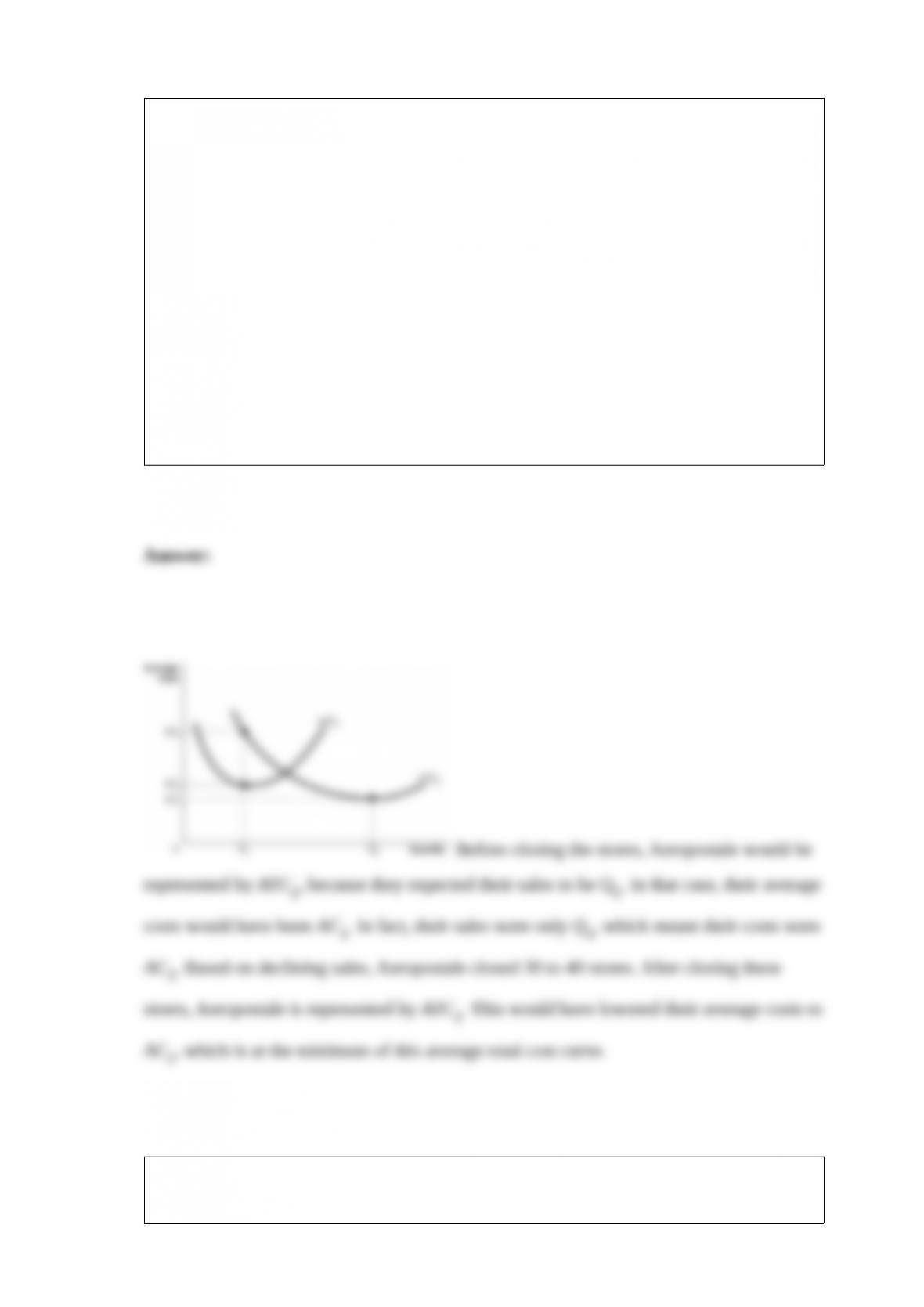
Use a graph to illustrate average total cost curves for Aeropostale before and after
closing the 30 to 40 stores. Assume that after closing the stores, Aeropostale will be
producing at minimum average total cost.
What are the advantages of setting up a proprietorship or partnership as opposed to a
corporation?
Explain how “menu costs” affect the slope of the short-run aggregate supply curve.
Suppose that at a price of $55, 100 units were sold while at a price of $33, 153 units
were sold. Without calculating the price elasticity value, can you determine whether
demand is elastic, unit-elastic, or inelastic? Explain your answer.
Is it possible for average total cost to be decreasing over a range of output where
marginal cost is increasing? Briefly explain.
How might a monopolistically competitive firm continually earn economic profit
greater than zero?
In countries that have experienced hyperinflation, what role have large government
budget deficits played in causing the very high inflation rates?
State the law of diminishing returns. How do diminishing returns differ from
diseconomies of scale? Be sure to define diseconomies of scale in your answer.