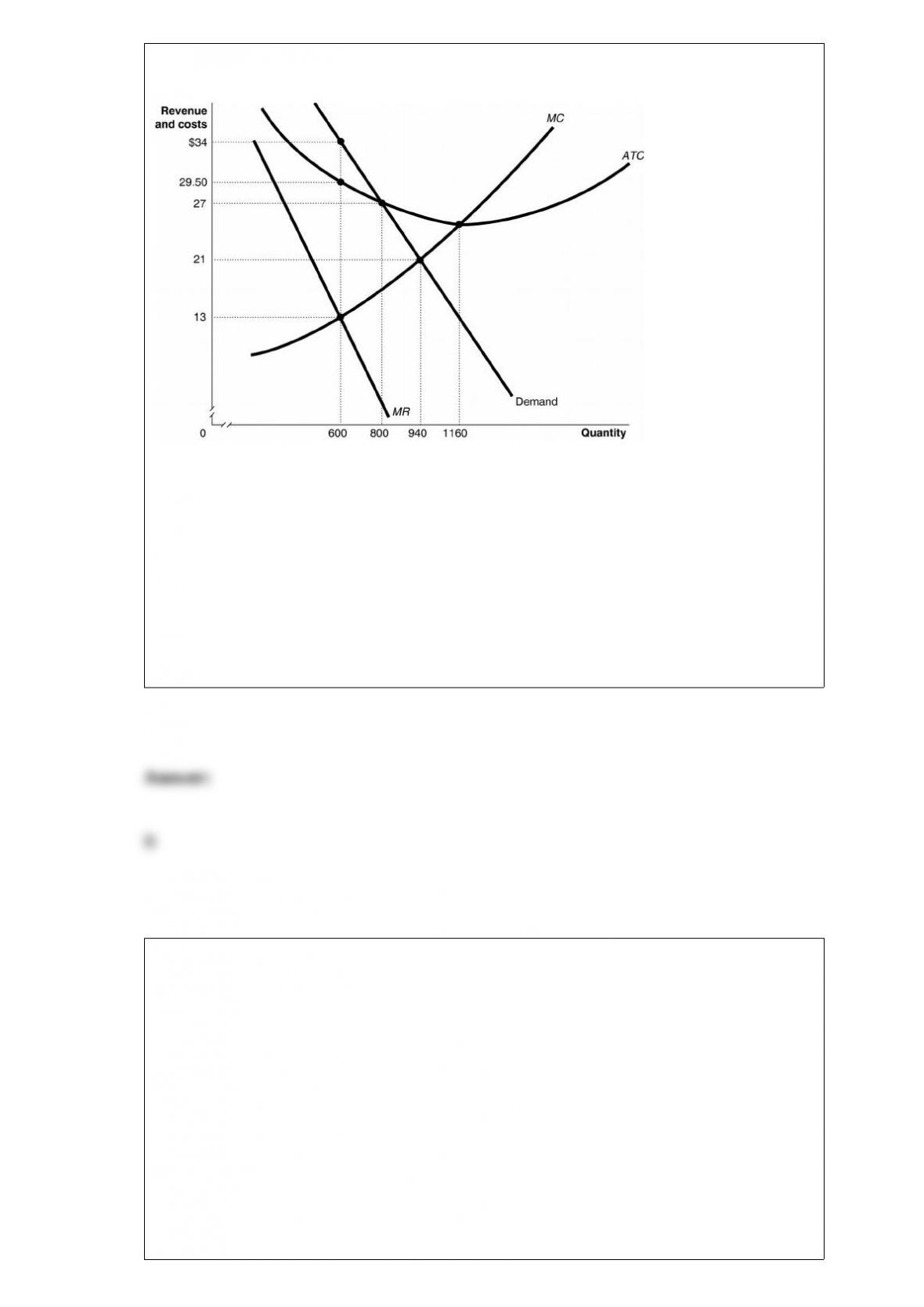
Figure 15-4
Figure 15-4 shows
the demand and cost curves for a monopolist. What is the amount of the monopoly’s
total revenue?
A) $21,600
B) $20,400
C) $19,740
D) $7,800
Suppose Dublin Electronics charges regular customers $90 for a Blu-ray player but
allows senior citizens to purchase the same item for $75. Is this likely to be a successful
price discriminating strategy?
A) Yes, firms price discriminate to maximize profits.
B) No, price discrimination will not be effective because the store cannot prevent senior
citizens from buying large quantities of Blu-ray players and reselling them for a profit.
C) Yes, because senior citizens are likely to have a more elastic demand and therefore
will be willing to pay a lower price compared to regular customers.
D) No, because there are many different brands of Blu-ray players and consumers will
shop around.
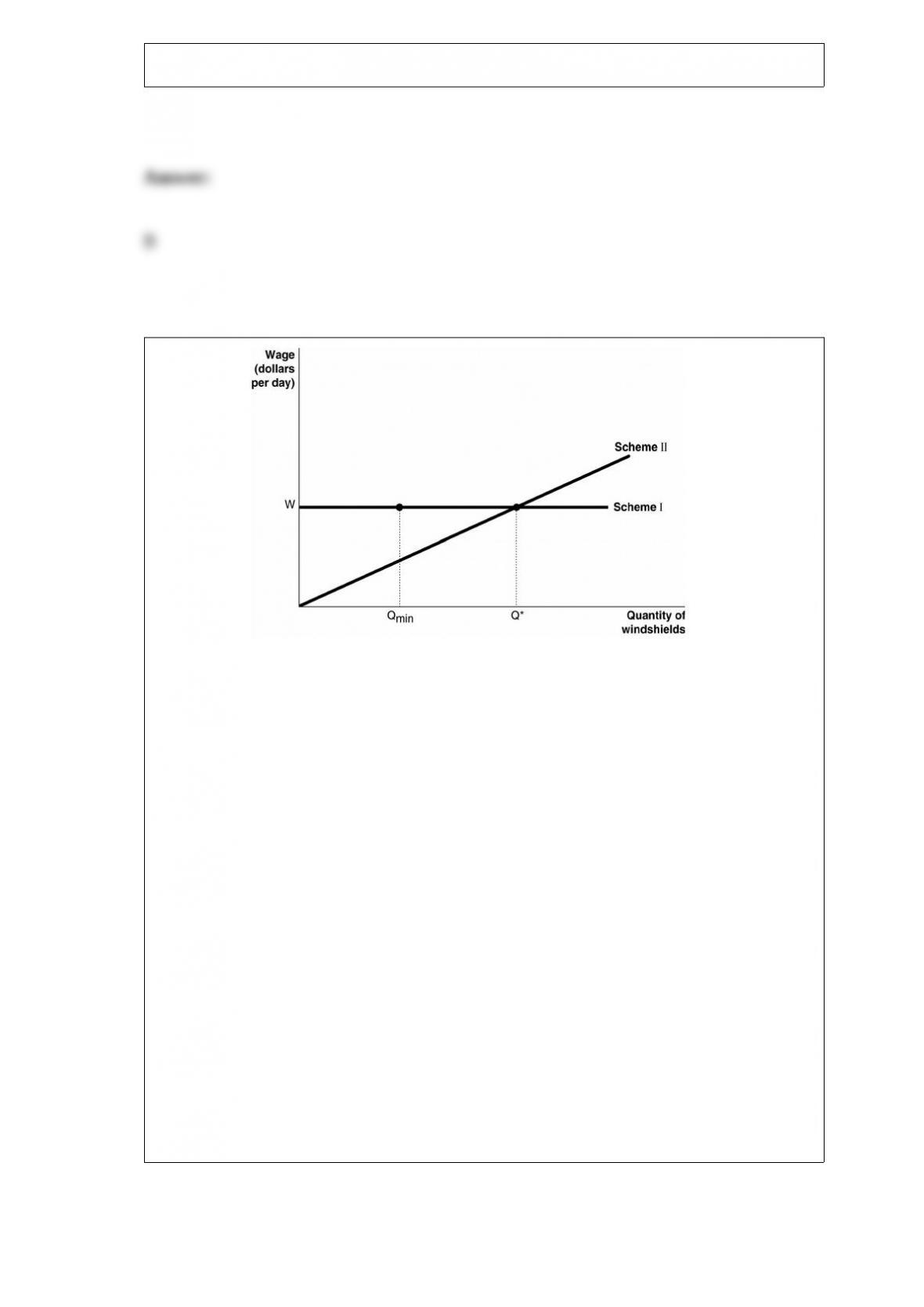
Figure 17-6 Figure 17-6
shows two different compensation schemes for the Safelite Glass Corporation, an
installer of auto glass windshields. Under Scheme I, the firm pays a consistent wage of
$80 per day based on an 8-hour workday. Qmin represents the cut-off point under the
hourly-wage system: if a worker installed fewer than Qmin windshields, the worker got
fired. Scheme II represents a piece-rate scheme with an earnings floor: no worker
would get less than $80 per day (for an 8-hour workday) and would have to produce at
least Qmin. For any output level beyond Q* the worker earned an additional $20 for
each unit produced.
Under Scheme I,
A) workers compete with each other to see who can produce beyond Qmin in the
shortest possible time.
B) workers have no incentive to produce beyond Qmin.
C) workers signal their productivity to the firm by consistently producing above Qmin.
D) the incentive to increase productivity depends on where Qmin is set; if it is at a very
high level, then workers will rise to the challenge for fear of losing their jobs.

A perfectly competitive firm in a constant-cost industry produces 1,000 units of a good
at a total cost of $50,000. The prevailing market price is $48. Assuming that this firm
continues to produce in the long run, what happens to output level in the long run?
A) The firm’s output falls.
B) The firm’s output increases.
C) The firm produces the same output level.
D) There is insufficient information to answer the question.
Consumer spending ________ and investment spending ________.
A) is very volatile and subject to fluctuations; follows a smooth trend
B) follows a smooth trend; is more volatile and subject to fluctuations
C) follows a smooth trend; is the most stable component of aggregate expenditure
D) is very erratic; is also erratic, but less erratic than consumer spending

Which of the following would result in a trade surplus for the United States?
A) Exports of goods = $450 billion
Imports of goods = $400 billion
Exports of services = $200 billion
Imports of services = $250 billion
B) Exports of goods = $450 billion
Imports of goods = $450 billion
Exports of services = $200 billion
Imports of services = $250 billion
C) Exports of goods = $450 billion
Imports of goods = $460 billion
Exports of services = $200 billion
Imports of services = $100 billion
D) Exports of goods = $450 billion
Imports of goods = $490 billion
Exports of services = $200 billion
Imports of services = $100 billion
Which of the following will shift the aggregate demand curve to the left, ceteris
paribus?
A) an increase in interest rates
B) an increase in disposable income

C) an increase in expected profits for firms
D) an increase in net exports
If Paul decides to buy a $60 ticket to a Cirque du Soleil show rather than a $45 ticket
for a Blue Man Group performance, we can conclude that
A) the marginal utility per dollar spent on Cirque du Soleil is lower than the marginal
utility per dollar spent on Blue Man Group.
B) Paul’s demand for a ticket to see Cirque du Soleil is more elastic than his demand for
a ticket to see Blue Man Group.
C) Paul is not making a rational choice.
D) the marginal utility per dollar spent on Cirque du Soleil is higher than the marginal
utility per dollar spent on Blue Man Group.
As the economy nears the end of a recession, which of the following do we typically
see?
A) further decreases in consumer spending
B) increased spending on capital goods by firms
C) increasing interest rates
D) all of the above
Trade-offs force society to make choices when answering what three fundamental
questions?
A) What will be the prices of goods and services; how will these goods and services be
produced; and who will receive them?
B) What goods and services to produce; how will these goods and services be produced;
and who receives them?
C) Who gets jobs; what wages do workers earn; and who owns what property?
D) How much will be saved; what will be produced; and how can these goods and
services be fairly distributed?
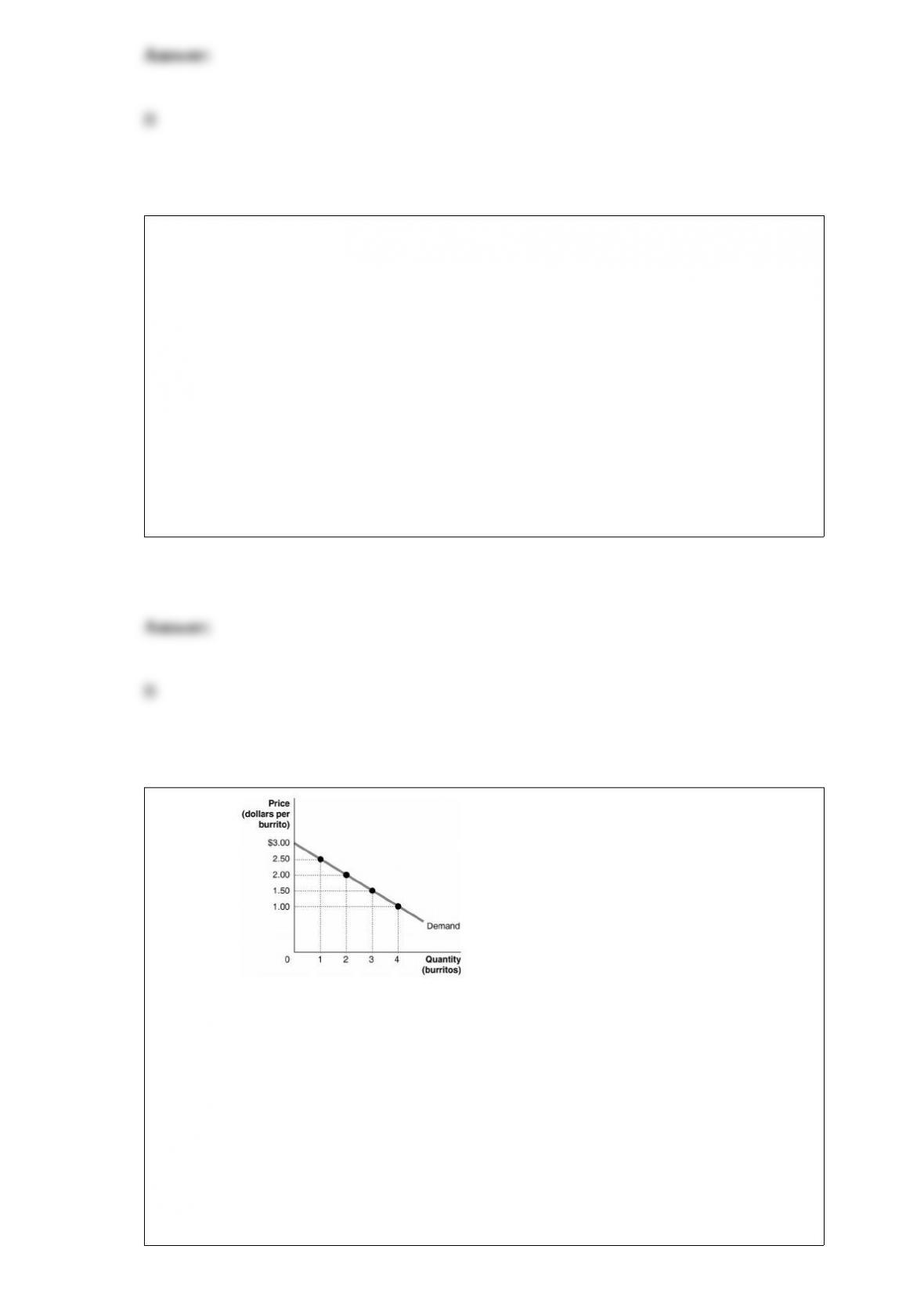
Figure 4-1 Figure 4-1 shows Arnold’s demand curve for
burritos.
What is the total amount that Arnold is willing to pay for 4 burritos?
A) $1.00
B) $4.00
C) $7.00
D) $10.00

Which of the following is an example of a common resource?
A) catfish in a private pond in Mississippi
B) impounded dogs in a dog pound
C) public health care services in the United States
D) sea otters in the coastal waters of the Pacific Ocean
Of the following, which has most likely contributed the most to the rapid rise in health
care costs in the United States?
A) the cost of malpractice insurance
B) the cost to treat uninsured patients
C) slow growth in labor productivity in health care
D) the cost of malpractice lawsuit settlements

If Congress passed a one-time tax cut in order to stimulate the economy in 2014, and
tax rate levels returned to their pre-2014 level in 2015, how should this tax cut affect
the economy?
A) The tax cut would increase consumption spending less than would a permanent tax
cut.
B) The tax cut would increase consumption spending more than would a permanent tax
cut.
C) The tax cut would increase consumption spending by the same amount as would a
permanent tax cut.
D) The tax cut would raise the price level in 2014.
Last year, the Pottery Palace supplied 8,000 ceramic pots at $40 each. This year, the
company supplied the same quantity of ceramic pots at $55 each. Based on this
evidence, The Pottery Palace has experienced
A) a decrease in supply.
B) an increase in supply.
C) an increase in the quantity supplied.
D) a decrease in the quantity supplied.
If an airport decides to expand by building an additional passenger terminal, and in
doing so it lowers its average cost per airplane landing, then the expansion would
provide ________ to the airlines.

A) economies of scale
B) diseconomies of scale
C) higher average costs but lower total costs
D) higher marginal costs but lower total costs