
Which of the following is an advantage of starting a new business as a corporation?
A) double taxation
B) ease in setting up
C) low expenses of legally organizing
D) greater ability to raise funds
Which of the following will not cause the labor demand curve to shift to the right?
A) an increase in the price of the firm’s product
B) a technological improvement that increases labor productivity
C) an increase in human capital in the labor force
D) an increase in the market wage rate
Gasoline taxes that are typically used for highway construction and maintenance are
consistent with which of the following principles of taxation?
A) the ability-to-pay principle
B) the horizontal-equity principle

C) the vertical-equity principle
D) the benefits-received principle
Suppose thatAmerican firms claim that protectionism in Canada is on the rise as the
Canadian government attempts to protect its infant industries. This protectionism will
cause the greatest harm to
A) Canadian manufacturers.
B) the Canadian government.
C) manufacturers who export to Canada.
D) Canadian consumers.
________ marginal opportunity cost implies that the more resources already devoted to
any activity, the payoff from allocating yet more resources to that activity increases by
progressively smaller amounts.
A) Increasing
B) Decreasing
C) Constant
D) Negative

Which of the following equations isincorrect?
A) ATC – AFC = AVC
B) AVC + AFC = ATC
C) AFC = ATC – AVC
D) ATC = AVC – AFC
In his book The Wealth of Nations, Adam Smith employed the example of a pin factory
in order to explain what economic concept?
A) the relationship between the marginal and average product of labor
B) the law of diminishing returns
C) why no firm would want to hire so many workers as to experience a negative
marginal product of labor
D) the division of labor

A positive externality results when
A) economists are sure that a good or service provides benefits to consumers.
B) someone pays for a good or service even though she is not directly affected by the
production or consumption of it.
C) when people who live in one country benefit from the production of a good or
service that occurs in another country.
D) people who are not directly involved in producing or paying for a good or service
benefit from it.
There are several types of barriers to entry that can create a monopoly. Which of the
following barriers is the result of government action?
A) network externalities
B) public franchise
C) economies of scale
D) control of a key resource

Diminishing marginal product of labor occurs when adding another unit of labor
A) decreases output.
B) changes output by an amount smaller than the output added by the previous unit of
labor.
C) increases output by an amount larger than the output added by the previous unit of
labor.
D) decreases output by an amount smaller than the output added by the previous unit of
labor.
If a firm is a natural monopoly, competition from other firms cannot be counted on to
force price down to the level where the company earns zero economic profit. How are
prices usually set in natural monopoly markets in the United States?
A) Each natural monopoly is made a public franchise. The public franchise is then
required to set its price equal to its marginal cost.
B) Natural monopolies are privately owned, but prices proposed by the firms must be
approved by the Antitrust Division of the Department of Justice.
C) Natural monopolies are privately owned and allowed to set their own prices.
Government regulation of the firms would result in greater deadweight losses.
D) Local or state regulatory commissions usually set prices for natural monopolies.

By drawing a demand curve with ________ on the vertical axis and ________ on the
horizontal axis, economists assume that the most important determinant of the demand
for a good is the ________ of the good.
A) quantity; price; quantity
B) price; quantity; quantity
C) price; quantity; price
D) quantity; price; price
When production reflects consumer preferences, ________ occurs.
A) allocative efficiency
B) productive efficiency
C) equity
D) efficient central planning
Table 14-9
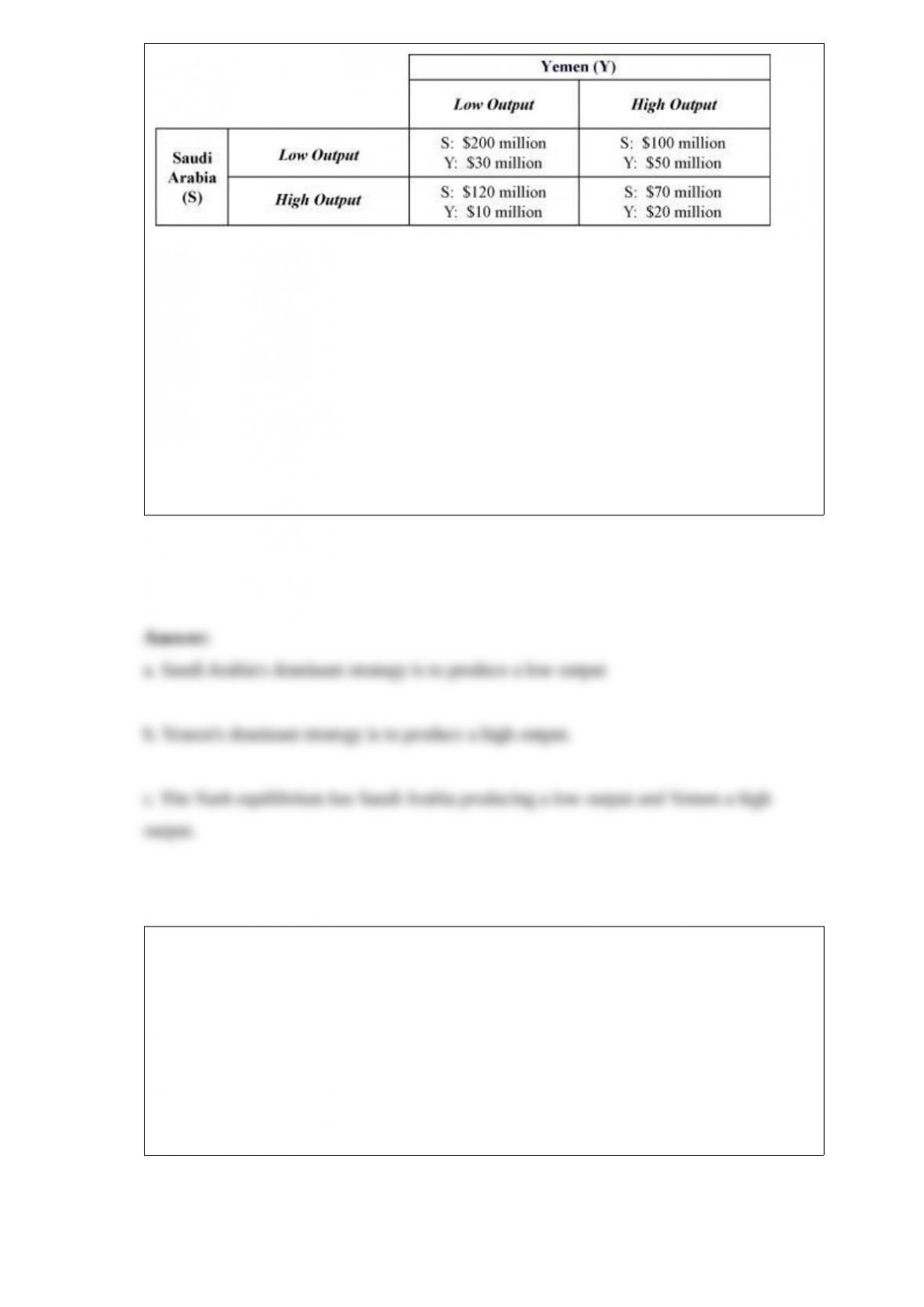
Refer to Table 14-9. Saudi Arabia and Yemen must decide how much oil to produce.
Since the demand for oil is inelastic, relatively low production rates drive up prices and
profits. Saudi Arabia, the world’s largest and lowest cost producer, is able to influence
market price; it has an incentive to keep output low. Yemen, on the other hand, is a
relatively high cost producer with much smaller reserves. Use the payoff matrix in
Table 14-9 to answer the following questions.
a. What is the dominant strategy for Saudi Arabia?
b. What is the dominant strategy for Yemen?
c. What is the Nash equilibrium?
Eighty-five percent of all firms employ ________ workers.
A) only one or two
B) fewer than 20
C) 50 or more
D) over 100
David Myers, former controller for WorldCom, pleaded guilty to falsely reported costs
for WorldCom that were ________ than they actually were, resulting in reported
accounting profits for WorldCom that were ________ than their actual level.
A) higher; higher
B) lower; higher
C) lower; lower
D) higher; lower
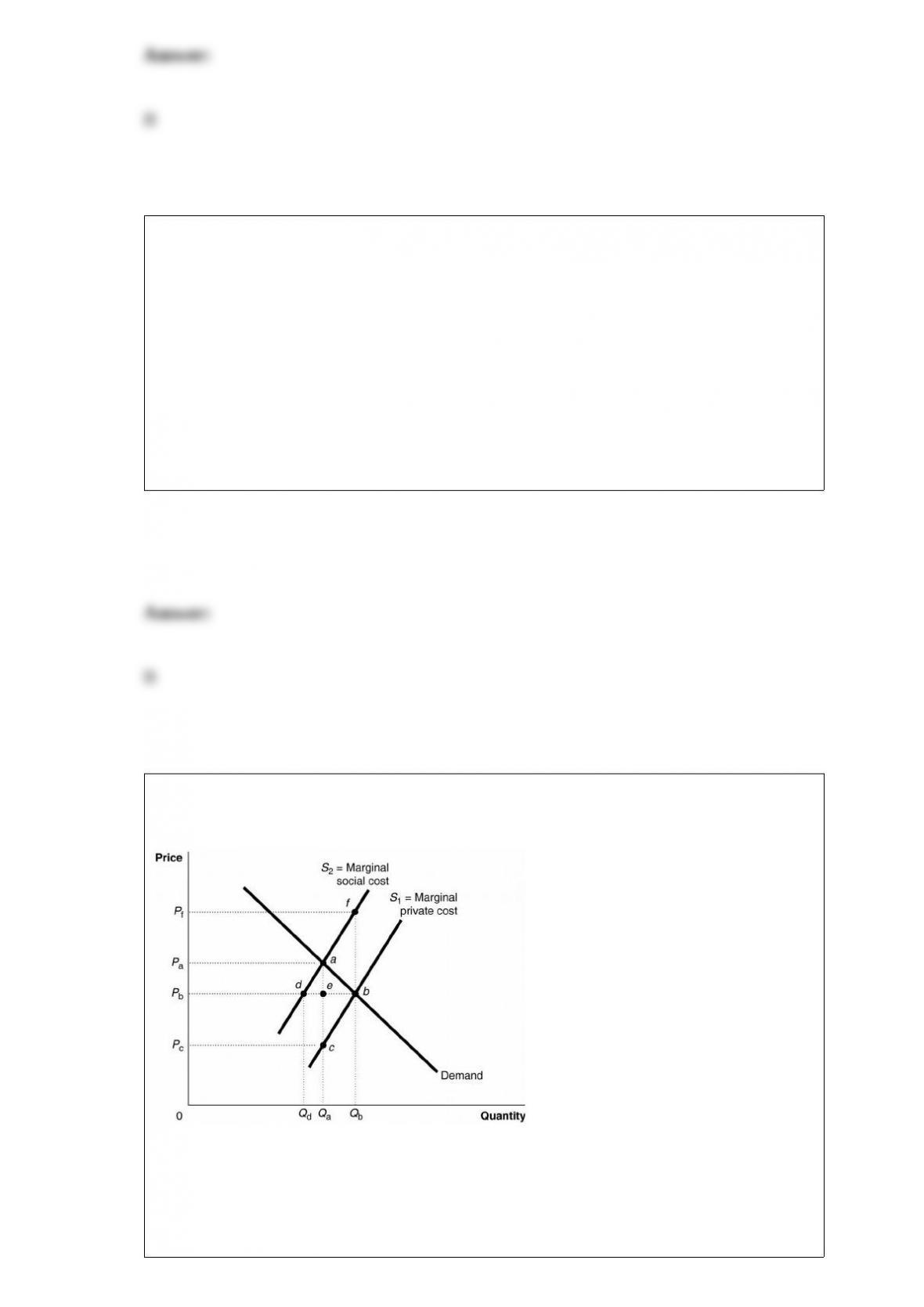
Figure 5-2
Figure 5-2 shows a market with a negative externality.
Refer to Figure 5-2. The efficient output level is
A) Qd.

B) Qb.
C) Qa.
D) Qb– Qd.
What is the present value of $888 in a one year if the current rate of interest is five
percent?
A) $4,440
B) $845.71
C) $177.60
D) none of these
Figure 5-3
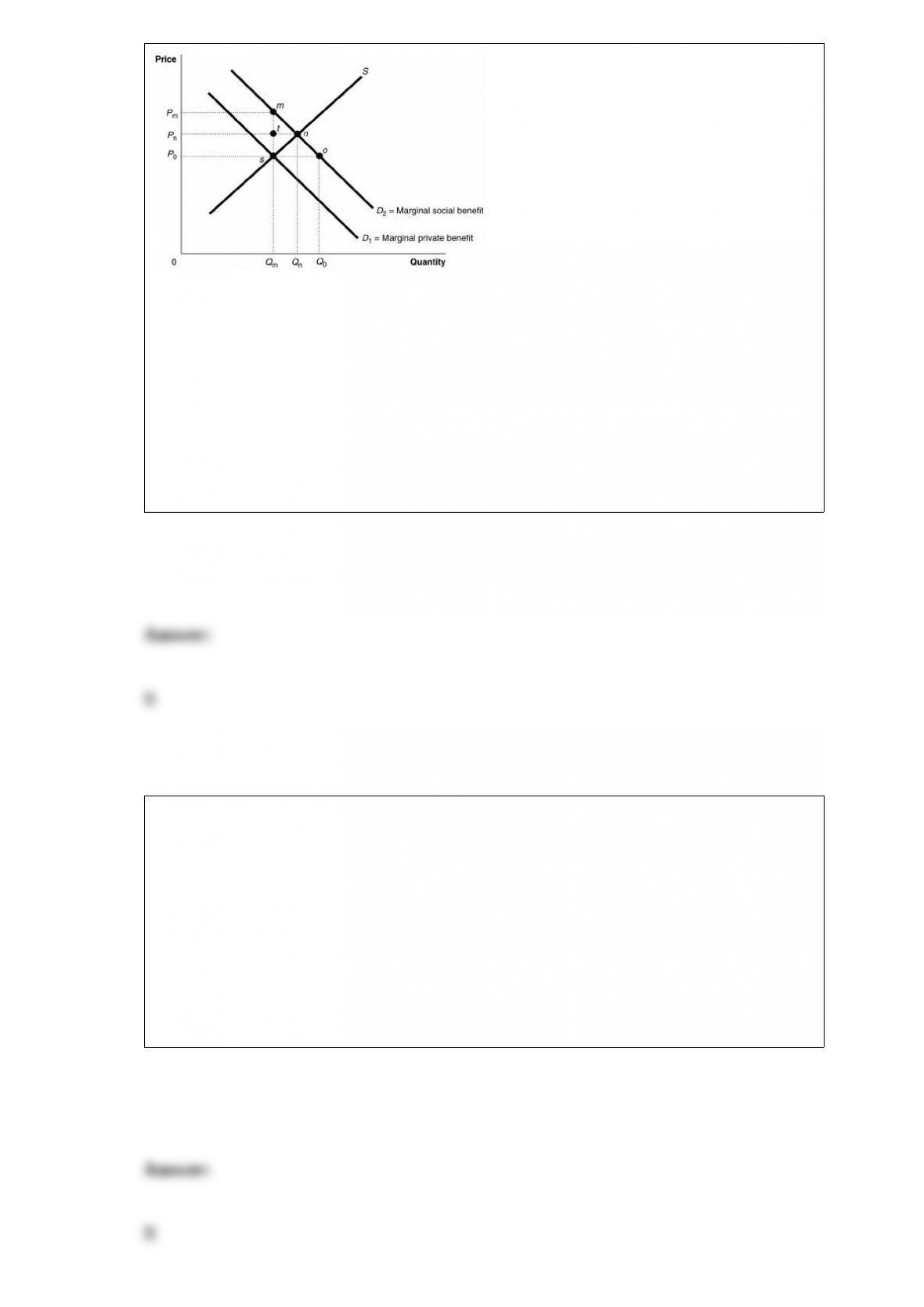
Refer to Figure 5-3. The deadweight loss due to the externality is represented by the
area
A) mso.
B) msn.
C) nso.
D) mtn.
Since 1994, obesity rates in the United States
A) have been on a slow and steady decline.
B) have increased in all 50 states.
C) have primarily increased in the Southeast and remained constant or slightly
decreased in the remainder of the country.
D) have remained fairly constant throughout the country.
Which of the following statements is false?
A) When marginal cost equals average total cost, average total cost is at its highest
value.
B) The marginal cost curve intersects the average variable cost curve and the average
total cost curve at their minimum points.
C) The difference between average total cost and average fixed cost is average variable
cost.
D) Firms often refer to the process of lowering average fixed cost as ‘spreading the
overhead.”
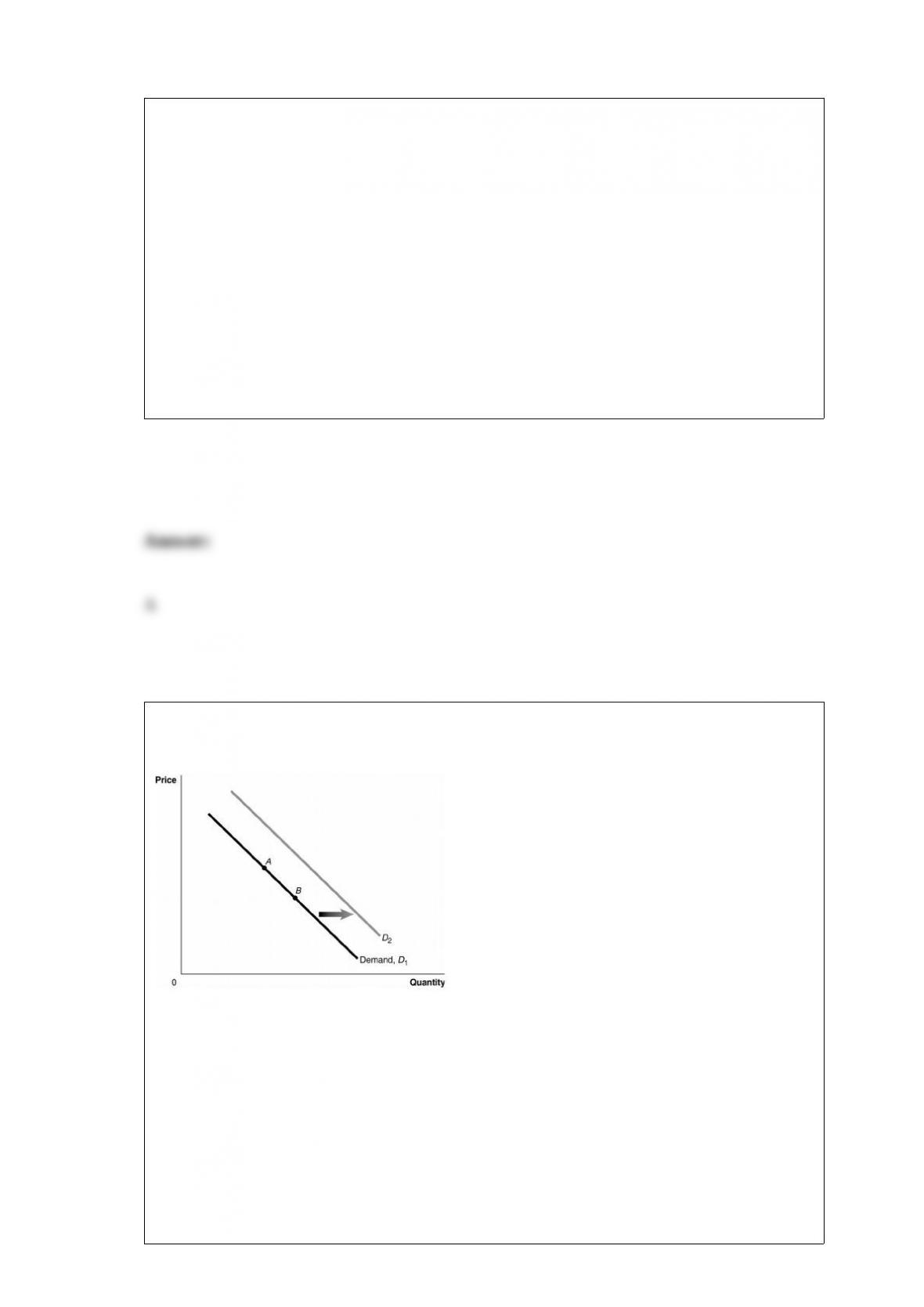
Figure 3-1
Refer to Figure 3-1. An increase in population would be represented by a movement
from
A) A to B.
B) B to A.
C) D1 to D2.
D) D2 to D1.

The public choice model assumes that government policy makers
A) must promote the public interest at the expense of their own self-interests in order to
be re-elected.
B) will pursue their self-interests in personal affairs but only if it does not conflict with
the public interest.
C) will often act irrationally in their personal affairs, but will act rationally when they
promote the public interest.
D) are likely to pursue their own self-interests, even if their self-interests conflict with
the public interest.
Figure 16-6
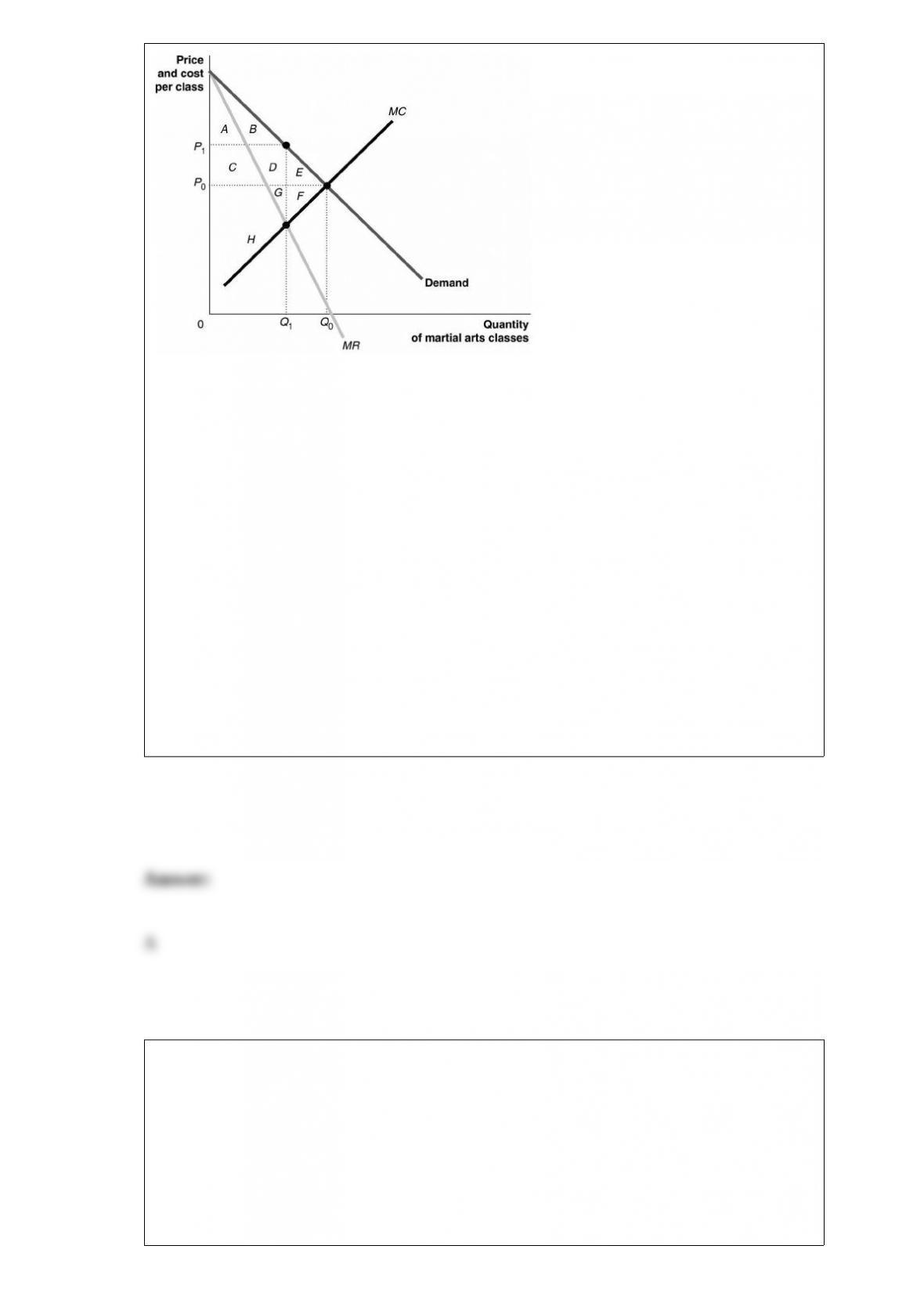
Watanabe Sensei operates the only martial arts school in Hartfield. For simplicity,
assume that consumers have identical demand curves and that Sensei knows what this
demand curve is. Figure 16-6 shows this demand curve.
Refer to Figure 16-6. Sensei’s friend, Marcel, suggests that he charge a one-time
membership fee to use the martial arts school, in addition to a per-class charge. Suppose
Sensei charges the monopoly price for each class and also imposes a one-time
membership fee. What is the maximum amount of revenue from the membership fee he
can collect from all his customers?
A) an amount equal to the area A + B
B) an amount equal to the area E + F
C) an amount equal to the area H + G
D) an amount equal to the area A + C + H
Households ________ final goods and services in the ________ market.
A) purchase; factor
B) purchase; product
C) sell; factor

D) sell; product
The ________ is an agency created to provide financing for national economic
development efforts.
A) Global Financial Markets Association
B) World Trade Organization
C) Financial Stability Board
D) World Bank
Figure 1-1
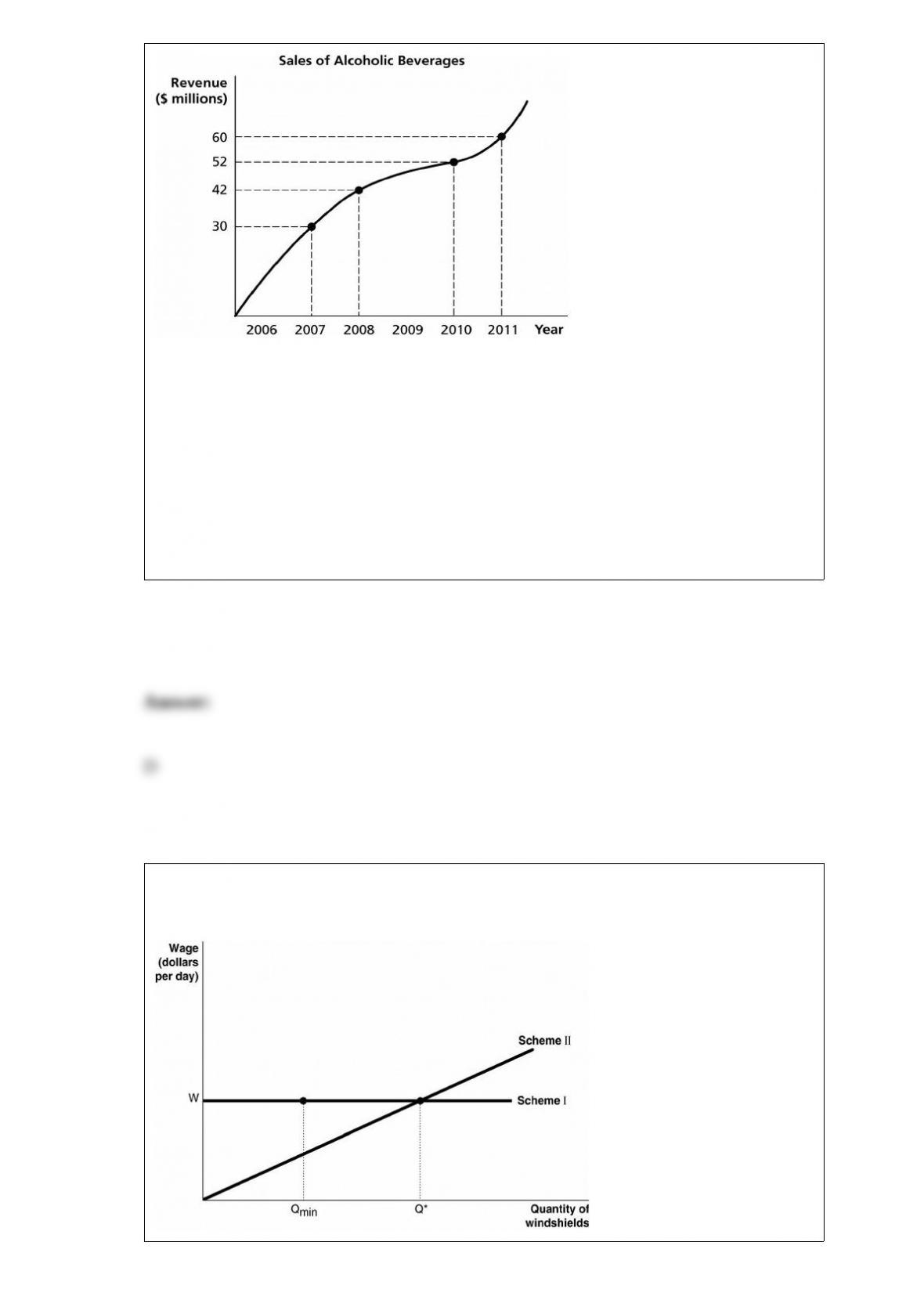
Refer to Figure 1-1. Using the information in the figure above, calculate the percentage
change in sales of alcoholic beverages between 2007 and 2011.
A) 30%
B) 50%
C) 66.7%
D) 100%
Figure 17-6

Figure 17-6 shows two different compensation schemes for the Safelite Glass
Corporation, an installer of auto glass windshields. Under Scheme I, the firm pays a
consistent wage of $80 per day based on an 8-hour workday. Qmin represents the cut-off
point under the hourly-wage system: if a worker installed fewer than Qmin windshields,
the worker got fired. Scheme II represents a piece-rate scheme with an earnings floor:
no worker would get less than $80 per day (for an 8-hour workday) and would have to
produce at least Qmin. For any output level beyond Q* the worker earned an additional
$20 for each unit produced.
Refer to Figure 17-6. Which of the following statements about Scheme II is false?
A) It is likely to draw highly productive workers who see the opportunity to increase
their wages.
B) It could discourage less productive workers and induce them to leave the firm.
C) It allows workers to increase their daily wage without penalizing those who are
content with their daily wage.
D) It is more risky for senior employees.
Adam Smith’s behavioral assumption about humans was that people
A) typically act irrationally.
B) usually act in a rational, self-interested way.
C) are consistently greedy.
D) typically act randomly.
If a typical firm in a perfectly competitive industry is earning profits, then
A) all firms will continue to earn profits.
B) new firms will enter in the long run causing market supply to decrease, market price
to rise and profits to increase.
C) new firms will enter in the long run causing market supply to increase, market price
to fall and profits to decrease.
D) the number of firms in the industry will remain constant in the long run.
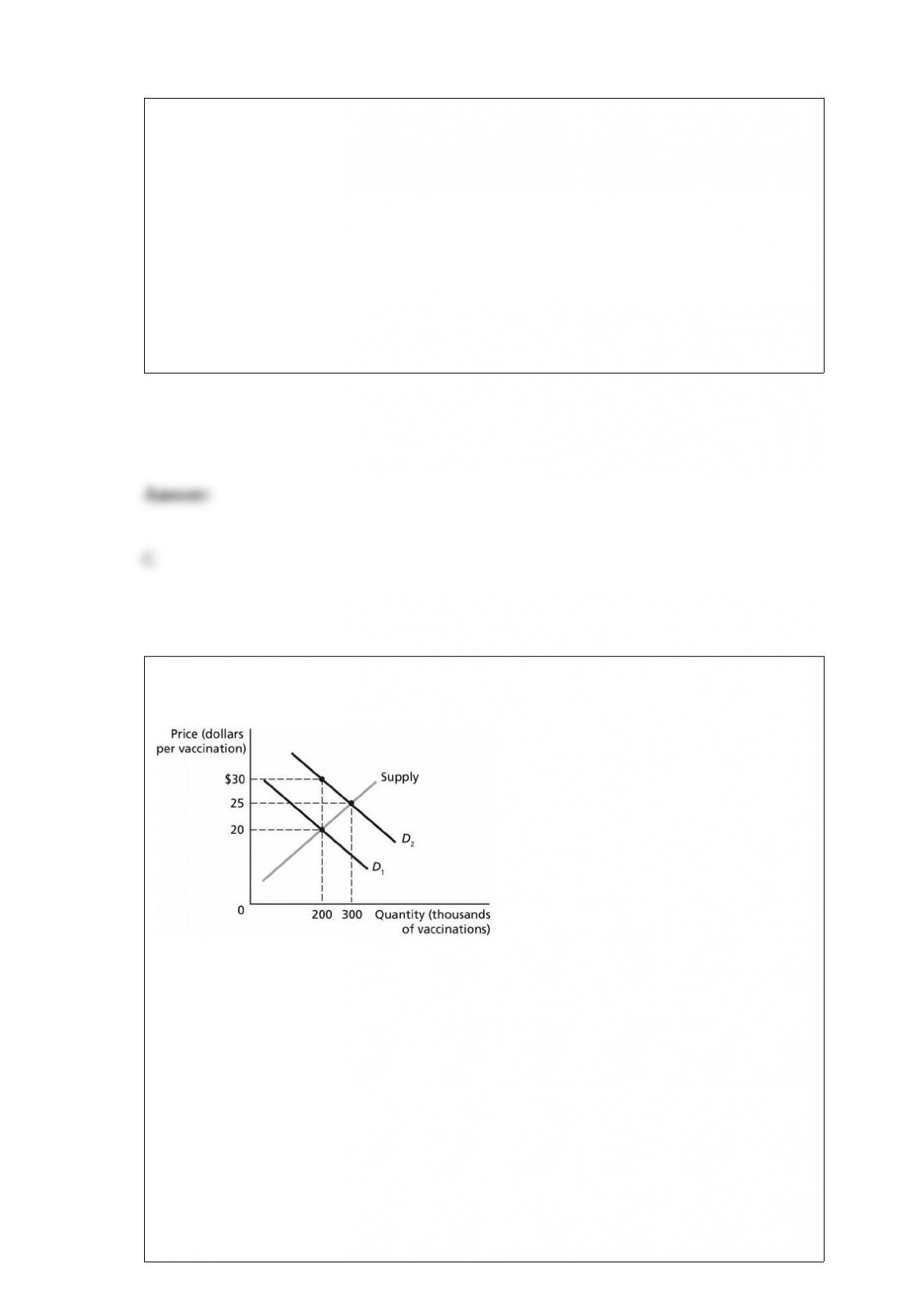
Figure 7-1
Figure 7-1 represents the market for vaccinations. Vaccinations are considered a benefit
to society, and the figure shows both the marginal private benefit and the marginal
social benefit from vaccinations.
Refer to Figure 7-1. Marginal social benefit is represented by which curve?
A) D1
B) D2
C) Supply
D) All of the above represent marginal social benefit.