For a given nominal exchange rate and foreign price level, a decrease in the domestic
price level ______ the real exchange rate.
A. increases
B. decreases
C. may either increase or decrease
D. offsets any change in
The absolute price of a good in dollar terms is the good’s:
A. market price
B. equilibrium price
C. nominal price
D. marginal price
Given the demand curve it faces, if an imperfectly competitive firm wants to sell
another unit of output, it must:
A. increase its advertising.
B. increase the value of its product.
C. lower its price.
D. lower its quality.
If the price elasticity of demand for a good is greater than one, then the demand for that
good is:
A. elastic.
B. inelastic.
C. unit elastic.
D. perfectly elastic.
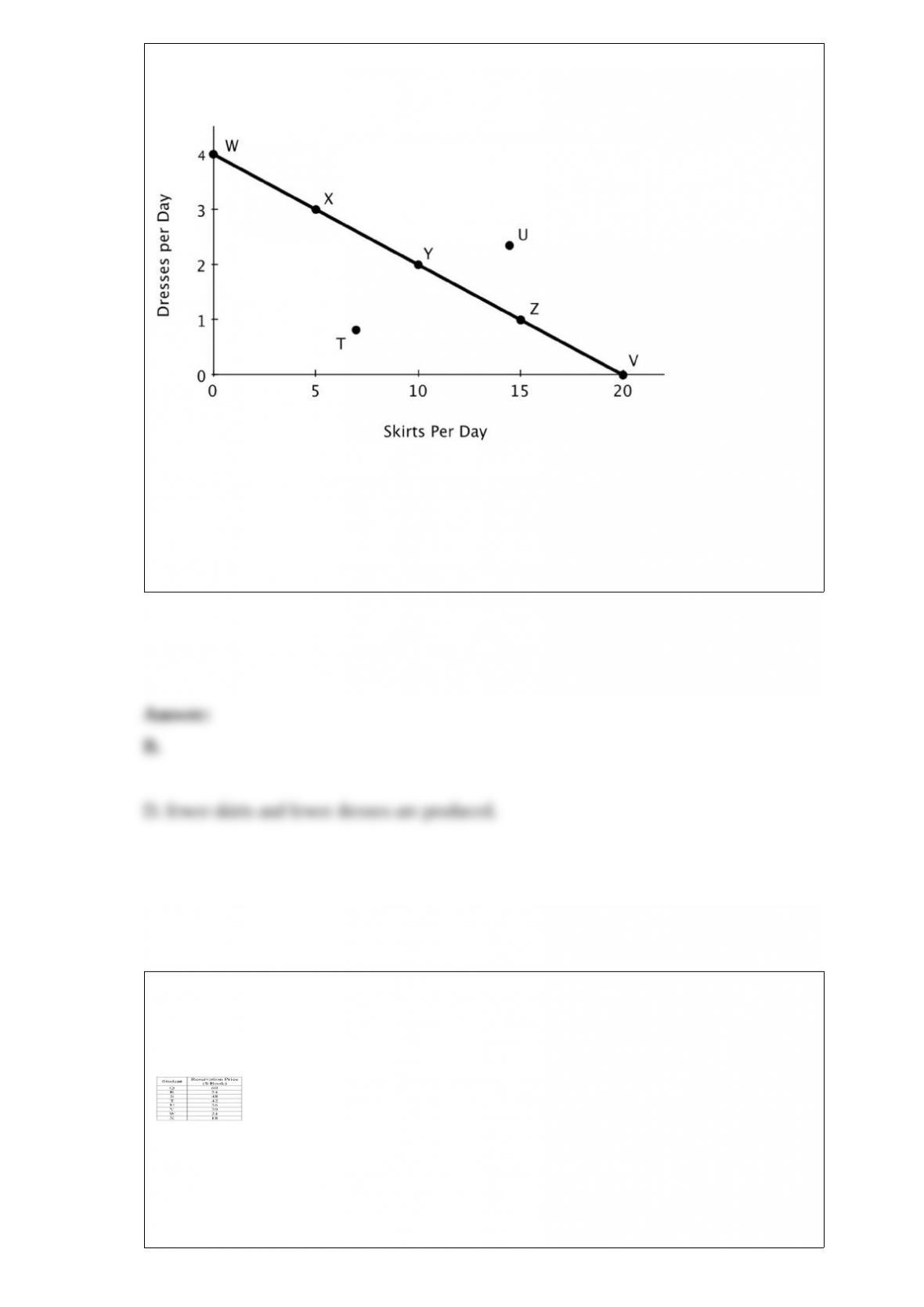
The figure below shows Becky’s daily production possibilities curve for dresses and
skirts.
Relative to point X, at point Y:
A. more dresses and more skirts are produced.
B. more skirts and fewer dresses are produced.
C. more dresses and fewer skirts are produced.
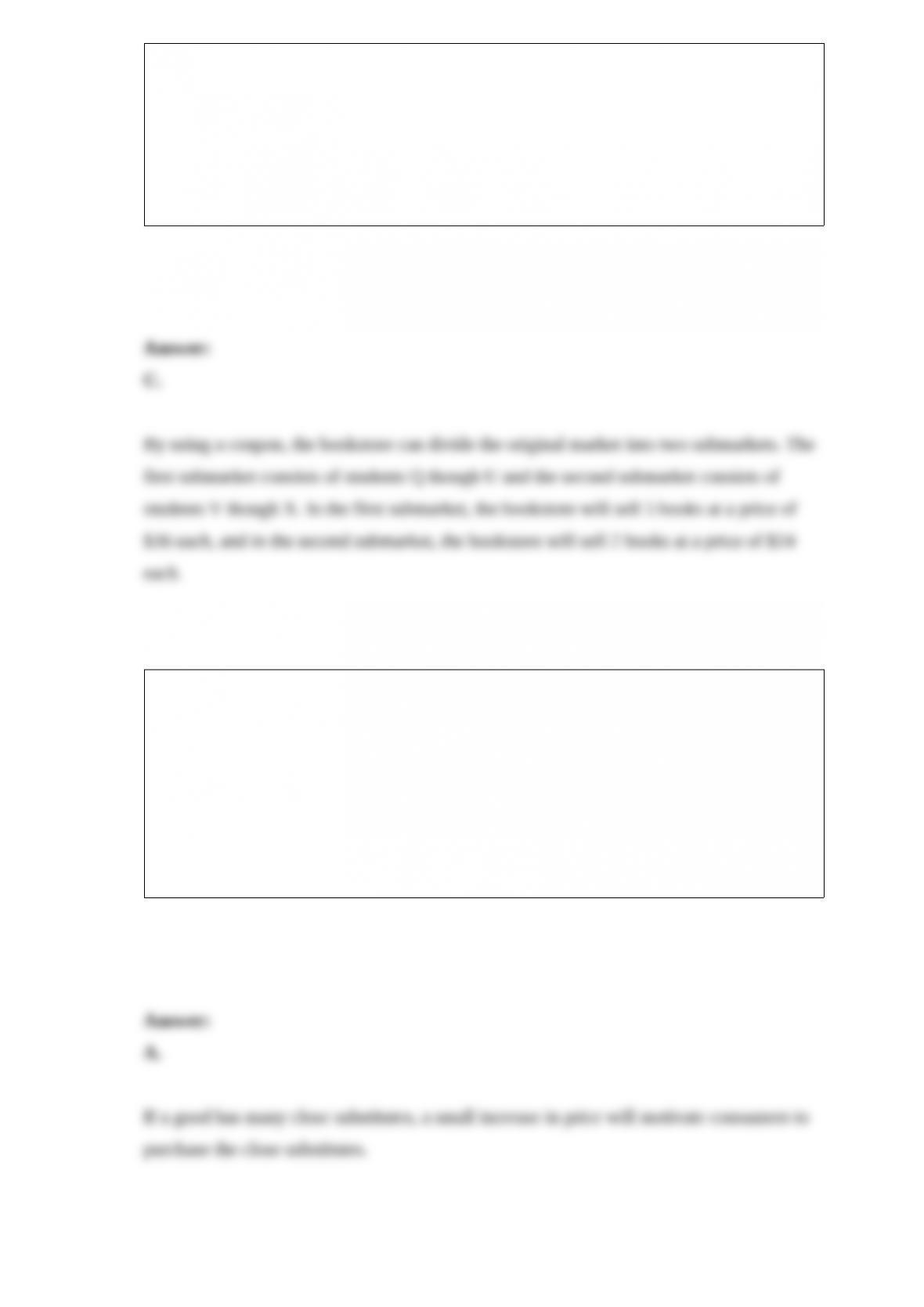
Suppose Campus Books, a profit-maximizing firm, is the only supplier of the textbook
for a given class. The marginal cost of supplying each book is constant and equal to
$10, and Campus Books has no fixed costs. The table below shows the reservation
prices of the eight students enrolled in the class.
If Campus Books is permitted to charge 2 prices, and the bookstore knows customers
with a reservation price above $30 never bother with coupons, whereas those with a
reservation price of $30 or less always use them, then the bookstore will set the list
price of the book to be _____ and the discounted price of the book to be ______.
A. $30; $24
B. $36; $30
C. $36; $24
D. $30; $18
If consumers can easily switch to a close substitute when the price of a good increases,
demand for that good is likely to be:
A. elastic.
B. inelastic.
C. unit elastic.
D. perfectly inelastic.

Potential output is:
A. equal to actual output.
B. also known as the output gap.
C. the same as the natural rate of unemployment.
D. the maximum sustainable amount of output.
Inflation inertia is the tendency for inflation to:
A. equal zero.
B. change relatively slowly from year to year.
C. decrease when the Fed increases interest rates.
D. increase when the Fed decreases interest rates.
If all taxpayers pay the same dollar amount, the tax is termed a:
A. proportional tax.
B. progressive tax.

C. head tax.
D. per unit tax.
If the marginal cost of pollution abatement differs across firms, then regulations that
require all polluters to reduce pollution by a fixed proportion will be:
A. efficient.
B. inefficient
C. ineffective.
D. fair to all polluters.
Business managers are people who:
A. engage exclusively in business travel.
B. entertain the workers.
C. run businesses on a day-to-day basis.
D. own the physical capital used in production.
Airlines that charge higher prices for customers who purchase their tickets at the last
minute are:
A. not price discriminating because the cost of the ticket is not the same.
B. price discriminating by identifying passengers with higher reservation prices.
C. perfect price discriminators.
D. lowering total economic surplus.
Curly is offered the following gamble: a 25% chance of winning $1,500 and a 75%
chance of losing $500. This is a(n):
A. fair gamble.
B. unfair gamble.
C. almost-fair gamble.
D. better-than-fair gamble.

The principal amount of a bond is the amount:
A. originally lent.
B. of interest agreed upon when the bond was originally issued.
C. paid to the bondholders on a regular basis.
D. of interest the bondholder is entitled to when the bond matures.
When the government runs a budget surplus, it uses the funds to:
A. issue bonds.
B. pay down outstanding debt.
C. decrease transfer payments.
D. decrease public saving.

The purchasing power parity theory is not a good explanation of nominal exchange rate
determination in the short run because:
A. there is no evidence that low inflation is associated with less rapid nominal exchange
rate depreciation.
B. most nominal exchange rates are fixed and foreign exchange markets do not bring
the supply and demand for currencies into equilibrium.
C. most goods and services are traded internationally and are standardized.
D. many goods and services are not traded internationally and not all
internationally-traded goods are standardized.
A CPI that equals 1.34 in 2008 (when 2000 is the base year) means that:
A. prices in 2008 are 34 percent higher than in 2007.
B. the CPI equals $1.34 in 2008.
C. the inflation rate in 2008 is 134 percent.
D. the average level of prices is 34 percent higher in 2008 than in the base year.
Fran is considering moving to Denver. There is a 70% chance that he will find a job that
pays $1,000 more than what he currently earns and a 30% chance he will find one that
pays $3,000 less. The expected value of moving to Denver is:

A. -$200.
B. $200.
C. $700.
D. $900.
The figure below shows the marginal benefit of hiring a security guard at the airport
(MBA), the bank (MBB) and City Hall (MBC). The marginal cost of hiring a security
guard is the same at all three places and is given by MC.
If each place hires the socially optimal number of security guards, the marginal benefit
of the last security guard hired at each place will be the:
A. same at all three places.
B. highest at the airport.
C. highest at the bank.
D. highest at City Hall.
The four components of aggregate expenditures are:
A. consumption, imports, government spending, and net exports.

B. consumption, interest payments, government spending, and net exports.
C. consumer durables, investment, government spending, and net exports.
D. consumption, investment, government spending, and net exports.
If short-run equilibrium output equals 10,000, the income-expenditure multiplier equals
10, the mpc equals 0.9, and potential output (Y*) equals 9,000, then taxes must be
increased by approximately ______ to eliminate any output gap.
A. 90
B. 100
C. 111
D. 1,000
Supply curves are generally _______ sloping because _______________.
A. downward; more consumers will buy the good if the price falls.
B. upward; of the principle of increasing opportunity costs.
C. downward; it is less expensive to mass-produce goods.
D. upward; of inflation.
Refer to the figure below.
If this market is unregulated, total economic surplus is:
A. $20.
B. $32.
C. $48.
D. $84.
The exchange rate that equates the quantities of currency supplied and demanded in the
foreign exchange market is called the ______ exchange rate.
A. real value of the

B. market equilibrium value of the
C. target value of the
D. fixed value of the
The CPI is a measure of the:
A. real wage.
B. price of a specific good or service.
C. rate of inflation.
D. average level of prices relative to prices in the base year.
If a nation has the lowest opportunity cost of producing a good, that nation has a(n)
______ in the production of that good.
A. comparative advantage
B. absolute advantage
C. comparative advantage and an absolute advantage
D. absolute advantage and possibly a comparative advantage.
For the past 40 years, the Federal Reserve has expressed policy in terms of a target
value for:
A. bank reserves.
B. the Federal Reserve discount rate.
C. the federal funds rate.
D. open market operations.
Investment spending includes spending on:
A. durables, nondurables, and services.
B. stocks, bonds, and other financial instruments.
C. capital goods, residential housing, and changes in inventories.
D. goods and services by federal, state, and local governments.

When the inflation rate increases, PAE ______, which in turn causes Y to ______
because of ______.
A. falls; fall; the income-expenditure multiplier
B. falls; rise; the income-expenditure multiplier
C. rises; rise; the wealth effect
D. rises; fall; the wealth effect