1)
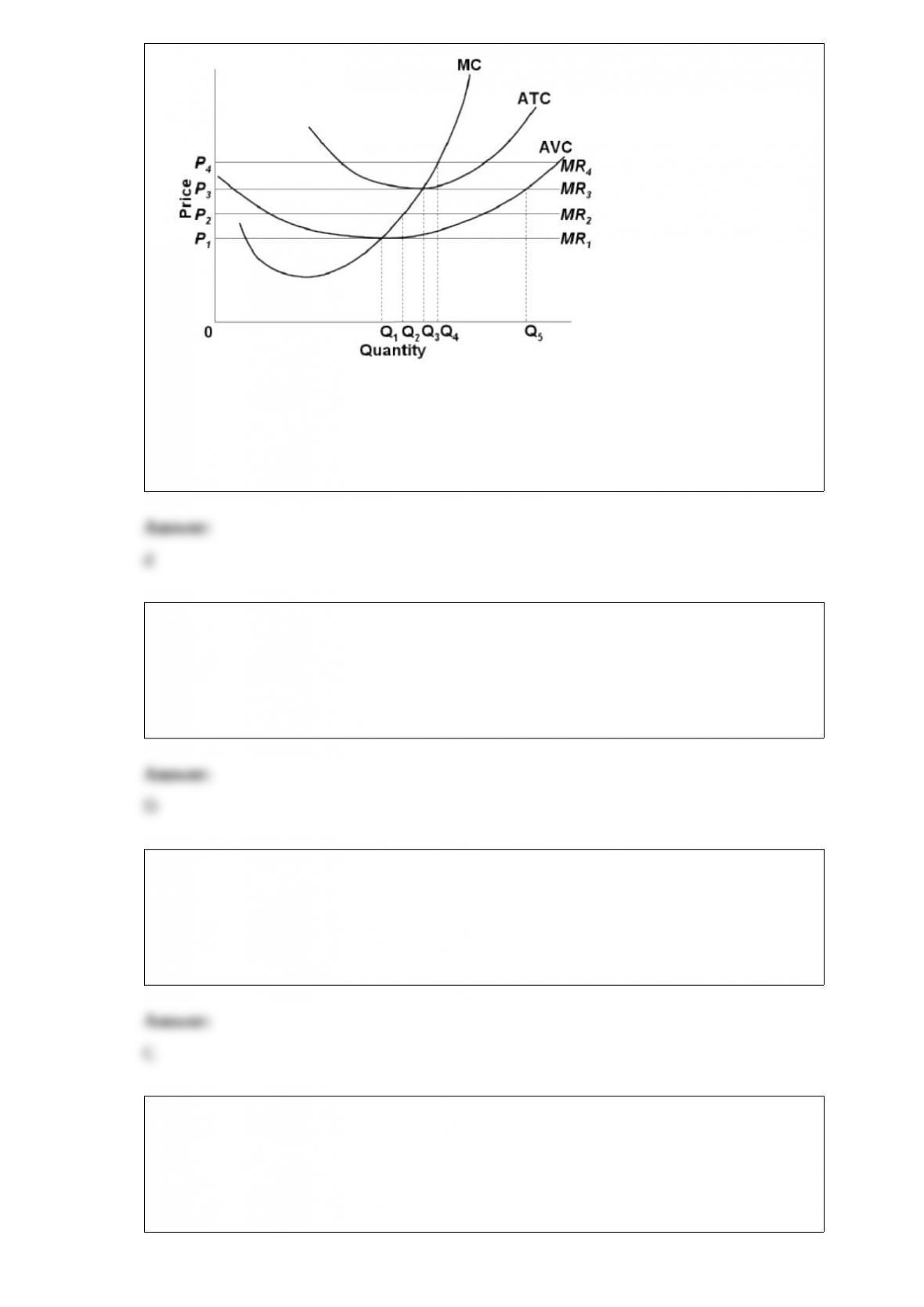
refer to the above diagram. the firm will realize an economic profit if price is:
a.p1
b.p2
c.p3
d.p4
2) A negative externality or spillover cost occurs when:
A.firms fail to achieve allocative efficiency.
B.firms fail to achieve productive efficiency.
C.price exceeds marginal cost.
D.the total cost of producing a good exceeds the costs borne by the producer.
3) Banks destroy money when they:
A.buy government bonds.
B.accept deposits of cash into checkable accounts.
C.fail to reissue loans that are paid off.
D.clear checks against another bank.
4) in terms of absolute dollar volume, the world’s leading export nations are:
a.germany, the united states, and china.
b.the united states, japan, and canada.
c.japan, china, and great britain.
d.japan, the united states, and france.
5) The majority of union members in the United States belong to unions that are:
A.affiliated with the United Workers of America (UWA).
B.affiliated with the AFL-CIO.
C.independent unions that are not affiliated with the AFL-CIO.
D.growing rapidly in membership.
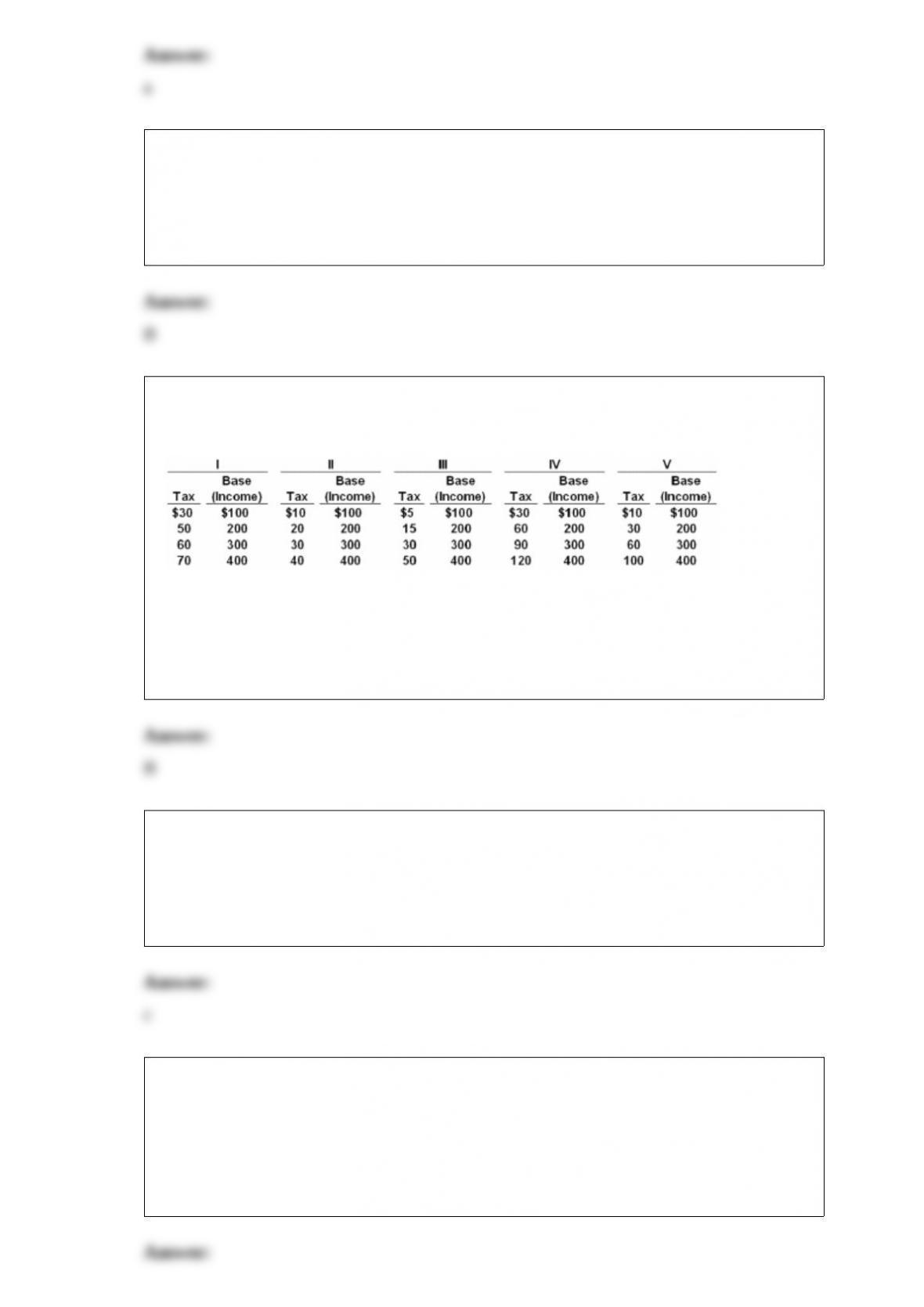
6) These five schedules represent income tax schedules for an economy. All figures are
in billions of dollars.
Which of the above schedules represent(s) a progressive tax?
A.V only
B.III and V
C.II and III
D.III only
7) pure monopoly means:
a.any market in which the demand curve to the firm is downsloping.
b.a standardized product being produced by many firms.
c.a single firm producing a product for which there are no close substitutes.
d.a large number of firms producing a differentiated product.
8) in which one of the following market models is x-inefficiency most likely to be the
greatest?
a.pure competition
b.oligopoly
c.monopolistic competition
d.pure monopoly
9) Exports have the same effect on the current size of GDP as:
A.imports.
B.investment.
C.taxes.
D.saving.
10) a market for human organs (rather than the current volunteer-donor system) would
be expected to:
a.reduce the price of organs.
b.create a surplus of organs.
c.reduce the supply of organs.
d.eliminate the shortage of organs.
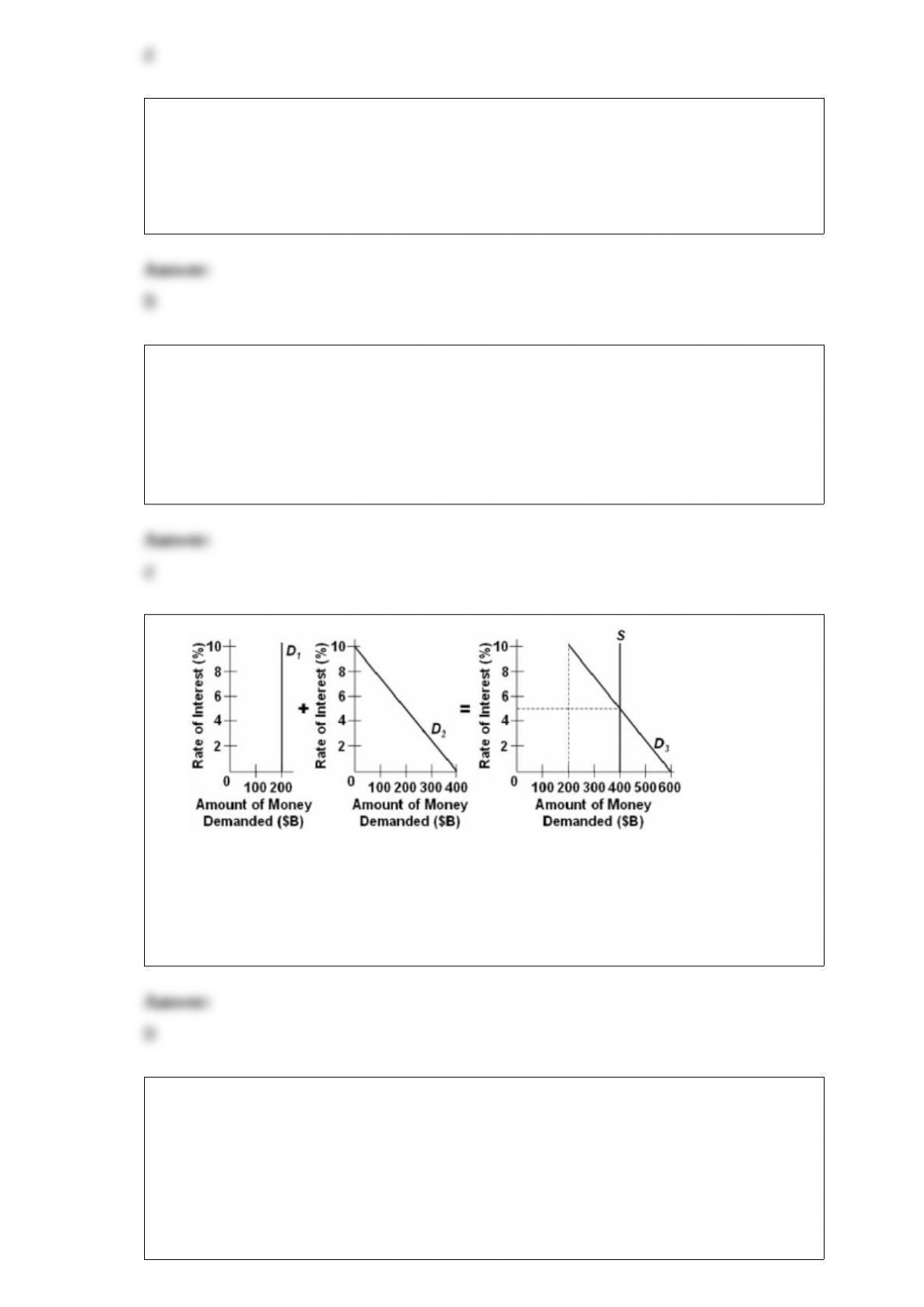
11)
Refer to the above market for money diagrams. Curve D1 represents the:
A.total demand for money.
B.transactions demand for money.
C.asset demand for money.
D.stock of money.
12) According to the purchasing power parity theory of exchange rates:
A.a dollar, when converted to other currencies at the prevailing floating exchange rate,
has the same purchasing power in various countries.
B.in equilibrium, national currencies have equal value in terms of gold.
C.the higher a nation’s price level in terms of its own currency, the greater is the amount
of foreign exchange it can obtain for a unit of its currency.
D.nominal currency values will tend to equalize (become 1 = 1) in the long run.

13) the ajax manufacturing company is selling in a purely competitive market. its
output is 100 units which sell at $4 each. at this level of output total cost is $600, total
fixed cost is $100, and marginal cost is $4. the firm should:
a.reduce output to about 80 units.
b.expand its production.
c.continue to produce 100 units.
d.produce zero units of output.