1) Insurance companies are a major category of financial institutions.
2) Official unemployment statistics overstate unemployment because discouraged
workers who are not actively seeking work are counted as unemployed.
3) The maximum deposit creation that can be made in the banking system is equal to
the excess reserves divided by the required reserve ratio.
4) The marginal productivity theory of resource demand suggests that those resources
whose productivity levels are high will end up getting a higher share of the economy’s
income.
5) The federal funds rate target is the most frequently used monetary policy tool.
6) A change in investors’ feelings about risk will change the intercept (and therefore
shift) the Security Market Line.
7) In the market for sushi, an increase in the price of fish along with an increase in the
popularity of sushi among consumers will cause the equilibrium quantity to increase,
but the effect on the equilibrium price is indeterminate.

8) Economists and policymakers are generally more concerned about nominal GDP
than real GDP.
9) Neoclassical economics and behavioral economics are similar in the assumption that
people are capable of making accurate, sometimes complex, calculations with respect to
their utility-maximizing decisions.
10) The endowment effect makes people value things less when they think of those
things as their own as opposed to identical things that are not theirs – as in “grass is
greener on the other side”.
11)
The equation for the given saving schedule is:
A.Yd = -20 + .8S.
B.Yd = 20 + .2S.
C.S = -20 + .2Yd.
D.S = 20 + .8Yd.
12) All figures in the table below are in billions of dollars.
Refer to the above data. Gross investment is $8 billion, net exports are $4 billion, and
government collects a lump-sum tax of $30 billion and spends $30 billion. Assume all
taxes are personal taxes and that government spending does not entail shifts in the
consumption and investment schedules. The equilibrium GDP will be:
A.$280 billion
B.$290 billion
C.$300 billion
D.$310 billion
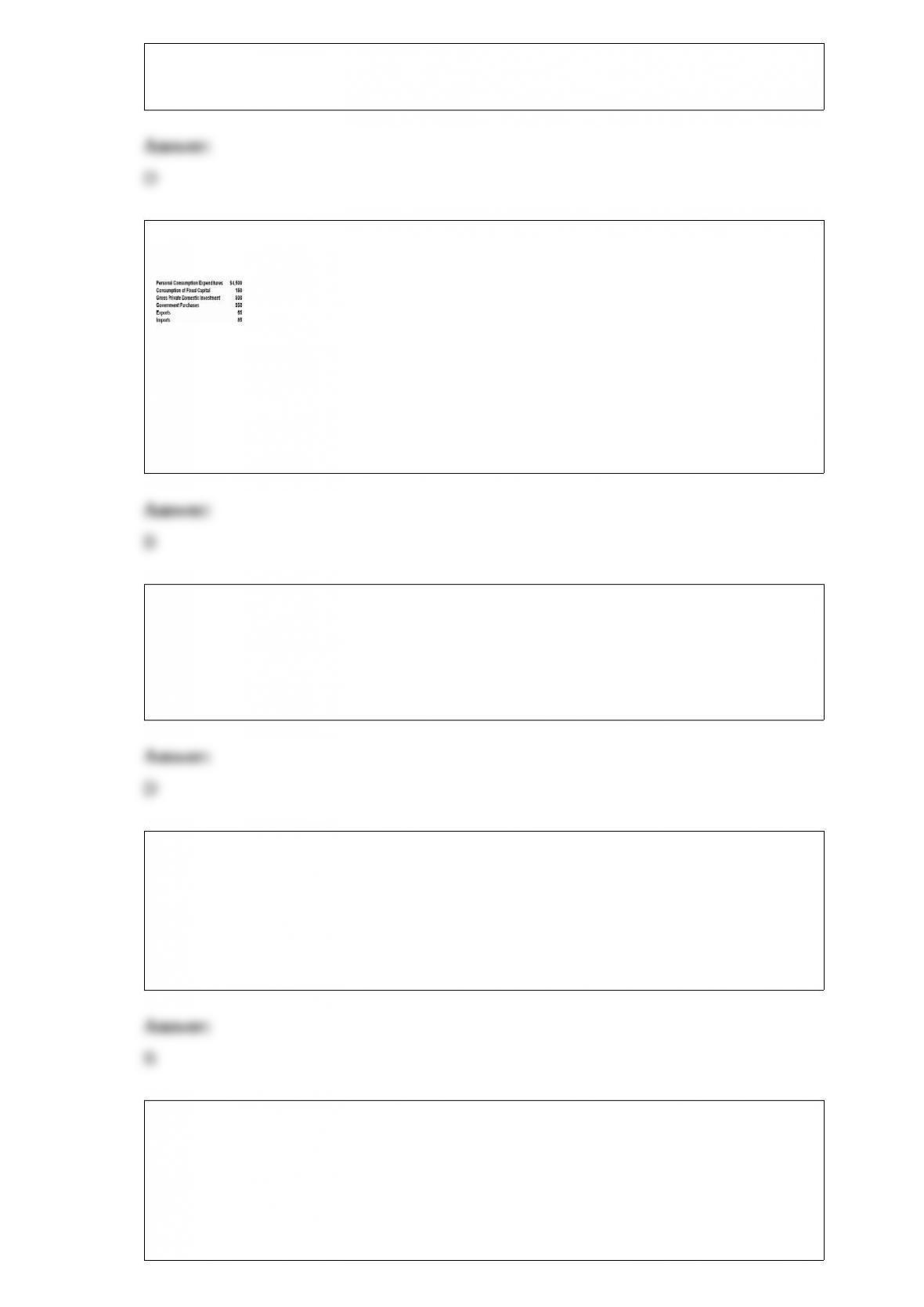
13) The following data about a hypothetical economy are in billions of dollars.
Refer to the above data. GDP in this economy is:
A.$6,080 billion
B.$6,230 billion
C.$6,380 billion
D.$6,400 billion
14) In the pizza analogy for income distribution, the pizza would shrink because:
A.The burden for the consumer would be greater than the burden for the producer
B.The risk of investment would be greater than the potential return on investment
C.There would be inequitable treatment of people
D.Redistribution would reduce incentives to work
15) Comparing an acreage allotment program versus a taxpayer-subsidized
price-support program, the acreage allotment program:
A.And the price-support program have similar costs to the taxpayers
B.Imposes a smaller cost on the taxpayers
C.Imposes a larger cost on the taxpayers
D.Does not impose a cost on the consumers
16) Which of the following statements is not correct?
A.An increase in a nation’s labor supply will cause its potential output to increase
B.Economic growth can be illustrated by an expansion of a nation’s production
possibilities curve
C.An increase in the quantity of a nation’s resources will cause economic growth, but an
increase in the quality of resources will not

D.New technologies or new ways of producing output can cause a nation’s production
possibilities curve to shift outwards
17) In the long run a monopolistically competitive firm:
A.earns an economic profit.
B.produces where P = ATC.
C.produces where MR exceeds MC.
D.achieves allocative efficiency.
18) Use the following diagrams for the U.S. economy to answer the following question.
Which of the diagrams best portrays an improvement in expected rates of return on
investment?
A.A.
B.B.
C.C.
D.D.
19) Which is the most valid criticism of the regulation of natural monopolies and other
firms subject to regulation by regulatory commissions?
A.It is difficult to find enough honest people to serve on regulatory commissions
B.Such regulation is unnecessary and amounts to creeping socialism
C.Many members of such commissions are appointed rather than being elected
D.Regulated firms may have little incentive to contain costs since they are assured a
“fair” return above costs
20) Kara’s Kittens typically produces and sells at its optimal (lowest per-unit cost) level
of 30 scratching posts per week. Kara’s also maintains an inventory of 20 scratching
posts. If prices are sticky and there is a positive demand shock this week resulting in
demand for 40 scratching posts, we would expect Kara’s to:

A.sell the additional scratching posts out of its inventory and rebuild the inventory later
when a negative demand shock occurs.
B.permanently expand production to 40 scratching posts per week.
C.raise prices on scratching posts.
D.introduce a new line of scratching posts.
21) The line that depicts the relationship between the average expected rate of return
and the risk level of a financial asset is known as the:
A.Beta Line.
B.Security Market Line.
C.Risk Premium Line.
D.Risk-Return Line.
22) Most economists believe that property taxes:
A.Should be eliminated
B.Are progressive
C.Are regressive
D.Should become an important source of revenue for the Federal government
23) In the kinked demand model of oligopoly, if one firm increases its price, the most
likely reaction of the other firms will be to:
A.Decrease their prices
B.Increase their prices
C.Not change their prices
D.Reduce their quantity
24) The effect of higher prices from the domestic sugar beet program in the United
States is:
A.Economically efficient because it maintains the income of sugar beet farmers and
reduces potential unemployment costs
B.That it discourages the production of sugar beets in the United States because
businesses cannot afford to use sugar beets in production
C.That it increases exports of sugar beets from the United States to other nations
D.”Regressive” because low-income households spend a larger percentage of their
income on food than do high-income households
25) The horizontal axis of a graph that shows a market demand curve indicates the:
A.Different prices at which various levels of output can be sold
B.Number of consumers who are in the market for this product
C.Various quantities of output at which the market will be cleared
D.Quantities which consumers will be willing and able to buy at various prices
26) The basic type of intervention by central banks under the managed floating
exchange rate system is to:
A.Readjust the peg for exchange rates
B.Buy and sell currencies to influence supply and demand for foreign exchange
C.Renegotiate the rate at which foreign currencies can be converted into gold
D.Make pronouncements but then do nothing and let the market set the exchange rate
27) Why do high fixed costs force firms to shut down temporarily or shut down
forever?
28) Discuss the pros and cons of legalizing drugs such as heroin or cocaine from an
economic perspective using the concepts of supply, demand, and elasticity.
29) Sue’s Shoe Shop is having a sale on shoes. The first pair of shoes is full price, the
second is 25% off, and the third is 50% off. Describe how this sale relates to individual
demand and marginal utility.
30) Why is GDP overstated in terms of the environment?
31) D.
32) The circular flow diagram below includes business, household, and government
sectors. Also shown are the product and resource markets. Supply a label or an
explanation for each of the twelve flows in the model.
33) How would a Verson stamping machine help a firm achieve economies of scale?