
The percentage change in quantity supplied that results from a 1 percent change in price
is known as the:
A. cross-price elasticity of supply.
B. slope of the supply curve.
C. price elasticity of supply.
D. cross-price elasticity of demand.
A perfectly elastic demand curve has a slope of ______ while a perfectly inelastic
demand curve has a slope of ______.
A. infinity; 0
B. 1; 0
C. 0; 1
D. 0; infinity

When Cody went to the physician with a sore elbow, after hearing Cody’s symptoms
and examining the elbow manually, Cody’s physician had two options: (1) prescribe an
anti-inflammatory drug and advise Cody to abstain from vigorous physical activity for a
period; or (2) advise Cody to undergo a magnetic resonance imaging (MRI) exam, a
costly diagnostic procedure. Which of the following physicians is more likely to
recommend option 1?
A. A physician who is compensated under a conventional health insurance plan.
B. A physician who is part of an HMO.
C. A physician who is not concerned about the marginal cost of an MRI.
D. All physicians would recommend option 1.
An increase in interest rates results in a(n) ______ in the required rate of return to hold
stocks and ______ current stock prices.
A. increase; reduces
B. increase; raises
C. decrease; raises
D. decrease; reduces
Planned investment may differ from actual investment because of:
A. changes in government purchases and net exports.
B. the marginal propensity to consume.
C. unplanned changes in inventories.
D. fluctuations in preset prices
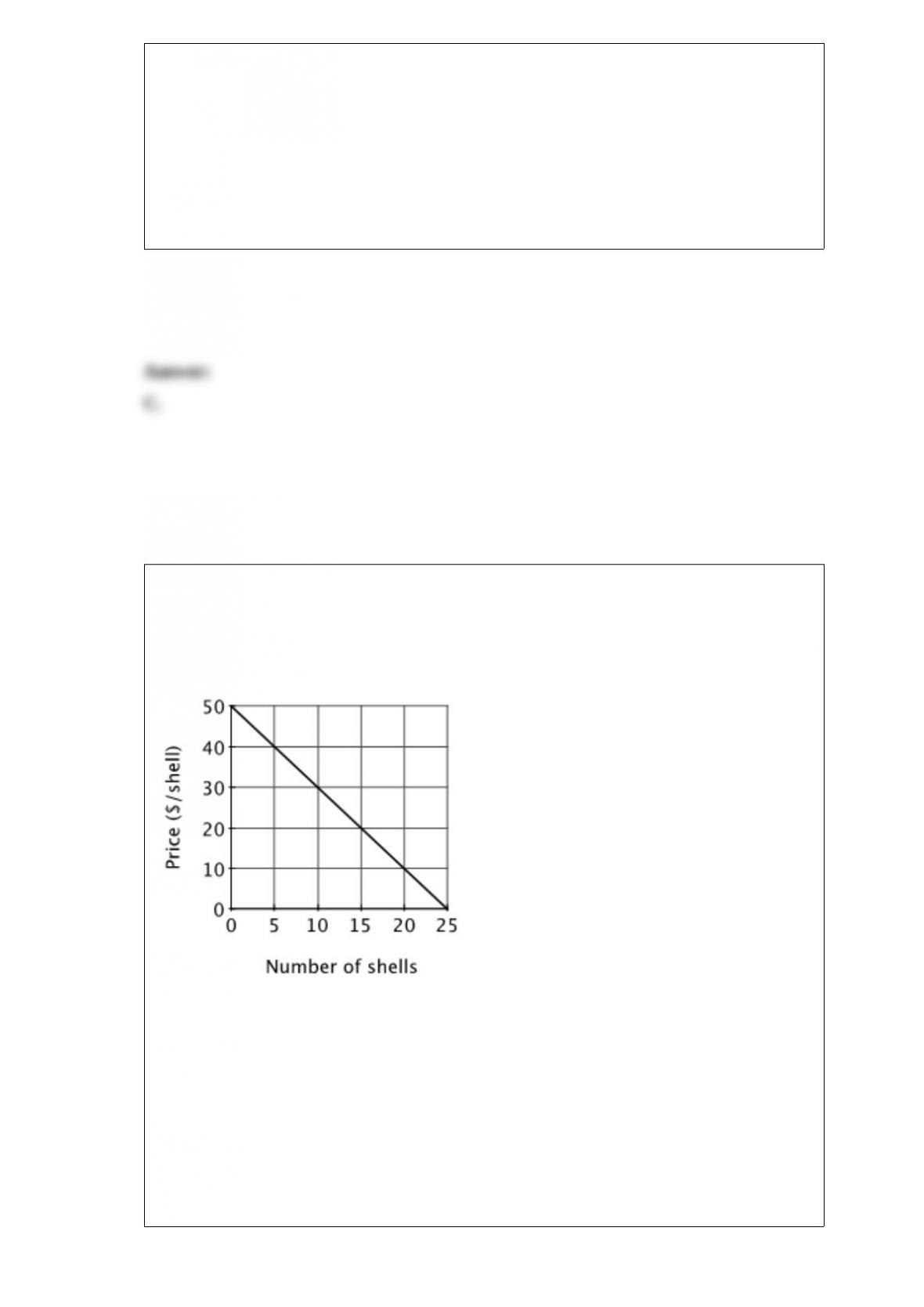
There are 20 residents in the village of Towneburg. The size of the village’s annual
fireworks display depends upon the number of shells that are fired off. Each resident’s
demand for fireworks is shown below. The total cost of the fireworks display is $1,000
plus $10 per shell.
Suppose 10 shells have been fired off. What is the marginal cost of firing off one more
shell?
A. $0
B. $10
C. $25
D. $100

Saving done for the purpose of leaving an inheritance is called ______ saving.
A. public
B. bequest
C. precautionary
D. life-cycle
Pascal is risk-averse while Marion is risk-neutral. Both are confronted with the
following gamble: win $5,000 with the probability of 65% or lose $9,000 with a
probability of 35%. One can predict that:
A. both might accept the gamble.
B. only Pascal will accept the gamble.
C. only Marion will accept the gamble.
D. neither will accept the gamble.

For a given nominal interest rate, an unexpectedly low inflation rate ______ the real
interest rate.
A. increases
B. decreases
C. has no impact on
D. may either increase or decrease
A fixed exchange rate is an exchange rate whose value:
A. is established annually by the International Monetary Fund.
B. varies according to supply and demand for the currency in the foreign exchange
market.
C. is set by official government policy.
D. reflects the comparative advantage of the home country versus other foreign
countries.

The payoff matrix below shows the daily profit for two firms, Row Restaurant and
Column Cafe, for two different strategies, publishing coupons in the student paper and
not publishing coupons in the student paper.
The payoffs of this game are such that:
A. if Row Restaurant expects Column Cafe to choose its dominant strategy, then Row
Restaurant should choose its dominated strategy.
B. profit at each firm is higher when they both follow their dominant strategy than
when they both follow their dominated strategy.
C. both firms would benefit from a law that made publishing coupons illegal.
D. an agreement not to publish coupons would be easy to maintain because neither firm
has an incentive to defect.
Suppose that all workers value a 1 percent reduction in the workplace injury rate at
$1,000 per year. The cost of reducing the injury rate by 1 percent is $200 per year for
each worker. Firms currently pay $20,000 per year to workers, without any effort to
improve safety. If new firms began to offer workers $19,500 and a 1 percent reduction
in the injury rate, then the total annual cost of hiring a worker would be ______ at the
new firms and ______ at the existing firms.
A. $19,500; $20,000
B. $18,500; $20,000
C. $19,500; $19,800
D. $19,700; $20,000
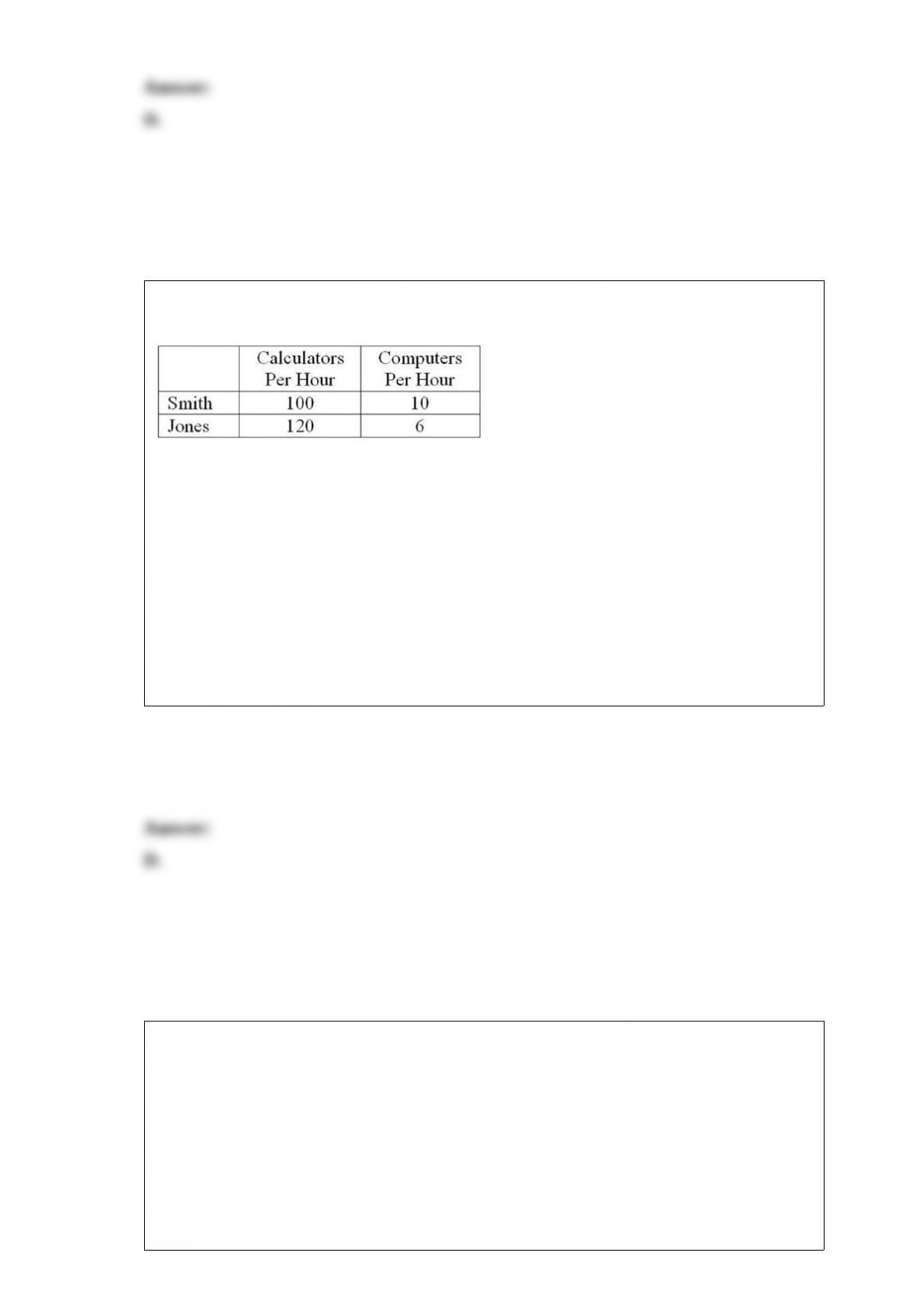
Smith and Jones comprise a two-person economy. Their hourly rates of production are
shown below.
Suppose Smith and Jones begin by producing 0 computers and 220 calculators per hour.
If they wish to produce 2 computers and 200 calculators per hour efficiently, then Smith
should spend ______, and Jones should spend ______.
A. 30 minutes on each; 30 minutes on each
B. 48 minutes on computers and 12 minutes on calculators; 1 hour on calculators
C. 1 hour on calculators; 10 minutes on computers and 50 minutes on calculators
D. 12 minutes on computers and 48 minutes on calculators; 1 hour on calculators
The bursting of the housing bubble in 2006 caused ______ to cut back on their
spending, thereby shifting the PAE line _____.
A. businesses and households; upward
B. businesses and households; downward
C. government and businesses; downward
D. government and businesses; upward
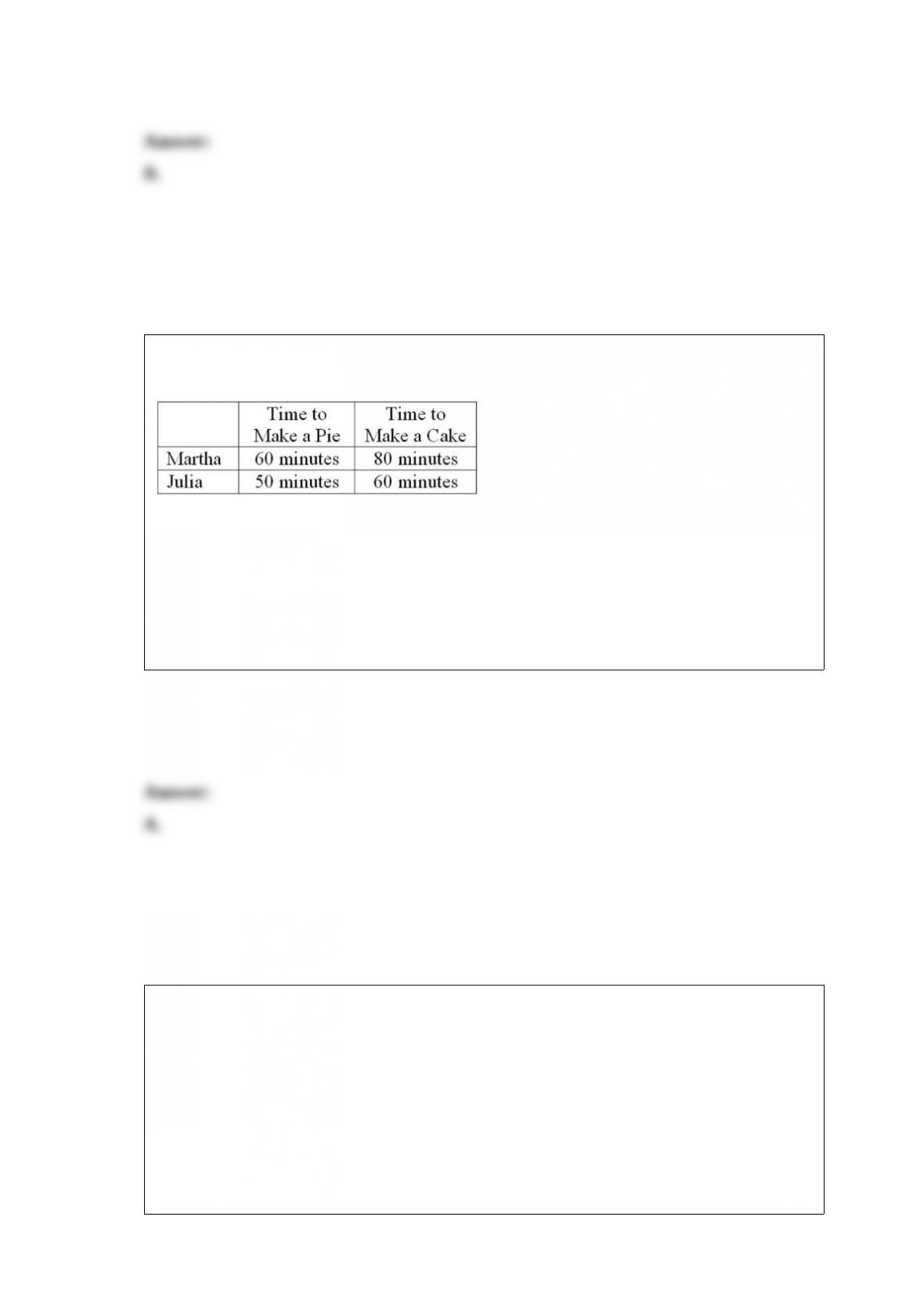
Refer to the table below. Based on their comparative advantage, Martha should
specialize in _______ while Julia should specialize in _______.
A. pies; cakes
B. cakes; pies
C. neither pies nor cakes; both pies and cakes
D. both pies and cakes; neither pies nor cakes
The most important, most convenient, and most flexible way in which the Federal
Reserve affects the supply of bank reserves is through:
A. conducting open-market operations.
B. changing the Federal Reserve discount rate.
C. changing bank reserve requirement ratios.
D. changing interest rates.

Which of the following is an example of structural unemployment?
A. Dora lost her job when the textile factory closed. She does not have skills to work in
another industry and has been unemployed for over a year.
B. Marsha was laid off from her job with the airline because the recession has reduced
the demand for airline travel. She expects to get her job back when the economy picks
up.
C. Alan, a software engineer, lost his job when the internet startup he worked for went
bankrupt. He interviewed with five companies in the area before taking a job with
another firm in the industry.
D. Jim had a job as an engineer, but quit when his wife was transferred to another state.
He looked for a month before finding a new job that he liked.
Suppose that a government agency is trying to decide between two pollution reduction
policy options. Under the permit option, 100 pollution permits would be sold, each
allowing emission of one unit of pollution. Firms would be forced to shut down if they
produced any units of pollution for which they did not hold a permit. Under the
pollution tax option, firms would be taxed $250 for each unit of pollution emitted. The
regulated firms all currently pollute and face varying costs of pollution reduction,
though all face increasing marginal costs of pollution reduction. The two policies being
considered will result in the same amount of pollution reduction
A. never.
B. always.
C. only if the equilibrium price in the pollution permit market is $250.

D. only if the equilibrium price in the pollution permit market is greater than $250.
Capital goods are treated as ______ goods and, therefore, are ______ GDP.
A. final; included in
B. final; excluded from
C. intermediate; included in
D. intermediate; excluded from
If the production of a good generates a negative externality, then at the market
equilibrium quantity, the marginal cost to society of another unit of the good will be:
A. less than the marginal benefit of another unit.
B. greater than the marginal benefit of another unit.
C. equal to the marginal benefit of another unit.
D. negative due to the external cost.

Slower growth in labor demand in combination with increases in labor supply explains
____________ accompanied by __________.
A. a slowdown in real wage growth; a decline in employment
B. a slowdown in real wage growth; rapid employment growth
C. a slowdown in real wage growth; increasing wage inequality
D. accelerated real wage growth; a decline in employment
The federal funds rate is the interest rate on short-term loans made by:
A. the Federal Reserve to commercial banks.
B. the federal government to the Federal Reserve.
C. the Federal Reserve to the federal government.
D. commercial banks to other commercial banks.

The figure below shows the demand curve, marginal revenue curve, marginal cost curve
and average total cost curve for a monopolist.
At this monopolist’s profit-maximizing level of output, it:
A. earns an economic profit of $16 per day.
B. incurs an economic loss of $16 per day.
C. earns an economic profit of $64 per day.
D. incurs an economic loss of $64 per day.
There are two employers in Bucolic that hire people who do not have a high school
degree: a grocery store and a hardware store. The grocery store pays $10 per hour and
the hardware store pays $12 per hour. People who work at either store can work as
many hours as they want at those wages. Assume that it takes two hours to interview for
a job. Lee works at the grocery store, but would like to work at the hardware store. If
Lee interviews at the hardware store, there is a 10% probability of being hired. Assume
that Lee is risk-neutral. In terms of foregone earnings, what does it cost Lee to spending
two hours interviewing for a job at the hardware store?
A. 0
B. $2
C. $10
D. $20

Carson and Fran are both thrill seekers. Carson has health insurance and Fran does not.
One can predict that:
A. Fran will engage in fewer dangerous activities.
B. Carson will engage in fewer dangerous activities.
C. Carson and Fran will participate in the same number of dangerous activities.
D. Carson’s health insurance will not affect Carson’s behavior.
At each value of the domestic interest rate, decreases in the riskiness of domestic assets
______ capital inflows, ______ capital outflows, and ______ net capital inflows.
A. increase; increase; increase
B. increase; increase; decrease
C. increase; decrease; increase
D. decrease; decrease; decrease

For a given domestic and foreign price level, a decrease in the nominal exchange rate
______ the real exchange rate.
A. increases
B. decreases
C. may either increase or decrease
D. offsets any change in
If a country is producing at point where an increase in the production of one good
requires a reduction in the production of another good, then it must be producing at an:
A. inefficient point.
B. efficient point.
C. unattainable point.
D. undesirable point.

An increase in the price a firm receives for its output will lead the firm to:
A. expand output.
B. leave output unchanged and earn greater profits.
C. leave output unchanged and earn smaller losses.
D. reduce output.
For two goods X and Y to be classified as substitutes, it must be the case that:
A. X and Y are identical.
B. consumers tend to purchase both items.
C. when the price of X rises, the demand for Y decreases.
D. when the price of X rises, the demand for Y increases.

Assume point A on a linear production possibilities curve represents the combination of
12 coffees and 3 cappuccinos, and point B represents 3 coffees and 6 cappuccinos.
Suppose coffees are on the vertical axis and cappuccinos are on the horizontal axis. The
absolute value of the slope of the production possibilities curve between points A and B
equals:
A. 6
B. 4
C. 3
D. 1/3