Exhibit 25-10
Suppose that the letter grade earned on a test for each student in a class depends upon
how well he/she does relative to other students in the class.This exhibit shows a
prisoner’s dilemma setting for two representative students in the class, George and
Gina.
If George studies for two hours and Gina studies for four hours, George’s letter grade on
the test will be a ___________ and Gina’s letter grade on the test will be a
__________________.
a. C; A
b. C; C
c. B; B
d. A; C
Most voters choose not to be informed about political and governmental issues because
they are not smart enough to really understand the issues.
a. True
b. False
The free rider problem is the main source of market failure in the provision of
nonexcludable public goods.
a. True
b. False
The purchasing power parity theory states that
a. exchange rates between any two currencies will adjust to reflect changes in the
relative price level of the two countries.
b. exchange rates between any two currencies will adjust to reflect change in the
relative income growth rates of the two countries.
c. the larger the economic growth rate in a country, the less likely its currency will
depreciate in value.
d. exchange rates cannot be compared over time.
e. currencies appreciate as often as they depreciate.
In a foreign exchange market diagram with pesos per dollar on the vertical axis, the
quantity of __________ would be on the horizontal axis, and the U.S. demand for
Mexican goods would help to determine the __________ curve.
a. dollars; demand
b. dollars; supply
c. pesos; demand
d. pesos; supply
Which of the following statements is true?
a. The perfectly competitive firm produces a level of output at which P=MC.
b. The single-price monopolist produces a level of output at which P > MC.
c. The perfectly price-discriminating monopolist produces a level of output at which
P>MC.
d. a and b
e. all of the above
Situation 22-3
Gizmos, Inc. produces gizmos at an average total cost of $15 and an average variable
cost of $12. The only fixed input used in the production of gizmos costs $240.
What are the total costs?
a. $1,200
b. $2,400
c. $850
d. $960
e. There is not enough information to answer the question.
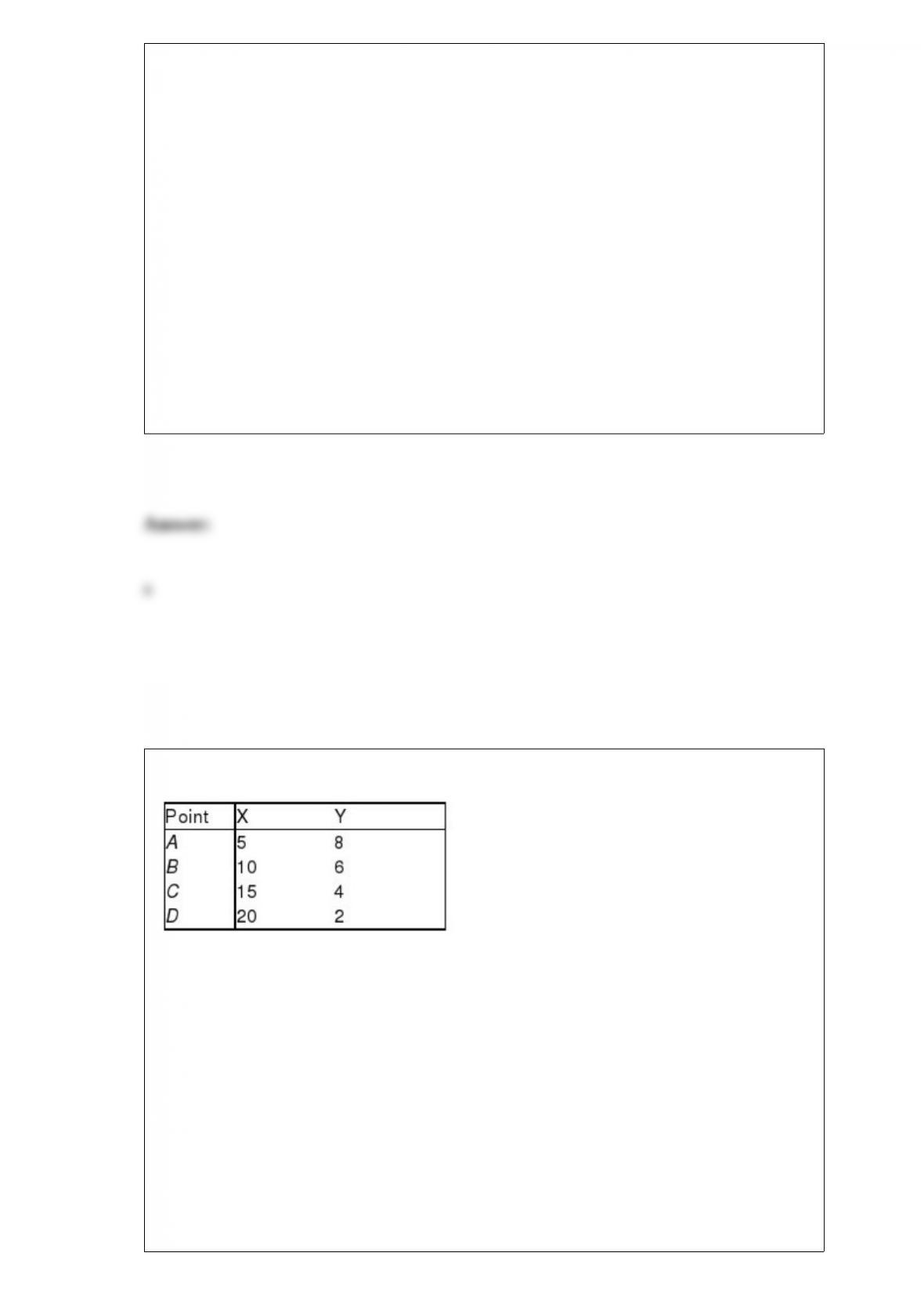
Exhibit 1-3
According to the data provided in this table, what is the slope of the line between points
C and D (if these data were graphed with X on the horizontal axis and Y on the vertical
axis)?
a. -0.40
b. -2.50
c. 0.40
d. 2.50
e. none of the above
In 2009, the top fifth of households in the U.S. received approximately 50 percent of
the total money income.
a. True
b. False
The government’s provision of nonexcludable public goods such as national defense is
accepted because
a. government is more efficient than private firms at producing goods.
b. the market fails to produce nonexcludable public goods as a result of the free-rider
problem.
c. people do not value public goods such as national defense very highly.
d. a and c
e. all of the above
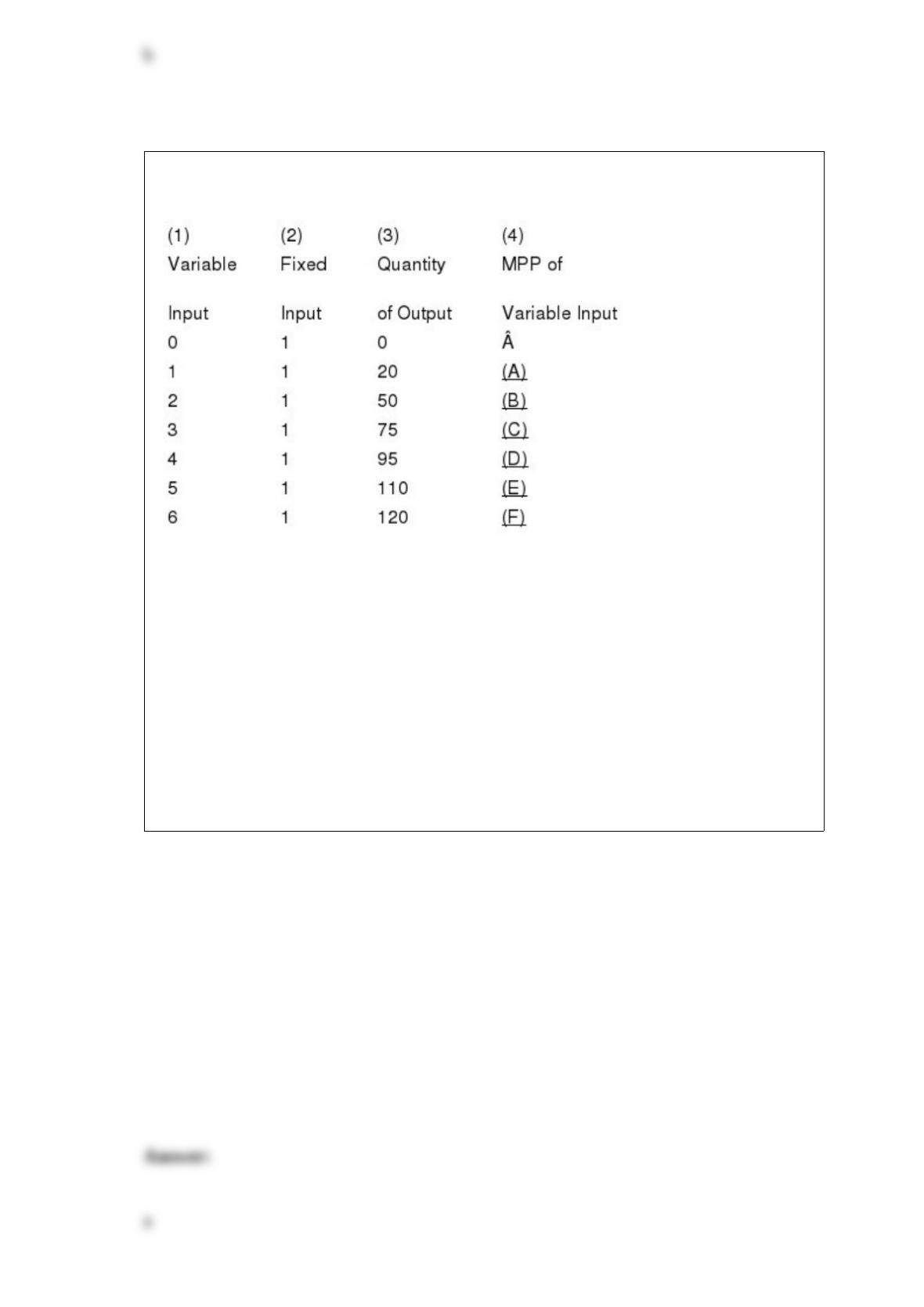
Exhibit 22-1
The numbers that go in blanks (C) and (D) are, respectively,
a. 25 and 20.
b. 20 and 22.
c. 25 and 24.
d. 22 and 20.
e. none of the above
The price of good X has a pattern such that P = $3 on Monday through Thursday of
every week, andP = $2 on Fridays.If speculators begin participating in the market for
good X, their actions will likely lead to a(n) ______________ in the price of good X on
Monday through Thursday and a(n) _______________ in the price of good X on
Friday.
a. increase; increase
b. increase; decrease
c. decrease; increase
d. decrease; decrease
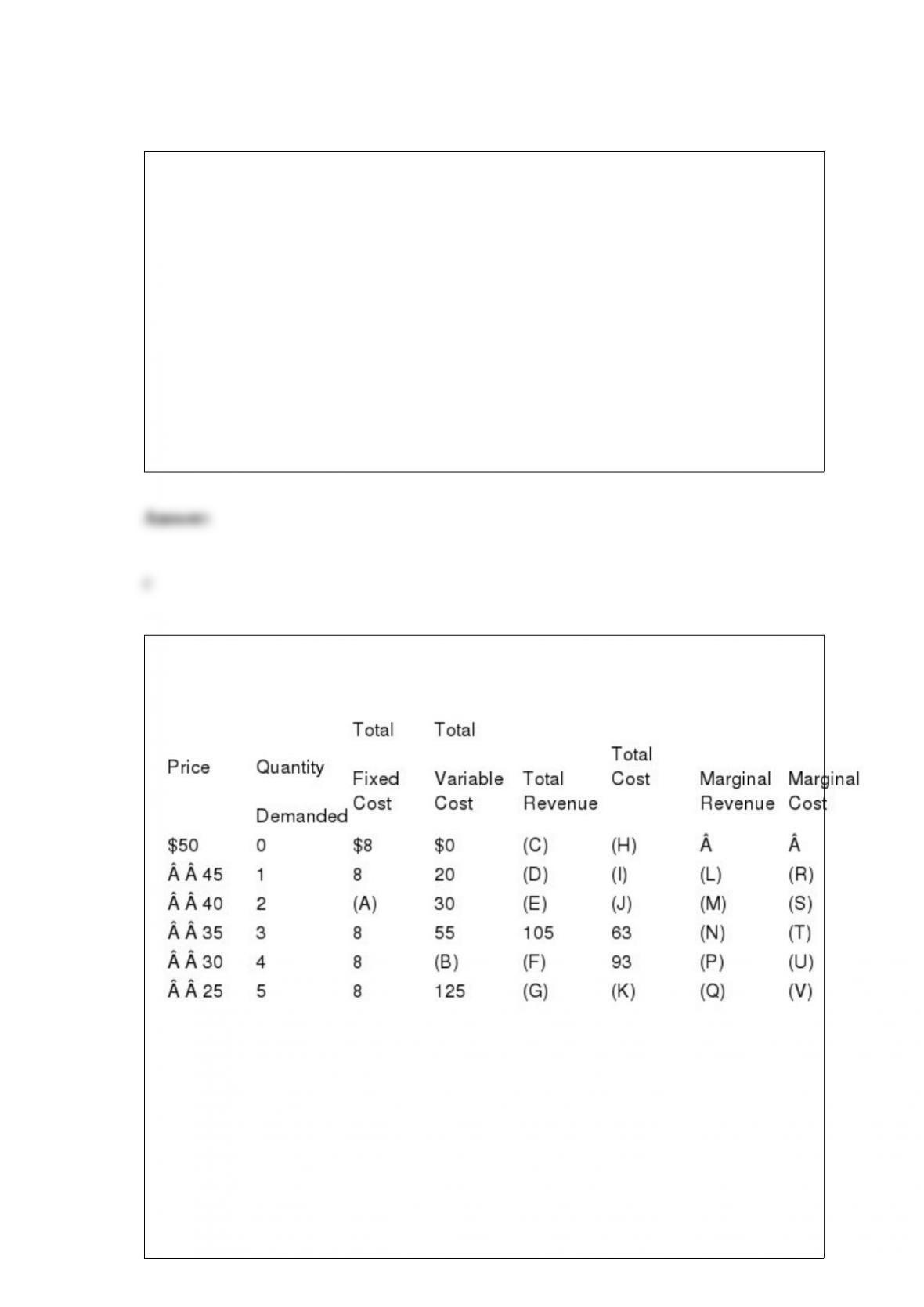
Exhibit 24-4
What dollar amounts go in blanks (T), (U) and (V), respectively?
a. $25; $30; and $40
b. $16; $19.50; and $23.60
c. $30; $40; and $29
d. $23; $15; and $28
If you are buying a bond that is newly issued by the corporation, you are buying it in
the primary market.
a. True
b. False