
The reason buffalo were driven to extinction while at the same time cattle were thriving
is that:
A. cattle were owned by ranchers whereas buffalo were wild.
B. demand for buffalo meat was low, discouraging production.
C. Western expansion required killing the Indian’s main resource.
D. the price of buffalo hides was very low.
In Econland autonomous consumption equals 700, the marginal propensity to consume
equals 0.80, net taxes are fixed at 50, planned investment is fixed at 100, government
purchases are fixed at 100, and net exports are fixed at 40. The slope of the Expenditure
Line is:
A. 0.20.
B. 0.80.
C. 0.90.
D. 0.99.

The following payoff matrix shows the outcomes for the US and the USSR from relying
on conventional weapons or atomic weapons. The percentages refer to the fraction of
the population that would die if a war occurred under the two weapons strategies.
Assume the payoff matrix is for 1945, shortly after the US had demonstrated the
effectiveness of the atomic bomb in World War II, i.e., the example begins in the upper
right cell where USA has atomic weapons and the USSR has only conventional
weapons.
Refer to the information given above. Suppose that a diplomat representing the USSR
made the following statement to a diplomat representing the United States: “We will
disarm all of our atomic weapons and not develop any new ones.” That statement is:
A. a credible promise because it would convince the United States to disarm as well.
B. a credible promise because it contains a commitment device.
C. a non-credible promise because mutual disarmament yields a worse outcome for
both countries.
D. a non-credible promise because of the commitment problem.
In surveying their alumni, State U’s economics department discovered that ramen
noodle consumption declined as soon as students graduated and found jobs. One
conclusion the survey team might draw from this result is that:
A. there is excess demand for ramen noodles.
B. the equilibrium price for ramen noodles is too high.
C. college graduates have a high reservation price for ramen noodles.
D. ramen noodles are an inferior good.

Workers whose spells of unemployment are broken up by brief periods of employment
or withdrawal from the labor force are referred to as ______ workers
A. short-term unemployed
B. discouraged
C. long-term unemployed
D. chronically unemployed
If the exchange rate moves from 10 Mexican pesos per U.S. dollar to 8 Mexican pesos
per U.S. dollar, then the Mexican peso has ______ and the U.S. dollar has _____.
A. appreciated; appreciated
B. appreciated; depreciated
C. depreciated; appreciated
D. depreciated; depreciated

Suppose Acme and Mega produce and sell identical product with zero marginal and
average cost. Following is the market demand and marginal revenue curves for the
product.
Refer to the figure above. Suppose Mega and Acme have colluded to work as a pure
monopolist, but Mega cheats on Acme and reduces its price to $1.00 each. Mega would
then sell ____ units and Acme would sell _____ units.
A. 150; 50
B. 100; 50
C. 150; 0
D. 100; 0
Assume one investor bought a 10-year inflation-protected bond with a fixed annual real
rate of 1.5% and another investor bought a 10-year bond without inflation protection
with a nominal annual return of 4.2%. If inflation over the 10-year period averaged 3
percent, which investor earned a higher real return?
A. The investor who purchased the inflation protected bond.
B. The investor who purchased the bond without inflation protection.
C. Both investors earned the same real return.
D. Neither investor earned a positive real return.
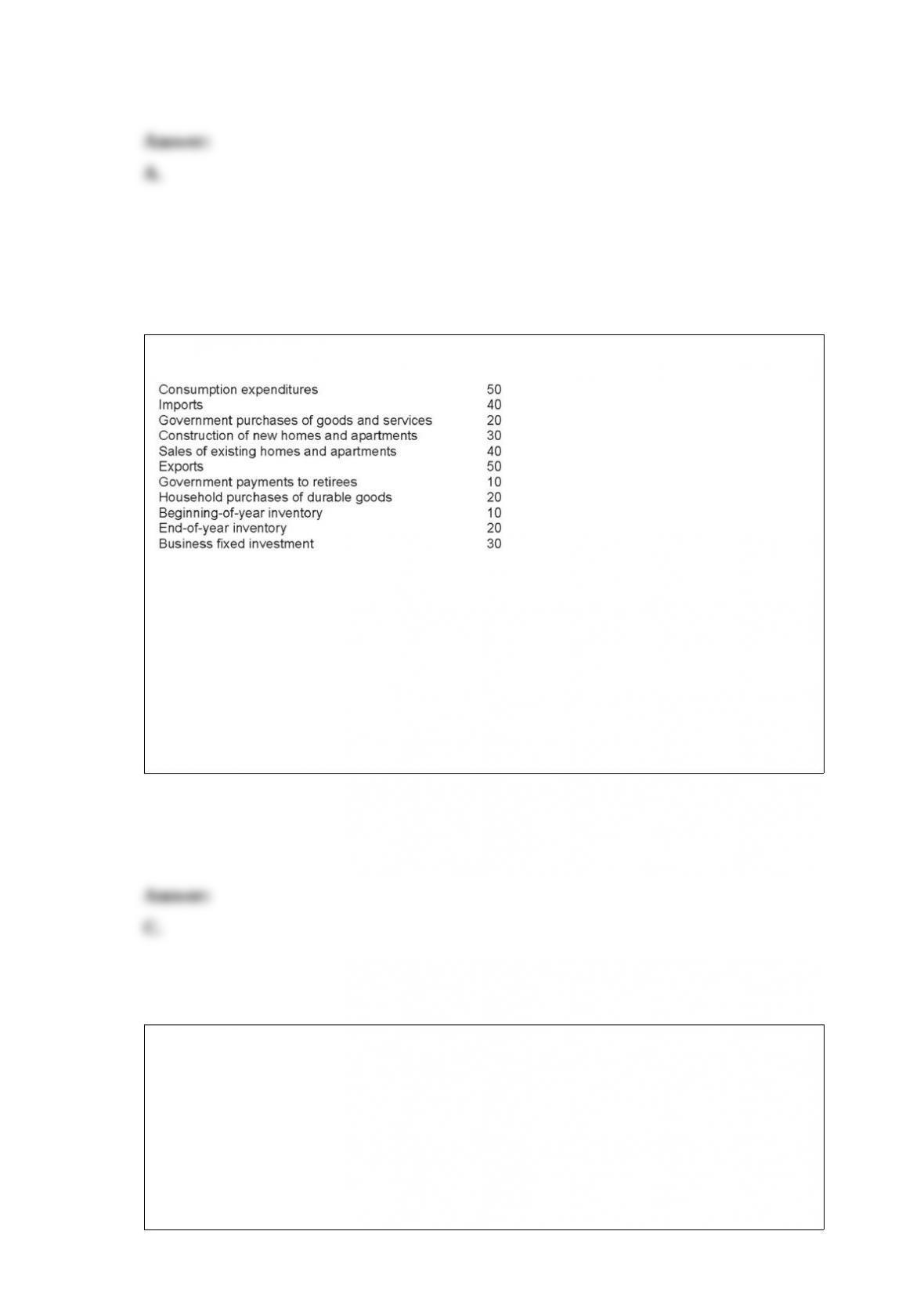
The following table provides data for an economy in a certain year.
Given the data in the table, compute the value of GDP.
A. 130
B. 140
C. 150
D. 160
Larger increases in the demand for labor than in the supply of labor explain:
A. the substantial increase in real wages.
B. the slowdown in real wage growth.
C. increasing wage inequality.
D. skill-biased technological change.

Jay owns a classic car he purchased for $50,000. At a car rally he is offered $75,000 for
the car by a knowledgeable classic car enthusiast. Based on this information:
A. Jay’s saving this year has increased by $25,000.
B. Jay’s saving this year has decreased by $25,000.
C. Jay has experienced a $25,000 capital gain.
D. Jay’s wealth is unchanged.
Two types of existing houses are for sale: ones with a cracked foundation and ones
without. In all other respects, they are identical. Houses without cracked foundations
are worth $200,000 while those with cracked foundations are worth $200,000 minus the
$20,000 to fix the crack or $180,000. The frequency of solid foundations is 80%.
Sellers know which type of house they have but buyers cannot detect a crack. No seller
“must” sell his house in order to move and thus no one accepts anything less than its
value.
The long run equilibrium in the housing market is
A. 80% homes with solid foundations, 20% cracked foundations, and a reservation
price of $180,000.
B. 100% cracked foundation homes and a reservation price of $180,000.
C. 100% solid foundation homes and a reservation price of $200,000.

D. 100% cracked foundation homes and a reservation price between $200,000 and
$180,000.
When the government transfers resources to the poor in the form of a good or service, it
is called
A. the Earned Income Tax Credit.
B. Aid to Families with Dependent Children.
C. an in-kind transfer.
D. a regressive tax.
The following table provides information about production at the XYZ-TV Company.
How many workers will the XYZ-TV Company hire if the going wage for TV
production workers is $32,000?
A. 0

B. 1
C. 2
D. 3
The nominal interest rate equals the:
A. real interest rate minus the inflation rate.
B. real interest rate plus the inflation rate.
C. real interest rate divided by the inflation rate.
D. inflation rate minus the real interest rate.
Which of the following is a nominal quantity?
A. The number of people unemployed
B. The current price of a barrel of oil
C. The number of cars produced in 2005
D. The amount of coal mined in one month
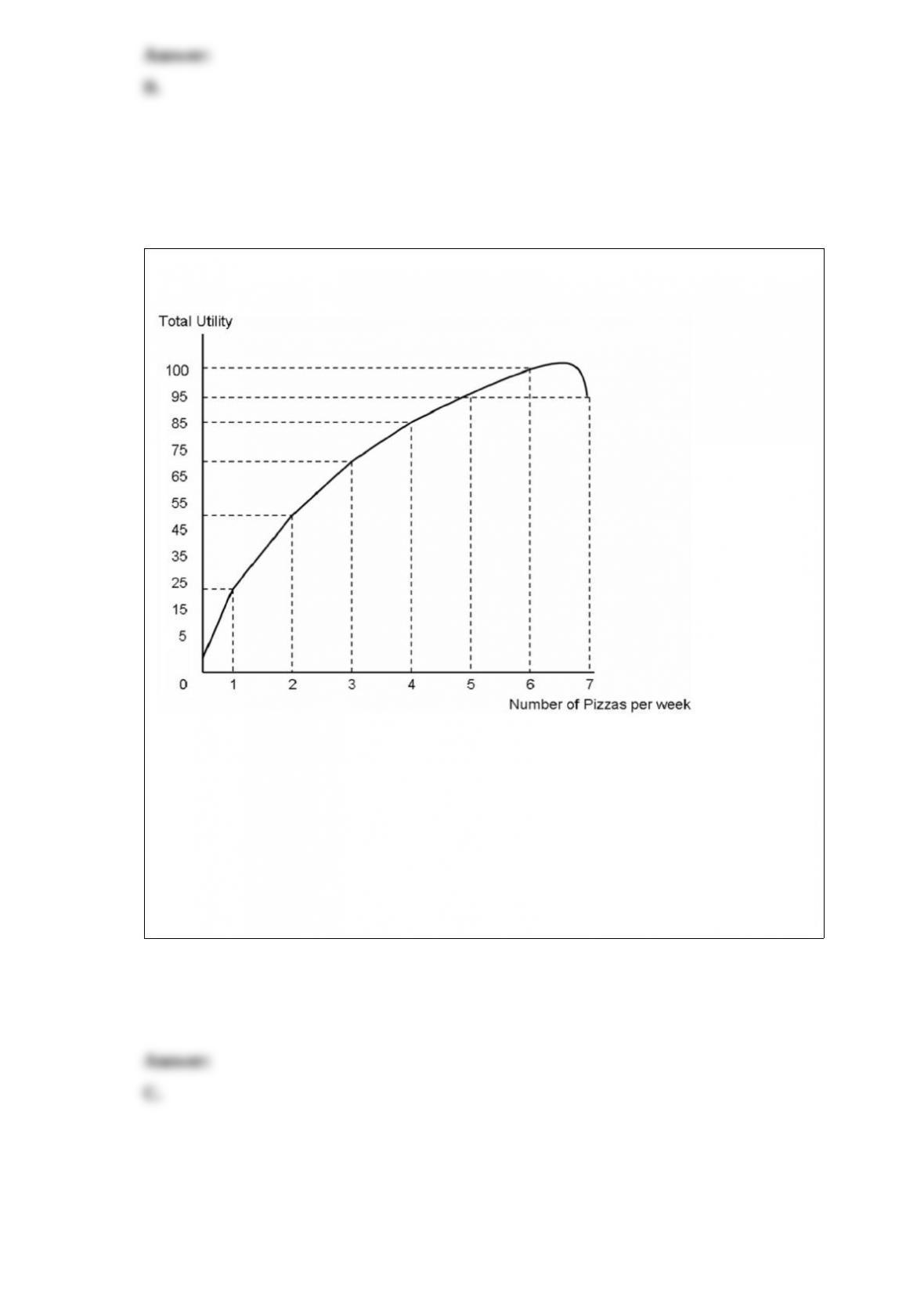
Refer to the figure above. The total utility of consuming 4 pizzas each week is
A. 50
B. 70
C. 85
D. 95

Matt has decided to purchase his textbooks for the semester. His options are to purchase
the books via the Internet with next day delivery to his home at a cost of $175, or to
drive to campus tomorrow to buy the books at the university bookstore at a cost of
$170. Last week he drove to campus to buy a concert ticket because they offered 25
percent off the regular price of $16.
Assume the minimum that Matt would be willing to accept to drive to the university
campus is equal to the amount he saved on the concert ticket. What would be the
amount of his economic surplus if he bought his textbooks at the university bookstore
rather than via the Internet?
A. $5
B. $1
C. $50
D. $20
Changes in government purchases affect planned spending _____, and changes in taxes
and/or transfers affect planned spending _______.
A. directly; directly
B. directly; indirectly
C. directly; not at all
D. indirectly; indirectly
A firm might have a monopoly in a market because:
A. its average total cost function is increasing over the entire relevant range of output.
B. the market is geographically isolated from other sellers.
C. the firm’s technology is obsolete.
D. it faces a perfectly elastic demand curve.
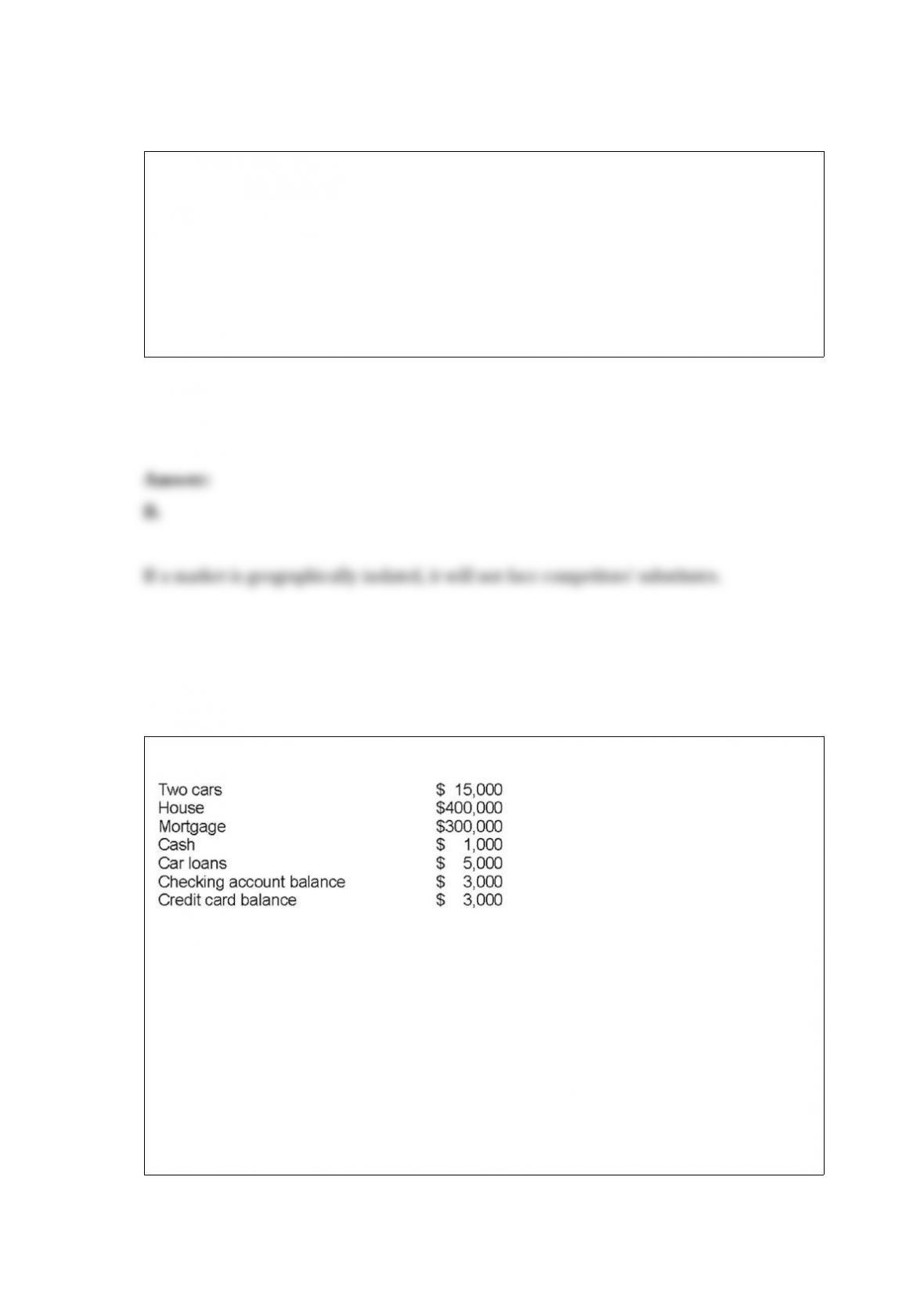
Taylor has the following assets and liabilities:
Suppose that Taylor receives a $10,000 bonus from her employer. If she puts that
money toward her mortgage, her wealth would ______; if she puts that money in her
checking account, her wealth would ______.
A. increase to $121,000; decrease to $101,000
B. increase to $115,000; decrease to $95,000
C. increase to $121,000; increase to $121,000
D. increase to $115,000; increase to $115,000

If planned aggregate expenditure (PAE) in an economy equals 3,000 + 0.75Y and
potential output (Y*) equals 12,000, then this economy has:
A. an expansionary gap.
B. a recessionary gap.
C. no output gap.
D. no autonomous expenditure.
When some factors of production are fixed, in order to increase production by equal
amounts, a firm would need to add successively:
A. smaller and smaller quantities of the variable factor.
B. constant quantities of the variable factor.
C. larger and larger quantities of the variable factor.
D. larger and larger quantities of the fixed factors.

Which of the following situations will come closest to perfect price discrimination?
A. Charging a different price on different days
B. Charging a different price at the end of the year
C. Negotiating a price with a group of consumers
D. Negotiating a price with each individual consumer
Which of the following statements about the provision of public goods is true?
A. Government must always provide public goods.
B. The optimal amount of public good provision is that level at which all taxpayers
receive some of the good.
C. If the marginal benefit of the public good exceeds the marginal costs, more should be
provided.
D. The optimal amount of public good provision is when total benefits equal total costs.

Suppose that the equilibrium price of apples falls and the equilibrium quantity
increases. Which of the following best fits the observed data?
A. An increase in demand with supply constant.
B. A decrease in supply with demand constant.
C. An increase in demand coupled with an increase in supply.
D. An increase in supply with demand constant.
Suppose that average labor productivity in Country C is $5,000, and that Countries C
and E have the same real GDP per capita. Based on the information in the table, what
must be the average labor productivity in Country E?
A. $1,000
B. $1,500
C. $4,500
D. $6,250
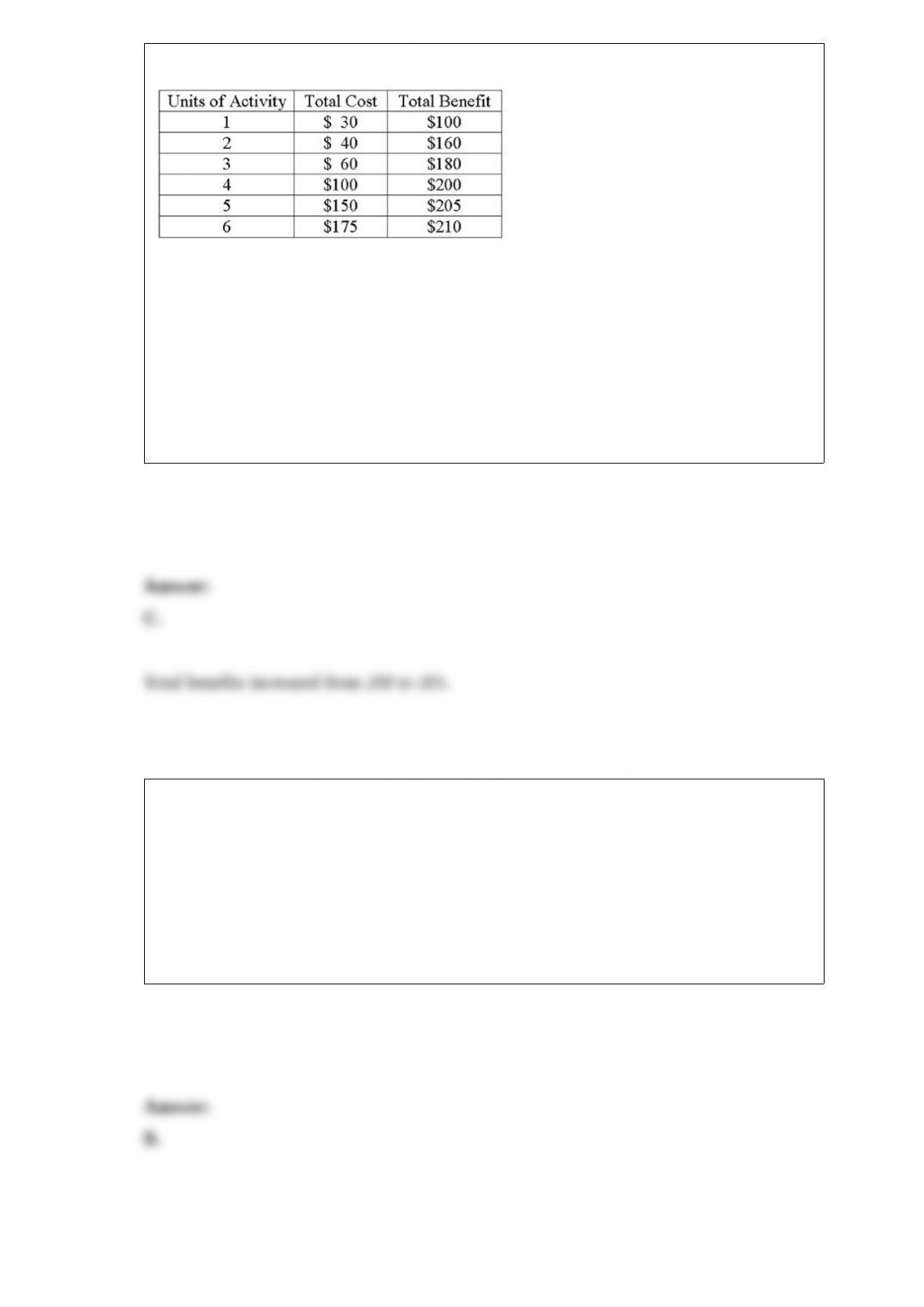
Refer to the table above. The marginal benefit of the 5th unit of activity is:
A. $60
B. $50
C. $5
D. $0
As disposable income decreases, consumption:
A. increases.
B. decreases.
C. may either increase or decrease depending on the mpc.
D. may either increase or decrease depending on the wealth effect.

Refer to the figure above. When the price decreases from $3.00 to $2.50, quantity
demanded in the market will ______ by _____ lbs.
A. decrease, 3
B. increase, 3
C. decrease, 4
D. increase, 4
Searching should continue until
A. all options have been explored.
B. the marginal benefits of further searching equals the marginal costs.
C. the marginal benefit of searching is zero.
D. the marginal cost of searching is zero.
When calculating price elasticity of demand, if the numerator is positive, the
denominator is:
A. always greater than one.
B. always greater than zero.
C. sometimes positive and sometimes negative.
D. always less than zero.
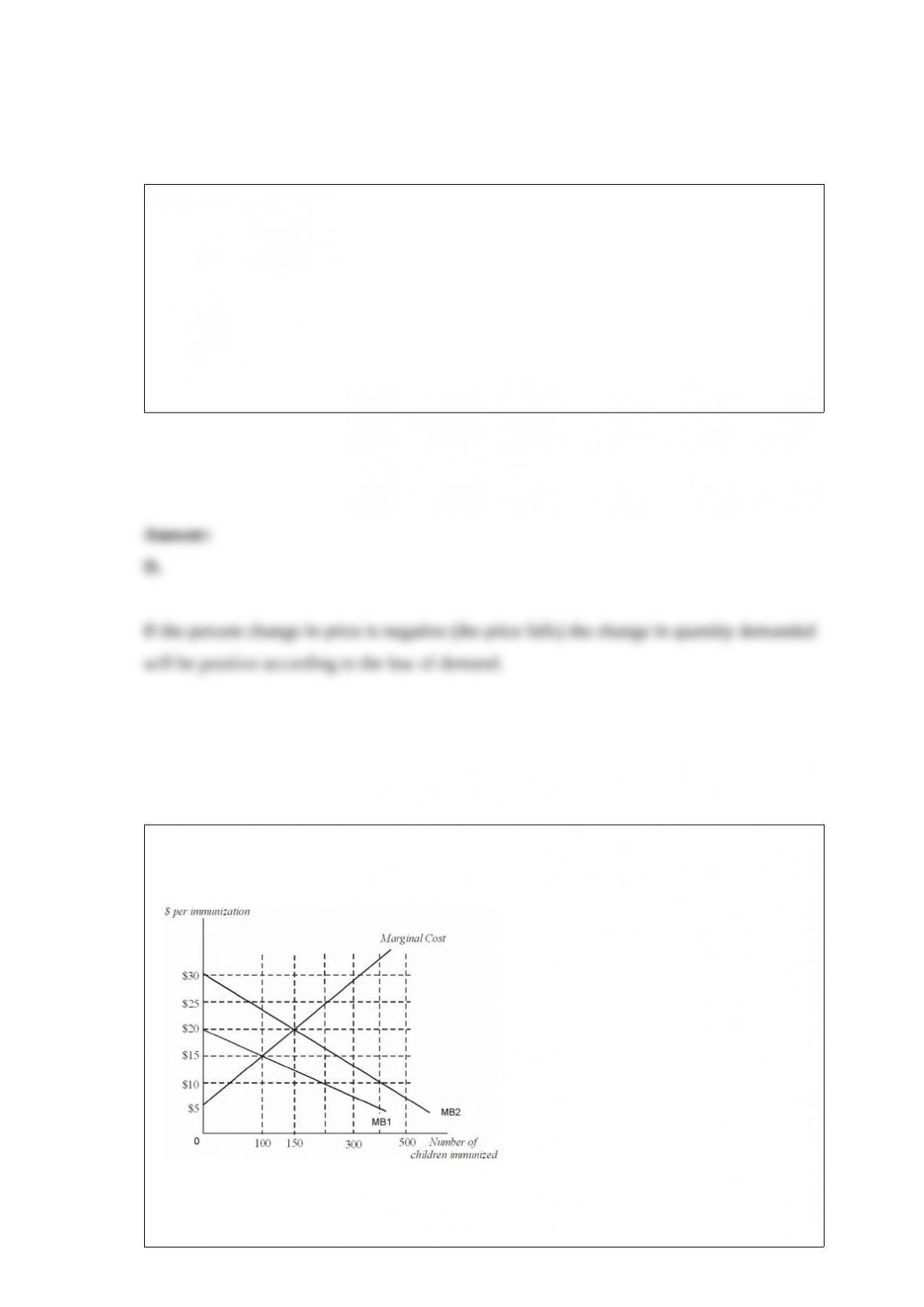
This graph illustrates the marginal cost, marginal private benefit, and marginal social
benefit of immunization against a contagious childhood disease.
If school districts imposed a rule that all children must be immunized to enroll, and 300
children are school-aged

A. the number of immunizations would be efficient, but the entire cost would fall on the
parents.
B. too few children would be immunized.
C. the number of immunizations would be efficient, but the cost to taxpayers would be
unjustifiable.
D. too many children would be immunized.
A nominal quantity is measured:
A. in physical terms.
B. in terms of current dollar value.
C. using the consumer price index.
D. by indexing.
The price elasticity of supply at a point is:
A. the percentage change in quantity supplied divided by the percentage change in
price.
B. the percentage change in price divided by the percentage change in quantity
supplied.
C. the change in quantity supplied divided by the change in price.

D. the change in price divided by the change in quantity supplied.