1) in the long run:
a.all costs are variable costs.
b.all costs are fixed costs.
c.variable costs equal fixed costs.
d.fixed costs are greater than variable costs.
2) Which one of the following is presently a major deterrent to bank panics in the
United States?
A.the legal reserve requirement
B.the fractional reserve system
C.the gold standard
D.deposit insurance
3) Coins held in commercial banks are:
A.included in M1, but not in M2.
B.included both in M1 and in M2.
C.included in M2, but not in M1.
D.not part of the nation’s money supply.
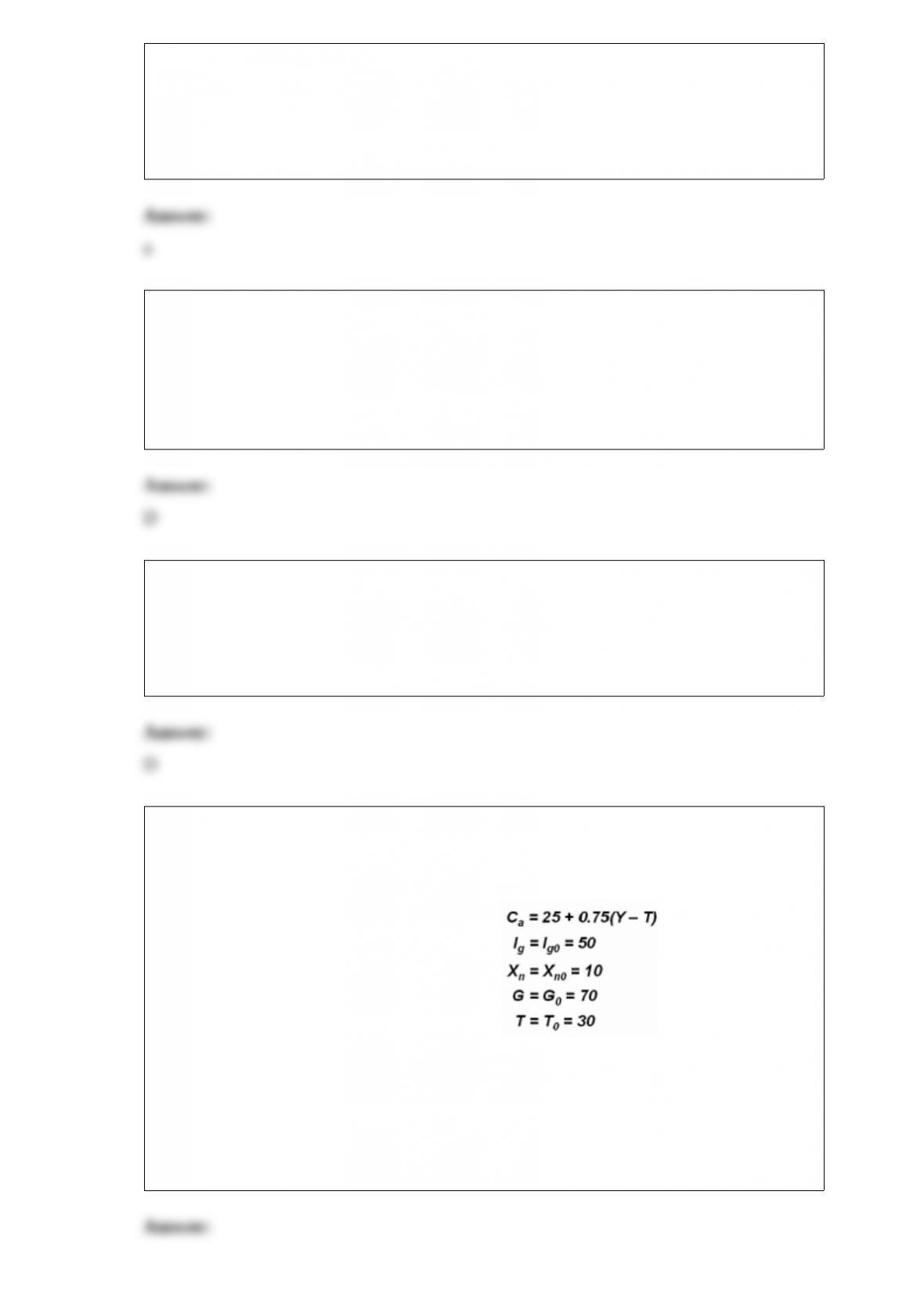
4) (Advanced analysis) Answer the next question(s) on the basis of the following
information for a mixed open economy. The letters Y, Ca, Ig, Xn, G, and T stand for
GDP, consumption, gross investment, net exports, government purchases, and net taxes
respectively. Figures are in billions of dollars.
Refer to the above information. If the economy’s tax schedule was T = 0.2Y rather than
T = T0 = 30, the equilibrium GDP would be:
A.$387.5.
B.$518.5.
C.$316.
D.$412.

5) When the public sector is added to the aggregate expenditures model:
A.the equilibrium condition becomes G + S = T + Ig + X.
B.the equilibrium condition becomes G + T = S + Ig + X.
C.the equilibrium condition becomes Ca + Ig + Xn + G + T = GDP.
D.we add a new leakage in the form of taxes and a new injection in the form of
government spending.
6) between 1960 and 2006, u.s. health care spending as percentage of domestic output:
a.more than tripled.
b.more than quadrupled.
c.declined by one-half.
d.remained relatively constant.
7) Suppose in some economy there are 100 million workers; 2 million of those workers
work in mining, and 1 million of the miners belong to unions. The rate of unionization
in mining is:
A.50 percent.
B.2 percent.
C.1 percent.
D.20 percent.
8) (last word) the u.s. government agency responsible for compiling the national
income accounts is the:
a.census bureau.
b.bureau of labor statistics (bls).
c.commerce department’s bureau of economic analysis (bea).
d.government accounting office (gao).
9) historically, real gdp has increased less rapidly than nominal gdp because:
a.price indices have not reflected improvements in product quality.
b.the general price level has increased.
c.technological progress has resulted in more efficient production.
d.the general price level has declined.
10)
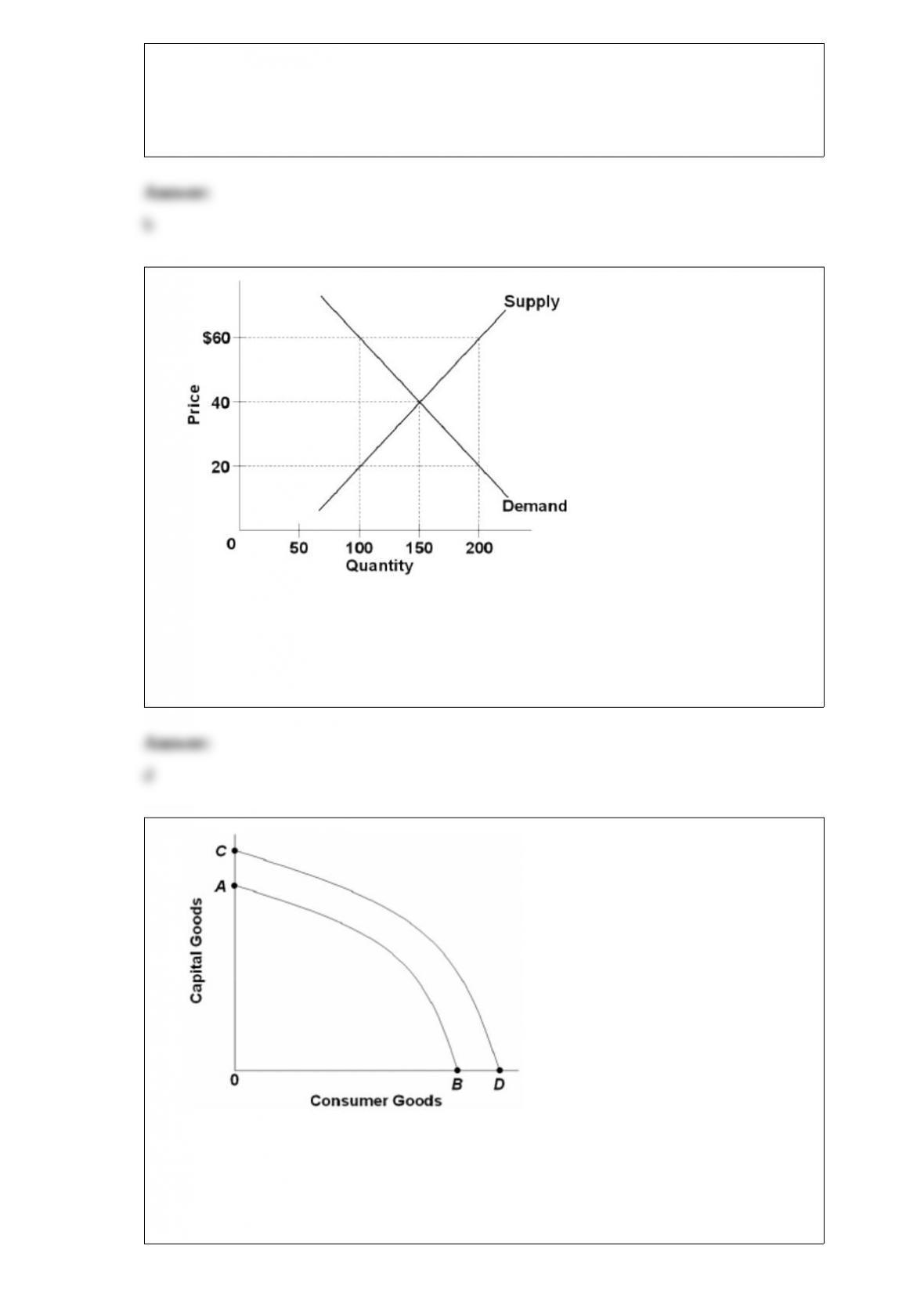
refer to the above diagram. a price of $60 in this market will result in:
a.equilibrium.
b.a shortage of 50 units.
c.a surplus of 50 units.
d.a surplus of 100 units.
11)
curve ab is a:
a.production possibilities curve.
b.consumer demand curve.
c.market supply curve.
d.labor productivity curve.