1) A decrease in per unit production costs will shift the aggregate supply curve leftward.
2) The supply of loanable funds is perfectly elastic.
3) The United States has experienced both budget surpluses and deficits over the past
decade.
4) An employer (biased against African-Americans) whose discrimination coefficient is
$5 will hire only whites if the actual African-American-white wage gap is $7.
5) terms of trade of 1x=5y will be acceptable to two countries that have domestic
opportunity costs of 1x=4y and 1x=1y, respectively.
6) a moral hazard problem arises in the health care market because health insurance
causes people to overconsume health care.
7) the law of diminishing returns explains why short-run marginal cost curves are
upward sloping.
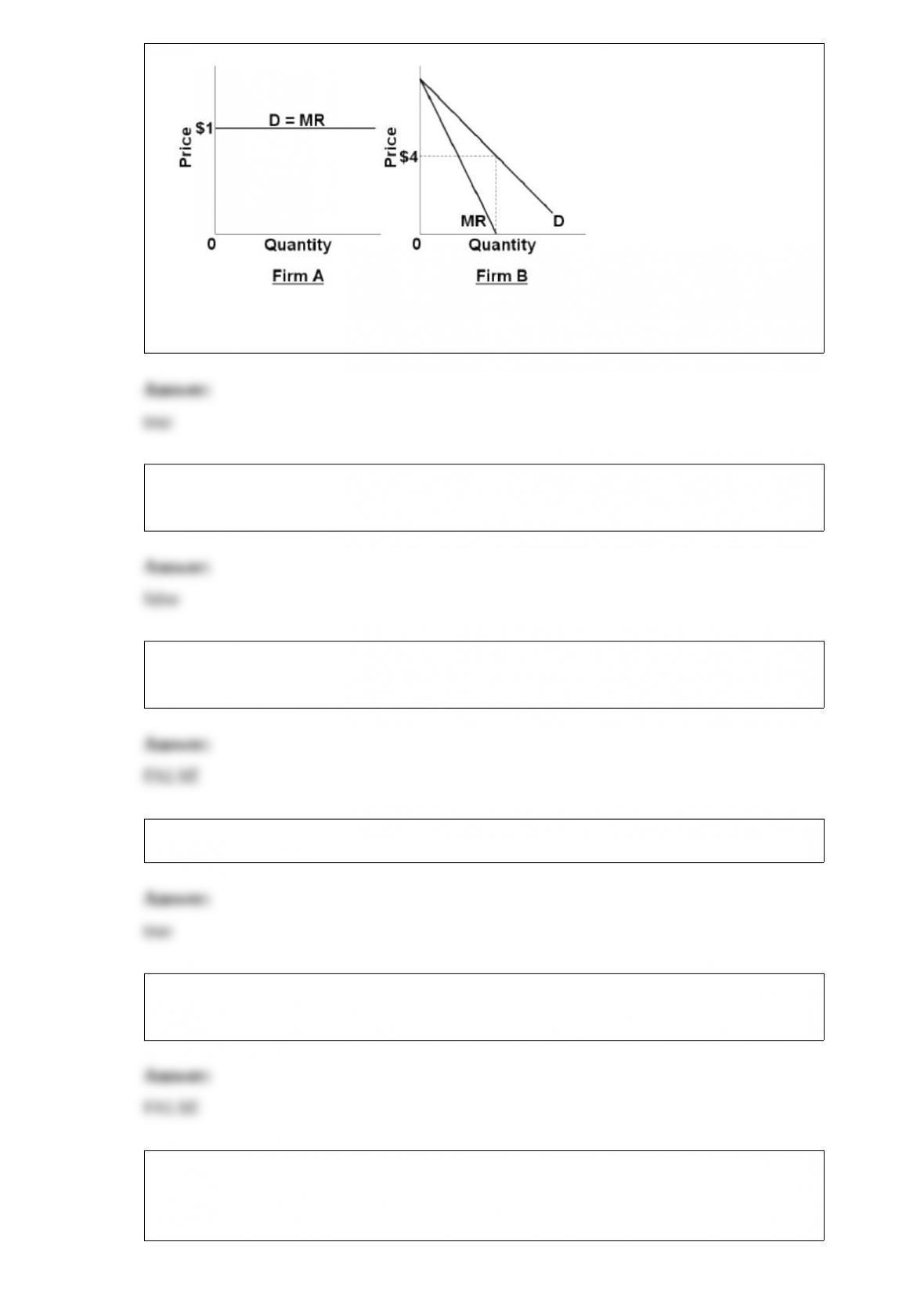
8)
refer to the above diagrams. the demand for firm b’s product is elastic at all prices in
excess of $4.
9) if a good’s production creates substantial negative externalities, then too little of it
will be produced unless firms are subsidized.
10) A restrictive monetary policy may be frustrated if the investment-demand curve
shifts to the left.
11) the major expenditure of local governments is for education.
12) The most important growth obstacle common to all DVCs is the lack of desire to
increase their standards of living.
13) The terms of trade reflect the:
A.rate at which gold exchanges internationally for any domestic currency.
B.ratio at which nations will exchange two goods.
C.fact that the gains from trade will be equally divided.
D.cost conditions embodied in a single country’s production possibilities curve.
14) The amount that a commercial bank can lend is determined by its:
A.required reserves.
B.excess reserves.
C.outstanding loans.
D.outstanding checkable deposits.
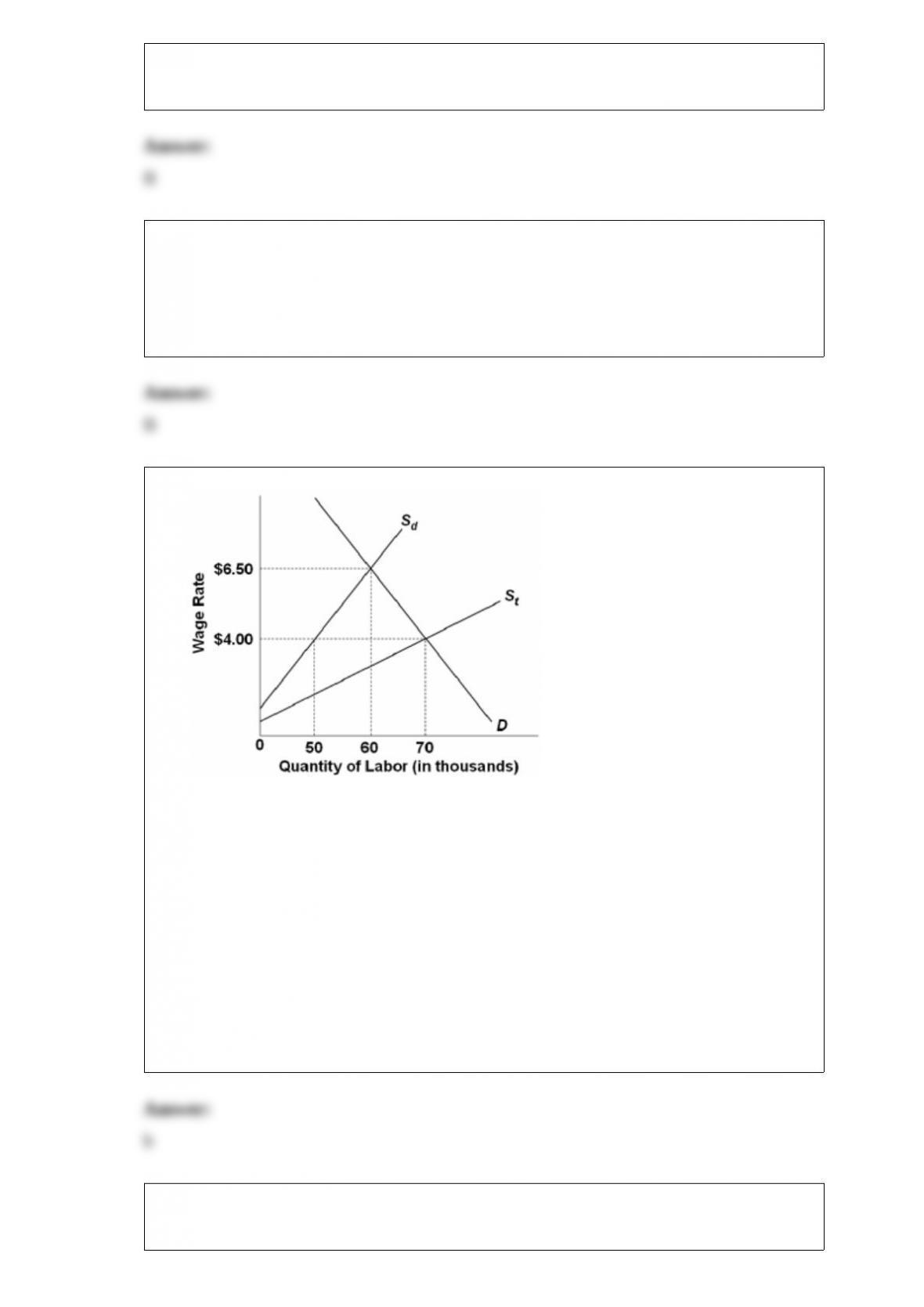
15)
assumptions: 1) employers in this market are willing and able to ignore minimum wage
laws; 2) sd represents the supply of domestically-born (and legal immigrant) workers;
3) st represents the total supply of workers in this labor market (sd plus illegal
immigrants); and 4) unless otherwise stated, illegal immigration is not effectively
blocked by the government.
refer to the above figure. how many domestically-born (and legal immigrant) workers
will be hired at equilibrium?
a.20,000
b.50,000
c.60,000
d.70,000
16) more than half the growth of real gdp in the united states is caused by:
a.a falling price level.
b.the reallocation of labor from manufacturing to agriculture.
c.increases in the productivity of labor.
d.the use of fewer inputs of labor.
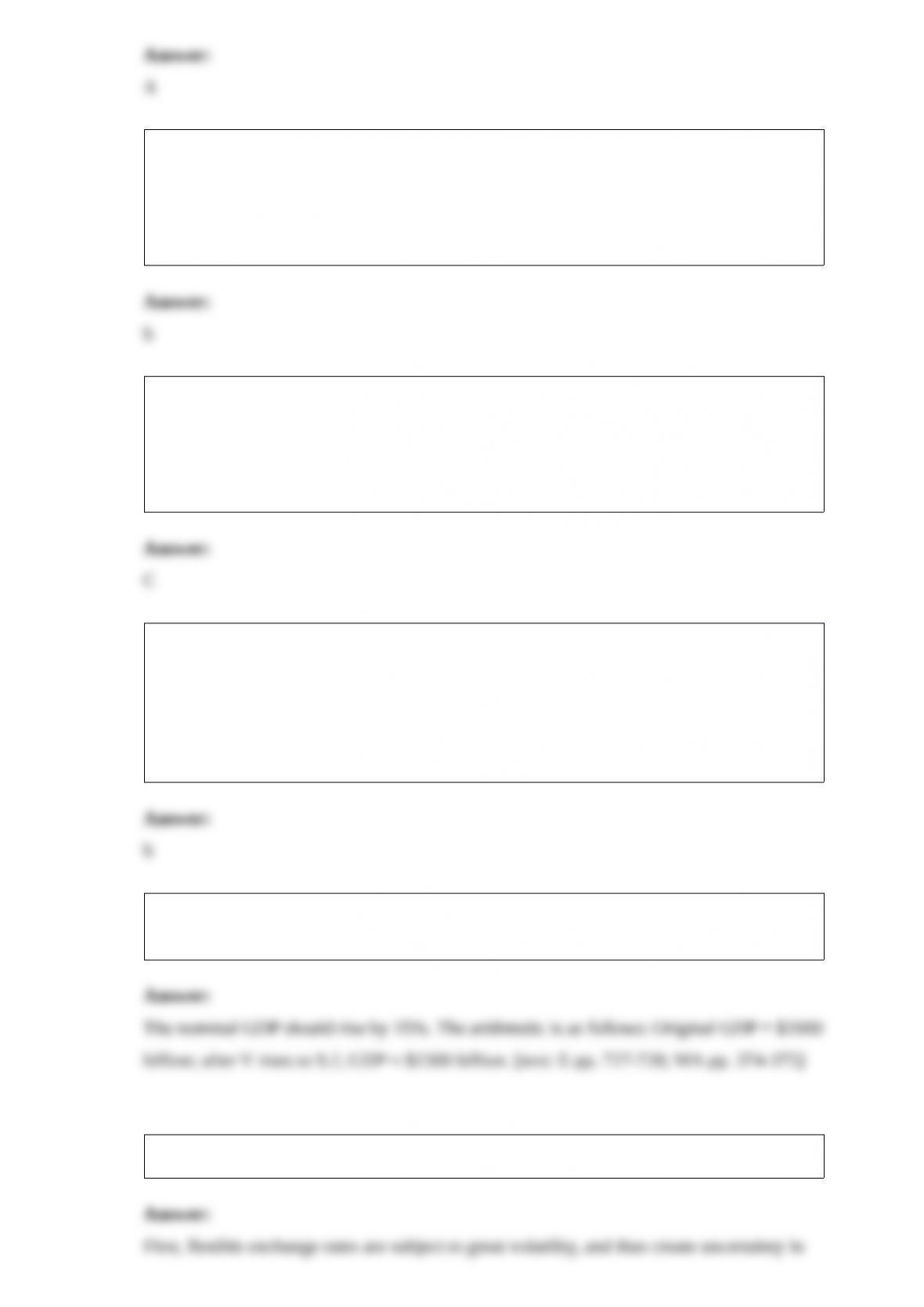
17)
refer to the above diagram. in the p3p4price range demand is:
a.of unit elasticity.
b.relatively inelastic.
c.relatively elastic.
d.perfectly elastic.
18) Empirical studies suggest that the efficiency loss associated with the misallocation
of labor caused by the union wage advantage is:
A.$6 billion per year.
B.about 2 percent of domestic output.
C.less than one-half of one percent of domestic output.
D.about 4 percent of domestic output.
19) Suppose the government purposely changes the economy’s standardized budget
from a deficit of 0 percent of real GDP to a deficit of 3 percent of real GDP. The
government is engaging in a(n):
A.expansionary fiscal policy.
B.contractionary fiscal policy.
C.neutral fiscal policy.
D.low-interest rate policy.
20) the major objective of medicaid is to:
a.provide health care services to the aged.
b.provide health care services to those receiving public assistance.
c.contain rising health care costs.
d.make a basic health care package available to all americans.
21) In 2006, the United States current account deficit was what proportion of GDP?
A.2.3 percent
B.5.7 percent
C.6.2 percent
D.8.2 percent
22) in recent years the united states has:
a.exported more goods and services than it has imported.
b.imported more goods and services than it has exported.
c.realized an approximate balance in its imports and exports.
d.experienced a falling absolute dollar amount of imports and a rising absolute dollar
amount of exports.
23) Assume that M is $250 billion and V is 8. If V increases by 15%, what will be the
change in nominal GDP?
24) Describe the three major disadvantages of flexible exchange rates.
25) Describe the essential features of the kinked-demand model of oligopoly pricing.
26) Explain the basic arguments for supply-side economics.
27) Who are the poor in the United States? How many people and what groups are most
affected by poverty?
28) What are the four principal tools of monetary policy? Explain how they can be
used.
29) What is the price leadership model of oligopoly pricing and what are its tactics?
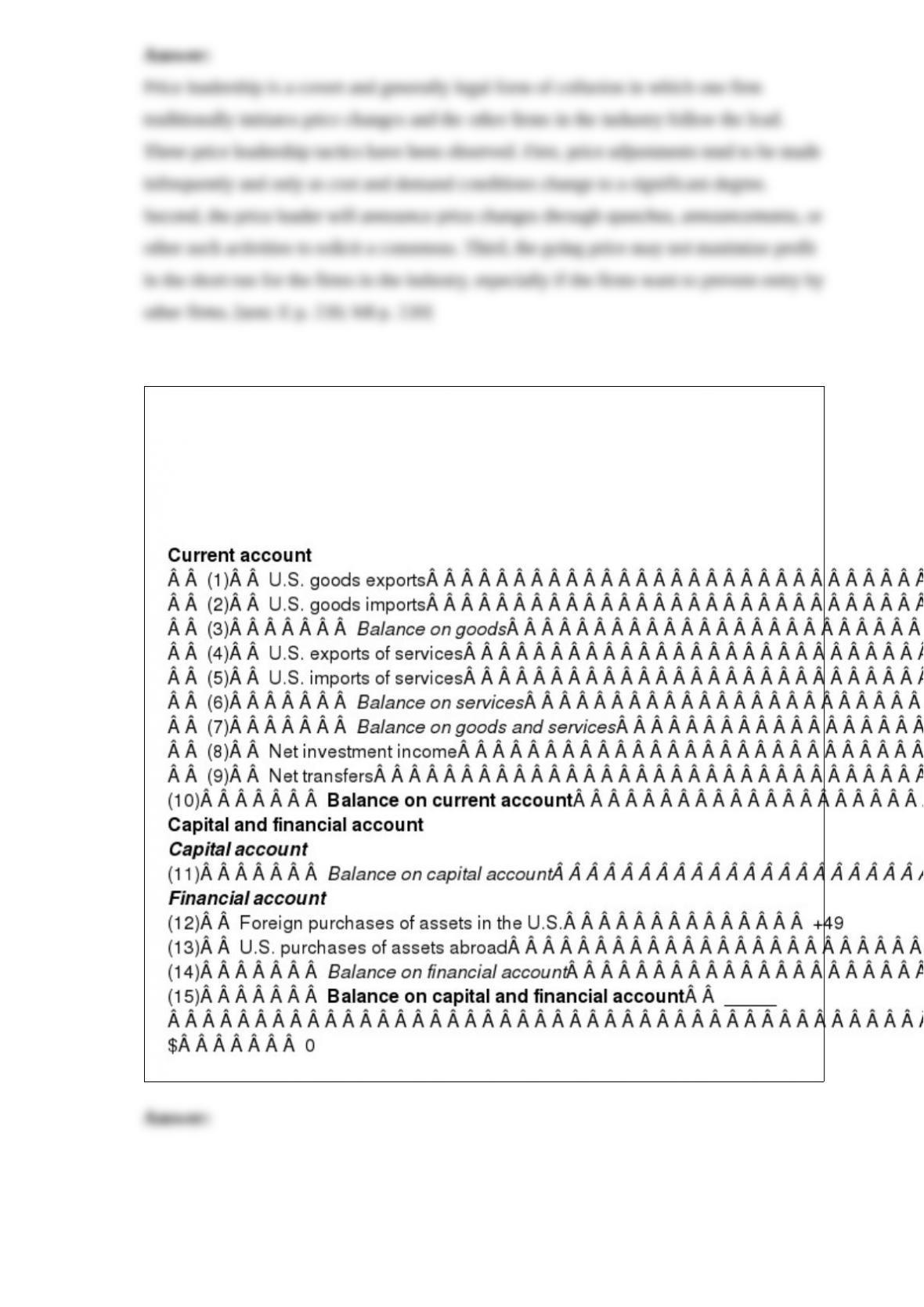
30) The table below contains hypothetical international balance-of-payments data for
the United States. All figures are in billions. Compute with the appropriate sign (+ or )
and enter in the table the six missing items. What was the condition of the balance of
payments in the United States?