
1) if the equation y = 15 – 4x was plotted, the:
a.vertical intercept would be -4
b.vertical intercept would be +4
c.vertical intercept would be +9
d.slope would be -4
2) The U.S. supply of Japanese yen is:
A.downsloping because a lower dollar price of yen means U.S. goods are cheaper to the
Japanese.
B.upsloping because a higher dollar price of yen means U.S. goods are cheaper to the
Japanese.
C.upsloping because a lower dollar price of yen means U.S. goods are cheaper to the
Japanese.
D.downsloping because a higher dollar price of yen means U.S. goods are cheaper to
the Japanese.
3) According to the Taylor rule, when real GDP is at its potential and inflation is at its
target rate of 2 percent, the Fed should:
A.carefully lower the Federal funds rate in an attempt to stimulate non-inflationary real
GDP growth.
B.raise the Federal funds rate in an attempt to eliminate the remaining inflation.
C.lower the Federal funds rate to lower borrowing costs for the Federal government.
D.keep the Federal funds rate at 4 percent.
4) Which of the following is true about U.S. energy consumption and per capita real
GDP since 1988?
A.Per capita energy consumption and per capita real GDP have both risen.
B.Per capita consumption of energy has been relatively constant, while per capita real
GDP has risen.
C.Per capita energy consumption and per capita real GDP have both fallen.
D.Per capita energy consumption has fallen, while per capita real GDP has risen.
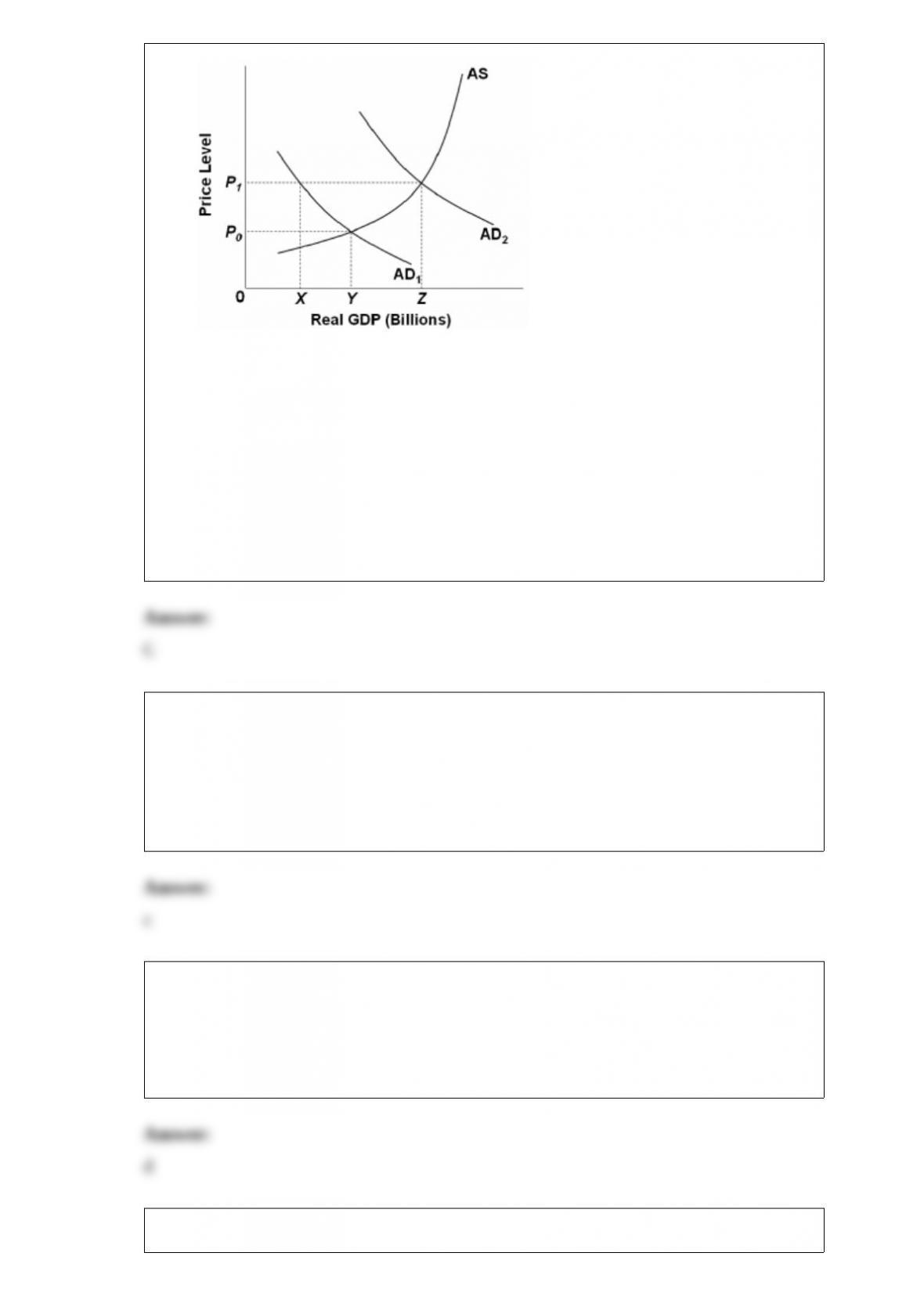
5)
Refer to the above figure. Suppose that the economy is currently operating at the
intersection of AS and AD2, and that the full employment level of output is Y. If the
government wants to move the level of real GDP back to Y and reduce demand-pull
inflation, it should:
A.reduce taxes or increase government spending.
B.enact a contractionary fiscal policy that will shift aggregate demand left to AD1.
C.enact a contractionary fiscal policy that will shift aggregate demand to the left, but
not as far as AD1.
D.enact a contractionary fiscal policy that will shift aggregate demand to the left,
farther left than AD1.
6) price is constant or given to the individual firm selling in a purely competitive
market because:
a.the firm’s demand curve is downsloping.
b.of product differentiation reinforced by extensive advertising.
c.each seller supplies a negligible fraction of total supply.
d.there are no good substitutes for its product.
7) the relationship between marginal cost and average fixed cost is such that:
a.declines in mc cause afc to decline as output increases.
b.increases in mc cause afc to increase as output increases.
c.mc intersects afc at that output where afc is at a minimum.
d.mc may either rise or fall as afc declines.
8) which of the following is not a valid generalization concerning the relationship
between price and costs for a purely competitive seller in the short run?
a.price must be at least equal to average total cost.
b.price times quantity produced must be equal to or greater than total variable cost for
some level of output or the firm will close down in the short run.
c.price may be equal to, greater than, or less than average total cost.
d.price must be equal to or greater than minimum average variable cost for the firm to
continue producing.
9) The most likely way the public debt burdens future generations, if at all, is by:
A.reducing the current level of investment.
B.causing future unemployment.
C.causing deflation.
D.reducing real interest rates.
10) Which of the following is not part of a nation’s infrastructure?
A.communications facilities
B.roads, highways, and bridges
C.the electrical power system
D.industrial plants and equipment
11) insurance companies use deductibles and copayments to:
a.increase access to health care.
b.reduce health care costs by discouraging overuse of the health care system.
c.prevent small companies from self-insuring their workers.
d.keep government out of the health care insurance industry.
12) the term laissez-faire suggests that:
a.land and other natural resources should be privately owned, but capital should be
publicly owned.
b.land and other natural resources should be publicly owned, but capital equipment
should be privately owned.
c.government should not interfere with the operation of the economy.
d.government action is necessary if the economy is to achieve full employment and full

production.
13) A recessionary expenditure gap is:
A.the amount by which the full-employment GDP exceeds the level of aggregate
expenditures.
B.the amount by which equilibrium GDP falls short of the full-employment GDP.
C.the amount by which investment exceeds saving at the full-employment GDP.
D.the amount by which aggregate expenditures exceed the full-employment level of
GDP.
14) Suppose the price level is fixed, the MPC is .8, the GDP gap is a negative $200
billion. To achieve full-employment output (exactly), government should:
A.increase government expenditures by $200 billion.
B.reduce taxes by $200 billion.
C.increase government expenditures by $40 billion.
D.reduce taxes by $160 billion.
15) the law of increasing opportunity costs exists because:
a.resources are not equally efficient in producing various goods.
b.the value of the dollar has diminished historically because of persistent inflation.
c.wage rates invariably rise as the economy approaches full employment.
d.consumers tend to value any good more highly when they have little of it.
16) If the quantity of money demanded exceeds the quantity supplied:
A.the supply-of-money curve will shift to the left.
B.the demand-for-money curve will shift to the right.
C.the interest rate will rise.
D.the interest rate will fall.