All else equal, compared to the case of a closed economy, monetary policy is ______
effective in an open economy with a ______ exchange rate.
A. more; fixed
B. more; flexible
C. less; real
D. less; nominal
The tendency of markets to automatically gravitate toward equilibrium is an application
of which core principle?
A. The Scarcity Principle
B. The Cost-Benefit Principle
C. The Principle of Comparative Advantage
D. The Incentive Principle

Which of the following is a liability of a family?
A. Checking account balance
B. Share of stock
C. House
D. Mortgage
Data for an economy show that the unemployment rate is 6 percent, the participation
rate 60 percent, and 200 million people 16 years or older are not in the labor force. How
many people are unemployed this economy?
A. 12.0 million
B. 18.0 million
C. 28.8 million
D. 43.2 million
A regular payment received by stockholders for each share they own is called a:
A. coupon payment.
B. dividend.

C. bond.
D. capital gain.
Sydney sells snow globes from a cart. When the cart is located on the sidewalk near a
discount store, Sydney’s customers have reservation prices of $5. When Sydney’s cart is
located on a sidewalk in an upscale mall, wealthier customers with reservation prices of
$10 buy snow globes. Assume that Sydney can sell the same volume at either location
and that marginal and average costs are $3 per globe at both locations. Total economic
surplus will be maximized if Sydney:
A. alternates between the two locations and price discriminates.
B. sells only near the discount store and charges $5.
C. sells only in the upscale mall and charges $10.
D. alternates between the two locations and charges $5 at both locations.
The real wage is the wage:
A. measured in current dollars.
B. required to maintain a minimum standard of living.
C. employers are required to pay workers.
D. measured in terms of purchasing power.
The economic surplus of an action is:
A. the benefit gained by taking an action.
B. the difference the explicit and implicit costs of taking an action.
C. the difference between the benefit and the cost of taking an action.
D. the money a person has left over after taking an action.
If firms maintain preset prices in the short run, then the primary cause of output gaps is
changes in:
A. potential output.
B. prices.
C. capital and technology.
D. economy-wide spending.

Jim Brown would like to work, but has not looked for work in the past four weeks
because he does not believe any jobs are available. In the official employment statistics,
Jim is classified as:
A. employed.
B. unemployed.
C. out of the labor force.
D. underemployed.
Mexico and the members of OPEC produce crude oil. Realizing that it would be in their
best interests to form an agreement on production goals, a meeting is arranged and an
informal, verbal agreement is reached. If both Mexico and OPEC abide by the
agreement, then OPEC’s profit will be $200 million and Mexico’s profit will be $100
million. If both Mexico and OPEC cheat on the agreement, then OPEC’s profit will be
$175 million and Mexico’s profit will be $80 million. If only OPEC cheats, then
OPEC’s profit will be $185 million, and Mexico’s profit will be $60 million. If only
Mexico cheats, then Mexico’s profit will be $110 million, and OPEC’s profit will be
$150 million. You may find it helpful to fill in the payoff matrix below.
To Mexico, the payoff to cheating is either:
A. $60 million or $100 million.
B. $150 million or $200 million.
C. $80 million or $110 million.
D. $100 million or $110 million.
Early settlers in the town of Dry Gulch drilled wells to pump as much water as they
wanted from the single aquifer beneath the town. (An aquifer is an underground body of
water.) As more people settled in Dry Gulch, the aquifer level fell and new wells had to
be drilled deeper at higher cost. The town council has proposed putting a meter on each
household’s pump, and charging residents for each gallon of water used. This would:
A. have no effect on water use.
B. discourage residents from using too much water.
C. convert private property to public property.
D. reduce total economic surplus.
Net exports will tend to be low when the real exchange rate:
A. is high.
B. is low.

C. equals the nominal exchange rate.
D. depreciates.
If planned aggregate expenditure (PAE) in an economy equals 3,000 + 0.75Y and
potential output (Y*) equals 12,000, then this economy has:
A. an expansionary gap.
B. a recessionary gap.
C. no output gap.
D. no autonomous expenditure.
Which of the following is correct?
A. National saving equals private saving plus public saving.
B. Public saving equals national saving plus private saving.
C. Private saving equals national saving plus public saving.
D. National saving equals public saving minus private saving.
A firm’s profit equals:
A. P – MC [price minus marginal cost]
B. (P – ATC) × Q [(price minus average total cost) times the quantity sold]
C. P × Q [price times the quantity sold]
D. (P – ATC) ÷ Q [(price minus average total cost) divided by the quantity sold]
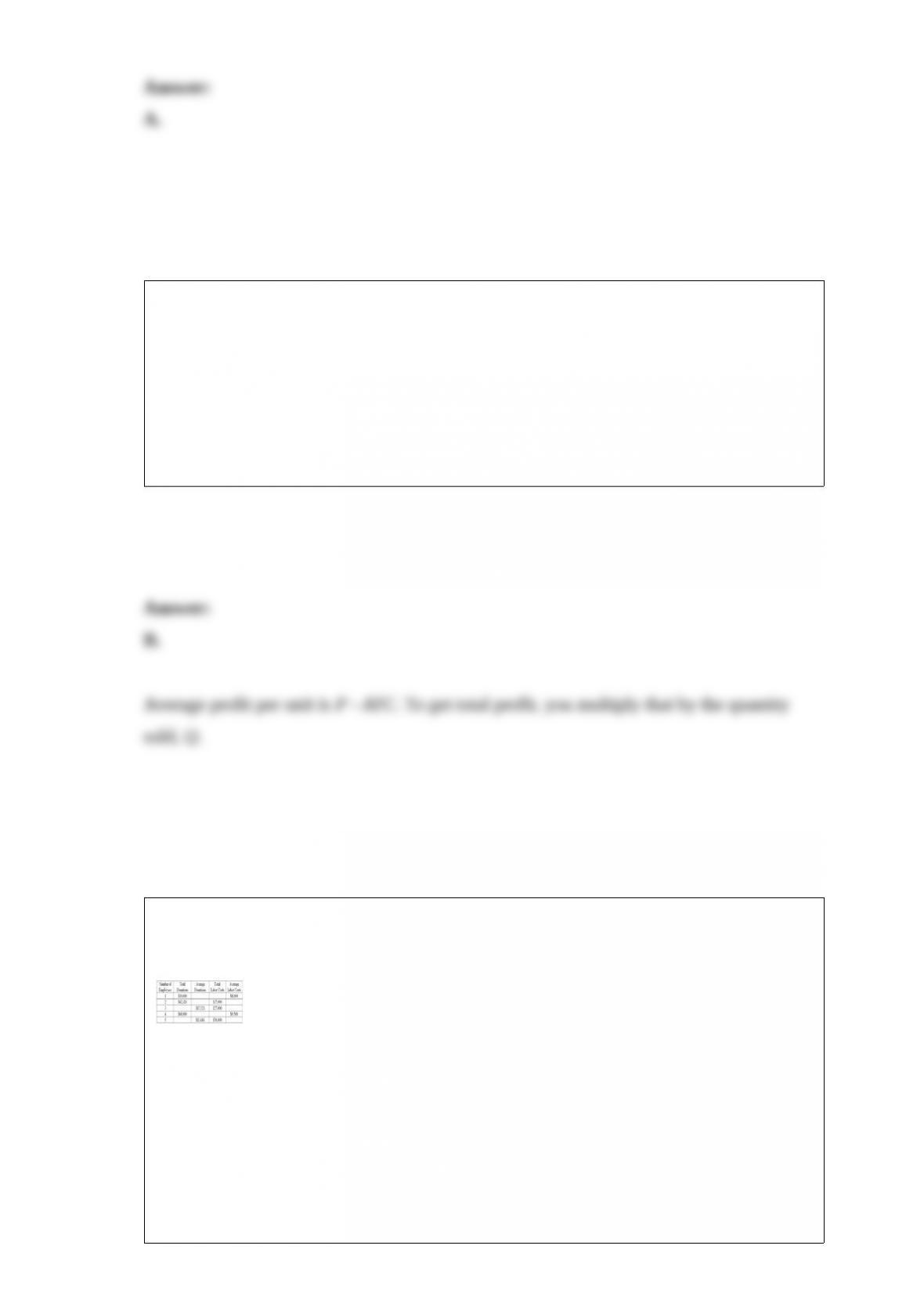
The table below shows how total donations, average donations, total labor costs and
average labor costs vary depending on the number of employees State U hires for its
fundraising activities.
The total labor cost with 4 employees is:
A. $21,500.
B. $22,000.
C. $38,000.
D. $43,121.

Which of the following policies is likely to enhance a central bank’s credibility?
A. Announcing inflation targets
B. Appointing inflation doves as central bankers
C. Making the central bank obligated to finance the national deficit
D. Appointing central bankers for short terms that coincide with those in the legislative
and executive branches of government
Pat can either drive to work, which takes half an hour and uses $1.50 worth of gas, or
take the bus, which takes an hour and costs $1.00. How should Pat get to work?
A. Pat should take the bus because it costs $0.50 less than driving.
B. Pat should drive because it saves half an hour relative to taking the bus.
C. Pat should drive if saving half an hour is worth $0.50 or more.
D. Pat should take the bus if saving half an hour is worth $0.50 or more.
The Scarcity Principle applies to:
A. poor people primarily.
B. consumers primarily.
C. firms primarily.
D. everyone.
A cost of an activity that falls on people not engaged in the activity is called a(n):
A. external benefit.
B. prisoner’s dilemma.
C. negative externality.
D. positive externality.
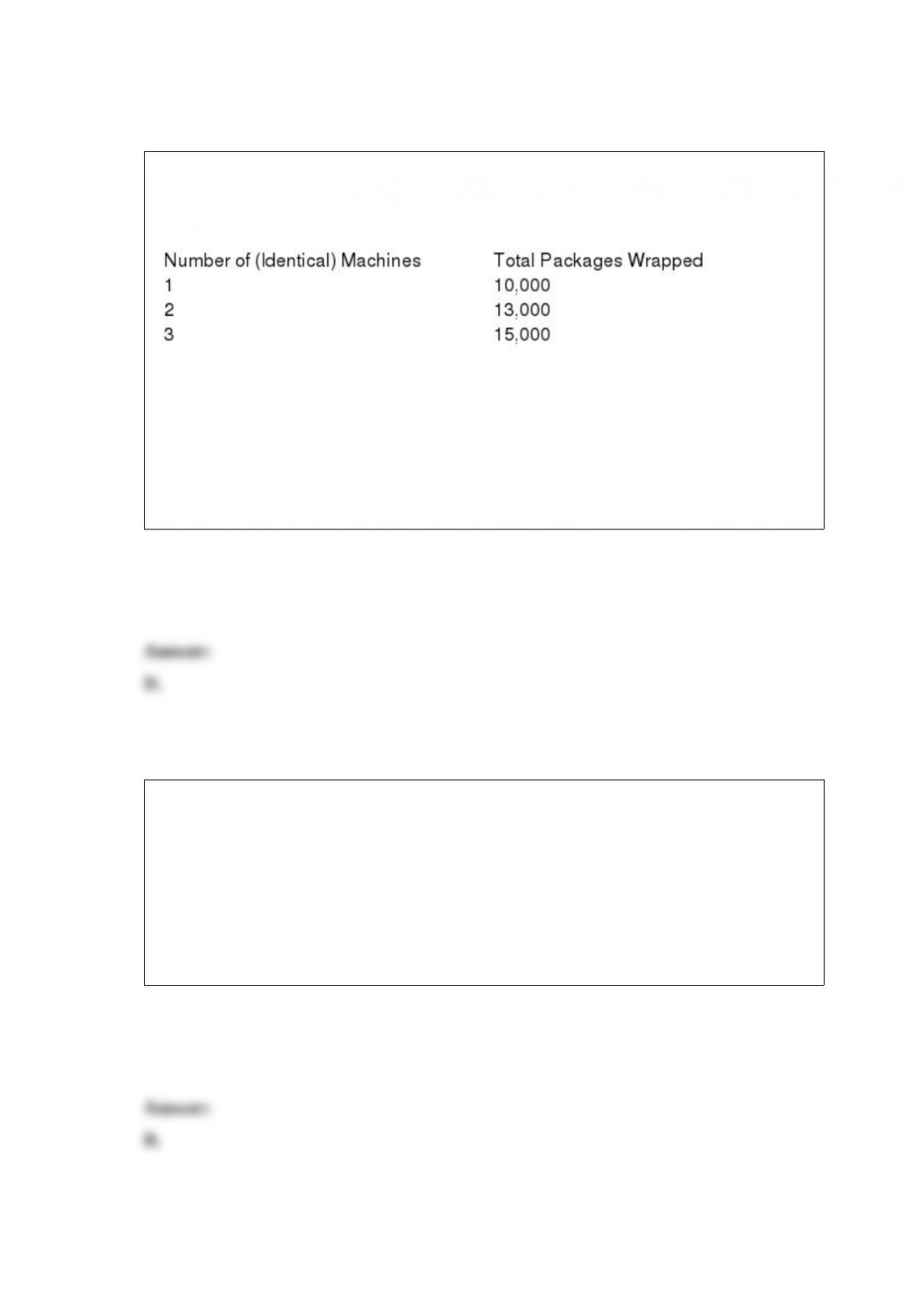
Based on the table below and the principle of diminishing returns to capital, then total
packages wrapped when a fourth machine is installed must be less than ______
packages.
A. 2,000
B. 15,000
C. 16,000
D. 17,000
Wages and salaries are examples of:
A. consumption.
B. labor income.
C. capital income.
D. profits.
Last year Christine worked as a consultant. She hired an administrative assistant for
$15,000 per year and rented office space (utilities included) for $3,000 per month. Her
total revenue for the year was $100,000. If Christine hadn’t worked as a consultant, she
would have worked at a real estate firm earning $40,000 a year.
For Christine to earn a normal profit as a consultant, her accounting profit would have
to be ______.
A. $51,000
B. $40,000
C. $9,000
D. $0
Because monopolists charge a price in excess of marginal cost, it must be the case that
monopolists:
A. earn a positive economic profit.
B. earn a negative economic profit.
C. produce more than the socially optimal level of output.
D. produce less than the socially optimal level of output.
The reason people in Professor Rawls’ thought experiment would choose an equal
distribution of income is that:
A. they are concerned about the welfare of others.
B. they fear ending up in a disadvantaged position themselves.
C. people are risk-neutral.
D. it is the easiest distribution to implement.
In the United States, the emergence of the third-party payment system explains ______
of the increase in health care expenditures from 1940 to the present.
A. all
B. a great deal
C. almost none
D. none
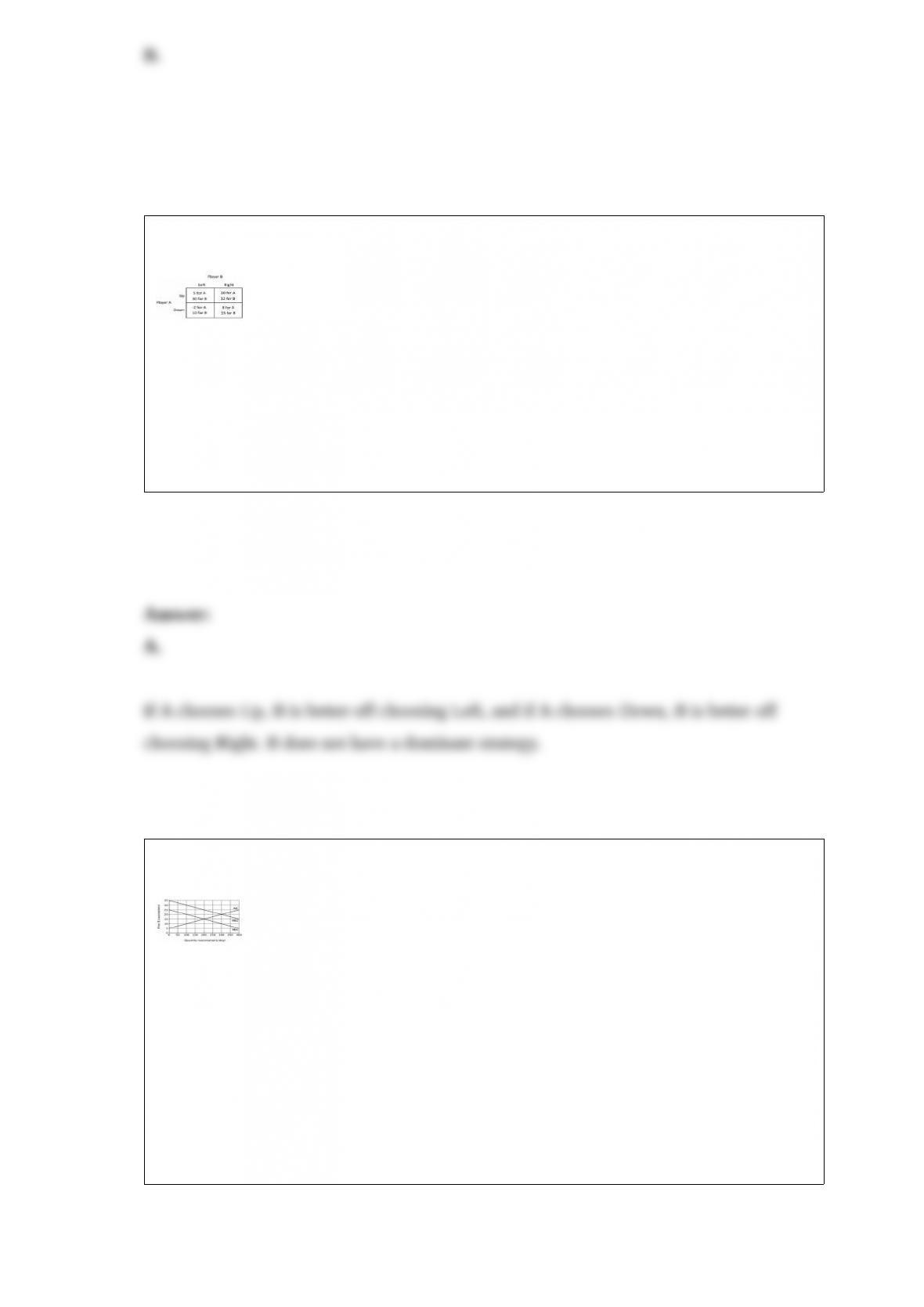
Refer to the figure below. In this game, how many dominant strategies does Player B
have?
A. 0
B. 1
C. 2
D. 4
The graph below illustrates the marginal cost, marginal private benefit, and marginal
social benefit of being vaccinated against a contagious childhood disease.
Private market incentives would result in ______ vaccinations per day, but the socially
optimal number of vaccinations is ______ per day.
A. 200; 300
B. 200; 400
C. 300; 0
D. 300; 200
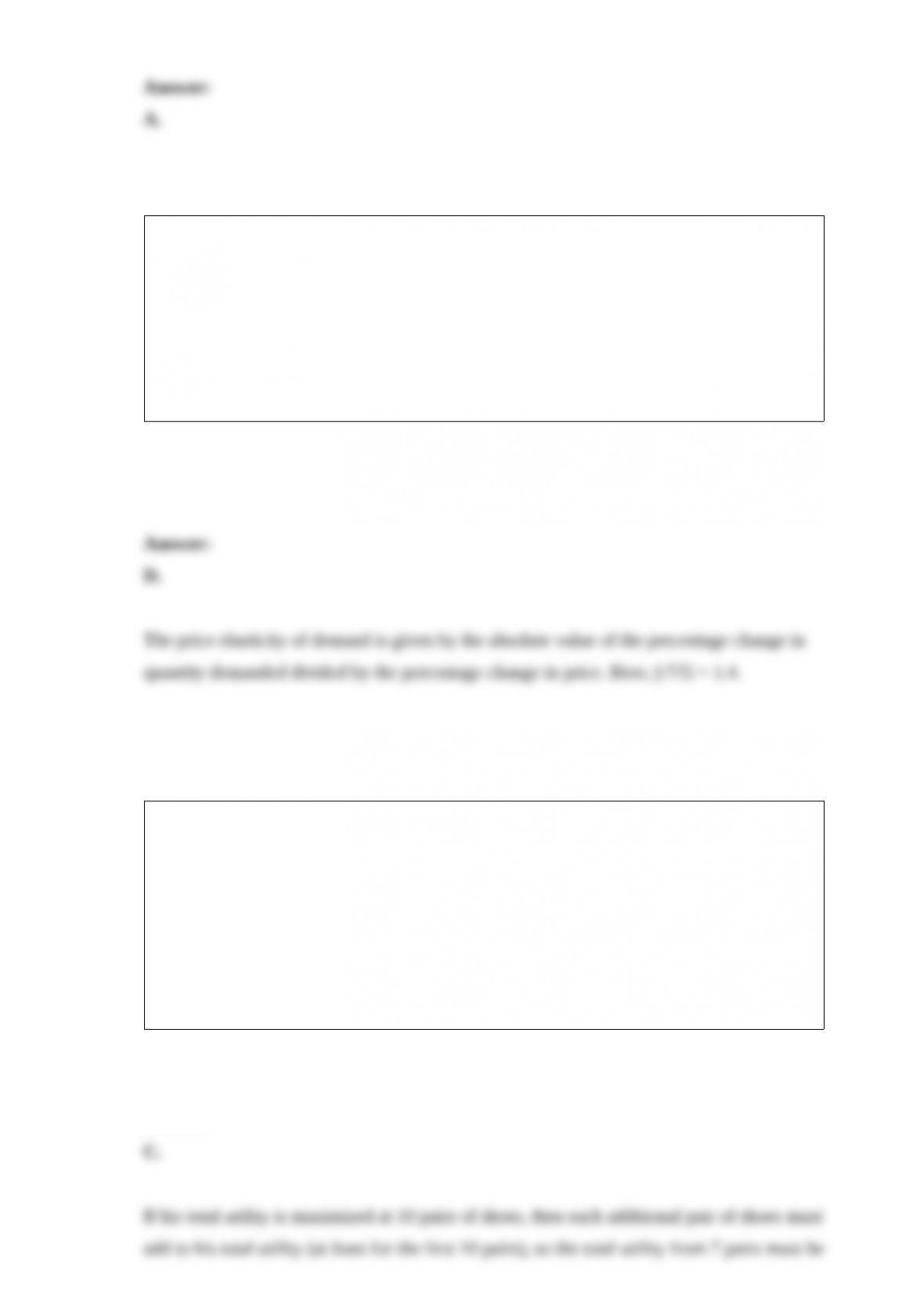
If the elasticity of demand for the latest American Idol album is 1.4, this means
A. few substitutes for the American Idol album exist.
B. a 1% increase in the price leads to a 14% decrease in quantity demanded.
C. a 10% decrease in the price leads to a 140% increase in quantity demanded.
D. a 5% increase in the price leads to a 7% decrease in quantity demanded.
If Terry’s total utility is maximized when he owns 10 pairs of shoes, then Terry’s total
utility from owning 7 pairs of shoes is ______ Terry’s total utility from owning 8 pairs.
A. greater than
B. equal to
C. less than
D. less than or equal to
An explanation for the low saving rate in the United States consistent with the
demonstration effect includes:
A. relatively generous government assistance for the elderly and large down payments
required for home purchases.
B. households spending beyond their means to keep up with community standards.
C. well-developed financial markets making it easy to borrow against home equity.
D. large and persistent capital gains.
A price ceiling that is set below the equilibrium price will cause:
A. producer surplus to fall.
B. total economic surplus to rise.
C. quantity supplied to exceed quantity demanded.
D. an increase in demand.
The Cost-Benefit Principle:
A. fully captures how people choose between alternatives.
B. provides an abstract model of how people should choose between alternatives.
C. describes how people behave once they have enough education.
D. provides little insight into how people actually chose between alternatives.