
Consider a good whose consumption takes place publicly. Your decision to buy that
good depends
A) both on the characteristics of the product and on how many other people are buying
the good.
B) only on the characteristics of the good.
C) only on how many other people buy the good.
D) only on the price of the good.
DeShawn’s Detailing is a service that details cars at the customers’ homes or places of
work. DeShawn’s cost for a basic detailing package is $40, and he charges $75 for this
service. For a total price of $90, DeShawn will also detail the car’s engine, a service that
adds an additional $20 to the total cost of the package. What is DeShawn’s marginal
benefit if he sells a basic detailing package?
A) $35
B) $75
C) He makes a marginal loss of $15, not a marginal benefit.
D) The marginal benefit cannot be determined.
Economists who support market-based reforms for health care believe that increased

competition among providers of health care would ________ costs and ________
economic efficiency.
A) increase; increase
B) increase; decrease
C) decrease; increase
D) decrease; decrease
A firm’s efforts to increase profit by price discrimination can be undermined by
A) arbitrage by buyers.
B) consumer ignorance.
C) differences in elasticity of demand.
D) seller market power.
The opportunity cost of going to an outdoor music festival is
A) the enjoyment you receive from going to the festival.
B) the value of the time spent at the festival.

C) equal to the highest value of an alternative use of the time and money spent on the
festival.
D) zero because there is no overhead costs for an outdoor festival.
E) the cost of the festival ticket only.
Scenario: Donna Bader, Globalization opponent
Donna Bader spent her final year at college studying the effect of various economic
factors on the economy of developing nations. Based on the results of her study, she
concluded that globalization does these countries more harm than good.Her argument is
vulnerable to criticism because it fails to ________.
A) quantify the disparity between high-income and low-income nations
B) show that political and cultural factors have been taken into account
C) demonstrate the importance of market flexibility
D) highlight the environmental effect of globalization
Table 13-2
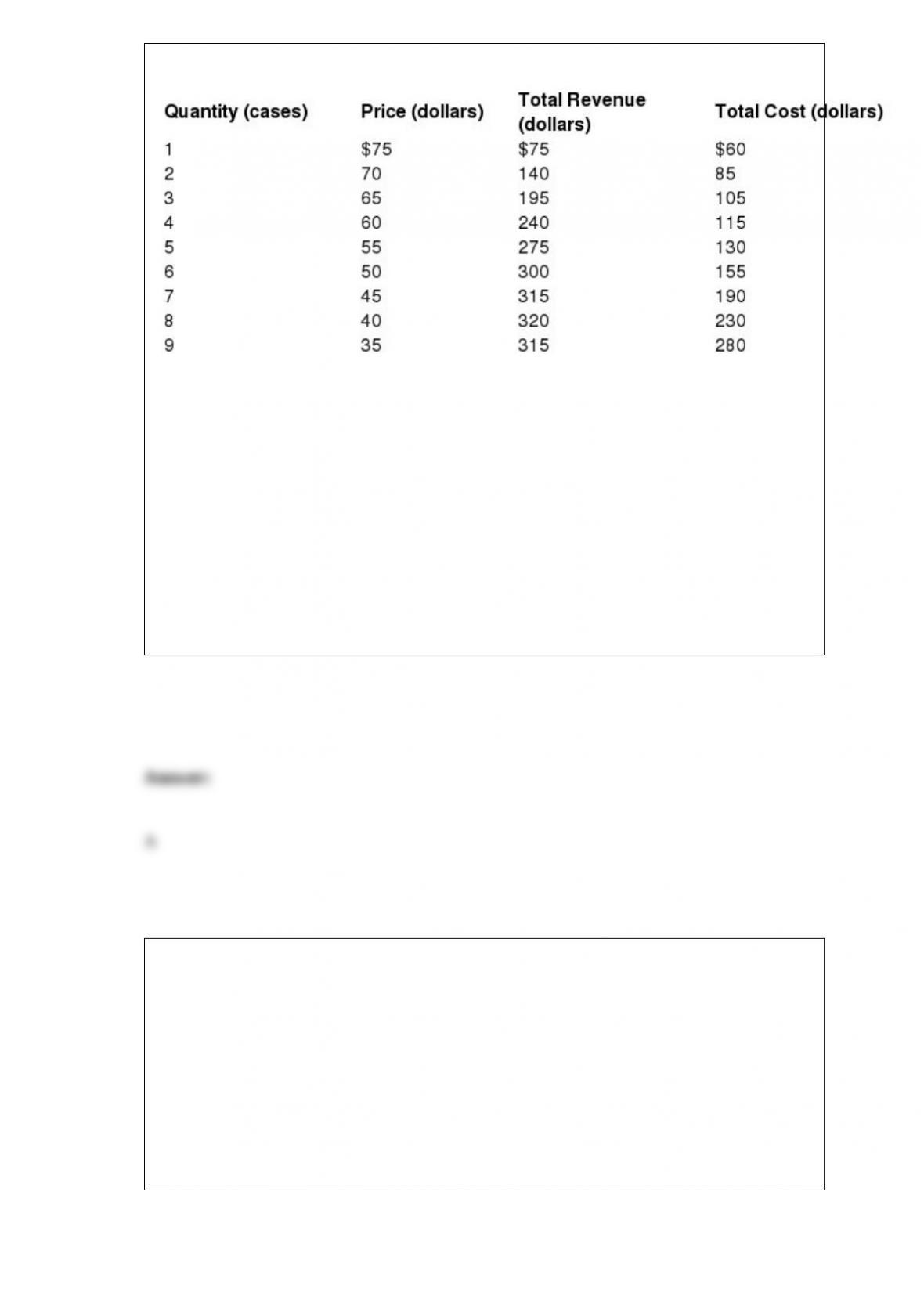
Eco Energy is a monopolistically competitive producer of a sports beverage called
Power On. Table 13-2 shows the firm’s demand and cost schedules.
Refer to Table 13-2. What is likely to happen to the product’s price in the long run?
A) It will fall.
B) It will increase.
C) It will remain constant.
D) This cannot be determined without information on its long-run demand curve.
One of the most widely followed stock indexes in the United States is the Dow Jones
Industrial Average. This index represents
A) the stock prices of 500 large U.S. firms.
B) an over-the-counter market.
C) the stock prices of more than 4,000 U.S. firms.
D) the stock prices of 30 large U.S. corporations.

The shape of the average total cost curve is determined by the shape of
A) the marginal cost curve.
B) the average fixed cost curve.
C) the average product curve.
D) the firm’s production function.
Which of the following is not an advantage of starting a new business as a corporation?
A) separation of ownership and business liability
B) enhanced ability to raise funds
C) ability to share risks
D) possibility of double taxation

The demand for gasoline in the short run is
A) elastic because people can easily switch to public transportation.
B) perfectly inelastic because people have no choice but to buy gasoline.
C) unit-elastic because people tend to consume a stable amount of gasoline per period.
D) inelastic because there are no good substitutes for gasoline.
Whenever a buyer and a seller agree to trade,
A) the agreement is made based on absolute advantage.
B) they must have identical opportunity costs in producing their respective products.
C) one party will always be worse off.
D) both must believe they will be made better off.
The substitution effect of a wage increase is observed when
A) the higher wage income causes workers to take more leisure and work less.
B) leisure’s higher opportunity cost causes workers to take less leisure and work more.
C) the higher wage income causes workers to take more leisure and work more.

D) leisure’s higher opportunity cost causes workers to take more leisure and work less.
Which of the following is an example of a nonexcludable product?
A) college education
B) a public library
C) public transportation
D) internet service for your home computer
Which of the following can a firm do in the long run but not in the short run?
A) decrease the size of its physical plant
B) reduce its rate of output by laying off workers
C) increase its variable costs
D) increase its use of raw materials
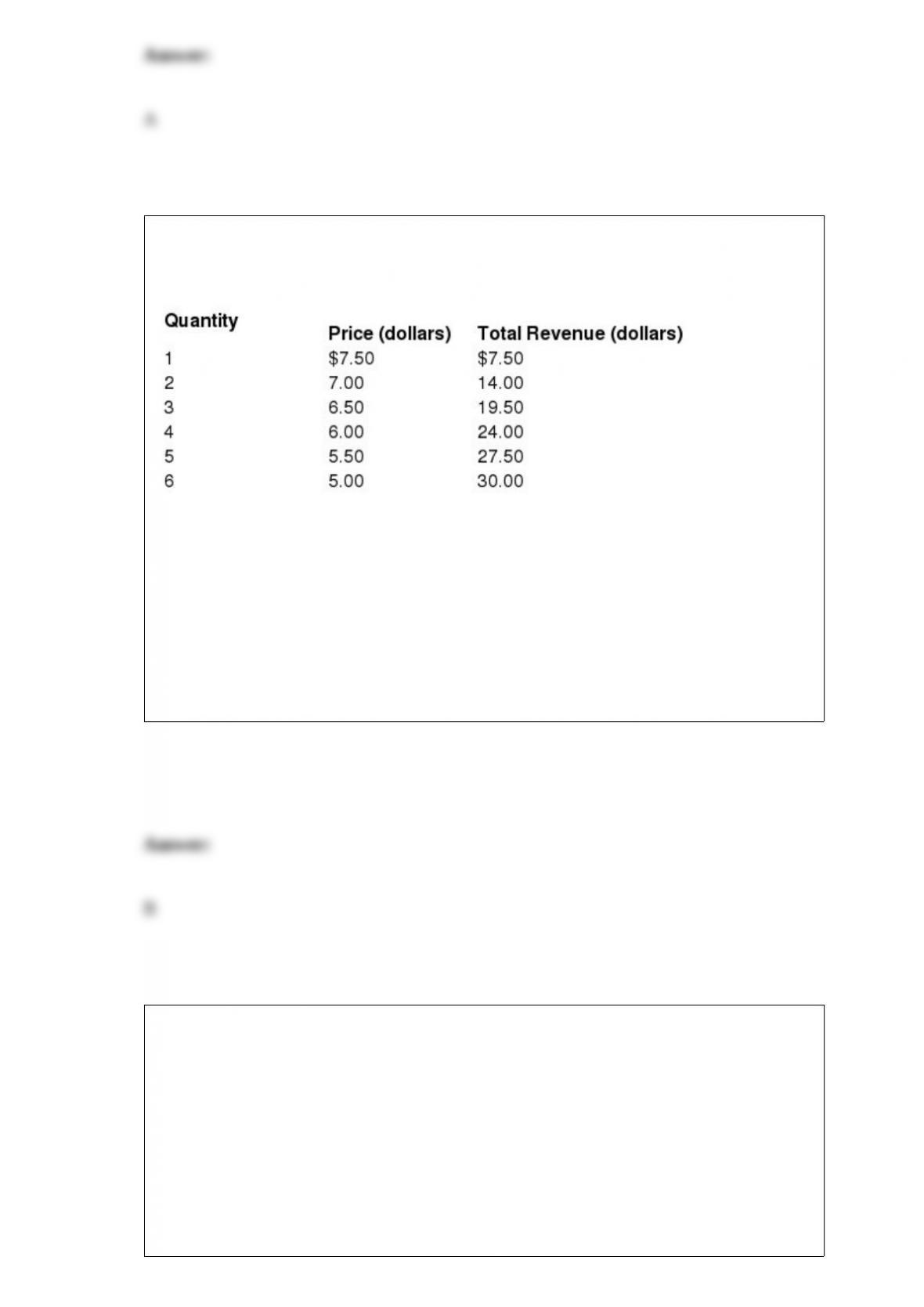
Table 13-1
Refer to Table 13-1. What is the marginal revenue of the 3rd unit?
A) $6.50
B) $5.50
C) $1.83
D) $0.50
Article Summary
In 2012, Colorado and Washington legalized marijuana for recreational use, and
one of the major selling points in each state’s pro-marijuana campaign was the
possibility of generating millions of dollars in tax revenue from sales which could
be used for funding general education. The Colorado legislature was weighing a
proposal to tax marijuana at 30 percent, of which 15 percent would be a sales tax
on consumers and 15 percent an excise tax on growers. Washington has set a tax
rate of 44 percent on consumers and 25 percent each for growers and retailers.
Since the legalization of marijuana is relatively new, projecting the economic

impact of its sale is difficult, leading to many questions as to the quantities that
will be produced and sold and what actual tax revenues will be generated.
Source: Elizabeth Dwoskin, “Colorado and Washington Try to Figure Out How to
Tax Marijuana,” Bloomberg Businessweek, April 26, 2013.
Refer to the Article Summary. Colorado is weighing a proposal to tax marijuana at 30
percent, of which 15 percent would be a sales tax on consumers and 15 percent would
be an excise tax on growers. Does this necessarily mean that each group will bear half
the burden of the tax?
A) Yes, since the taxes are divided equally between consumers and producers, each will
bear half the burden.
B) Yes, despite the even split of the 30 percent tax, consumers and producers always
bear equal burdens of a tax.
C) No, the burden of a tax is always 100 percent on the consumer.
D) No, the burden of the tax will depend on the elasticity of demand and supply.
Because a monopoly’s demand curve is the same as the market demand curve for its
product
A) the monopoly’s marginal revenue equals its price.
B) the monopoly is a price taker.
C) the monopoly must lower its price to sell more of its product.
D) the monopoly’s average total cost always falls as it increases its output.

What is always true at the quantity where a firm’s average total cost equals average
revenue?
A) The firm’s revenue is maximized.
B) The firm’s profit is maximized.
C) The firm breaks even.
D) Marginal cost equals marginal revenue.
Which of the following statements is false?
A) An implicit cost is a nonmonetary opportunity cost.
B) Economic costs include both accounting costs and implicit costs.
C) An explicit cost is a cost that involves spending money.
D) Economists consider all costs to be implicit costs.
All of the following statements are true of the minimum efficient scale except one.
Which one?
A) All possible economies of scale have been exhausted.

B) The short-run average total cost curve’s minimum point is equal to the long run
average cost curve’s minimum point.
C) Any increase in the scale of operation will encounter diseconomies of scale.
D) An increase in the output level will increase profit.
Between 1981 and 2011, the overall mortality rate in the United States
A) decreased by more than 25 percent.
B) slowly but steadily increased.
C) remained fairly constant.
D) was similar to the average rate in most low-income countries.
Table 14-2
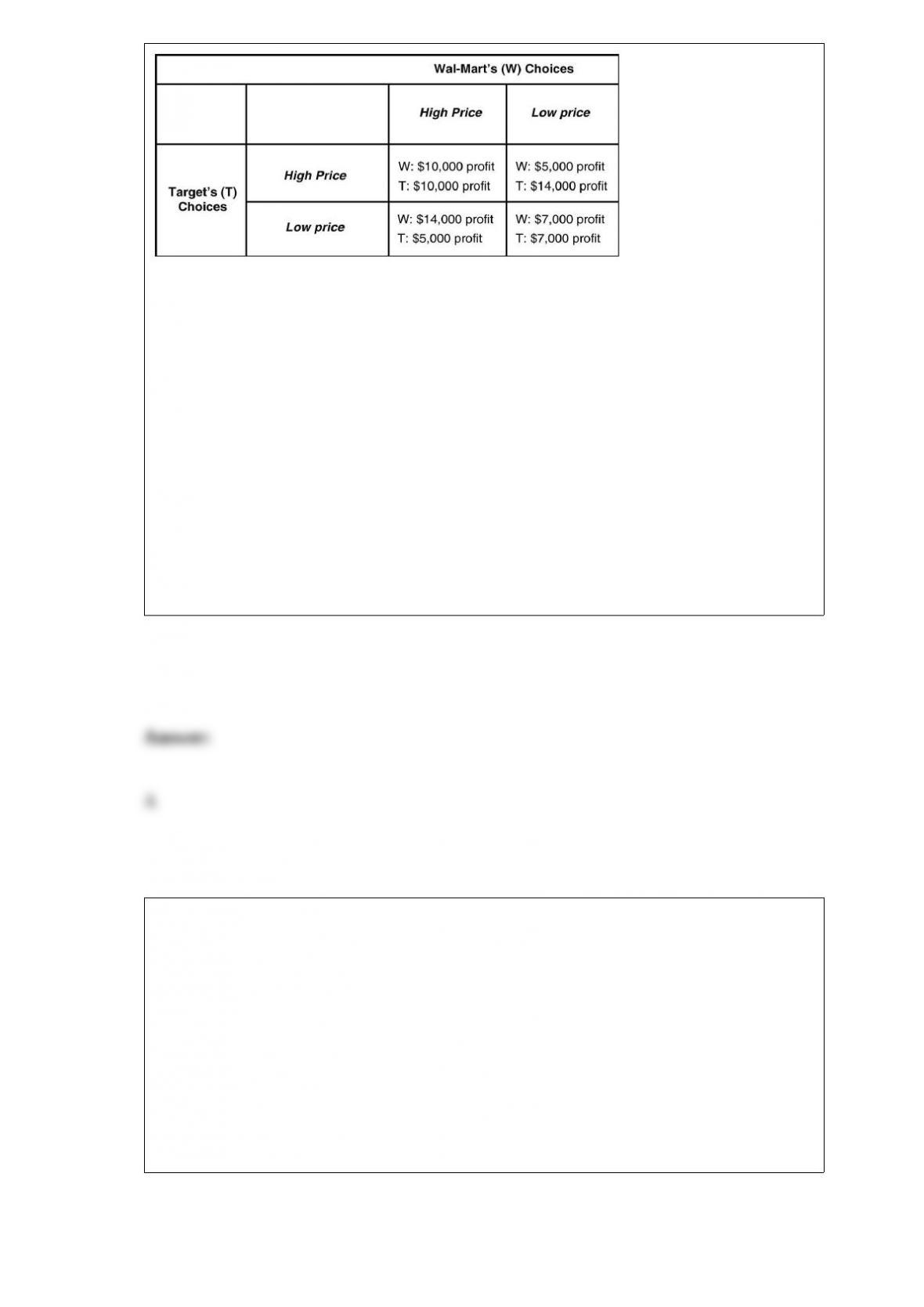
Table 14-2 shows the payoff matrix for Wal-Mart and Target from every combination of
pricing strategies for the popular PlayStation 3. At the start of the game each firm
charges a low price and each earns a profit of $7,000.
Refer to Table 14-2. For each firm, is there a better outcome than the current situation
in which each firm charges the low price and earns a profit of $7,000?
A) Yes, the firms can implicitly collude and agree to charge a higher price.
B) No, there is no incentive for each firm to consider any other strategy.
C) No, any other strategy hurts consumers.
D) Yes, each firm can implicitly agree to increase output and not to deviate from a low
price.
All of the following represent differences between stocks and bonds except
A) a stock can possibly pay dividends forever, but bonds have a fixed number of
payments.
B) differences of opinion about a stock’s future may vary considerably but there is less
difference about a bond’s future.
C) the future growth of a stock is more uncertain than the payments of a bond.
D) bonds represent partial ownership in a firm but stocks do not.
An expansion path shows
A) the level of sales necessary for a firm if it wants to expand.
B) the level of long-run average cost at different scales of operation.
C) the least-cost combination of inputs for each level of output.
D) the returns to scale at each level of output.
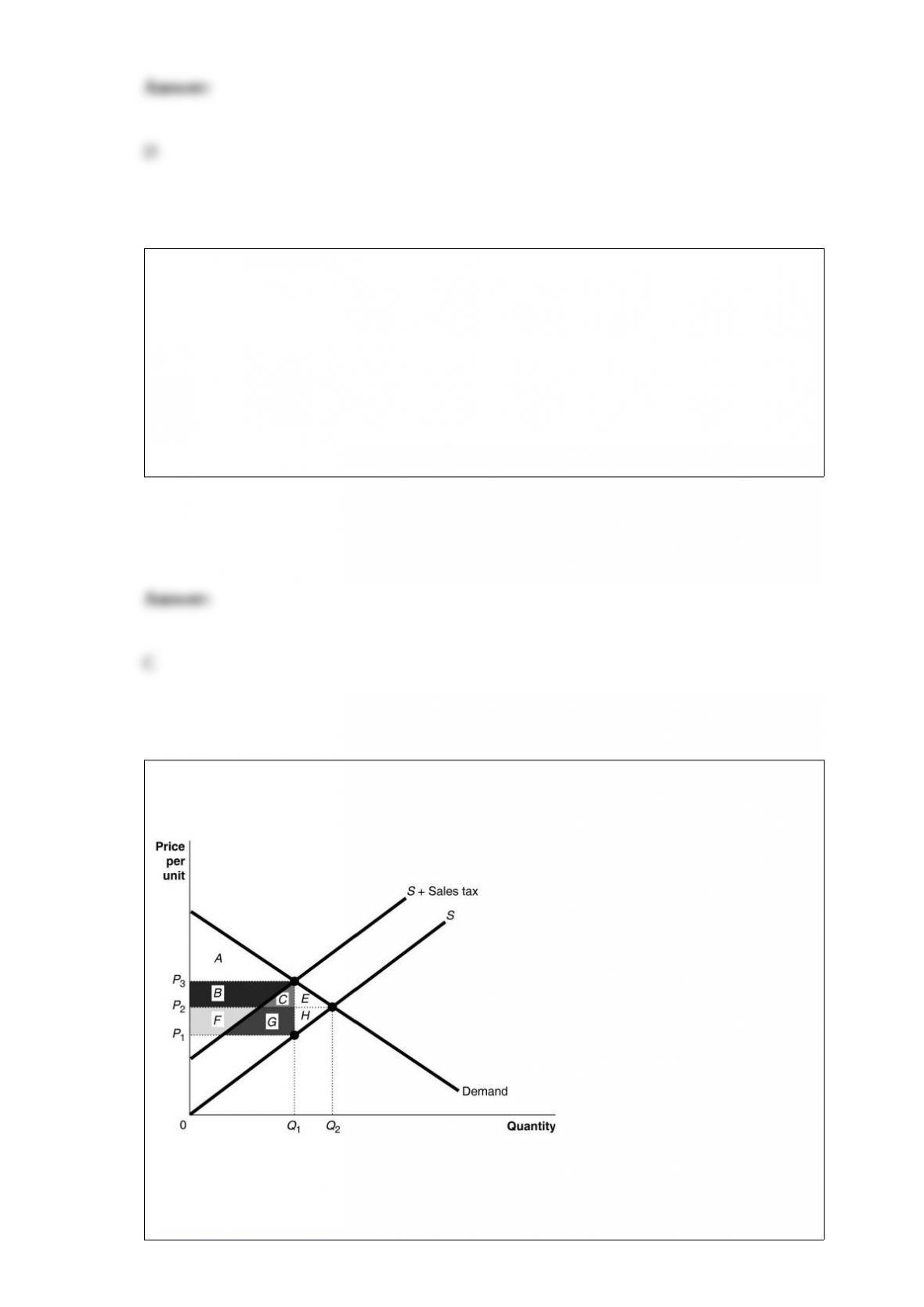
Figure 18-1
Refer to Figure 18-1. Area B+C+F+G represents
A) the portion of sales tax revenue borne by consumers.

B) the portion of sales tax revenue borne by producers.
C) the excess burden of the sales tax.
D) sales tax revenue collected by the government.
Companies in the sharing economy have the potential to lower the equilibrium price in
their market, and by doing so increase efficiency. This would have a tendency to
A) increase producer surplus and increase deadweight loss.
B) increase consumer surplus and decrease deadweight loss.
C) decrease consumer surplus and decrease producer surplus.
D) maximize consumer surplus and minimize producer surplus.
Figure 10-6
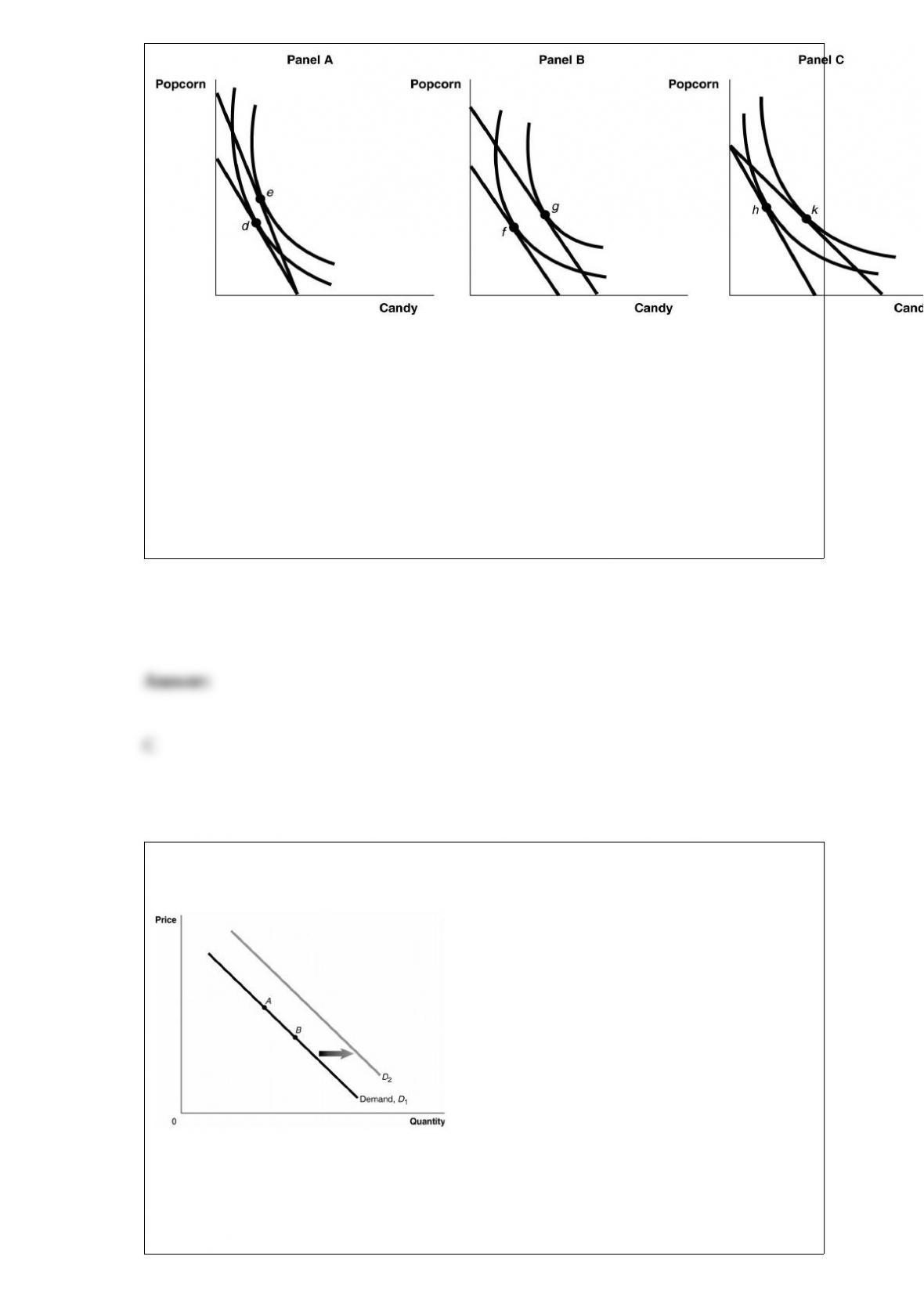
Refer to Figure 10-6. Which diagram demonstrates a decrease in total utility following
an increase in the price of candy?
A) the movement from e to d in Panel A
B) the movement from g to f in Panel B
C) the movement from k to h in Panel C
D) none of the above
Figure 3-1
Refer to Figure 3-1. A decrease in taste or preference would be represented by a
movement from
A) A to B.

B) B to A.
C) D1 to D2.
D) D2 to D1.
A major factor contributing to the slow growth rate of less developed economies is
A) the lack of well-defined and enforceable property rights.
B) the lack of natural resources.
C) the lack of workers.
D) the high rate of illiteracy.
How does a firm raise external funds through direct finance?

Anti-globalization and protectionism are both arguments against free trade. How do
these two arguments differ?
From a supply perspective, what impact would an increase in the price of motorcycles
have on the market for motorcycles?
Who decides who controls a corporation?

How is accounting profit found?
How can a corporation’s board of directors and its managers try to reduce the
principal-agent problem?
What factors would make you more sensitive or less sensitive to price when purchasing
gasoline?
What is meant by the “law of one price”? In discussing the law of demand, Hubbard
and O’Brien claim there has been no evidence of an exception to the law (that is, no
evidence of an upward-sloping demand curve). Are there exceptions to the law of one
price?
Identify four reasons for high entry barriers. Briefly explain each reason.

Explain the differences between a change in supply and a change in quantity supplied.
The Wilfer Resort Hotel has a spectacular view of a pine forest along a river bank.
Suppose a commercial logger has purchased the pine forest and is planning to clear-cut
the forest in a way that has a negative impact on the resort. Can the two parties arrive at
a Coasian solution and if so what is it?
What are the five most important variables that cause the market demand curve for
labor to shift?
Equilibrium in a perfectly competitive market results in the greatest amount of
economic surplus, or total benefit to society, from the production of a good. Why, then,
did Joseph Schumpeter argue that an economy may benefit more from firms that have
market power than from firms that are perfectly competitive?
How does a positive externality in consumption reduce economic efficiency?