1)
2) economists who believe that the recent productivity acceleration may be permanent
claim that the above-normal economic growth in the united states between 1995 and
2007 was caused by:
a.increases in the rate of personal saving.
b.increased entrepreneurial activity, application of information technology, and global
competition.
c.rising federal budget surpluses that reduced real interest rates.
d.expansionary monetary policy.
3)
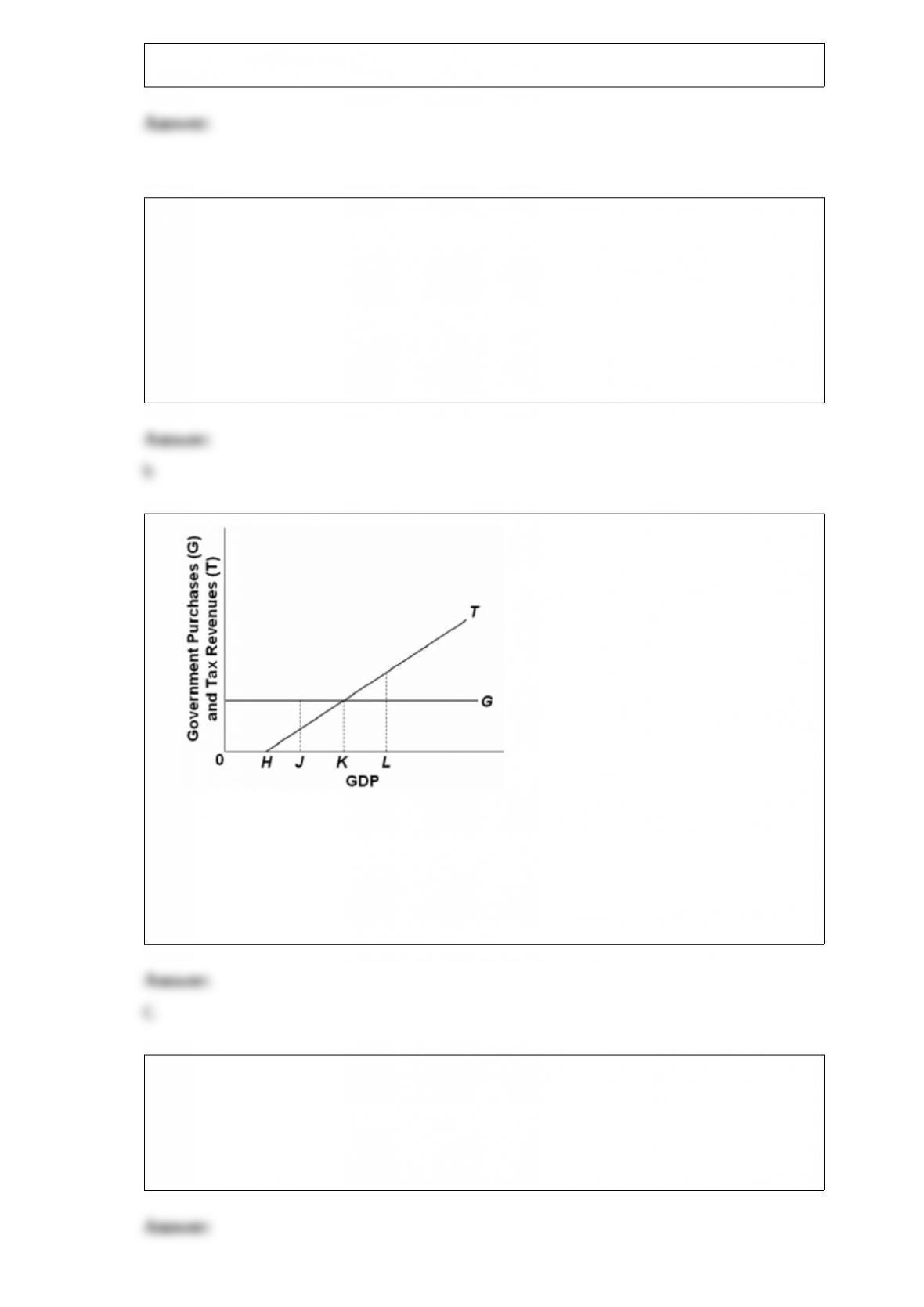
With the expenditures programs and the tax system shown in the above diagram:
A.the public budget will be expansionary at all GDP levels above K, and contractionary
at all GDP levels below K.
B.the public budget will be a destabilizing force at all levels of GDP.
C.deficits will occur at income levels below K, and surpluses above K.
D.deficits will occur at income levels below H, and surpluses above H.
4) the market system:
a.produces considerable inefficiency in the use of scarce resources.
b.effectively harnesses the incentives of workers and entrepreneurs.
c.is inconsistent with freedom of choice in the long run.
d.has slowly lost ground to emerging command systems.
5)
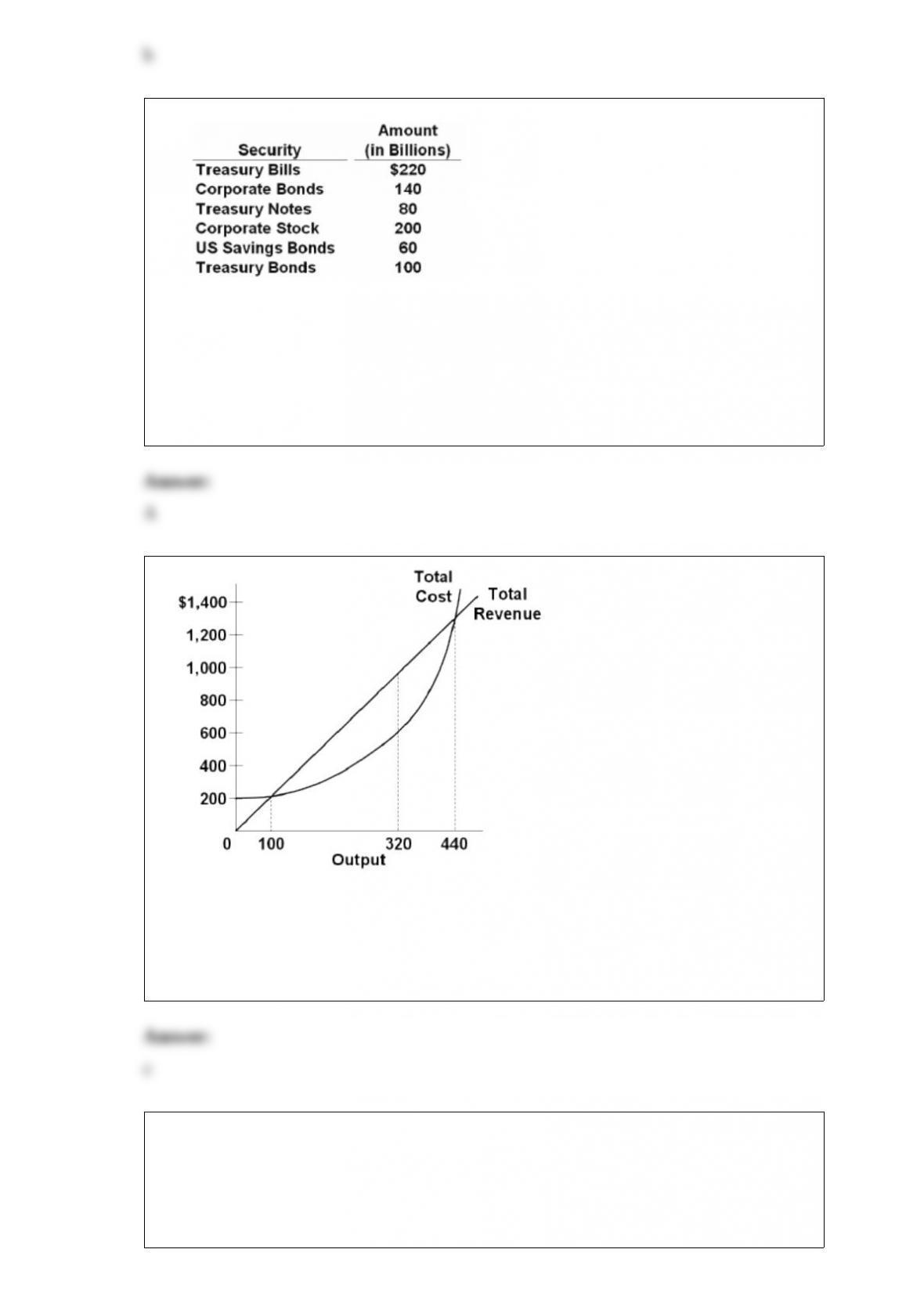
Other things equal, an increase of corporate bonds from $140 billion to $150 billion in
the above economy would:
A.not change the size of the public debt.
B.increase the public debt from $460 billion to $470 billion.
C.increase the public debt from $600 billion to $610 billion.
D.decrease the public debt by $20 billion.
6)
refer to the above short-run data. the shape of the total cost curve reflects:
a.diminishing opportunity costs.
b.the law of rising fixed costs.
c.increasing and diminishing returns.
d.economies and diseconomies of scale.
7) if the demand curve for product b shifts to the right as the price of product a declines,
then:
a.both a and b are inferior goods.
b.a is a superior good and b is an inferior good.
c.a is an inferior good and b is a superior good.
d.a and b are complementary goods.
8) The equation MPL/PL = MPC/PC:
A.designates the MR = MC level of output.
B.assumes imperfect competition in the hiring of labor and capital.
C.is a sufficient condition for the maximization of profits.
D.is a necessary, but not sufficient, condition for the maximization of profits.
9) Subprime mortgage loans refer to home loans:
A.made by less-than-reputable lenders.
B.made to home buyers with higher-than-average credit risk.
C.with interest rates below the prime interest rate.
D.D.for houses in poor neighborhoods.
10)
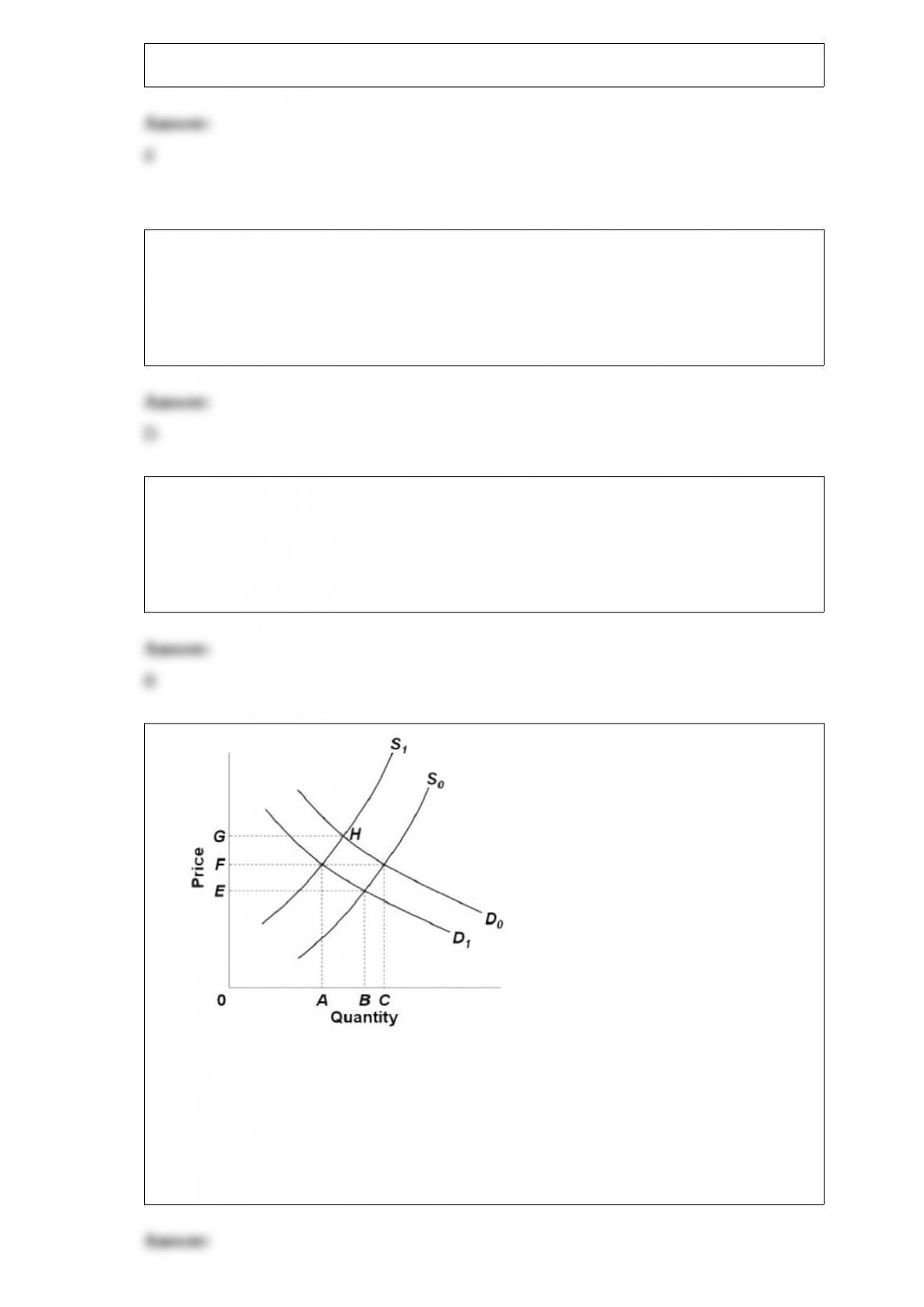
refer to the above diagram, which shows demand and supply conditions in the
competitive market for product x. other things equal, a shift of the supply curve from s0
to s1 might be caused by a(n):
a.increase in the wage rates paid to laborers employed in the production of x.
b.government subsidy per unit of output paid to firms producing x.
c.decline in the price of the basic raw material used in producing x.
d.increase in the number of firms producing x.

11) A tariff can best be described as:
A.an excise tax on an imported good.
B.a government payment to domestic producers to enable them to sell competitively in
world markets.
C.an excise tax on an exported good.
D.a law that sets a limit on the amount of a good that can be imported.
12) When aggregate demand declines, wage rates may be inflexible downward, at least
for a time, because of:
A.the foreign purchases effect.
B.inflexible product prices.
C.wage contracts.
D.the wealth effect.
13) an increasing-cost industry is the result of:
a.higher resource prices which occur as the industry expands.
b.a change in the industry’s minimum efficient scale.
c.x-inefficiency.
d.the law of diminishing returns.
14) a purely competitive seller should produce (rather than shut down) in the short run:
a.only if total revenue exceeds total cost.
b.only if total cost exceeds total revenue.
c.if total revenue exceeds total cost or if total cost exceeds total revenue by some
amount less than total fixed cost.
d.if total cost exceeds total revenue by some amount greater than total fixed cost.
15) Other things equal, an increase in input prices will:
A.reduce aggregate supply and reduce real output.
B.increase the interest rate and lower the international value of the dollar.
C.increase aggregate supply and increase the price level.
D.increase net exports, increase investment, and reduce aggregate demand.
16) when a firm does more of something, it gets better at it. this learning-by-doing is:
a.a source of diseconomies of scale.
b.a source of economies of scale.
c.called the principle of natural progression.
d.called ‘spreading the overhead.”
17)
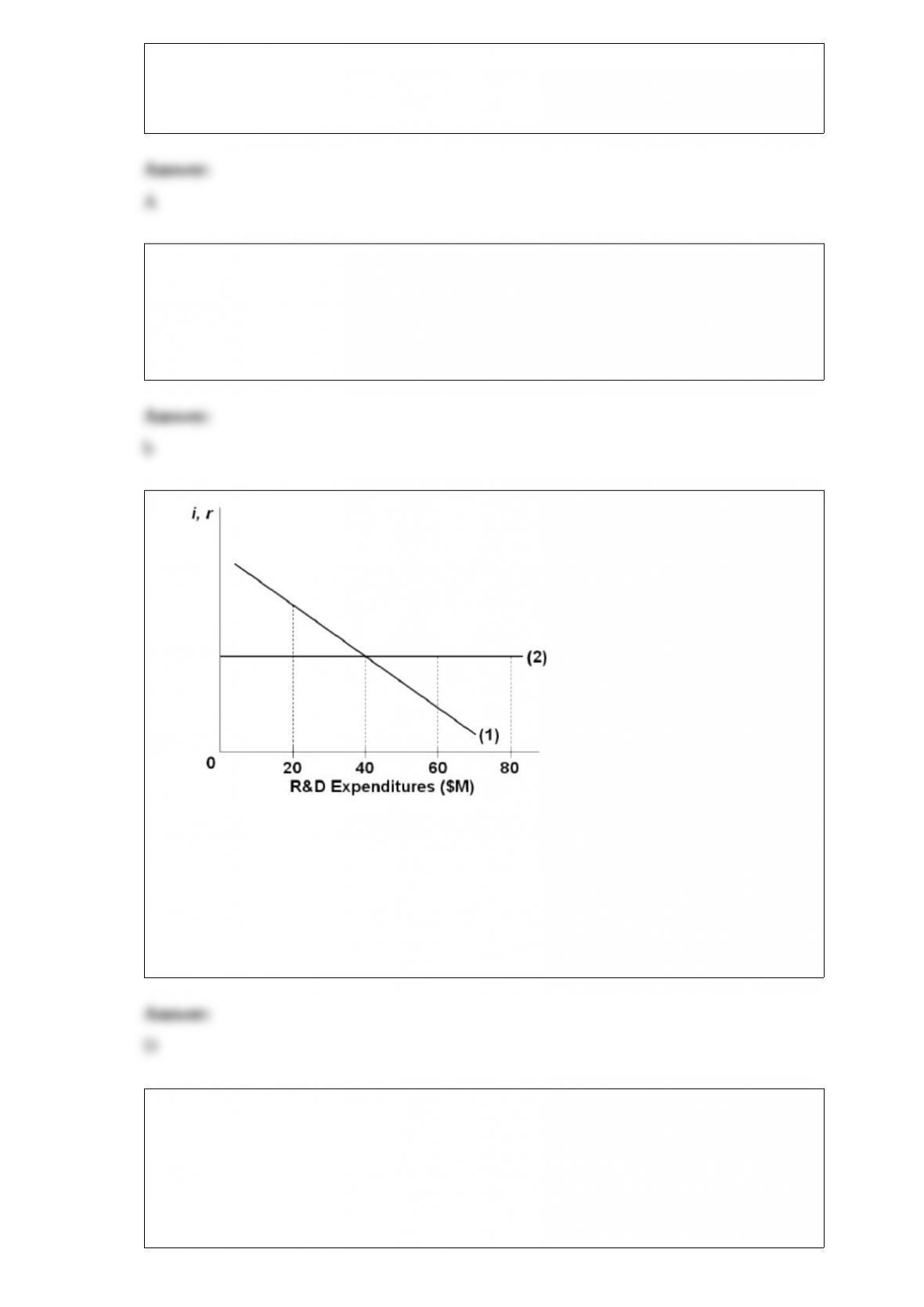
Assume that a firm’s interest-rate-cost of funds curve for R&D is perfectly elastic.
Which of the following would increase a firm’s optimal R&D expenditures and, in
equilibrium, reduce the expected rate of return on the last dollar of R&D?
A.a rightward shift of the expected-rate-of-return curve
B.an upward shift of the interest-rate-cost of funds curve
C.a leftward shift of the expected-rate-of-return curve
D.a downward shift of the interest-rate-cost of funds curve
18) Elasticity of resource demand is measured by the:
A.absolute change in resource quantity demanded divided by the absolute change in
resource price.
B.percentage change in resource quantity demanded divided by the percentage change
in resource price.
C.absolute change in resource price divided by the absolute change in resource quantity

demanded.