
1) In a natural monopoly case, the socially-optimal pricing policy rule will often yield a
higher price than the fair-return pricing rule.
2) When the government bails out large banks when the banks become unstable, it
could lead to a moral hazard problem.
3) In purely competitive market, the entry and exit of firms will push price towards
equality with marginal revenue.
4) Price support programs for agricultural products tend to cause shortages of these
products.
5) The real GDP of the United States has grown since the 1950’s largely because of
increases in labor productivity.
6) The technical and scientific characteristics of an industry may be less important than
its structure in determining R&D spending and innovation.
7) If two goods are substitutes, a decline in the price of one will cause a decrease in the
demand for the other.
8) When total input costs rise slower than the total units of output produced, then the
per-unit production costs:
A.Will decrease
B.Will increase
C.Would be unaffected
D.May either increase or decrease
9) Art Buchwald’s article “Squaring the Economic Circle” is a humorous description of:
A.a negative GDP gap.
B.a positive GDP gap.
C.the marginal propensity to save.
D.the multiplier.
10) Which transaction represents a debit in the current account section of the U.S.
balance of payments?
A.The Arab Capital Investment Corporation makes a loan to a U.S. firm
B.A U.S. subsidiary exports raw materials to the Canadian parent company
C.U.S. tourists in Great Britain purchase pounds with dollars in order to buy souvenirs
D.U.S. firms and individuals receive dividends from their investments in Latin America
11)
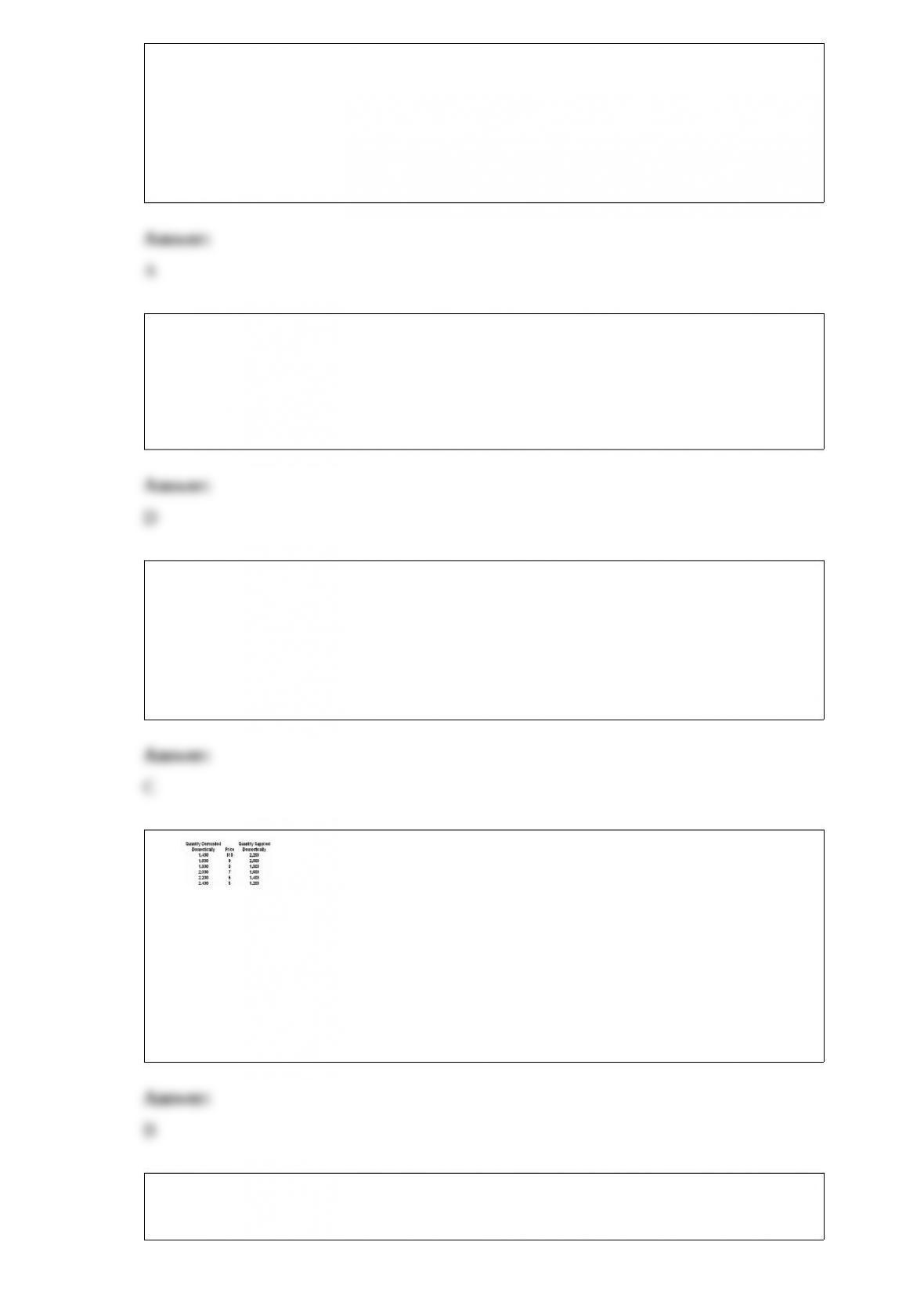
Refer to the table above for a certain product’s market in Econland. If Econland were
entirely closed to international trade, the equilibrium price and quantity would be:
A.$9 and 2,000 units
B.$8 and 1,800 units
C.$7 and 2,000 units
D.$6 and 1,400 units
12) Which of the following is generally not an effective strategy to promote DVC
growth?
A.Microlending.
B.Human capital development.
C.Fighting wars against neighbors to obtain resources and stimulate aggregate demand
through arms spending.
D.Controlling inflation.
13) Why are high rates of unemployment of concern to economists?
A.Higher rates of unemployment generally lead to higher inflation rates.
B.Environmental destruction is more prevalent when unemployment rates are high.
C.There is lost output that could have been produced if the unemployed had been
working.
D.All of these options are reasons why economists are concerned about high
unemployment rates.
14) The modern view of technological advance is that it:
A.Is the result of random lucky events unrelated to the economic system
B.Requires government R&D spending to keep it going
C.Arises from intense rivalry among individuals and firms within the capitalist system
D.Is a force that is external to the economy to which the economy adjusts
15) If the GDP gap is positive, then:
A.The inflation rate is falling
B.The unemployment rate is rising
C.Potential GDP is greater than actual GDP
D.Actual GDP is greater than potential GDP
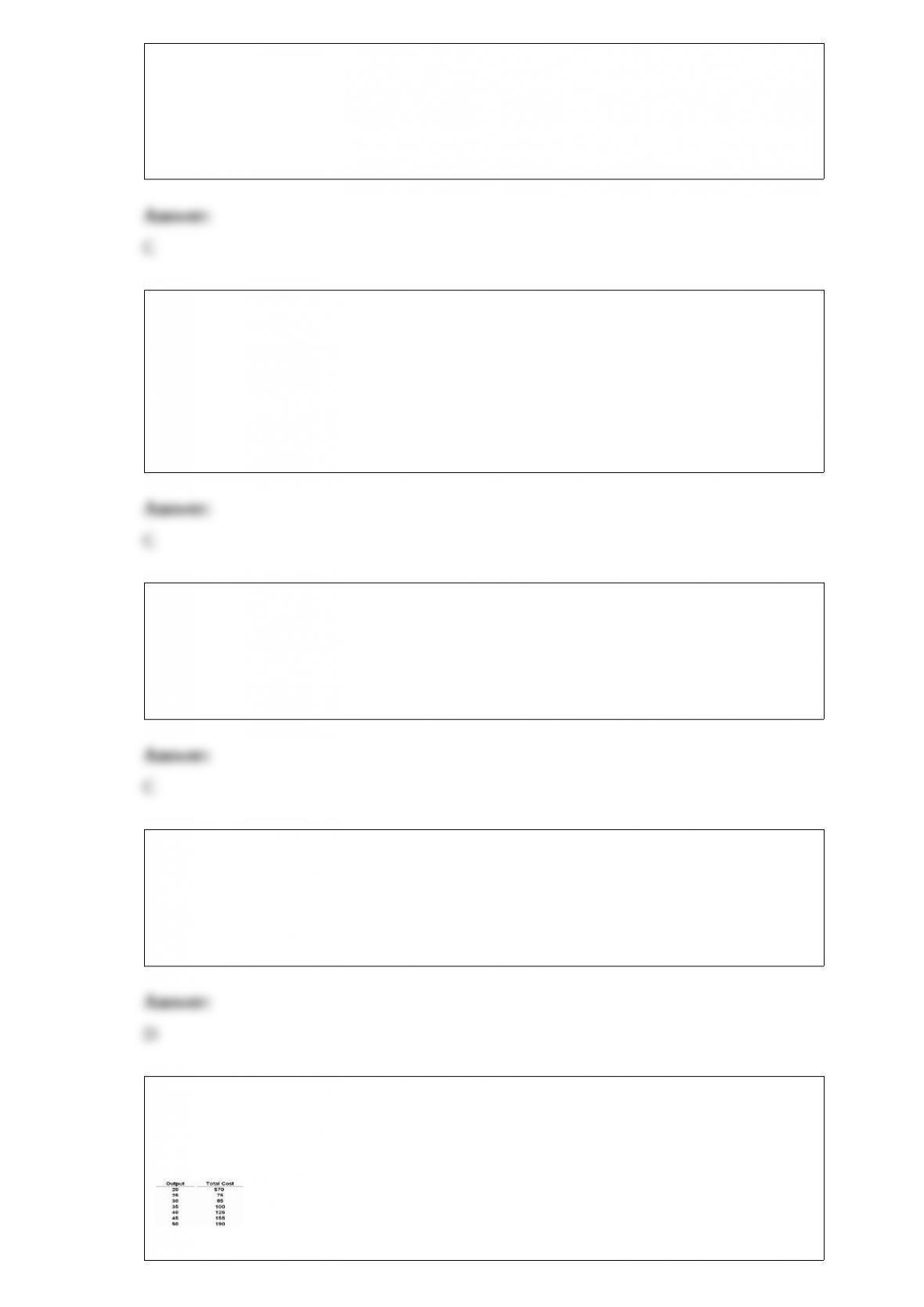
16) Assume the price of a product sold by a purely competitive firm is $5. Given the
data in the accompanying table, at what output level is total profit highest in the short
run?
A.20

B.30
C.40
D.50
17) Which of the following would be the best example of regulatory capture?
A.Starbucks buys up all the available supplies of coffee beans.
B.Nike executives influence the rules for track and field events.
C.Federal law makers write and pass legislation that protects domestic companies from
foreign competition.
D.Executives from the Ford, General Motors, and Chrysler companies write the rules
regulating automobile safety and fuel requirements.
18) Health insurance often pays 80 percent of health care cost. This situation will
encourage the rational consumer to:
A.Consume less health care because the cost is too expensive
B.Obtain health insurance that pays less than 80 percent of medical care costs
C.Use more medical services than they would if they had to paid the full price
D.Eliminate their health care coverage because it does not cover 100 percent of the cost
19) The main reason for the high price of antiques is that:
A.Supply is relatively elastic and demand increases over time
B.Supply is relatively inelastic and demand increases over time
C.Demand is relatively elastic and supply increases over time
D.Demand is relatively inelastic and supply increases over time
20) Rates of return on short-term U.S. government bonds are compensation for:
A.both the level of risk and the delaying of consumption.
B.delaying consumption only.
C.the level of risk only.
D.factors other than risk and delaying consumption.
21) Most developing countries (DVCs) exhibit a low level of:
A.Illiteracy
B.Population growth
C.Life expectancy
D.Infant mortality
22)
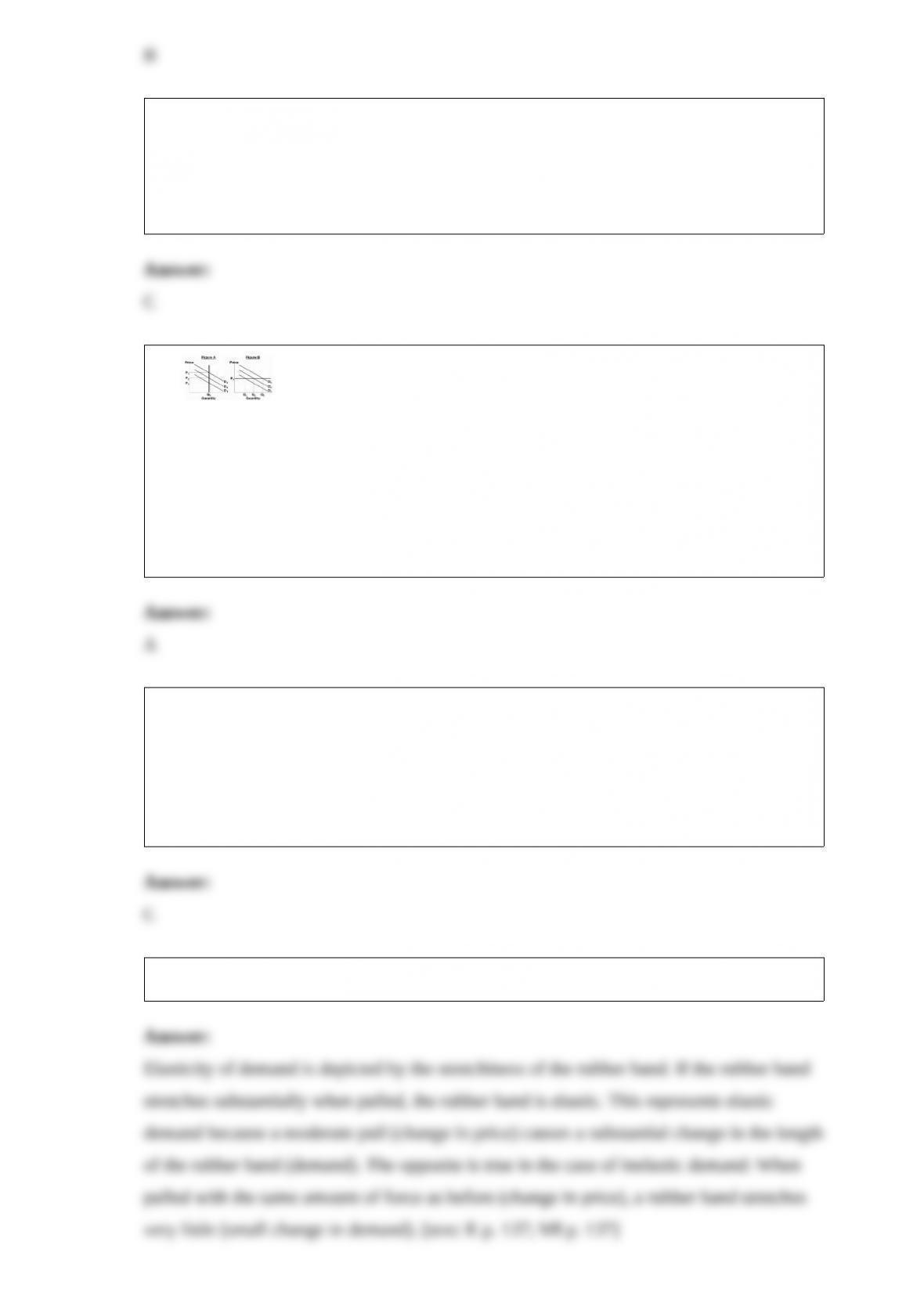
Refer to the figures. If government policy can be used to affect the level of demand in
the economy, these figures suggest that government policy:
A.can affect the level of output in the very short run, when prices are stuck.
B.can affect the level of output in the longer run, when prices are flexible.
C.cannot affect output in either the very short run or the longer run.
D.can be used to simultaneously affect the levels of output and prices.
23) Which of the following financial institutions pool deposits of customers and use the
money to buy a portfolio of stocks or bonds or both?
A.Thrifts
B.Brokerage firms
C.Mutual funds
D.Investment banks
24) How can a rubber band be used to explain elasticity and inelasticity of demand?
25) Differentiate between the independent and dependent variables in an economic
relationship.
26) How did mortgage defaults affect banks involved in mortgage lending and
mortgage investing?
27) Government polices sometimes have unintended consequences. Give an example of
one.
28)
29) What is the Trade Adjustment Assistance Act? What do critics say about it?
30)
31) Explain the principal€agent problem in job performance and briefly describe
actions that can be taken to correct the problem.