The market allocates goods to individuals according to the individuals’
a. desire for the good.
b. ability to pay for the good.
c. desire and ability to pay for the good.
d. political influence.
In a perfectly contestable market in the long run, each firm
a. produces at the minimum point on its long-run average total cost curve.
b. earns a profit below its opportunity cost of capital.
c. avoids making capital expenditures.
d. All of the above are correct.
A common fallacy that is used to oppose trade is the idea that
a. the only gains from trade go to the rich, so the poor must lose.
b. “you get what you pay for.”
c. “if it’s not broken, don’t fix it.”
d. one country’s gain must be another’s loss.
e. what is true for one is true for all.
Which of the following best describes compensating wage differentials?
a. Some jobs are more difficult than others, and the pay for them reflects this.
b. Some jobs require more training than others, and the pay for them reflects this.
c. Some jobs require more experience than others, and the pay for them reflects this.
d. Some jobs require unique abilities, and the pay for them reflects this.
An individual with a diversified stock portfolio usually
a. holds only the stocks of conglomerates (firms that participate in many industries).
b. deals with several brokerage houses.
c. holds stock in several types of firms.
d. holds stocks with several maturity dates.
Total utility increases if one more unit of a product is purchased and marginal utility is
positive.
a. True
b. False
What determines the magnitude of the changes in price level when central bank takes
monetary policy measures that leads to a change in the aggregate demand?
a. Changes in the money supply
b. Slope of the aggregate supply curve
c. Rate of change of interest rate
d. Total money supply in the economy

The market mechanism is more efficient in allocating resources between time periods
than it is in allocating resources among different industries.
a. True
b. False
All of the following are examples of fringe benefits except
a. health insurance.
b. retirement payments.
c. overtime payments.
d. education subsidies.
A ____ is a type of derivative in which the seller promises to pay the buyer of a
particular security the value of that security if it goes into default.
a. credit default swap
b. derivative
c. mortgage backed security
d. futures contract
If scientific research produces a technological breakthrough in the production of
computer memory, then
a. business costs will increase, profits will fall, and production will decrease.
b. business costs will fall, but profits will also fall, and production will decrease.
c. business costs will fall, profits will improve, and production will increase.
d. profits will increase, allowing businesses to cut back production.
Fractional reserve banking began as a result of the search for additional profits.
a. True
b. False
All other things being equal, a greater supply of scientists and engineers will increase
the level of technology.
a. True
b. False
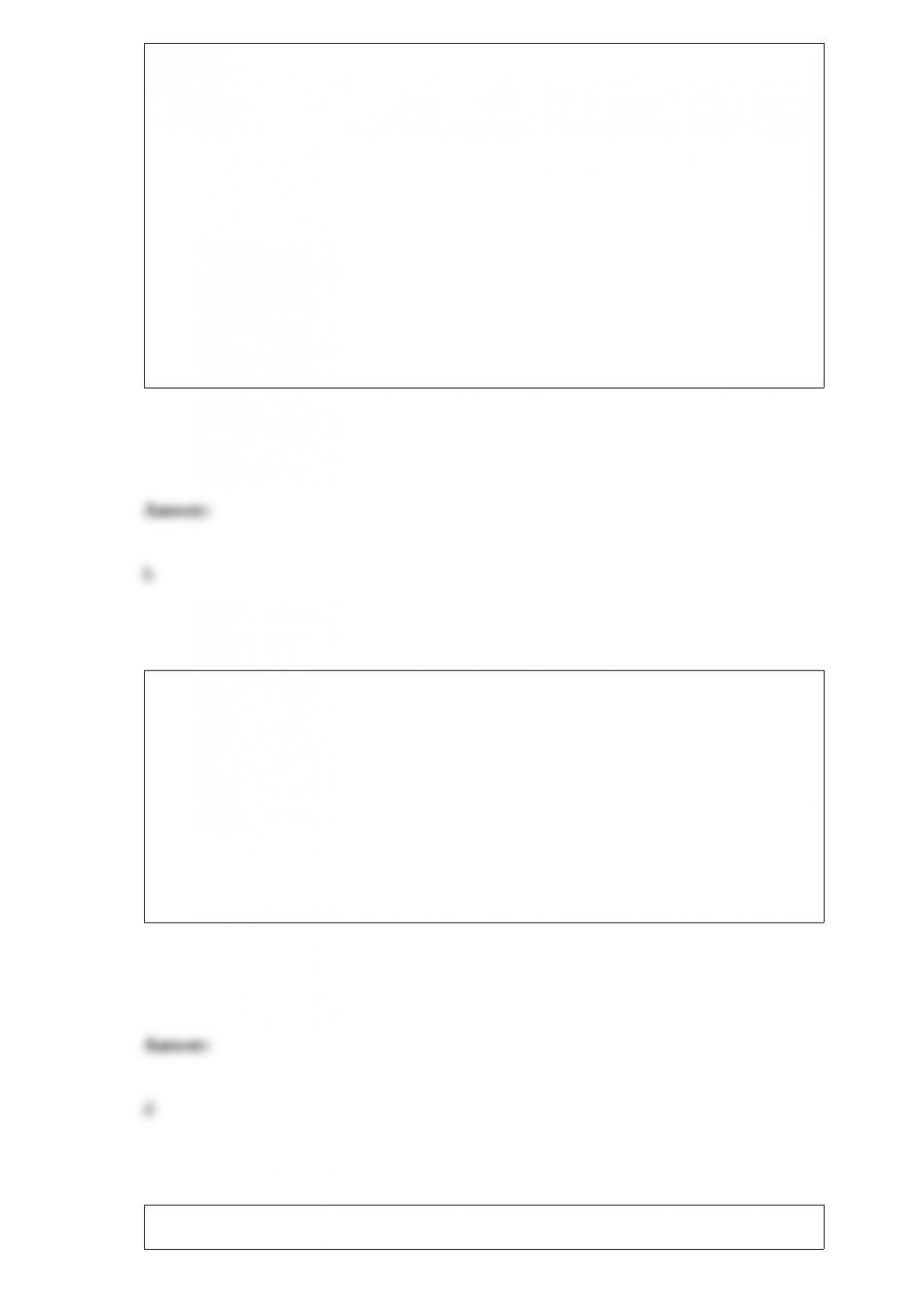
Table 3-2
In Table 3-2, from point C, the opportunity cost of 3 more units of cotton would be
a. 4 units of corn.
b. 8 units of corn.
c. 14 units of corn.
d. 16 units of corn.
The structural deficit can be defined as
a. the deficit that is structurally obstructing economic recovery to reach level of high
employment.
b. a hypothetical construct that estimates the deficit, given current tax rates and
expenditure policies, if the economy were operating at some fixed high-employment
level.
c. the deficit necessary to restructure the economy and reach a desired
high-employment level.
d. the deficit that would prevail if fiscal policy were structured differently in order to
reach a desired high-employment level.
Which of the following acts prohibits directors of one company from sitting on the
board of a competitor?
a. Sherman Act
b. Federal Trade Commission Act
c. Robinson-Patman Act
d. Clayton Act
How are aggregate supply and stagflation related?

a. Stagflation usually causes an adverse shift in aggregate supply.
b. An adverse supply shift usually causes stagflation.
c. Stagflation only follows inflation, with no relation to aggregate supply.
d. There is no relationship between the two.
If U.S. securities pay 6 percent interest, and if Great Britain’s securities pay 8 percent
interest, then
a. pounds depreciate relative to dollars.
b. pounds appreciate relative to dollars.
c. Great Britain’s imports will fall.
d. Great Britain’s exports will rise.
Which of the following would lead to a depreciating dollar?
a. a higher federal deficit
b. lower interest rates
c. higher interest rates

d. contractionary monetary policy
Many environmentalists have advocated a substantial increase in the gasoline tax to cut
down the federal deficit and to reduce pollution due to auto emissions. Such a tax
increase would be devastating to people who commute significant distances to work. In
fact, it would provide an incentive to relocate closer to work or change jobs.
Economists refer to such effects of taxes as the
a. burden of a tax.
b. regressive incidence of a tax.
c. incidence of a tax.
d. excess burden of a tax.
If both the supply and demand curves shift to the left, then we can conclude that there
will be
a. an increase in the equilibrium quantity sold.
b. a decrease in the equilibrium quantity sold.
c. an increase in the equilibrium price.
d. a decrease in the equilibrium price.
If strong fiscal policy stimulus is used to combat a recessionary gap, what will happen?
a. a rapid movement toward lower unemployment and higher inflation
b. a rapid movement toward lower unemployment and lower inflation
c. a slow movement toward lower unemployment and higher inflation
d. a slow movement toward lower unemployment and lower inflation.
Approximately half of all U.S. workers are employed by various levels of government.
a. True
b. False

Labor productivity growth in the United States during the 1973-1995 period could be
explained by a ____ slowdown.
a. labor force
b. capital formation
c. technological
d. population growth
If aggregate demand shifts inward over a long period of time, with aggregate supply
held constant, the economy should experience
a. unemployment.
b. recession.
c. stagflation.
d. inflation.
e. budget surpluses.
A contractionary monetary policy is most likely to reduce output with little impact on
inflation when the economy
a. is near full employment and the aggregate supply curve is horizontal.
b. is near full employment and the aggregate supply curve is vertical.
c. has substantial unemployment and the aggregate supply curve is vertical.
d. has substantial unemployment and the aggregate supply curve is horizontal.
In spite of the fact that unemployment rates were at a 30-year low in 1996-2000, the
United States economy also experienced
a. declining inflation.
b. balance of payments surpluses.
c. large budget deficits.
d. low growth.
The main goal of fiscal policy should always be to
a. generate a budget deficit.
b. balance the budget.
c. balance C + I with government spending.
d. balance aggregate demand with aggregate supply.
The income effect of a wage increase is expected to increase
a. supply of labor.
b. supply of goods and services.
c. demand for leisure.
d. demand for labor.
Compared to a nonpoor individual, a poor individual is more likely to be
a. female.
b. black.
c. a child.
d. All of the above are correct.
Abstraction can be thought of as
a. ignoring reality in order to build theory.
b. omitting unimportant details in order to understand complex phenomena.
c. creating absurdity in order to explain simplicity.
d. assuming complexity when simplicity will do.
e. stylizing reality rather than analyzing cause and effect.
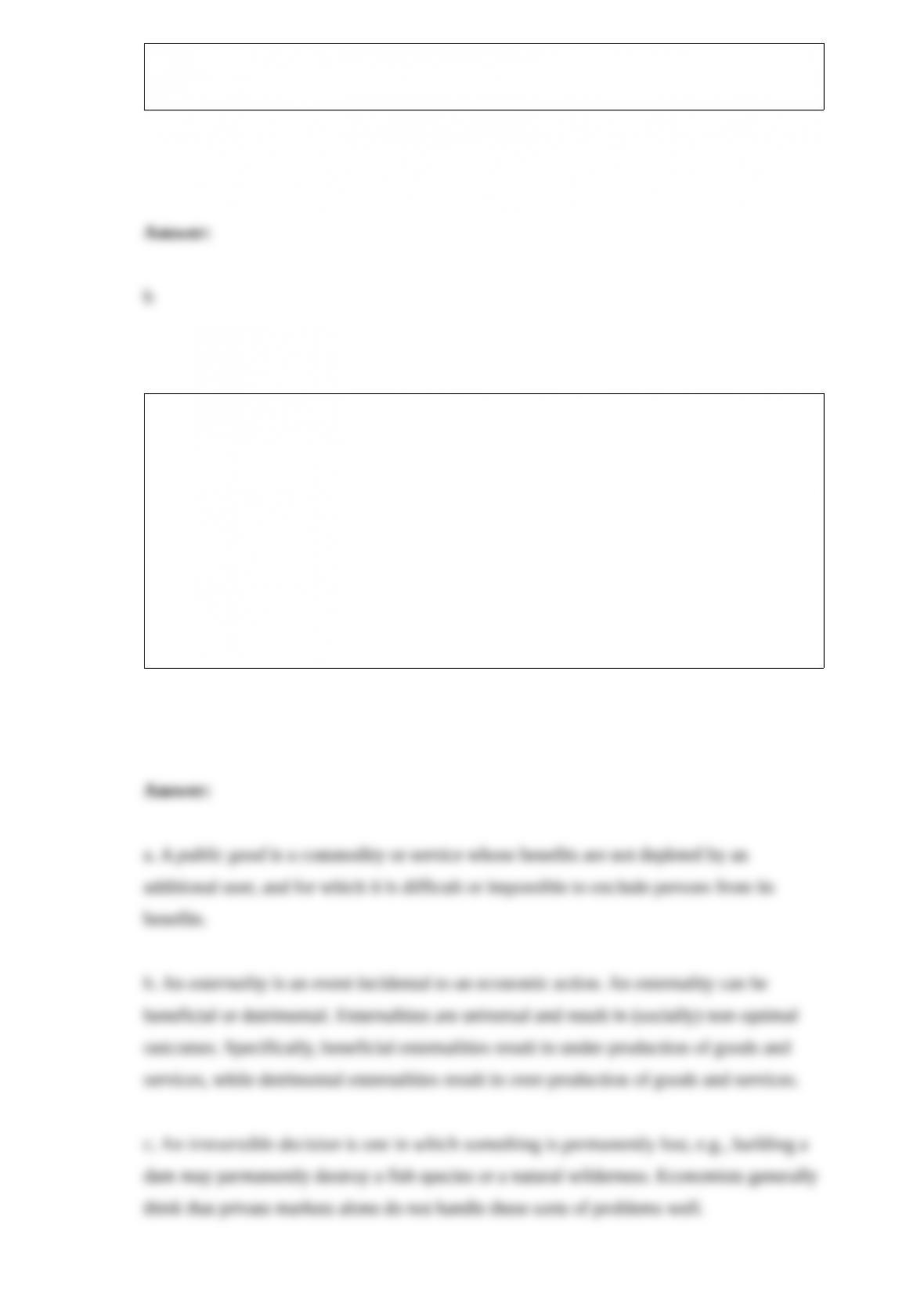
Table 9-1
In Table 9-1, the equilibrium level of output is
a. 2,500.
b. 3,000.
c. 3,500.
d. 4,000.
Define the following terms and explain their importance to the study of economics.
a. public good
b. externality
c. irreversible decision
d. moral hazard
e. rent seeking
Perfectly competitive firms are known for being “price makers.”
a. True
b. False
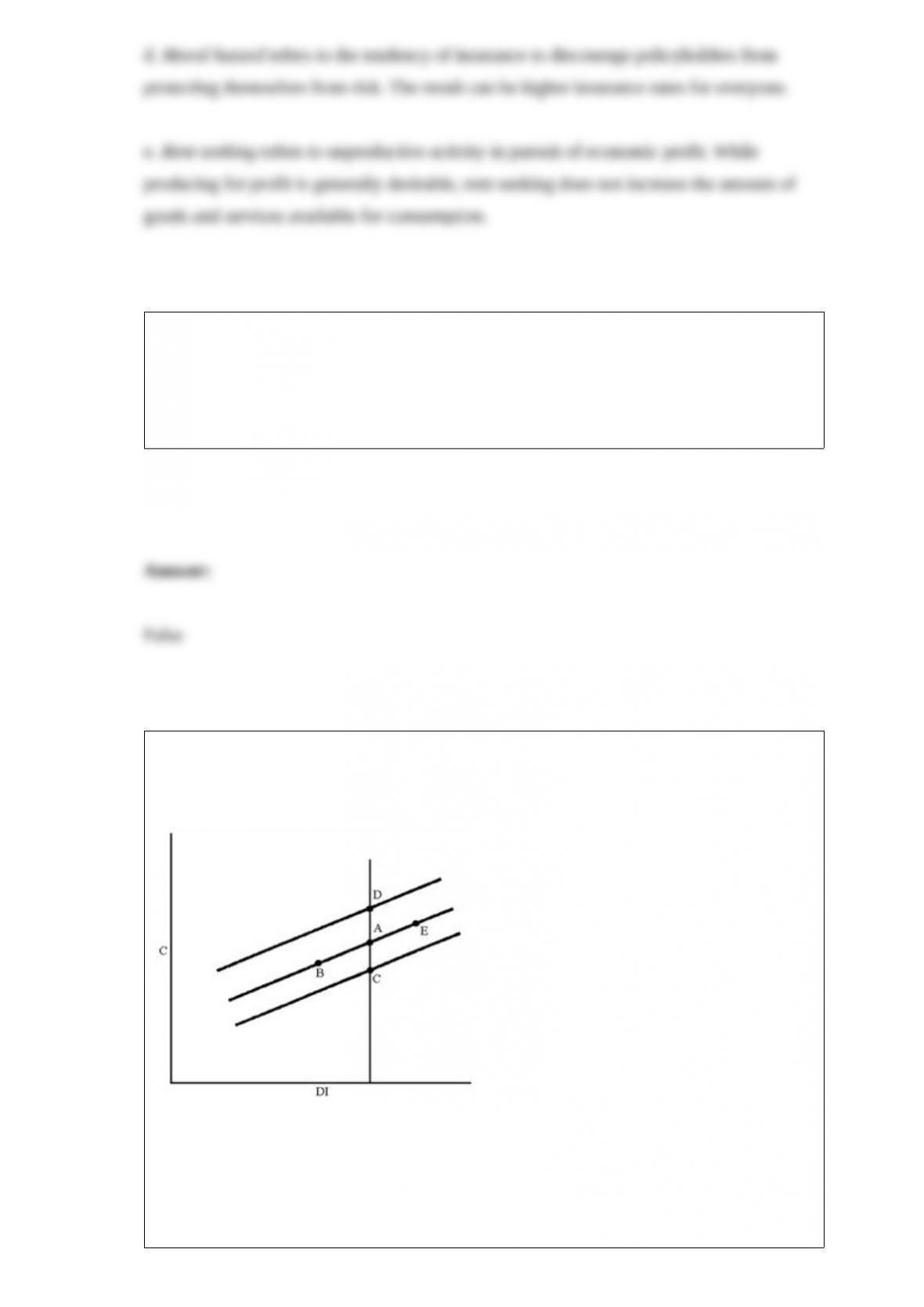
Figure 8-2
In Figure 8-2, which of the following moves can be explained by a tax cut?
a. A to B
b. A to C
c. A to D
d. A to E
How is state and local government funded and how does such funding differ from
federal government funding?
What would be the likely result of a recessionary gap? If this leads to a fall in the
nominal wage what impact it would have on the aggregate supply curve and on
recessionary gap?
In what way is monopolistic competition more like competition, and in what way is it
more like monopoly?
Suppose that the citizens of South Dakota decided to limit imports of citrus fruit from
Florida and California on the grounds that climatic differences give those two states an
unfair advantage in the production of those products. How would the analysis used to
explain international trade apply?
Is the image of the typical American worker as a blue-collar worker true? Substantiate
your answer with facts.
Explain why the average cost curve for the long run differs from that for the short run.
Give an example of a price floor. Draw a corresponding diagram and explain why there
is a continuing surplus.
Suppose a study showed that as the income of doctors increased, doctors spent more
time on the golf course and less in the office. What would such a conclusion say about
the relative sizes of substitution and income effects?
How does the price system cope with depletable resources?
How does a central bank influence the lending capacity of the banks?
How is it possible to have a separation between ownership and control of a major
corporation? What specific type of market imperfection can cause this?
Why study perfect competition, if it rarely exists?
Define investment?
The meaning of investment is different for economists. Explain.
Figure 5-24
Given the demand curve in Figure 5-24, explain how consumer’s surplus is calculated.
Draw the point of consumer equilibrium from an indifference map and budget line.
Explain why this is the point of optimization. Be sure your diagram is fully and
correctly labeled.
Why is it possible that the economy will not self-correct out of a recessionary gap?