
Capital expenditures:
a. are easily reversible
b. are forms of operating expenditures
c. Affect long-run future profitability
d. Involve only money, not machinery
e. none of the above
The ____ is equal to the some of the squares of the market shares of all the firms in an
industry.
a. market concentration ratio
b. Herfindahl-Hirschman index
c. correlation coefficient
d. standard deviation of concentration
e. none of the above
All of the following are reasons why an association relationship may not imply a causal
relationship except:
a. the association may be due to pure chance
b. the association may be the result of the influence of a third common factor
c. both variables may be the cause and the effect at the same time
d. the association may be hypothetical
e. both c and d

An optimal incentives contract can induce the revelation of true costs in a partnership
by
a. imposing penalties when costs are overstated
b. offering bonus payments when costs are verified
c. renewing the reliance relationship
d. linking revealed cost to the partner’s foregone expected profits
e. enlisting third-party enforcement
To accomplish its purpose a linear profit-sharing contract must
a. induce the employee to moonlight
b. communicate a code of conduct that will be monitored and enforced
c. meet either the participation or the incentive compatibility constraint
d. establish a separating equilibrium
e. not realign incentives
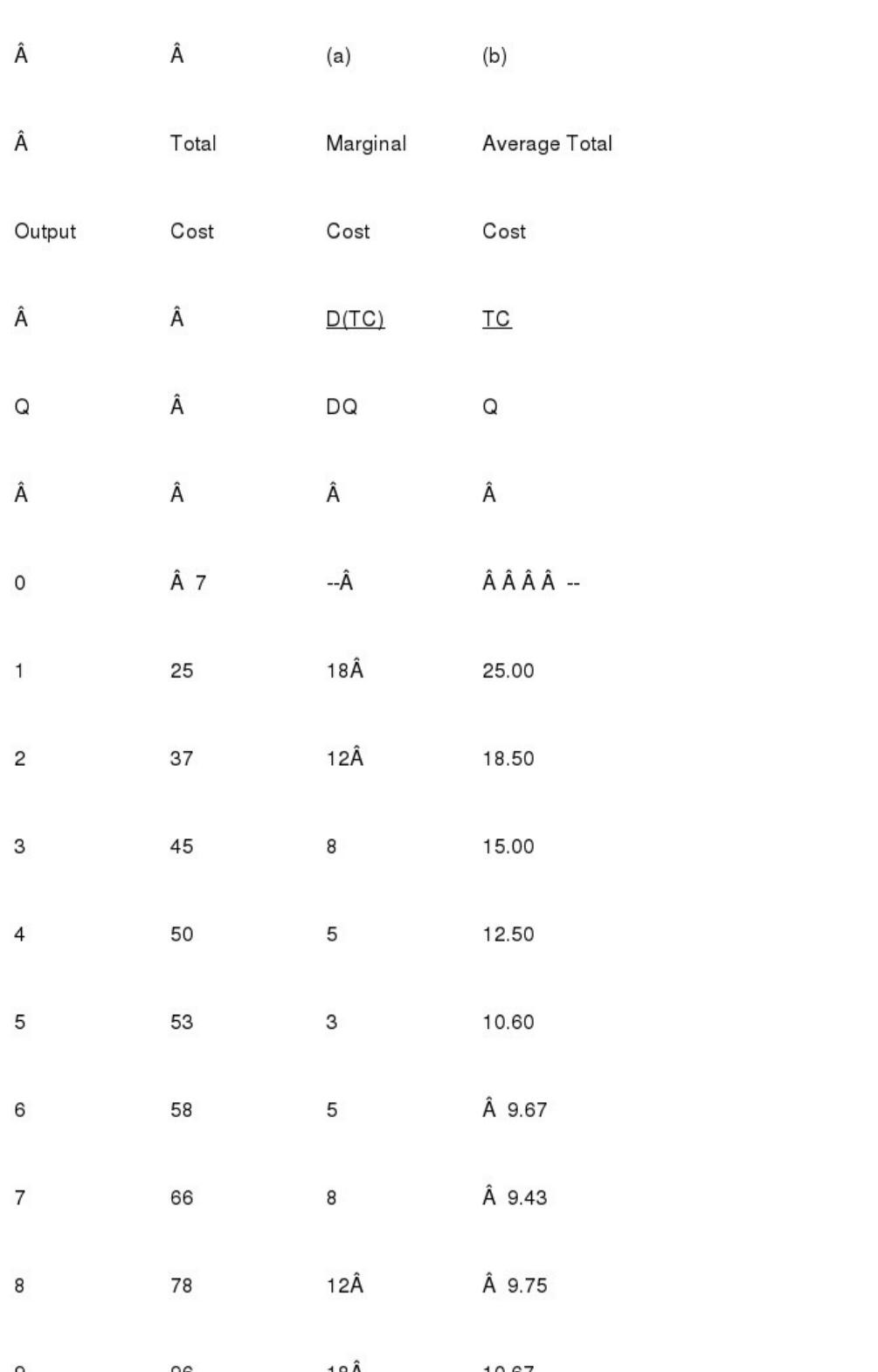
Suppose that the firm’s cost function is given in the following schedule (where Q is the
level of output):

Determine the (a) marginal cost and (b) average total cost schedules

In order to help assure that all relevant factors will be considered, the
capital-expenditure selection process should include the following steps except:
a. generating alternative capital-investment project proposals
b. estimating cash flows for the project proposals
c. reviewing the investment projects after they have been implemented
d. allocate manpower to the various divisions within the firm
e. a and d
A Real Option Value is:
a. An option that been deflated by the cost of living index makes it a “real” option.
b. An opportunity cost of capital.
c. An opportunity to implement cost savings or revenue expansion in a flexible business
plan.
d. An objective function and a decision rule that comes from it.
e. Both a and b.
Consider the following multiplicative demand function where QD= quantity demanded,
P = selling price, and Y = disposable income: The coefficient of Y
(i.e., .2) indicates that (all other things being held constant):
a. for a one percent increase in disposable income, quantity demanded would increase
by .2 percent
b. for a one unit increase in disposable income, quantity demanded would increase by .2
units

c. for a one percent increase in disposable income quantity demanded would increase
by .2 units
d. for a one unit increase in disposable income, quantity demanded would increase by .2
percent
e. none of the above
The Identification Problem in the development of a demand function is a result of:
a. the variance of the demand elasticity
b. the consistency of quantity demanded at any given point
c. the negative slope of the demand function
d. the simultaneous relationship between the demand and supply functions
e. none of the above
In the linear breakeven model, the difference between selling price per unit and variable
cost per unit is referred to as:
a. variable margin per unit
b. variable cost ratio
c. contribution margin per unit
d. target margin per unit
e. none of the above
Zar Island Gas Company is the sole producer of natural gas in the remote island country

of Zar. The company’s operations are regulated by the State Energy Commission. The
demand function for gas in Zar has been estimated as: P = 1,000 – .2Q where Q is
output (measured in units) and P is price (measured in dollars per unit). Zar Island’s cost
function is: TC = 300,000 + 10Q This total cost function does not include a “normal”
return on the firm’s invested capital of $4 million. (a) In the absence of any government
price regulation, determine Zar Island’s optimal (i) output level, (ii) selling price, (iii)
total profits, and (iv) rate of return on its asset base.
(b) The State Energy Commission has ordered the firm to charge a price which will
provide it with no more than a 12 percent return on its total assets. Determine Zar
Island’s (i) output level, (ii) selling price, and (iii) total profits under this constraint.
Hint: The roots of the quadratic equation:

Revenue equivalence theorem refers to equal seller revenue in which of the following

pairs:
a. sealed bid auctions and English auctions
b. second highest wins and pays auctions and Dutch auctions
c. English highest wins and pays auctions and sealed bid Dutch auctions
d. highest wins and pays auctions and second highest wins and pay auctions
Which of the following best represents management’s objective(s) in utilizing demand
analysis?
a. it provides insights necessary for the effective manipulation of demand
b. it helps to measure the efficiency of the use of company resources
c. it aids in the forecasting of sales and revenues
d. a and b
e. a and c
An increase in the exchange rate of the U.S. dollar relative to a trading partner can
result from
a. higher anticipated costs of production in the U.S.
b. higher interest rates and higher inflation in the U.S.
c. higher growth rates in the trading partner’s economy
d. a change in the terms of trade
e. lower export industry productivity
Common value auctions with open bidding necessarily entail
a. asymmetric information

b. ascending prices
c. more than two bidders
d. amendment of bids
e. sealed final offers.