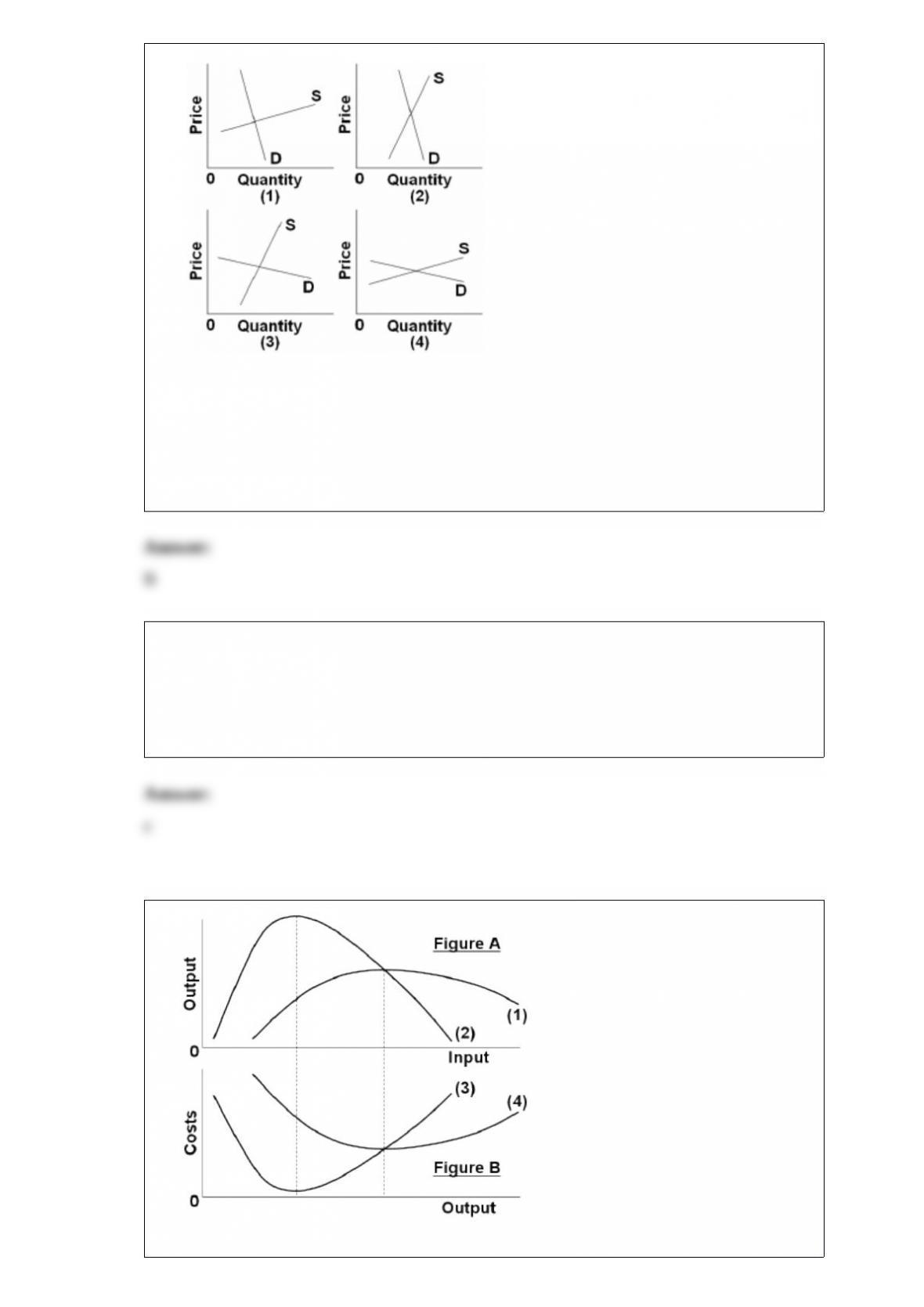
1)
In which of the above market situations will the largest portion of an excise tax of a
specified amount per unit of output be borne by producers?
A.4
B.3
C.1
D.2
2) which of the following statements is most accurate about the effects of migration?
a.migration generally benefits the mover, but there is a net efficiency loss to the world.
b.migration generally benefits everyone in both the origin and destination nation.
c.migration generally benefits the mover and creates a net efficiency gain for the world.
d. remittances cause the gains from immigration to be distributed unevenly.
3)
refer to the above short-run production and cost data. the curves of figures a and b
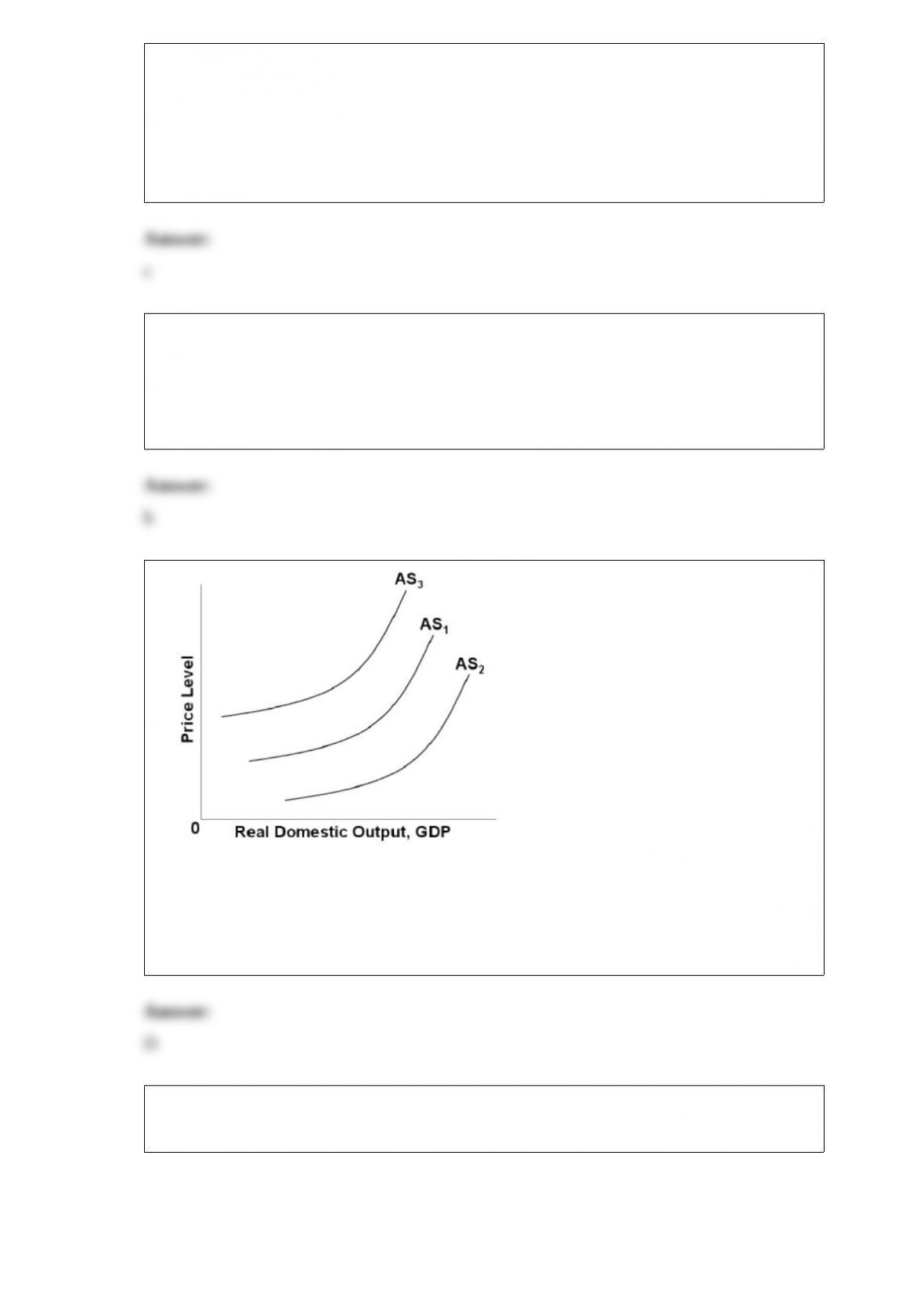
suggest that:
a.average product and average variable cost reach their maximum points at the same
output.
b.avc cuts mc at the latter’s maximum point.
c.avc reaches a minimum where ap is at its maximum.
d.afc declines so long as output increases.
4) which of the following is correct as it relates to cost curves?
a.average variable cost intersects marginal cost at the latter’s minimum point.
b.marginal cost intersects average total cost at the latter’s minimum point.
c.average fixed cost intersects marginal cost at the latter’s minimum point.
d.marginal cost intersects average fixed cost at the latter’s minimum point.
5)
In the above diagram, a shift from AS3 to AS2might be caused by an increase in:
A.business taxes and government regulation.
B.the prices of imported resources.
C.the prices of domestic resources.
D.productivity.
6) answer the next question(s) on the basis of the following national income data for the
economy. all figures are in billions of dollars.
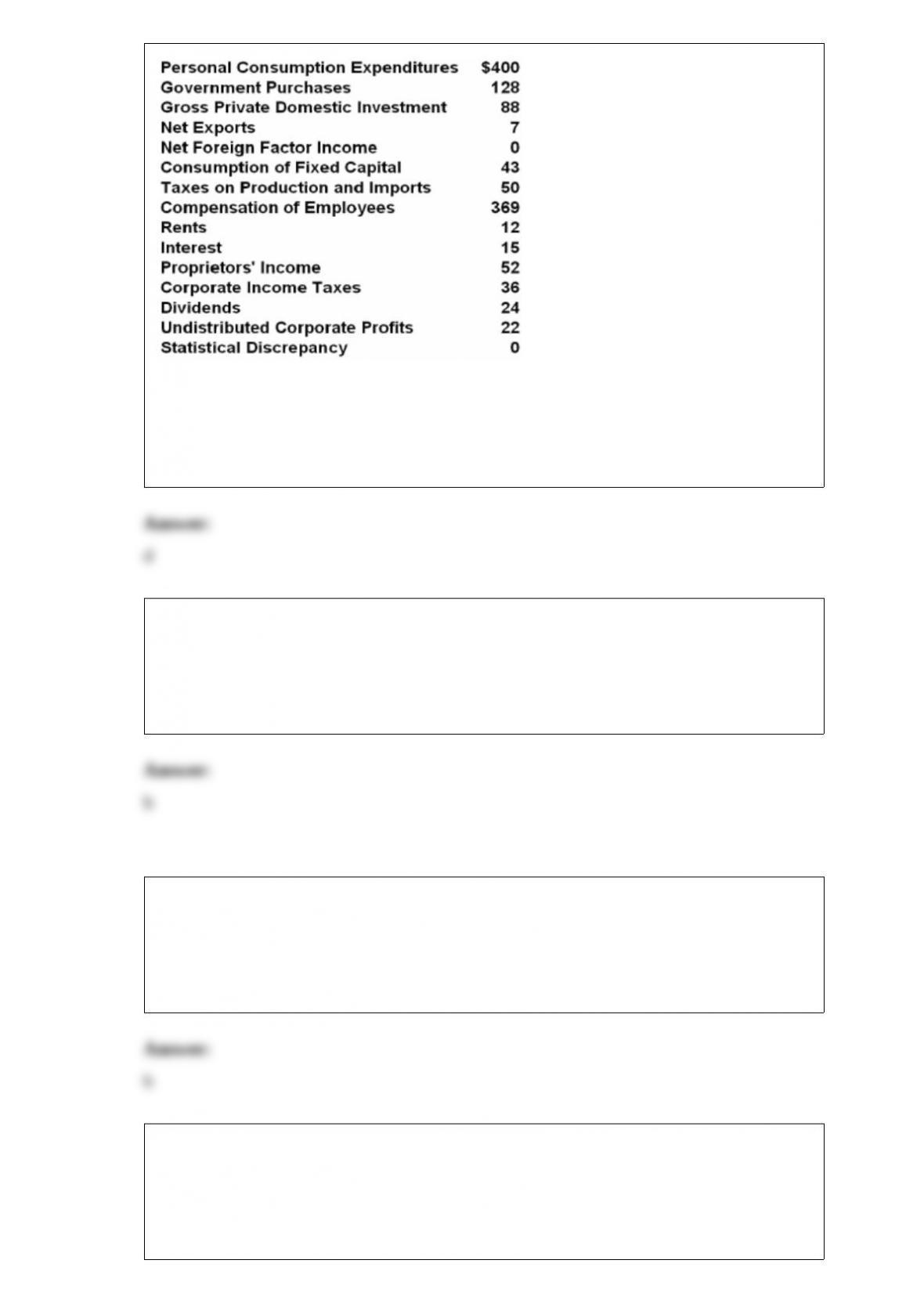
the gross domestic product for the above economy is:
a.$584.
b.$592.
c.$609.
d.$623.
7) in the past few years, the social security trust fund in the united states has been:
a.drawn down to cover payouts that currently exceed payroll tax revenues.
b.built up in anticipation of payroll revenue shortfalls beginning in 2017.
c.drawn down to eliminate unnecessarily large surpluses in the fund.
d.built up because of greater than expected immigration to the united states.
8) a price ceiling means that:
a.there is currently a surplus of the relevant product.
b.government is imposing a legal price that is typically below the equilibrium price.
c.government wants to stop a deflationary spiral.
d.government is imposing a legal price that is typically above the equilibrium price.
9) Technological advance is a three-step process involving:
A.invention, duplication, and diffusion.
B.duplication, innovation, and diversity.
C.invention, innovation, and diffusion.
D.necessity, invention, and solution.
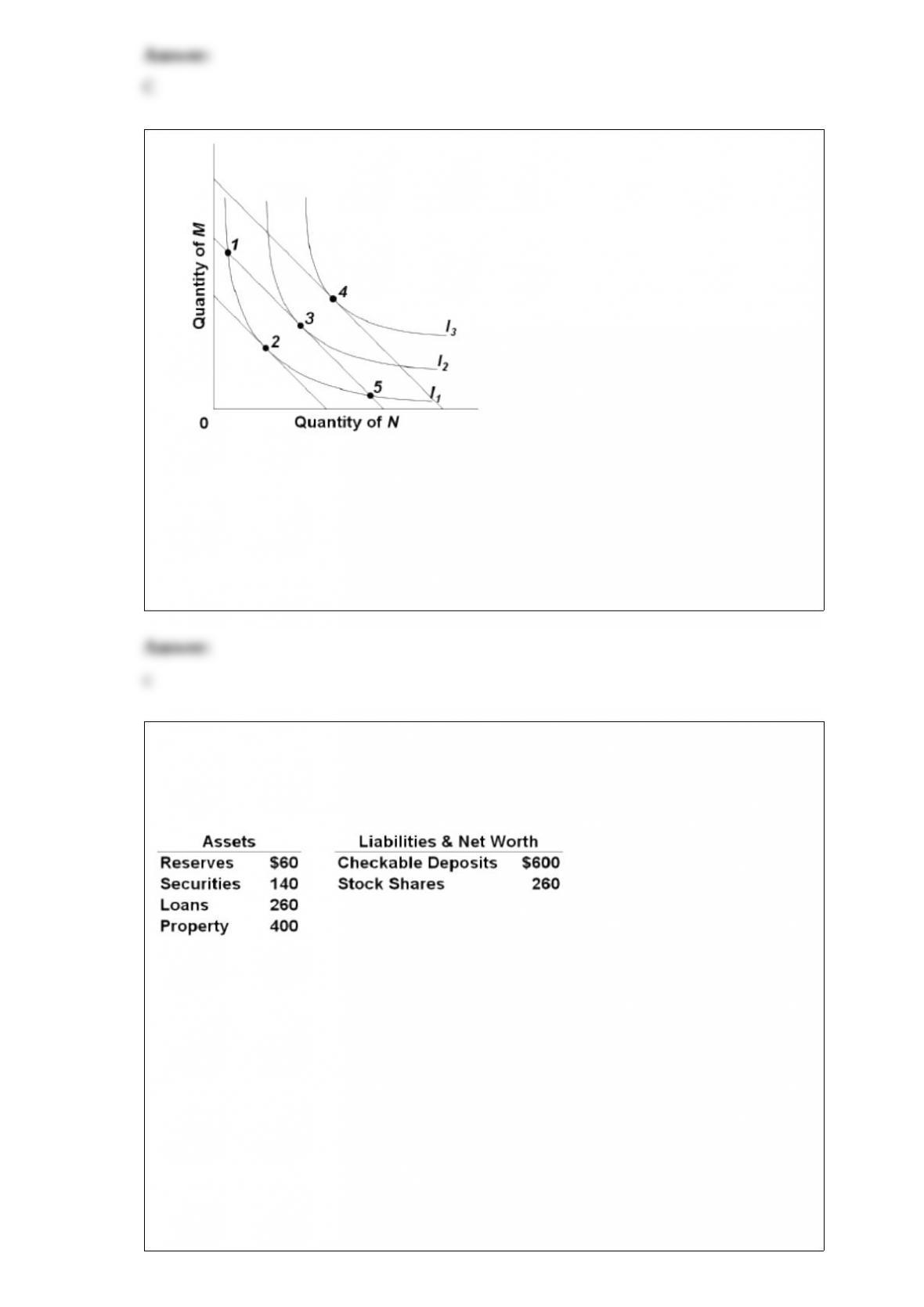
10)
refer to the above diagram in which the downsloping linear lines are budget lines and
i1, i2, and i3 comprise an indifference map. with respect to points 2, 3, and 4, we can
say that:
a.point 4 entails more utility than 3, but less than 2
b.point 4 entails more utility than 2, but less than 3
c.point 4 yields more utility than either 2 or 3
d.the levels of utility associated with these three points cannot be compared
11) The following consolidated balance sheet of the commercial banking system.
Assume that the reserve requirement is 10 percent. All figures are in billions and each
question should be answered independently of changes specified in any preceding ones.
Refer to the above data. Suppose the Fed bought $20 billion of U.S. securities from the
banks. This would:
A.increase bank reserves to $80 billion, reduce bank-held securities to $120 billion, and
assuming a full money multiplier effect, increase the money supply (checkable
deposits) by $200 billion.
B.increase bank reserves to $80 billion, reduce bank-held securities to $120 billion, and
assuming a full money multiplier effect, decrease the money supply (checkable
deposits) by $200 billion.
C.reduce bank reserves to $40 billion, increase bank-held securities to $160 billion, and
assuming a full money multiplier effect, increase the money supply (checkable
deposits) by $200 billion.
D.reduce bank reserves to $40 billion, increase bank-held securities to $160 billion, and
assuming a full money multiplier effect, decrease the money supply (checkable

deposits) by $200 billion.
12) The possible asymmetry of monetary policy is the central idea of the:
A.invisible hand concept.
B.ratchet analogy.
C.pushing-on-a-string analogy.
D.bandwagon effect.
13) the phase of the business cycle in which real gdp is at a minimum is called:
a.the peak.
b.a recession.
c.the trough.
d.the pits.
14) purposeful behavior means that:
a.people are selfish in their decision-making.
b.people weigh costs and benefits to make decisions.
c.people are immune from emotions affecting their decisions.
d.decision-makers do not make mistakes when weighing costs and benefits.
15) use the list below to answer the following questions:
1. improvements in technology
2. increases in the supply (stock) of capital goods
3. purchases of expanding output
4. obtaining the optimal combination of goods, each at least-cost production
5. increases in the quantity and quality of natural resources
6. increases in the quantity and quality of human resources
refer to the above list. as distinct from the demand and efficiency factors of economic
growth, the supply factors of economic growth are:
a.2, 5, and 6 only.
b.2, 4, 5, and 6 only.
c.1, 2, 5, and 6 only.
d.1, 3, 4 only.
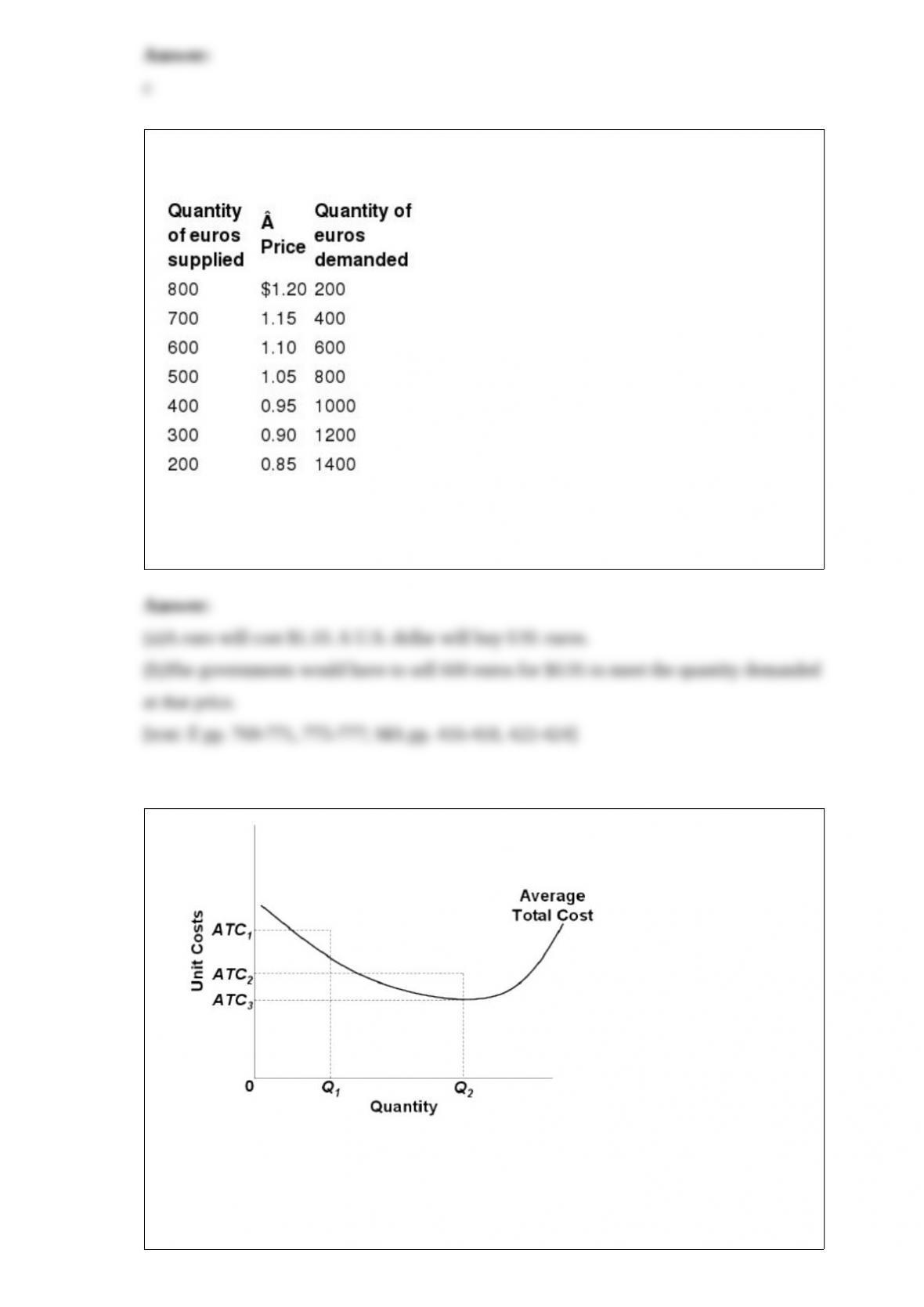
16) In the table below are the supply and demand schedules for euros.
(a)What will be the rate of exchange for the euro and for the U.S. dollar?
(b)What would happen if the U.S. and European governments wanted to fix or peg the
price of a euro at $0.95?
17)
refer to the above long-run cost diagram for a firm. if the firm produces output q1 at an
average total cost of atc1, then the firm is:
a.producing the profit-maximizing output, but is failing to minimize production costs.
b.incurring x-inefficiency, but is realizing all existing economies of scale.
c.incurring x-inefficiency and is failing to realize all existing economies of scale.

d.producing that output with the most efficient combination of inputs and is realizing all
economies of scale.
18) The Federal budget deficit is found by:
A.subtracting government tax revenues plus government borrowing from government
spending in a particular year.
B.subtracting government tax revenues from government spending in a particular year.
C.cumulating the differences between government spending and tax revenues over all
years since the nation’s founding.
D.subtracting government revenues from the noninvestment-type government spending
in a particular year.