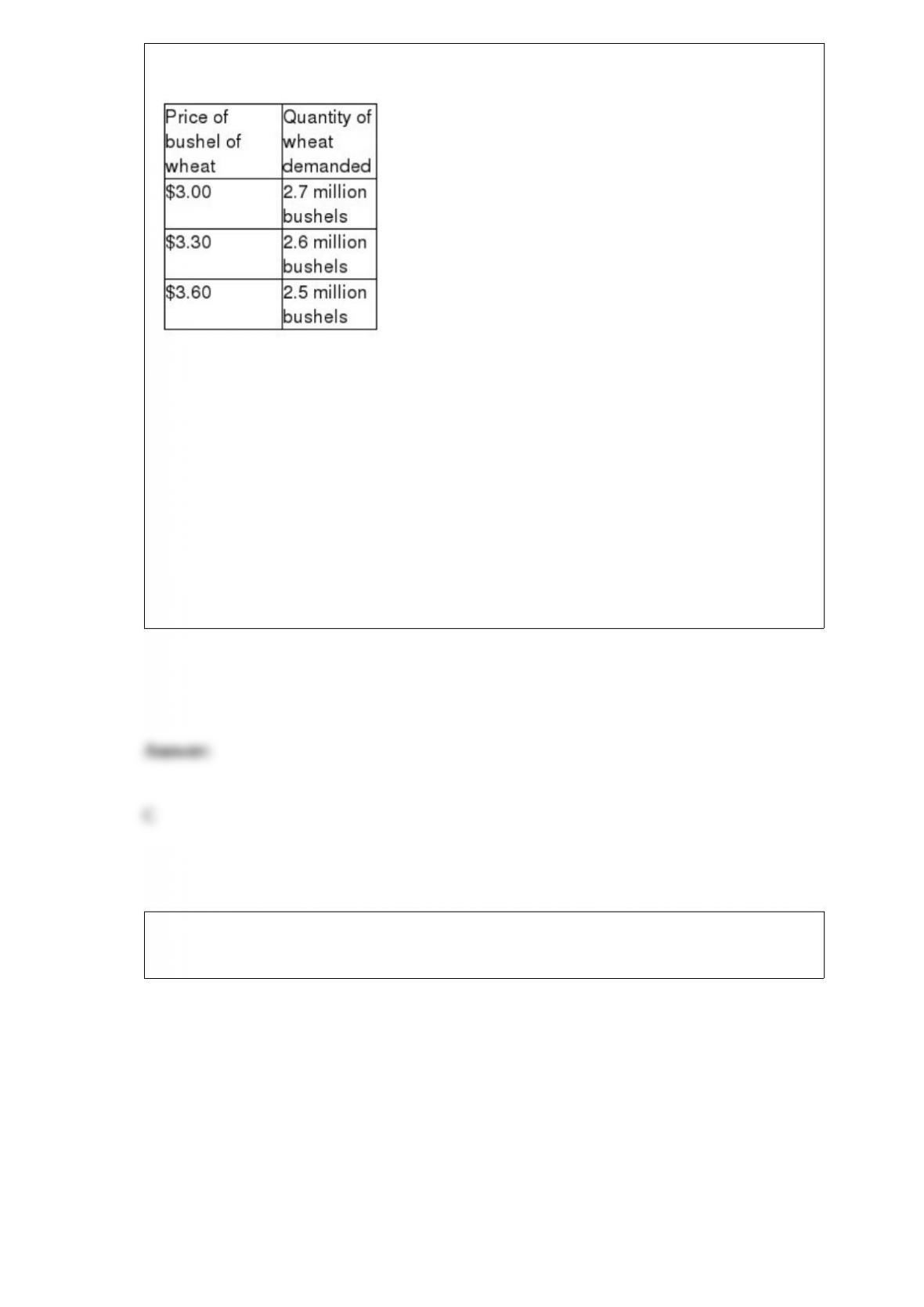
The following questions are based on the following demand schedule for wheat:
In this range, the demand for wheat is
a. perfectly elastic.
b. of unit elasticity.
c. price inelastic.
d. arc elastic.
e. invariant.
The following questions are based on the following information about a hypothetical
economy:
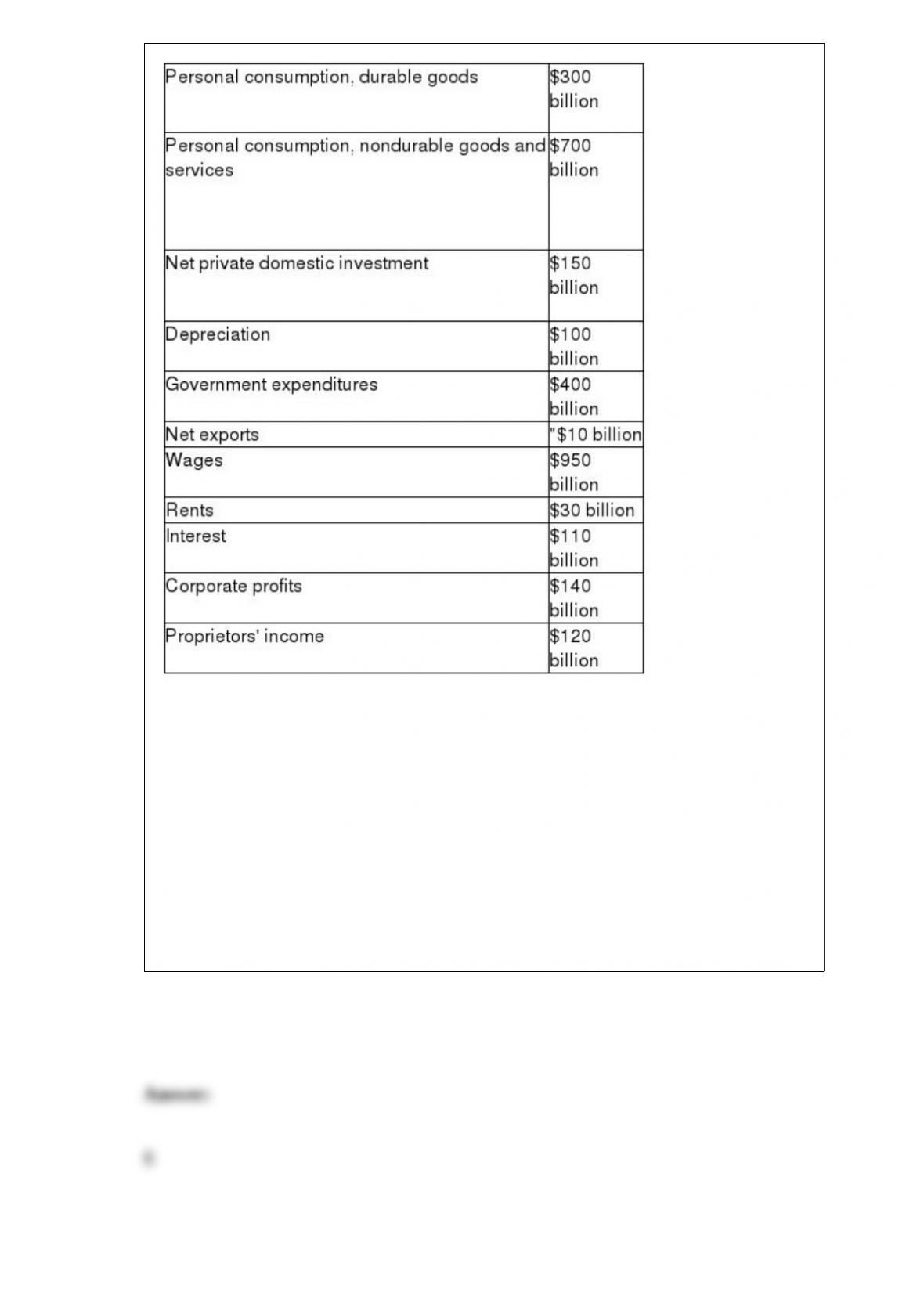
In this economy
a. the stock of capital goods fell during the year.
b. the government balanced its budget.
c. value added exceeded the income.
d. output exceeded GDP.
e. imports exceeded exports.

Compared to the proprietorship, the partnership has the disadvantage of
a. limited liability to each partner.
b. encountering more red tape to remain in existence.
c. double taxation of each partner.
d. finding more difficulty in securing funds and specialized know-how.
e. unlimited liability of each partner.
An outcome associated with a large national debt is that the interest payments on the
debt
a. increase the size of the country’s capital stock.
b. require that the government sell off some of the country’s assets such as public lands.
c. lead to a redistribution of income from the poor to the rich.
d. reduce the amount of tax revenues collected by the government.
e. reduce the Fed’s ability to carry out monetary policy.
A characteristic typical of commercial banks is that
a. depositors are completely protected, because every cent of their deposits is covered
by the bank’s reserves.
b. money put up by the owners is the main source of funds for making loans.
c. they lend short and borrow long.
d. they are more profitable as the percentage of demand deposits they keep as reserves
rises.
e. a very large percentage of their liabilities must be paid on demand.
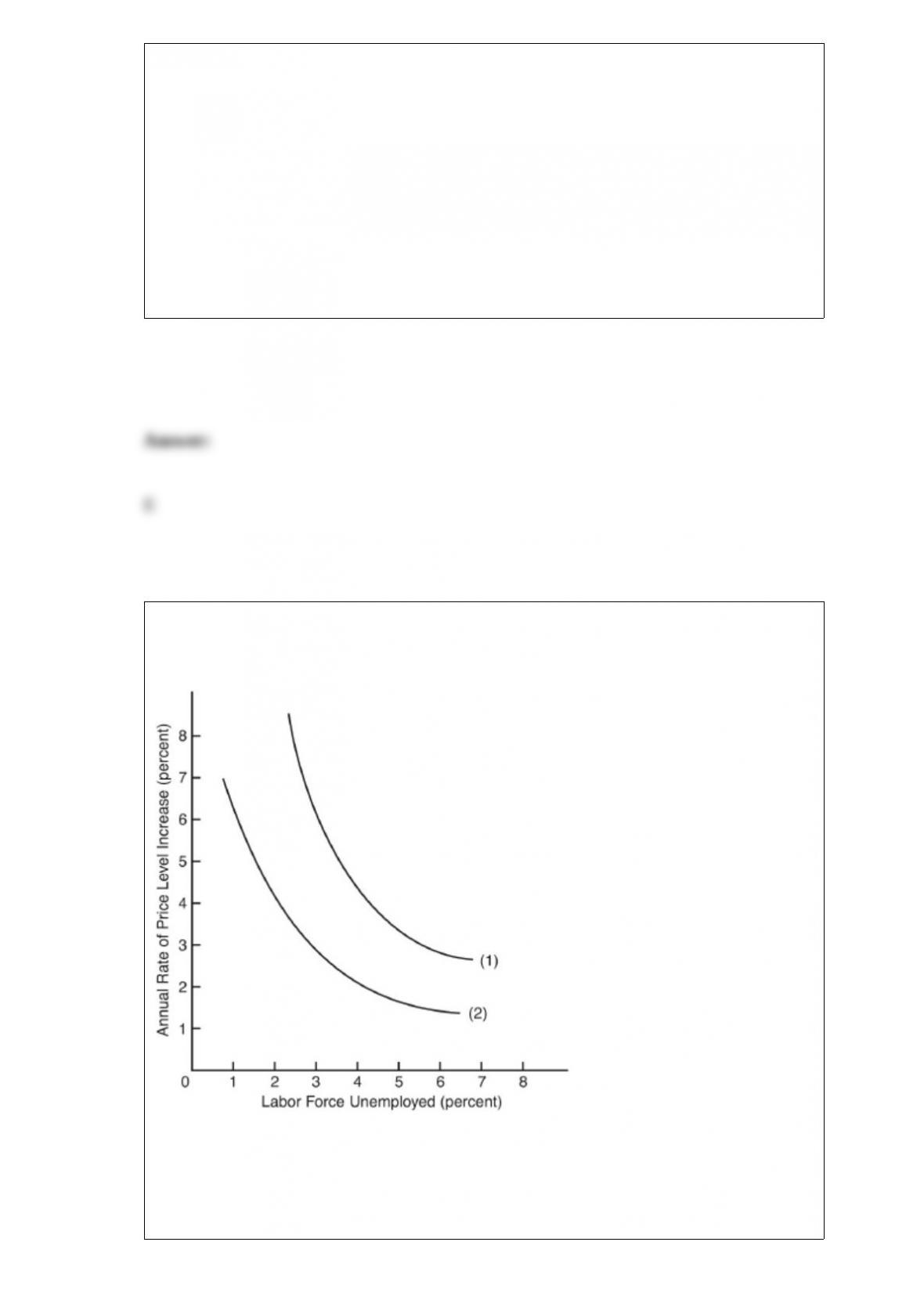
The following questions are based on the following graph, which shows two different
Phillips curves, labeled (1) and (2):
Phillips curves (1) and (2) are examples of ________ Phillips curves.
a. equilibrium

b. accelerated
c. natural
d. short-run
e. substandard
Price elasticity of demand is the
a. change in quantity divided by the change in price.
b. ratio of quantity to price.
c. change in quantity divided by the change in price times the original price-quantity
ratio.
d. change in price times the change in quantity divided by the original price-quantity
ratio.
e. reciprocal of the original price-quantity ratio times the change in price.
The following questions are based on the following graph:
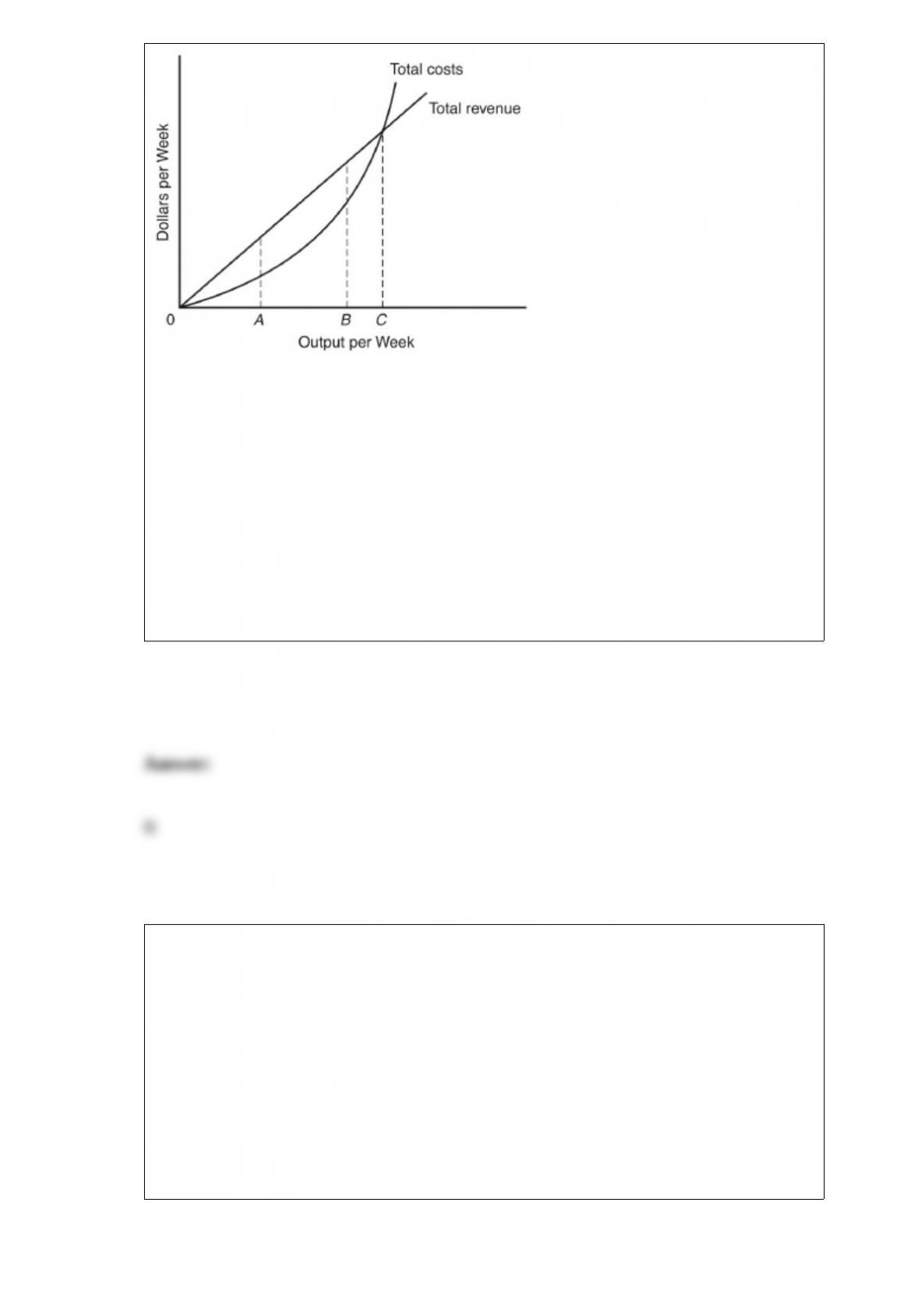
Profits are maximized at an output
a. between 0 and A.
b. between A and B.
c. between B and C.
d. at C.
e. greater than output C.
In perfectly competitive markets, prices are
a. set by powerful firms.
b. unaffected by actions of individual buyers or sellers.
c. regulated by government interaction.
d. likely to remain unchanged for long periods of time.
e. unimportant.

Increases in the discount rate tend to tighten the money supply by
a. making it more expensive for member banks to augment their reserves by borrowing
from the Fed.
b. forcing member banks to recall loans.
c. inducing banks to sell government securities.
d. reducing the amount of demand deposits that a given amount of reserves can legally
support.
e. increasing the interest rate banks are legally allowed to pay depositors.
Which of the following conditions would be LEASTlikely to lead to a monopolistic
market structure?
a. possession of patent rights for basic production processes
b. control over the entire supply of a basic input
c. the need to be a price taker in order to sell in the market
d. significant economies of scale leading to declining average cost until the entire
market demand is satisfied
e. exclusive rights to sell in a particular geographic market

The irregularity of the innovation rate
a. primarily affects the levels of household spending and saving.
b. helps explain why gross investment expenditure tends to be unstable.
c. causes average real wages to tend toward subsistence levels.
d. is a major reason behind the classical economists’ belief that interest rates are
inflexible.
e. is increased when the value of the multiplier is less than 1.
The distribution of income generated by the price system
a. inevitably becomes egalitarian.
b. may not create sufficient spending power to provide for the needs of the poor.
c. is an example of an external diseconomy.
d. is considered by most people to be fair and therefore in no need of alteration to suit
humanitarian concerns.
e. enables firms to satisfy all consumer desires.

Retail clothing stores provide a good example of monopolistic competition because
a. there are few firms in the industry.
b. there are significant barriers to entry in the industry.
c. each firm possesses somewhat unique attributes in the form of location, service, and
variety of merchandise.
d. profit margins are generally quite large for retail establishments.
e. firms in the industry face horizontal demand curves for their products.
If the supply curve is vertical and the demand curve slopes downward, the imposition of
a sales tax will
a. shift entirely to the buyer.
b. fall more heavily on the buyer.
c. be equally shared by the buyer and seller.
d. fall more heavily on the seller.
e. shift entirely to the seller.

Balancing the government’s budget over the course of each business cycle
a. results in a stable economy at all times.
b. does not take into account the fact that the size of the deficits needed to reduce
unemployment may not equal the size of the surpluses needed to moderate subsequent
inflation.
c. guarantees a steady decrease in the national debt.
d. is a policy biased in favor of reducing unemployment at the cost of allowing
persistent inflation.
e. is called functional finance.
The main reason that President Franklin Roosevelt went off the gold standard was that
a. the U.S. gold reserves had been completely depleted.
b. he believed that a devalued dollar might rekindle a failing economy.
c. he foresaw the establishment of a new international agreement under the Bretton
Woods system.
d. rumors that Britain would soon abandon the gold standard could no longer be
ignored.
e. many economists of the time predicted higher dollar values if the gold standard was
abandoned.

To correct for changes in the price level, output values are expressed in terms of
a. current dollars.
b. base-year prices.
c. residuals.
d. inflationary expectations.
e. relative deviations.
According to supply-side economists, noninflationary policies to expand real GDP
involve
a. decreasing the rate of growth of the money supply to lower interest rates.
b. reducing the tax burden.
c. increasing welfare and other government income support programs.
d. policies to make the aggregate supply curve vertical.
e. the use of wage and price controls.

One means of increasing national output without increasing pollution at a
commensurate rate is to
a. achieve zero economic growth.
b. achieve a higher rate of population growth.
c. substitute the production of nonpolluting products for polluting products.
d. discourage technological change.
e. trust in the efficiency of the private market system.
Profit-maximizing firms should increase output to the point where
a. total revenue is largest.
b. total revenue just exceeds total cost.
c. an increase in revenue is just offset by an increase in cost.
d. fixed costs are covered.
e. total cost is minimized.
Cost functions show

a. that one of the functions of production is to incur costs.
b. the relationship between various costs of production and output.
c. the amount of output per unit of input.
d. the demand for factors of production.
e. how production costs are derived from input-output price ratios.
The consumer price index
a. is a 10-year moving average of commodity prices.
b. establishes the maximum price sellers may charge consumers.
c. lists the annual ratios of consumption to disposable income.
d. shows the ratio of cost of a market basket of goods and services in a given year to a
base year.
e. is another name for aggregate demand.
That wage and price rigidities cause changes in aggregate demand to lead to changes in
real output is a concept associated with
a. classical economists.

b. new classical macroeconomists.
c. real business cycle theorists.
d. new and traditional Keynesians.
e. supply-side economists.
Which of the following factors was probably most significant in putting an end to the
designer jeans fad?
a. Prices got so high that people stopped buying designer jeans.
b. Producers failed to advertise enough to promote this new product effectively.
c. So many consumers bought designer jeans that they lost their uniqueness.
d. The quality of the product declined as more firms entered the market.
e. Supply decreased because of the energy crisis.
The notion that workers are more inclined to shun risk and accept stable wages with
layoffs based on seniority is an important element in
a. the theory of deferred payments.

b. new classical macroeconomic theory.
c. profit-sharing plans.
d. the “efficient insider” hypothesis.
e. implicit contract theory.
If the United States and Britain were both on the gold standard, trade would be brought
into balance because
a. one country would eventually run out of gold.
b. both countries would eventually run out of gold.
c. as a country’s gold balance declines, it would have to import more and more to
compensate for the loss.
d. changes in the British and U.S. money supplies brought about by gold flows would
cause their respective domestic price levels to change.
e. the country with the positive export balance would export gold to the country with
the negative export balance, causing the imbalance to disappear.
The following questions are based on the following information: The marginal product
of an additional unit of labor is 100 units per day and the market price of this output is
$0.75 per unit.

If the cost to the firm of hiring this unit of labor (wages, Social Security, and other
payroll taxes) is $12 per hour for an eight-hour day, a profit-maximizing firm
a. should hire the additional unit of labor.
b. should not hire this extra unit.
c. should hire this person for half a day.
d. should hire this extra unit of labor plus one more.
e. There is not enough information available to determine the optimal number of
workers.
On the basis of the information provided in the diagram, the closed triangle represents
a. excess supply.
b. excess demand.
c. equilibrium prices.
d. actual prices.
e. surplus value.

For a country that uses them, the general result of tariffs and quotas is an increase in
a. the volume of trade.
b. the standard of living.
c. the level of imports.
d. domestic prices.
e. the quantities demanded.
Unions regularly encourage Congress to reduce both immigration and working hours
because unions want to
a. shift the supply curve for labor to the left.
b. shift the demand curve for labor to the right.

c. promote the unemployment of nonunion members.
d. encourage the importation of consumer goods from abroad.
e. stimulate the introduction of labor-saving machinery.
If the estimated current dollar output is $3,535 billion and the relevant price index is
2.21, current prices must on average be what percentage of base-year prices?
a. 2.21 percent
b. 22.1 percent
c. 121 percent
d. 221 percent
e. 321 percent