
Predatory pricing occurs when a monopolist charges a:
A) price above average total cost.
B) price above average variable cost.
C) low price to drive out competition, then charges a high price.
D) high price to drive out competition, then charges a low price.
Because of asymmetric information, a seller of a lemon used car earns:
A) more profit than a seller of a plum used car.
B) less profit than a seller of a plum used car.
C) the same profit as a seller of a plum used car.
D) less revenue than a seller of a plum used car.
Imagine that an upward sloping line is depicted in a graph with income per week on the
y-axis and hours worked per week on the x-axis. The slope of the line in the graph
depicts the:
A) minimum wage of the worker.
B) hourly wage of the worker.

C) the total monthly income of the worker.
D) increase in income earned by the worker per every year of service.
Recall the application about opening a Dunkin’ Donuts shop and the small barriers to
entering the donut business. Which of the following is NOT required to operate a
Dunkin’ Donuts franchise?
A) paying a franchise fee
B) earning an economic profit
C) paying a royalty rate on profits
D) selling a specific brand of donuts
Consider Figure 12.3. Choosing a high price is:
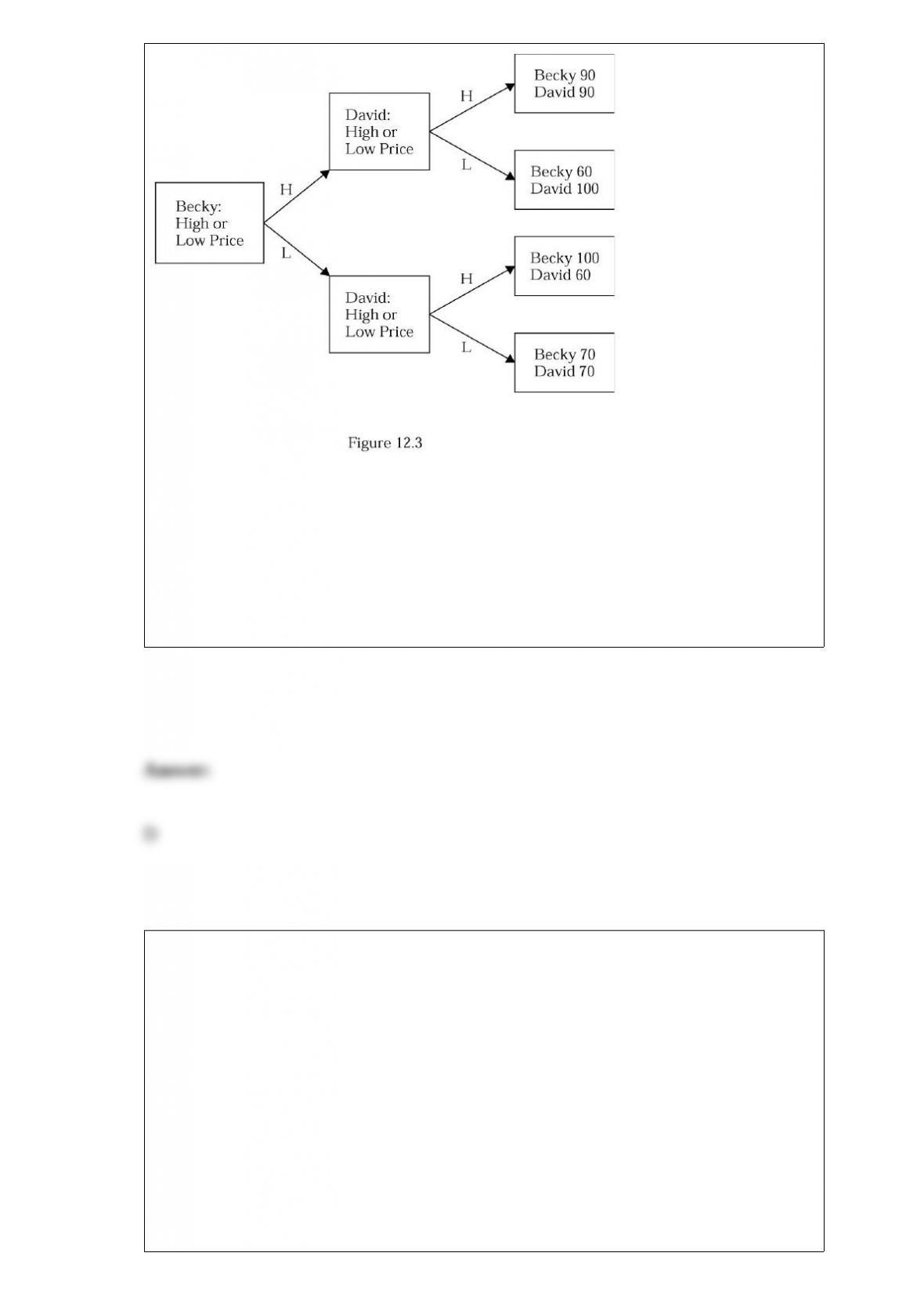
A) a dominant strategy for David but not for Becky.
B) a dominant strategy for Becky but not for David.
C) a dominant strategy for both David and Becky.
D) not a dominant strategy for either David or Becky.
Recall the Application about the merger of Sirius Satellite Radio and XM Satellite
Radio to answer the following question(s).
Recall the Application. One might expect no more firms to enter after the market
consolidated into one firm because:
A) the fixed cost of setting up a company system and acquiring programing is very
high.
B) the marginal cost of adding addition subscribers if very high.
C) demand is very elastic.

D) all of the above.
If the number of highway deaths among young people is roughly proportional to their
beer consumption and young peoples’ elasticity of demand for beer is 1.5, then to
decrease highway deaths of young people by 15 percent, taxes would need to be
increased enough to increase the price of beer by:
A) 1%.
B) 1.5%.
C) 10%.
D) 15%.
Recall the Application. When the U.S. acquires and then shares weather data with
organizations in other countries:
A) both the U.S. economy and the economies of other countries benefit.
B) the U.S. does not benefit and other countries free ride.
C) the information is excludable and rival.
D) the information is incomplete because no country can monitor oceans outside its
own borders.

Recall the application about the response to lower taxes in French restaurants. If the
demand for restaurant meals is elastic, we could predict the tax cut will:
A) decrease the sales of restaurant meals.
B) increase the sales of restaurant meals.
C) benefit only sellers.
D) none of the above
As bags of nitrogen applied went from 0 to 1 to 2 to 3 to 4, crop yield went from 85 to
120 to 135 to 144 to 147 bushels per acre or production exhibited:
A) increasing returns to fertilizer.
B) constant returns to land.
C) diminishing returns to fertilizer.
D) decreasing returns to land.

Recall the Application. In order to fully internalize the external costs of collisions:
A) drivers with different collision rates would pay different taxes.
B) all drivers would pay a tax equal to the average cost of collisions.
C) taxes paid would be determined by number of miles driven.
D) taxes paid would decrease with the age of the driver, so that the oldest drivers paid
the lowest taxes.
An Italian restaurant is profit-maximizing firm in monopolistic competition differs from
a firm in perfect competition because the firm in monopolistic competition:
A) faces a perfectly elastic demand curve at the market price.
B) faces no barriers to entry.
C) faces a downward sloping demand curve for its product.
D) can earn economic profits in the long run.
In the Staples/Office Depot Case, the government:
A) blocked a merger.
B) allowed a merger but regulated the resulting firm.
C) allowed a merger and did not regulate the resulting firm.
D) prosecuted the two firms for collusion.
Daily Output of Japan and U.S.
Table 18.2
Refer to Table 18.2. The nation with a comparative advantage in tractors is:
A) both the U.S. and Japan.
B) neither the U.S. nor Japan.
C) the U.S.
D) Japan.

From the Application, we can infer that the wine lakes will grow faster if:
A) the government set minimum prices further above the equilibrium.
B) the government set maximum prices further below the equilibrium.
C) the government set maximum prices further above the equilibrium.
D) the government set minimum prices further below the equilibrium.
Suppose the nation of Alphonia was charged with dumping electric lawnmowers in the
nation of Omegalon. The charge of dumping electric lawnmowers in the Omegalon
market means that Alphonia was accused of:
A) selling faulty electric lawnmowers in Omegalon.
B) selling electric lawnmowers below cost or below domestic prices.
C) selling counterfeit-branded electric lawnmowers in Omegalon.
D) discarding electric lawnmowers which would not sell in their home country.
Table 8.4 presents the cost schedule for David’s Figs. If David produces three figs,
David’s total variable costs are:
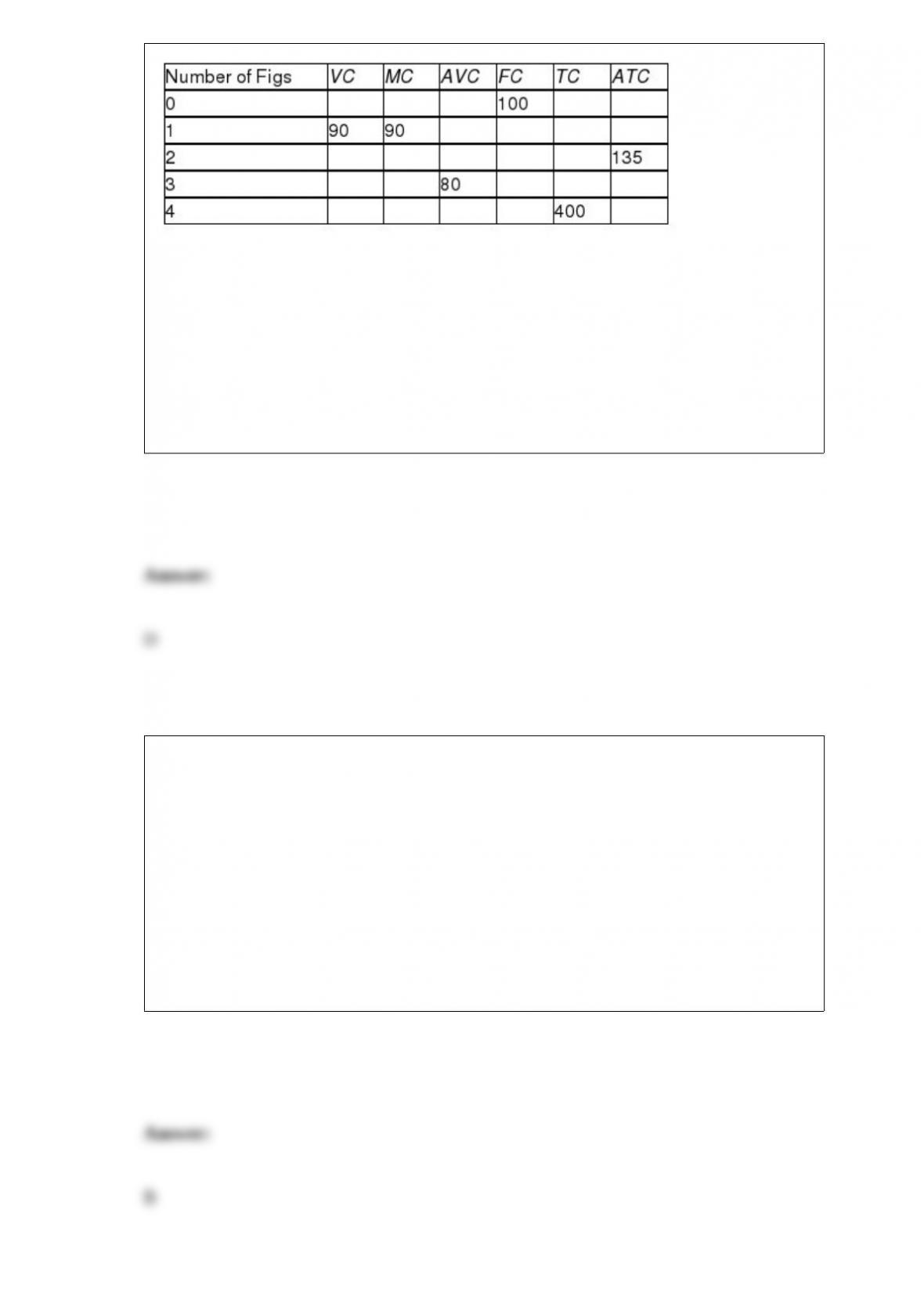
Table 8.4
A) $0.
B) $41.67.
C) $80.
D) $240.
Which one of the following is true of a market for used cars?
A) A consumer typically overestimates the probability of getting a lemon (low-quality
car).
B) As buyers become more pessimistic about their chances of buying a high-quality car,
the price of used cars (both low-quality and high-quality) decreases.
C) There is a public information problem.
D) The willingness to pay is less than the willingness to accept.

There is a positive relationship between two variables if the two variables:
A) have positive values.
B) move in opposite directions.
C) move in the same direction.
D) have negative values.
As compared to a perfectly competitive firm, a monopolistically competitive firm will:
A) have more control over price.
B) have less control over price.
C) face more barriers to entry.
D) face many more competitors.
When the EPA dictates the abatement equipment for vehicles, it determines:
A) pollution per mile driven.
B) pollution per car per year.
C) gasoline mileage per gallon.

D) pollution per driver per year.
After the implementation of the congestion tax in London, traffic volume was reduced
and travel time for cars and buses was cut in half. This is an example of:
A) responding to incentives.
B) the role of pricing in allocating resources.
C) caveat emptor.
D) comparative advantage.
You notice that the price of butter rises and then falls. The best explanation for this is
that:
A) demand for butter increased causing price to rise, which attracted other firms to
enter the market causing supply to increase, which caused the price to go back down.
B) demand for butter decreased causing price to rise, which attracted other firms to
enter the market causing supply to increase, which caused the price to go back down.
C) demand for butter increased causing price to rise, which induced other firms to exit
the market causing supply to decrease, which caused the price to go back down.
D) demand for butter increased causing price to rise, which attracted other firms to

enter the market causing supply to decrease, which caused the price to go back down.
Monopolistically competitive firms do NOT differentiate their products by:
A) selling products at different locations.
B) selling a product with different levels of services accompanying the product.
C) convincing consumers that the product is identical to those sold by competitors.
D) using advertising to create a special aura or image for the product.
Figure 4.4 illustrates the supply of tacos. A technological advancement which makes
tacos cheaper to produce would most likely cause a movement from:
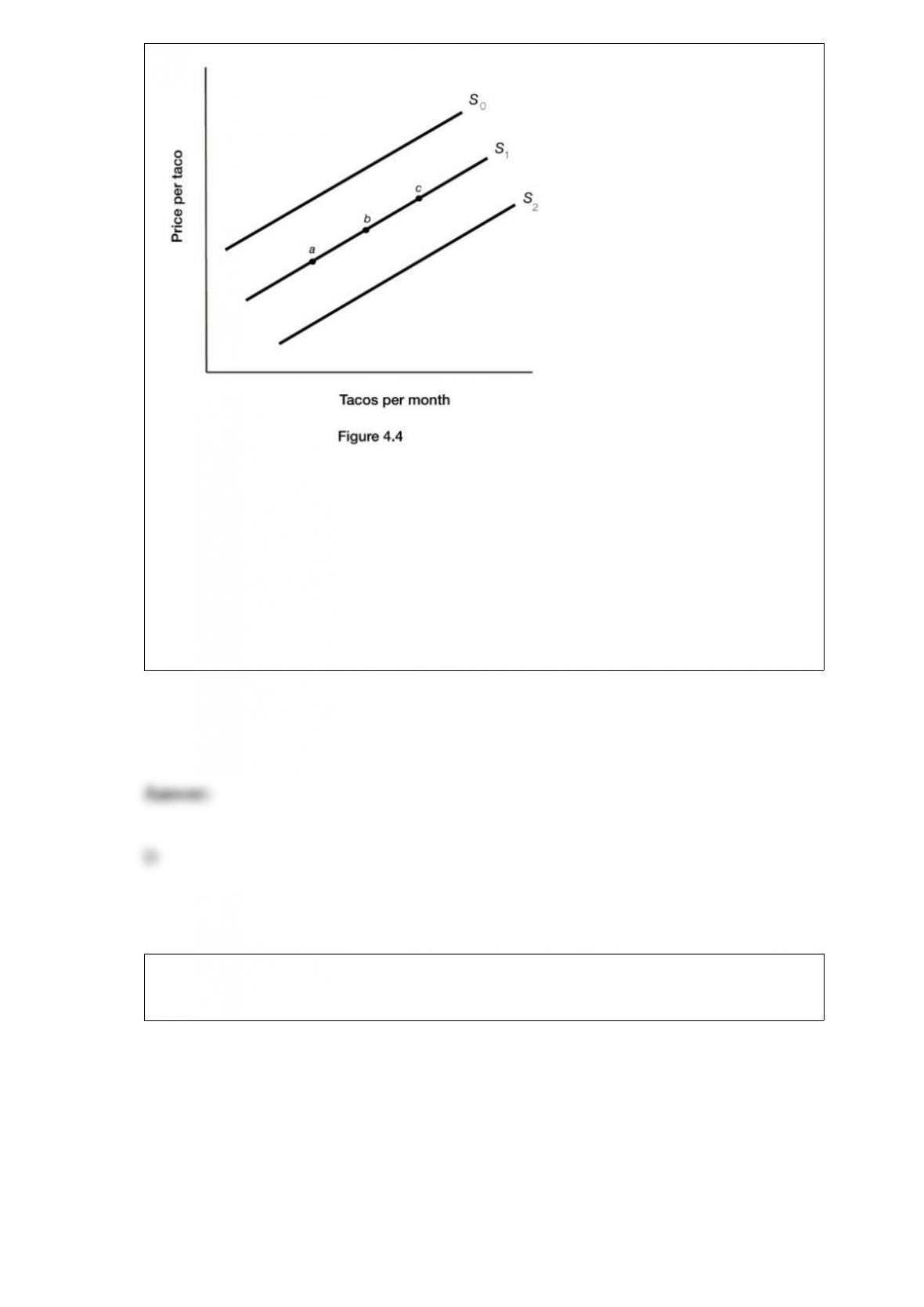
A) point a to point c.
B) point c to point a.
C) S2 to S0.
D) S0 to S2.
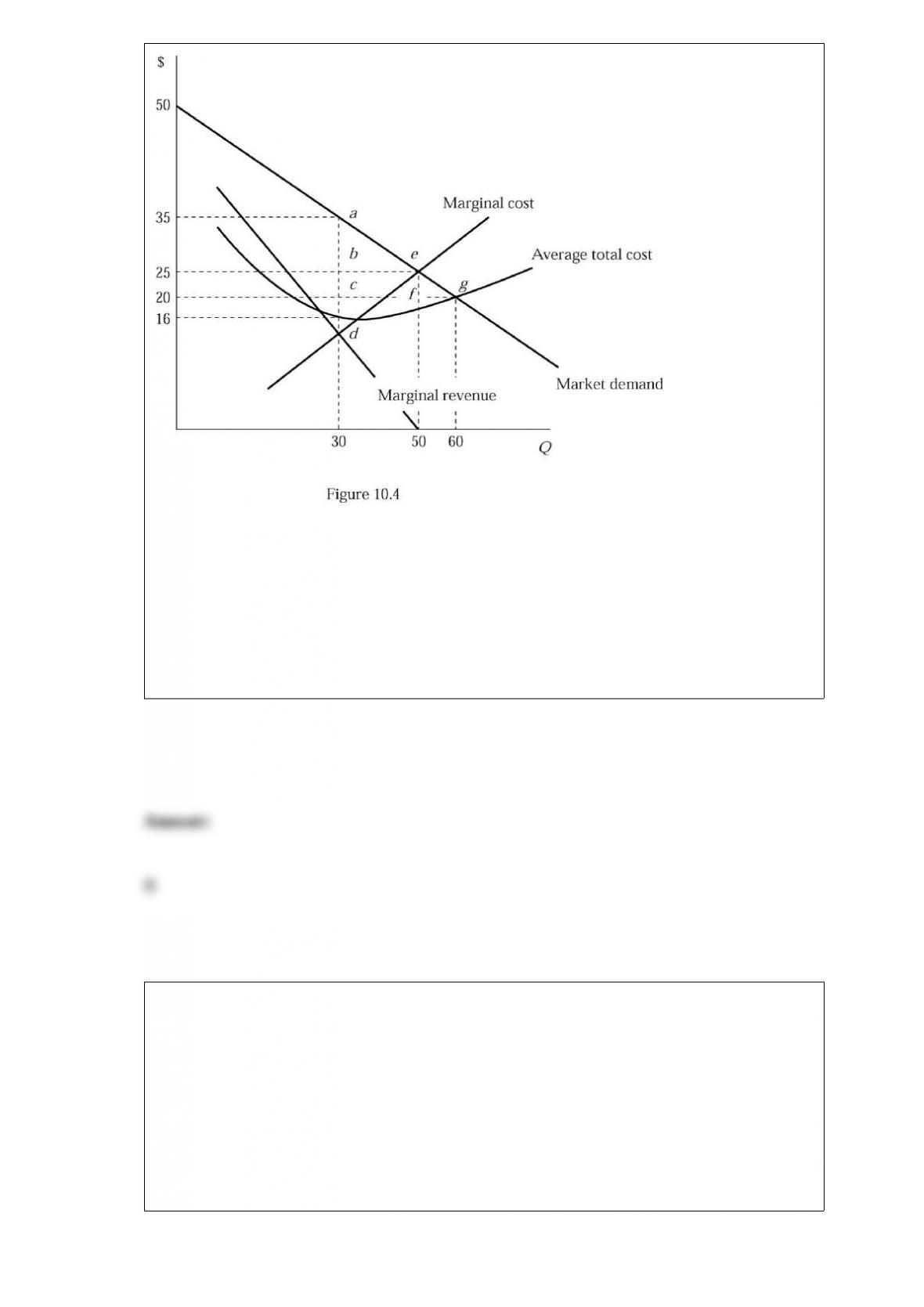
Suppose that Figure 10.4 shows a monopolist’s demand curve, marginal revenue, and its
costs. At the profit maximizing output level, the monopolist’s profit would be:
A) $730.
B) $570.
C) $320.
D) $150.
Which one of the following groups had the lowest incidence of poverty in 2010?
A) married couples
B) Asian households
C) 65 years of age and older
D) female-headed households

When the price of bricks increases 5%, quantity demanded decreases 15%. The
elasticity for bricks is:
A) perfectly inelastic.
B) elastic.
C) inelastic.
D) unitary elastic.
The practice of requiring a consumer to purchase two or more products together, rather
than separately is called ________.
A) free-riding
B) cartelling
C) tie-in sales
D) predatory pricing
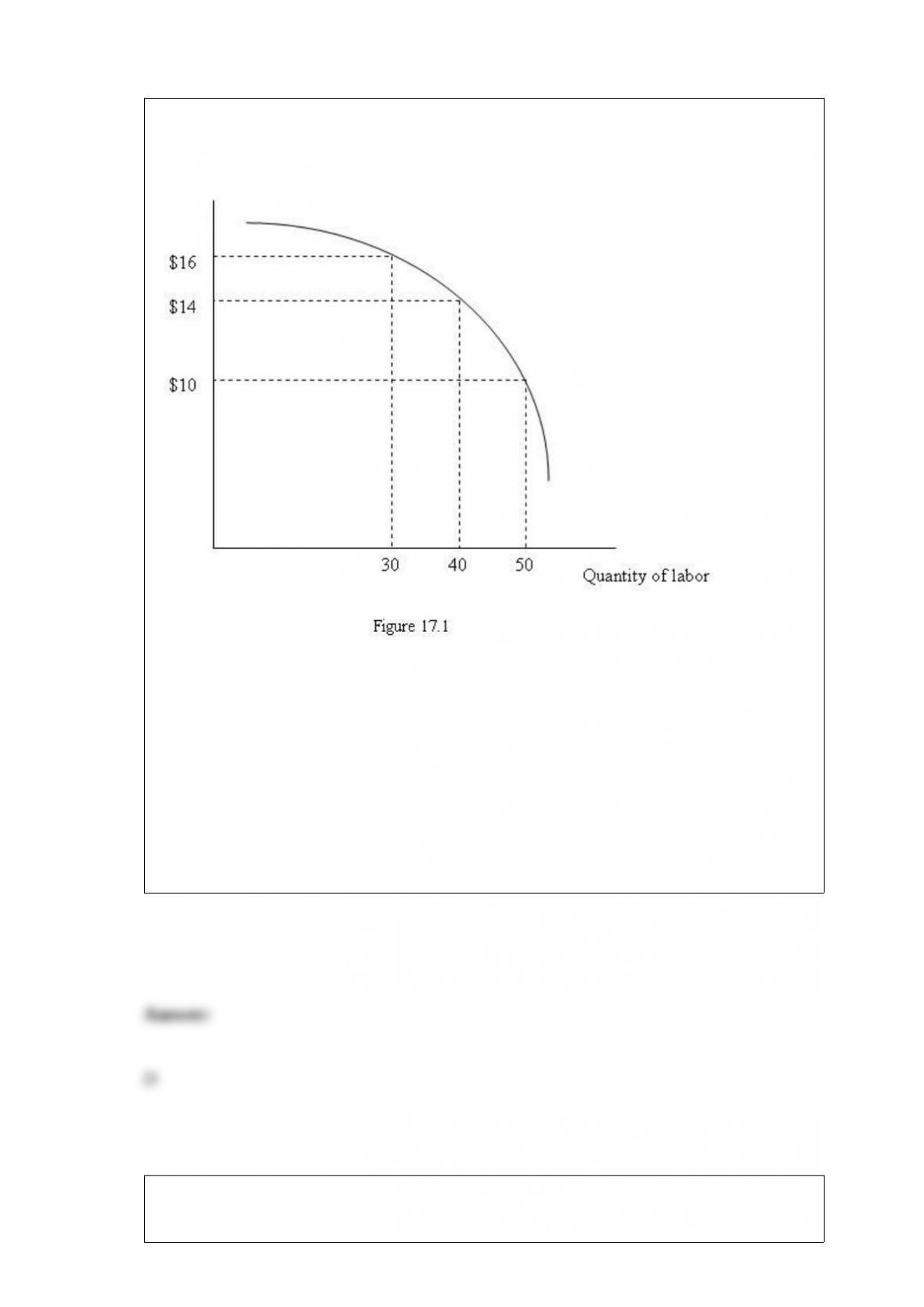
Figure 17.1 depicts a firm’s marginal revenue product curve. If the prevailing hourly
wage decreases:
A) the marginal revenue product curve shifts upward.
B) the marginal revenue product curve shifts downward.
C) the marginal revenue product curve does not shift but there is a movement upward
along the curve.
D) the marginal revenue product curve does not shift but there is a movement
downward along the curve.
To make things simpler and focus attention on what really matters, economists would:
A) use assumptions.
B) ignore all variables.
C) think at the margin.
D) respond to incentives.