
The economy of Omega operates according to Okun’s law. In Omega, the actual and the
natural rates of unemployment equal 5 percent, and real GDP equals $10 trillion. What
is potential GDP in Omega?
A. $9.0 trillion
B. $9.5 trillion
C. $10.0 trillion
D. $10.5 trillion
P-TV and QRS-TV are trying to decide whether to air a sit-com or a reality show in a
given time slot. Viewers like both sit-coms and reality shows, but sit-coms are more
expensive to produce than reality shows since real actors need to be hired. QRS-TV
makes its decision first, and then P-TV observes that choice before making its decision.
Both stations know all of the information in the decision tree below.
Given the information in this decision tree, if QRS-TV announces that it will air a
reality show, it can expect to:
A. lose $5 million.
B. earn $5 million.
C. earn $10 million.
D. earn $20 million.
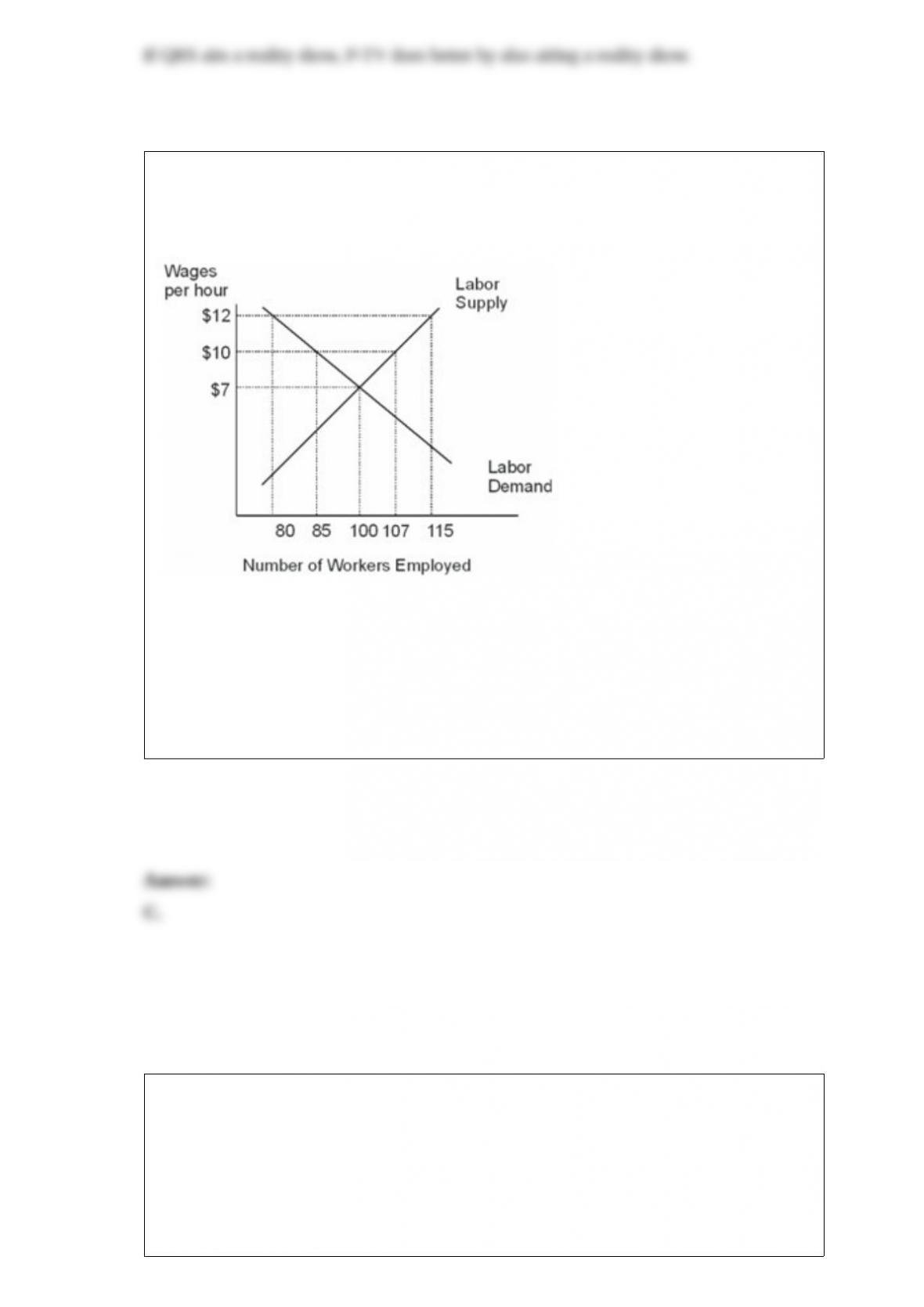
Based on the labor market diagram below, if the minimum wage is set at $10 per hour,
there will be ______ unemployed workers.
A. 7
B. 15
C. 22
D. 27
Liabilities are:
A. current income minus spending on current needs.
B. the debts one owes.
C. saving minus investment.

D. anything of value one owns.
Which of the following would be expected to decrease the demand for money in the
U.S.?
A. Grocery stores begin to accept credit cards in payment.
B. The economy enters a boom period.
C. Political instability increases dramatically in developing nations.
D. Households fear increasing computer glitches will severely limit their ability to use
ATMs.
The greater the flow of investment spending, the greater the increase in the stock of:
A. saving.
B. money.
C. income.
D. capital.

Curly and Moe are considering living alone or being roommates and splitting the rent
for the next twelve months. If they live alone, they each rent a one bedroom, one bath
apartment for $500 per month, while if they are roommates, they can split a two
bedroom, one bath apartment for $800 per month. The one difficulty they have is that
Moe snores very loudly. Curly estimates the cost of poor sleep due to Moe’s snoring at
$150 per month. Moe could obtain a snore-eliminating device for $50 per month. The
actual monthly gain in surplus to Curly and Moe from living together after addressing
the snoring problems in the least costly way is:
A. $200.
B. $150.
C. $100.
D. $50.
When the nominal exchange changes from 120 yen per dollar to 110 yen per dollar, the
dollar has:
A. appreciated.
B. depreciated.
C. become overvalued.
D. become undervalued.

A group of workers who bargain collectively with employers for higher wages and
better working conditions is called a:
A. labor monopsony.
B. labor union.
C. labor collective.
D. closed shop.
Quick Buck and Pushy Sales produce and sell identical products and face zero marginal
and average cost. Below is the market demand curve for their product.
Suppose Quick Buck and Pushy Sales decide to collude and work together as a
monopolist with each firm producing half the quantity demanded by the market at the
monopoly price. If Quick Buck cheats by reducing its price to $1 while Pushy Sales
continues to comply with the collusive agreement, then Quick Buck’s economic profit
will be ______.
A. $6,000
B. $4,000
C. $2,000
D. $3,000

An increase in unemployment insurance benefits will:
A. increase the demand for labor.
B. decrease the demand for labor.
C. increase job search efforts of unemployed workers.
D. decrease job search efforts of unemployed workers.
Because many European nations have adopted the euro as their common currency, they
are ______ able to conduct independent ______ policy.
A. no longer; monetary
B. no longer; fiscal
C. increasingly; monetary
D. increasingly; fiscal

Based on the figure, if a union contract requires that workers be paid $25 per hour, there
will be ______ unemployed workers.
A. 9
B. 12
C. 21
D. 31
Suppose a cup of tea costs $0.60 and a scone costs $1.20. If Edith spends all of her
income on these two goods, and at her current level of consumption, she receives a
marginal utility of 6 utils from the last cup of tea she buys and a marginal utility of 24
utils from the last scone she buys, then Edith should:
A. buy more tea and fewer scones.
B. buy less tea and more scones.
C. not change her consumption of tea and scones.
D. buy more tea and more scones.

Consider a perfectly competitive industry in a long-run equilibrium. If a single firm in
that industry discovers a significant cost-saving production technology, then:
A. all firms in the market will earn an economic profit in the short run.
B. the rest of the industry will quickly adopt the new technology.
C. the firm will earn an economic profit in the long run.
D. all the firms in the market will earn an economic profit in the long run.
A country’s actual output ______ its potential output.
A. can never exceed
B. can never fall below
C. can only temporarily exceed
D. is always be approximately equal to

Early settlers in the town of Dry Gulch drilled wells to pump as much water as they
wanted from the single aquifer beneath the town. (An aquifer is an underground body of
water.) As more people settled in Dry Gulch, the aquifer level fell and new wells had to
be drilled deeper at higher cost. Compared to a town in which all residents collectively
decide on how much water to use, water use will likely be ______ in Dry Gulch.
A. higher
B. the same
C. lower
D. the same or lower
When the central bank buys $1,000,000 worth of government bonds from the public,
the money supply:
A. increases by more than $1,000,000.
B. increases by $1,000,000.
C. increases by less than $1,000,000.
D. decreases by $1,000,000.

Innovations in the United States, such as credit cards, debit cards, and ATMs have:
A. increased the demand for money.
B. decreased the demand for money.
C. had no impact on the supply or demand for money.
D. increased the supply of money.
If all the world’s resources were to magically increase one hundredfold, then:
A. people would still have to make trade-offs.
B. economics would no longer be relevant.
C. scarcity would disappear.
D. trade-offs would become unnecessary.
Suppose a monopolist faces the demand curve shown below.
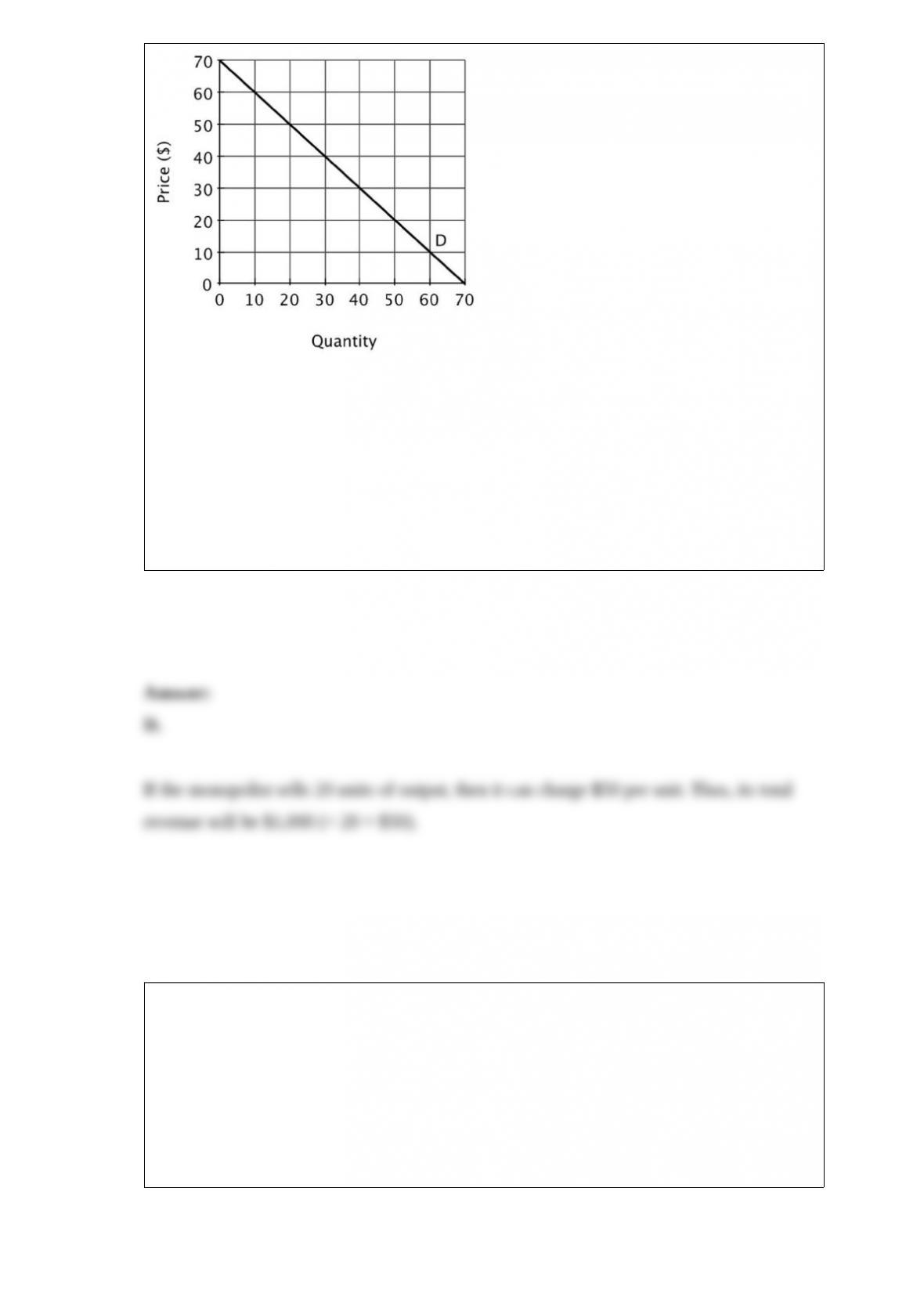
If the monopolist were to sell 20 units of output, its total revenue would be:
A. $50.
B. $100.
C. $140.
D. $1,000.
A measure defined at a point in time is called a(n) ______ variable.
A. stock
B. nominal
C. aggregate
D. flow

Refer to the figure below. Suppose the economy is in a short-run equilibrium at output
Y3 and inflation rate π2. The economy is currently experiencing ______, and the correct
monetary policy response to this situation, to return the economy to potential GDP, is to
______.
A. a recessionary gap; raise taxes
B. an expansionary gap; cut taxes
C. a recessionary gap; increase the money supply
D. an expansionary gap; decrease the money supply
When Dale visits the doctor, Dale does not pay for either the visit or any tests the doctor
may order. From this we can infer that Dale must:
A. be a member of an HMO.
B. have a medical insurance policy with a deductible.
C. have first-dollar medical insurance coverage.
D. be underutilizing medical care.

Structural unemployment is increased when the wage is kept above the market-clearing
wage by:
A. unemployment insurance.
B. worker mobility.
C. skill-biased technological change.
D. labor unions.
Suppose that the total production of an economy consists of 10 oranges and 5 candy
bars, each orange sells for $0.20, and each candy bar sells for $1.00. Which expression
of the output of this economy is most consistent with the concept of GDP?
A. This economy produces two-thirds oranges and one-third candy bars.
B. This economy produces food valued at $1.20.
C. This economy produces 15 food items.
D. This economy produces $7.00 worth of food.

Suppose the economy is currently operating at potential output; a recessionary gap may
be caused by each of the following except:
A. a negative demand shock.
B. a negative inflation shock.
C. a decrease in government spending.
D. a decrease in the inflation rate.
One difference between the long run and the short run in a perfectly competitive
industry is that:
A. economic profits in the long run are always greater than they are in the short run.
B. economic profits in the short run are always greater than they are in the long run.
C. firms necessarily earn zero economic profit in the long run but may earn positive or
negative economic profit in the short run.
D. firms necessarily earn positive economic profit in the long run but may earn positive
or negative economic profit in the short run.

Refer to the figure below. Total producer surplus in this market is:
A. $10
B. $125
C. $250
D. $500
According to the textbook, the best possible solution to the problem of poverty is:
A. a combination of a negative income tax and public employment.
B. to maintain the current system.
C. a negative income tax with the tax credit equal to the poverty threshold.
D. the complete elimination of all efforts to assist the poor.
Data for an economy shows that the unemployment rate is 10%, the participation rate
80 percent, and 200 million people 16 years or older are not in the labor force. How
many people are in the working-age population in this economy?
A. 250 million

B. 800 million
C. 1.0 billion
D. 1.6 billion
Accounting profit is equal to:
A. total revenue minus implicit costs.
B. total revenue minus explicit costs.
C. total revenue minus explicit and implicit costs.
D. economic profit minus implicit costs.
Suppose Jordan and Lee are trying to decide what to do on a Friday. Jordan would
prefer to see a comedy while Lee would prefer to see a documentary. One documentary
and one comedy are showing at the local cinema. The payoffs they receive from seeing
the films either together or separately are shown in the payoff matrix below. Both
Jordan and Lee know the information contained in the payoff matrix. They purchase
their tickets simultaneously, ignorant of the other’s choice.

Which of the following statements is true?
A. Jordan does not have a dominant strategy.
B. For Jordan, seeing a comedy is a dominant strategy.
C. For Jordan, seeing a documentary is a dominant strategy.
D. Jordon’s dominant strategy depends on Lee’s choice.
The table below shows how total donations, average donations, total labor costs and
average labor costs vary depending on the number of employees State U hires for its
fundraising activities.
The marginal benefit (in terms of extra donations) of the 2nd employee is:
A. $42,426.
B. $21,213.
C. $12,426.
D. $11,337.