
The justification for occupational licensing laws is that they protect the public from
incompetent practitioners (for example, lawyers and medical doctors), but the laws also
result in
A) higher prices and restrictions on the number of people who can enter the professions
affected by the laws.
B) economies of scale.
C) ownership of a key input.
D) an increase in the amount of output required to achieve minimum efficient scale.
Which of the following individuals is most likely to purchase a life insurance policy
that pays out an annual income beginning at a certain age until the individual’s death?
A) Ian, who expects to have a short life expectancy because of an illness
B) Bradley, who has six young children
C) Avril, a tax attorney who wants to avoid adverse selection
D) Alma, who expects to live a long life, based on her family history
An increase in the demand for lobster due to changes in consumer tastes, accompanied
by a decrease in the supply of lobster as a result bad weather reducing the number of
fishermen trapping lobster, will result in
A) a decrease in the equilibrium quantity of lobster and no change in the equilibrium
price.

B) an increase in the equilibrium price of lobster and no change in the equilibrium
quantity.
C) an increase in the equilibrium price of lobster; the equilibrium quantity may increase
or decrease.
D) a decrease in the equilibrium quantity of lobster; the equilibrium price may increase
or decrease.
An unplanned increase in inventories results from
A) an increase in planned investment.
B) a decrease in planned investment.
C) actual investment that is greater than planned investment.
D) actual investment that is less than planned investment.
If wages and prices adjust rapidly, we would expect expansionary monetary policy to be
A) more likely to reduce the natural rate of unemployment.
B) more likely to affect the unemployment rate.
C) less likely to affect the unemployment rate.
D) less likely to result in a vertical short-run Phillips curve.

The slope of an isoquant measures
A) the price ratio of the two inputs.
B) the average product of labor.
C) the ratio of the marginal utility of the two inputs.
D) the rate at which inputs can be substituted for each other keeping total output
constant.
What is outlet bias?
A) the tendency for households to spend more money over time
B) the tendency for households to spend their money at discount stores as prices rise
C) the tendency for the quality of products to improve over time even though the CPI
does not measure changes in quality
D) the tendency for consumers to purchase newer, more technologically advanced
products even though they have higher prices
When Wal-Mart decides to build a new retail store in a town, it will decide to build a
large store rather than a small store if the large store is expected to earn a greater
economic profit. What other motive would Wal-Mart have for choosing to build a large
store?
A) A larger store will help Wal-Mart maintain its position as the leading retail company
in the world more than a smaller store would.
B) A larger store will give Wal-Mart greater political influence in the community.
C) A larger store may deter entry into the town by a rival firm.
D) Because of economies of scale, the average total cost of production is less for a
larger store than a smaller store.
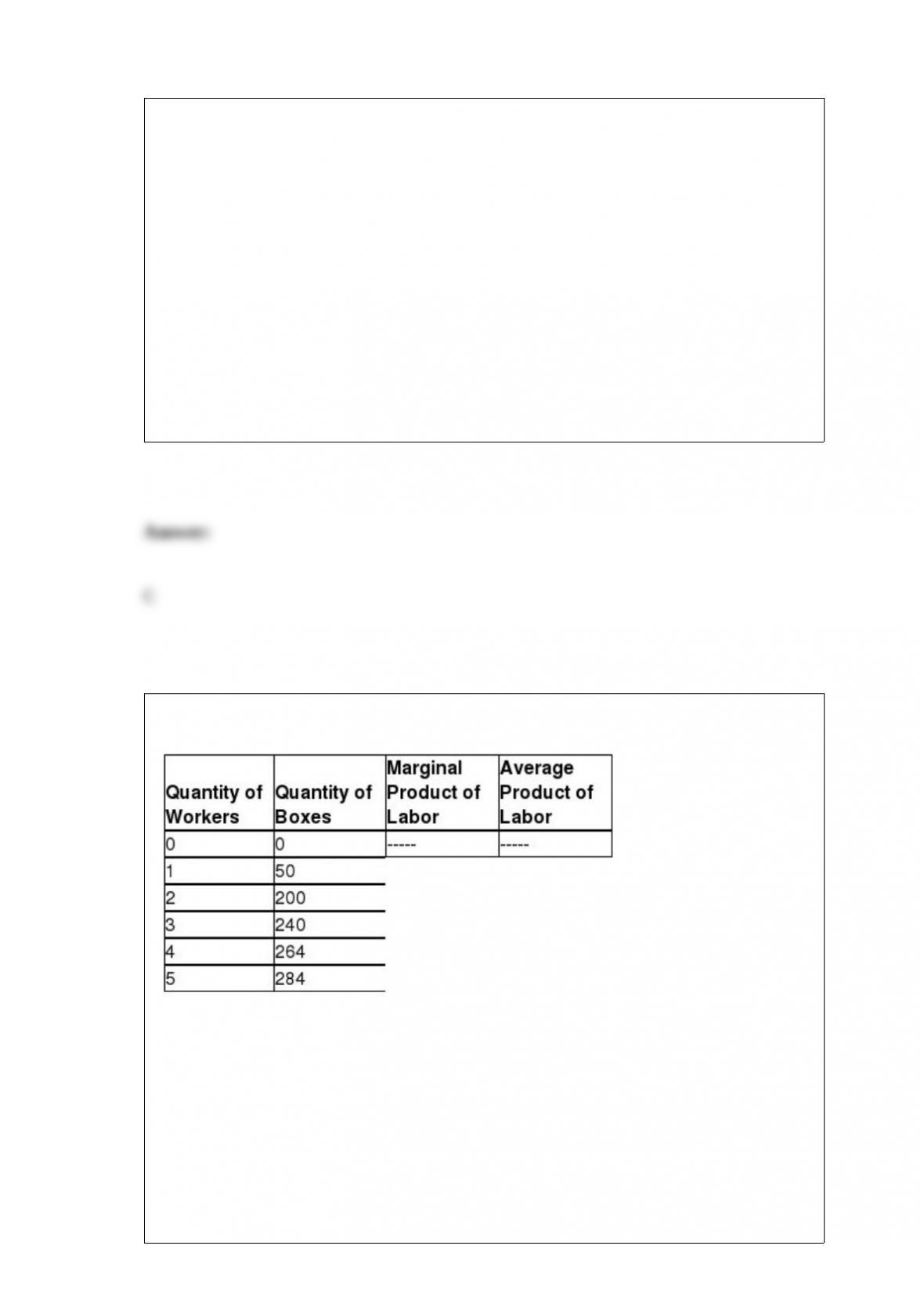
Table 11-3
The table above refers to the relationship between the quantity of workers employed
and the number of cardboard boxes produced per day by Manny’s House of Boxes. The
capital used to produce the boxes is fixed. The highest value of the average product is
labor is ________ when Manny hires ________ workers.
A) 80; 3
B) 100; 3
C) 100; 2
D) 80; 4
Which of the following will prevent firms from engaging in price discrimination?
A) yield management
B) arbitrage
C) transactions costs
D) odd pricing
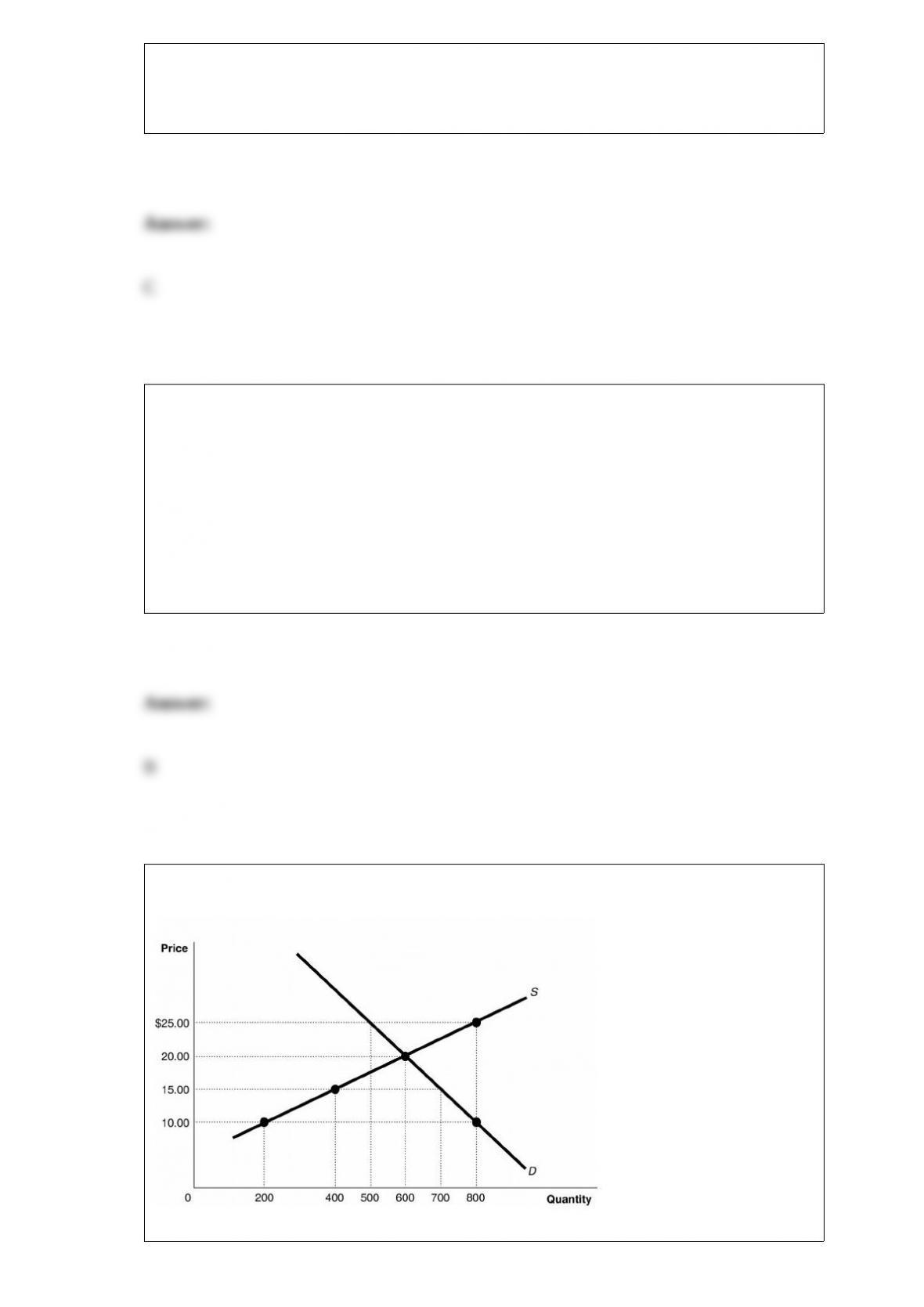
Figure 3-4

If the price is $10,
A) there would be a surplus of 600 units.
B) there would be a shortage of 600 units.
C) there would be a surplus of 200 units.
D) there would be a shortage of 200 units.
The free rider problem refers to a situation in which
A) people consume a pure public good without payment, even though the good may not
be produced if no one chooses to pay.
B) the marginal cost of allowing additional consumers to consume a public good is
zero.
C) high income individuals subsidize the production of goods, such as education, that
make society better off.
D) markets fail to allocate resources efficiently when benefits outweigh costs.
Figure 2-14
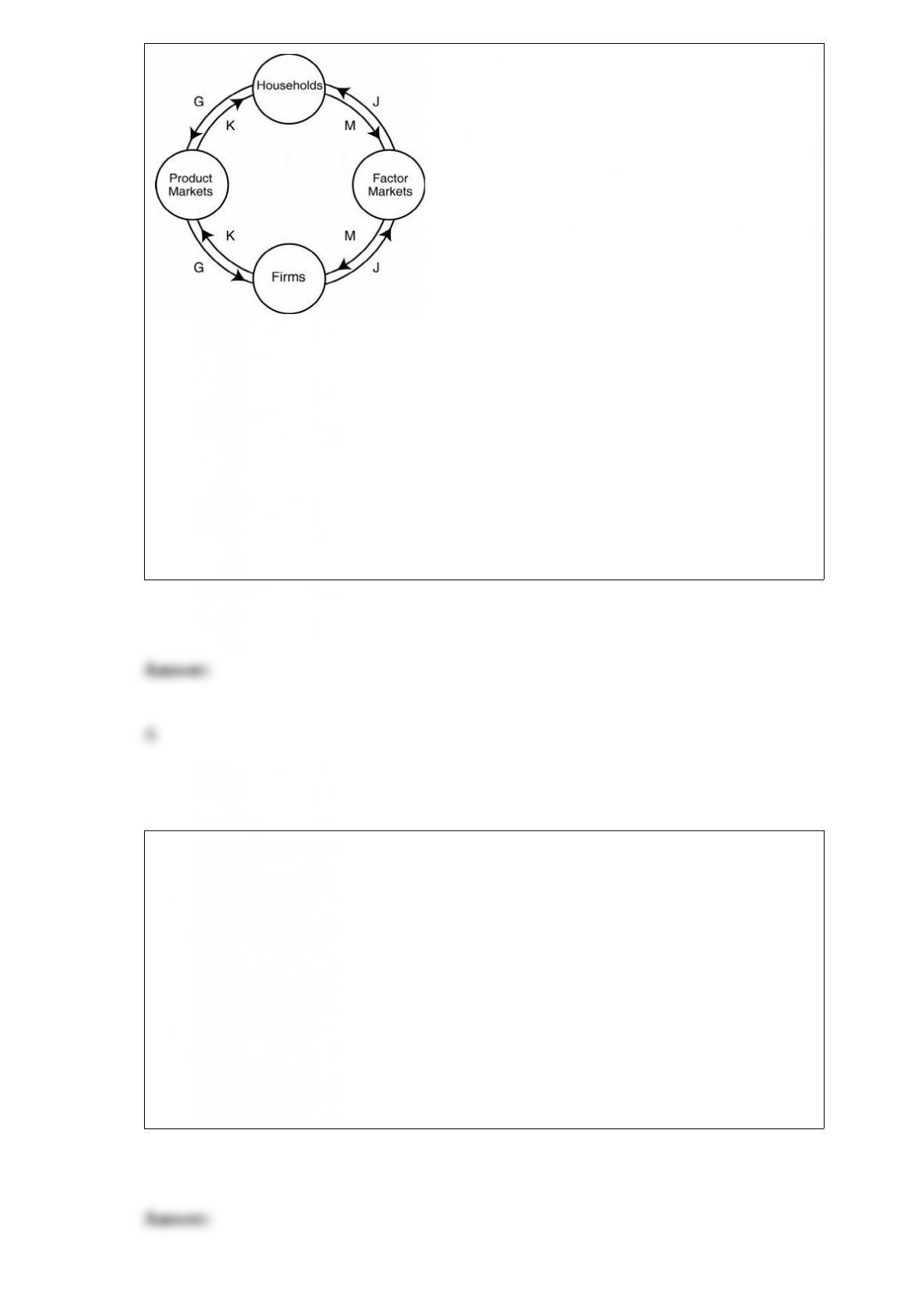
Which two arrows in the diagram depict the following transaction: Myrna earns $450
for working at HempHill’s Drug Store.
A) J and M
B) K and G
C) K and M
D) J and G
The “Big Mac Theory of Exchange Rates” tests the accuracy of purchasing power
parity theory. In July 2013, The Economist reported that the average price of a Big Mac
in the United States was $4.56. In India, the average price of a Big Mac at that time was
90 rupees. What is the “implied exchange rate” between the yen and the dollar?
A) 0.05 rupees per dollar
B) 19.74 rupees per dollar
C) 46.72 rupees per dollar
D) 410.4 rupees per dollar

Suppose that the federal budget is balanced when GDP is at potential GDP. If
equilibrium GDP falls below potential,
A) this will result in a current budget deficit.
B) the cyclically adjusted budget will be balanced.
C) government transfer payments will be rising and tax receipts will be falling.
D) All of the above are correct.
Which of the following is not a durable good?
A) furniture
B) automobile
C) clothing
D) refrigerator
Figure 10-9
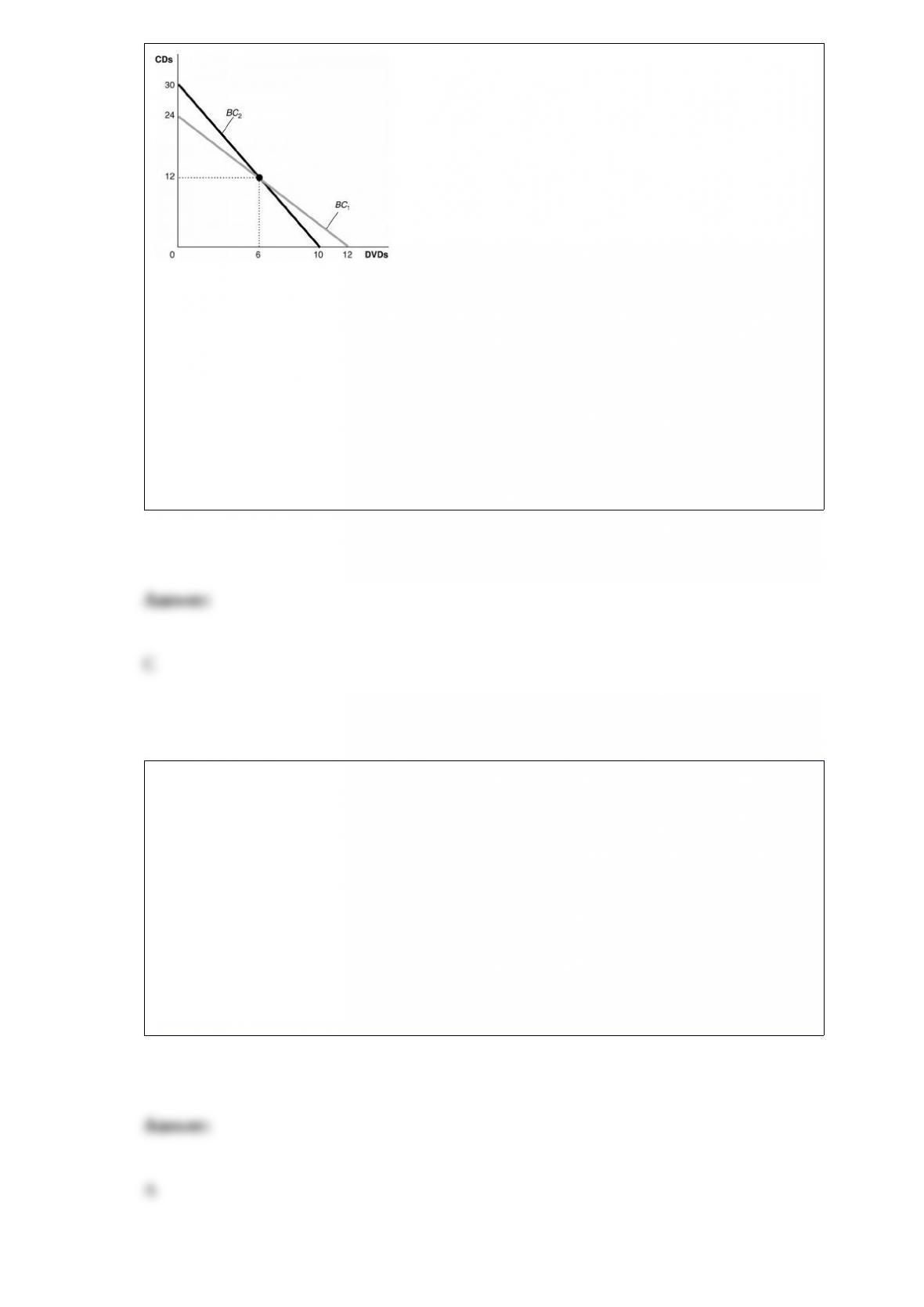
The change in the budget constraint from BC1 to BC2 implies
A) the prices of DVDs and CDs have increased.
B) income and the prices of DVDs and CDs have increased.
C) the price of DVDs has increased and the price of CDs has decreased.
D) the price of DVDs has decreased and the price of CDs has increased.
From an initial long-run macroeconomic equilibrium, if the Federal Reserve anticipated
that next year aggregate demand would grow significantly slower than long-run
aggregate supply, then the Federal Reserve would most likely
A) decrease interest rates.
B) increase interest rates.
C) decrease income tax rates.
D) increase income tax rates.