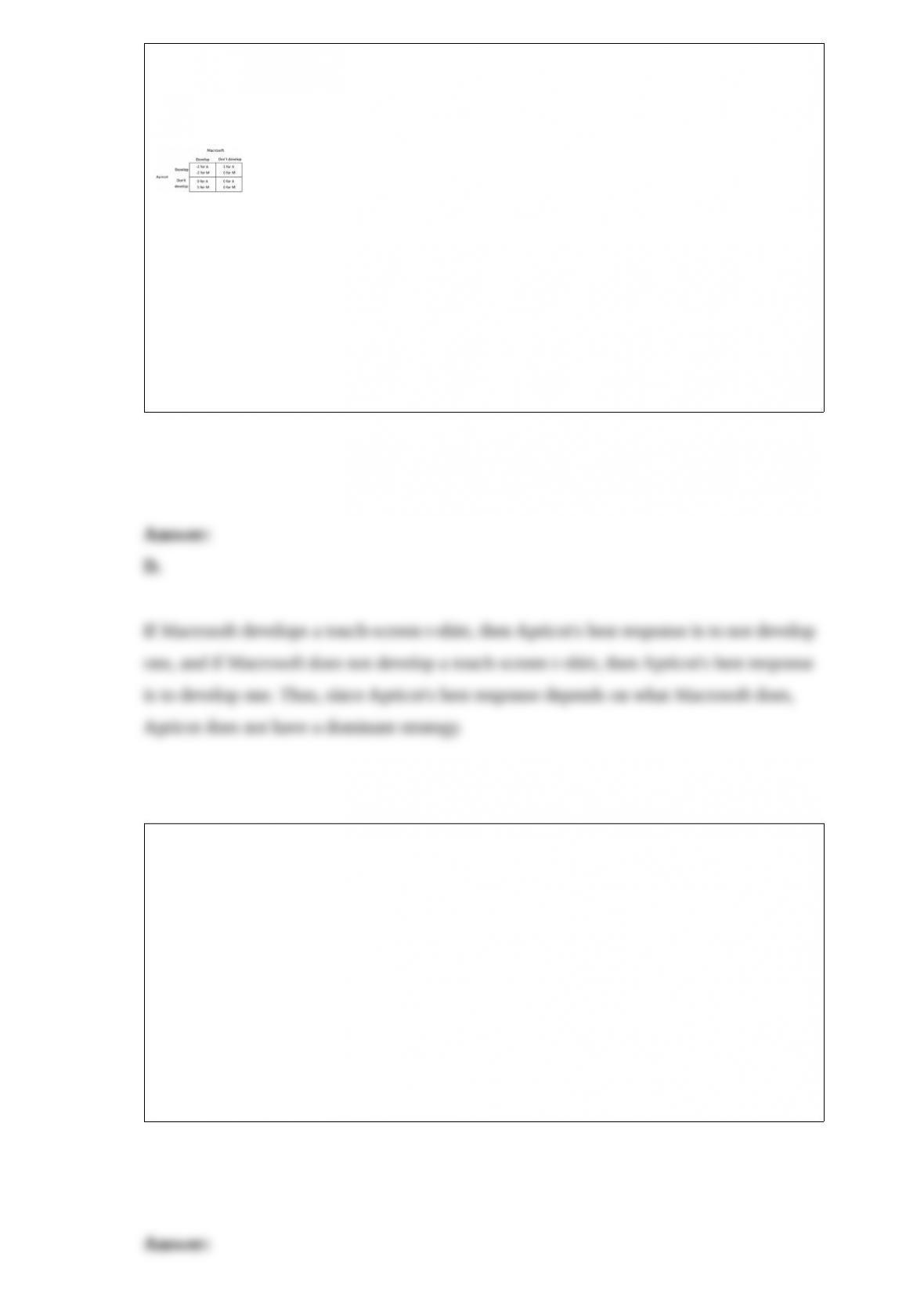
Suppose two companies, Macrosoft and Apricot, are considering whether to develop a
new product, a touch-screen t-shirt. The payoffs to each of developing a touch-screen
t-shirt depend upon the actions of the other, as shown in the payoff matrix below (the
payoffs are given in millions of dollars).
Which of the following statements is correct?
A. Apricot’s dominant strategy is to develop a touch-screen t-shirt.
B. Apricot’s dominant strategy is to develop a touch-screen t-shirt if Macrosoft does not.
C. Apricot’s dominant strategy is to not develop a touch screen t-shift.
D. Apricot does not have a dominant strategy.
In exchange for a share of the revenues earned on campus, State U has granted
CheapFizz the exclusive right to sell soft drinks in the student union and in vending
machines on campus. Prior to the deal, three soft drink companies sold beverages on
campus; now no other soft drink company is allowed to sell its products on campus.
CheapFizz now has market power due to:
A. economies of scale in the production of soda.
B. its exclusive ownership of an input.
C. its exclusive license to sell soda.
D. network economies in the consumption of soda.
The profit maximizing rule P = MC applies to:
A. all firms.
B. monopolists only.
C. both perfectly competitive firms and imperfectly competitive firms.
D. perfectly competitive firms only.
Suppose that each week Henry buys 12 peaches and 3 apples at his local farmer’s
market. Both kinds of fruit cost $1 each. From this we can infer that:
A. Henry is not maximizing his utility.
B. if Henry is maximizing his utility, then his marginal utility from the 12th peach he
buys must be greater than his marginal utility from the 3rd apple he buys.
C. if Henry is maximizing his utility, then his marginal utility from the 12th peach he
buys must equal his marginal utility from the 3rd apple he buys.
D. for Henry the law of diminishing marginal utility does not apply to peaches.
The ______ is the interest rate commercial banks pay to the Fed; the ______ is the
interest rate commercial banks charge each other for short-term loans.
A. federal funds rate; discount rate
B. discount rate; federal funds rate
C. nominal interest rate; real interest rate
D. nominal interest rate; prime rate of interest
When Acme Dynamite produces 250 units of output, its variable cost is $2,000, and its
fixed cost is $500. It sells each unit of output for $25. When Acme Dynamite produces
250 units of output, its profit is:
A. $6,250
B. $5,750
C. $4,250
D. $3,750
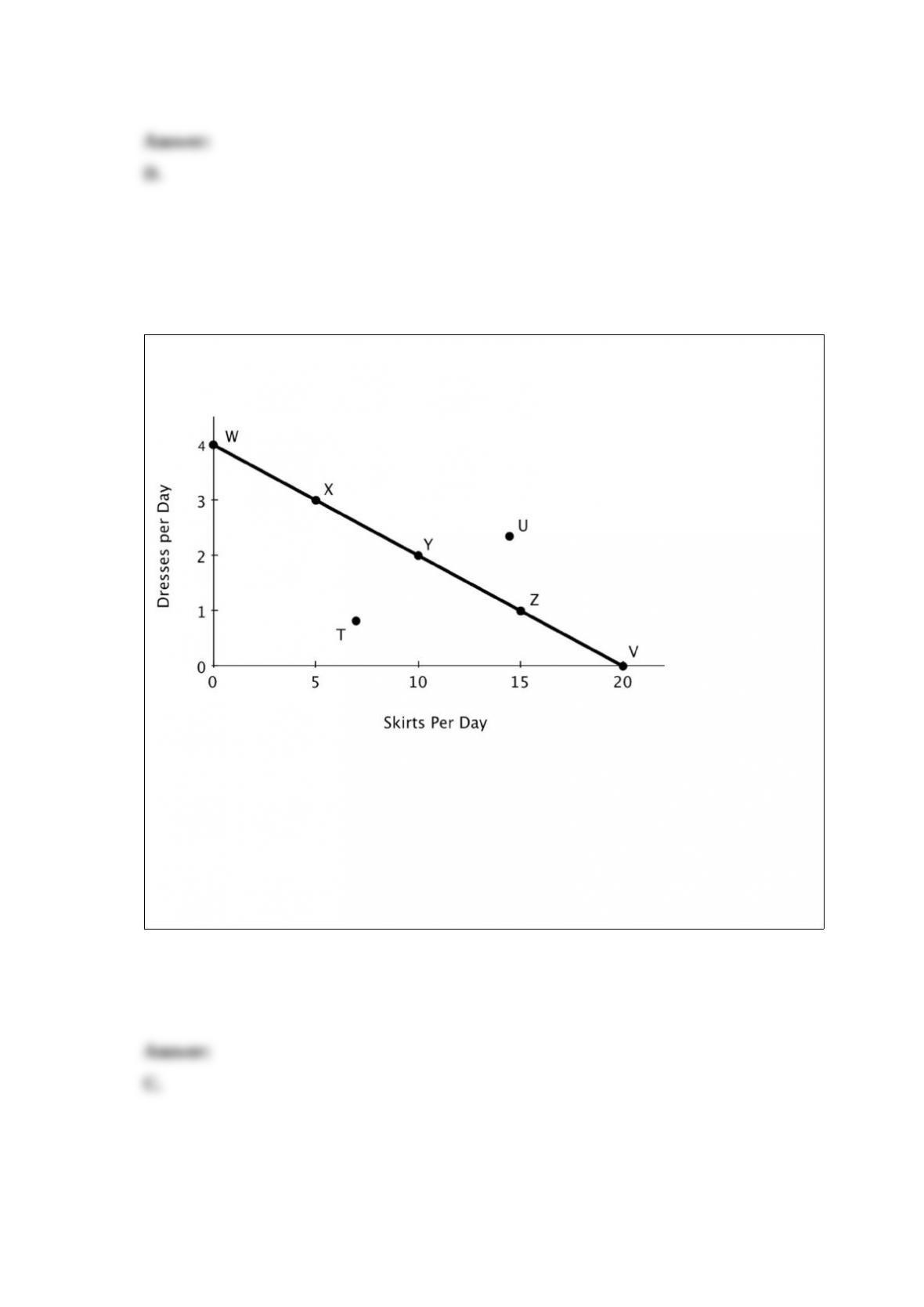
The figure below shows Becky’s daily production possibilities curve for dresses and
skirts.
Point Y is ______, and point V is ______.
A. efficient; inefficient
B. inefficient; efficient
C. efficient; efficient
D. inefficient; inefficient
Free entry and exit of firms is a characteristic of:
A. all industries in the U.S. economy.
B. perfectly competitive industries.
C. centralized economies.
D. industries in which firms are earning positive economic profit.
When there is a recessionary gap, capital and labor resources are:
A. not being fully utilized.
B. decreasing in number.
C. misallocated.
D. producing beyond their capacity.
One reason there is political opposition to international trade is that:
A. the potential gains from specialization and trade are small.
B. trade does not increase the total value of goods and services produced by a nation.
C. the differences in opportunity costs between countries are small.
D. not everyone benefits from trade.
Refer to the figure below. In this case, the private market ______ resources efficiently
because ______.
A. does not allocate; demand and supply do not cross at the market equilibrium
B. does not allocate; some of the costs of paper production do not fall on producers
C. allocates; firms are motivated to maximize profit
D. allocates; consumers are willing to pay the external cost of production
Suppose Acme and Mega produce and sell identical products and face zero marginal
and average cost. Below is the market demand curve for their product.
Suppose Acme and Mega decide to collude and work together as a monopolist with
each firm producing half the quantity demanded by the market at the monopoly price. If
Mega cheats on the agreement by reducing its price to $1 and Acme matches the price
cut, then if consumers are evenly split between the two firms, Acme’s economic profit
will be ______.
A. $75
B. $100
C. $150
D. $200
In a recession, cyclical unemployment:
A. is rising.
B. exceeds the natural rate of unemployment.
C. is falling.
D. equals the natural rate of unemployment.
If the existence of alternative opportunities makes people become less willing to work
in poultry processing plants, then the real wage of unskilled workers in poultry
processing plants is predicted to ______ and the employment of unskilled workers in
poultry processing plants is predicted to ______.
A. increase; increase
B. increase; decrease
C. increase; not change
D. decrease; decrease
Suppose that the equilibrium price of pickles falls while the equilibrium quantity rises.
The most consistent explanation for these observations is:
A. a decrease in demand for pickles with no change in supply.
B. an increase in demand for pickles with no change in supply.
C. a decrease in the supply of pickles and a decrease in the demand for pickles.
D. an increase in the supply of pickles with no change in demand.
Suppose that each serving of Mac & Cheese costs $0.50 to make no matter how many
servings are produced. This means that the price elasticity of supply for Mac & Cheese
is ______ and the supply curve is ______.
A. one; perfectly inelastic
B. zero; perfectly elastic
C. infinite; perfectly inelastic
D. infinite; perfectly elastic
The economy of Omega operates according to Okun’s law. In Omega, potential GDP
and real GDP both equal $7 trillion, and the natural rate of unemployment equals 6
percent. What is the actual rate of unemployment in Omega?
A. 4.2 percent
B. 6.0 percent
C. 7.0 percent
D. 13.0 percent
If a perfectly competitive firm produces an output level at which price is greater than
marginal cost, then the firm should:
A. employ more fixed factors of production.
B. reduce output to earn greater profits or smaller losses.
C. expand output to earn greater profits or smaller losses.
D. leave its output decision unchanged because it is earning a profit.
GDP is a measure of an economy’s:
A. domestic price level.
B. level of unemployment.
C. total output.
D. domestic productivity.

Banks hold reserves:
A. to earn interest.
B. to increase profits.
C. only because the government requires them to hold reserves.
D. to meet depositor withdrawals and payments.
Suppose there are ten people playing cards in a room. One of them wants to smoke a
cigar; nine of them dislike the smell of cigar smoke. The smoker values the privilege of
smoking at $5, and each of the other nine people of the room would be willing to pay
fifty cents for clean air in the room. The rules governing use of the room state that
smoking is not allowed unless everyone agrees to allow smoking. If the rules governing
the room instead stated that smoking is allowed unless everyone in the room agrees to
prohibit it, then:
A. the non-smoking occupants will pay the cigar smoker to not smoke.
B. the cigar smoker will smoke and not have to pay the other occupants for the external
cost.
C. the cigar smoker will smoke, and will pay each other occupant 50 cents.
D. the parties may or may not be able to reach a negotiated agreement depending on the
bargaining strength of each.
Laura’s total utility from consuming 8, 9, and 10 bonbons is 35, 42, and 45,
respectively. Her marginal utility from the 9th bonbon is
A. 42.
B. 77.
C. 7.
D. 4.67.
This graph shows the marginal cost and marginal benefit associated with roadside litter
clean up. Assume that the marginal benefit curve and marginal cost curve each have
their usual slope.
Picking up the 20th bag of litter would:
A. be socially efficient.
B. increase total economic surplus.
C. create deadweight loss.
D. be socially efficient, but would not be consistent the actions of self-interested
individuals.
During the Great Depression in the United States between 1929 and 1933, banks’
reserve/deposit ratio ______ and the amount of currency held by the public ____, while
the money supply ______.
A. increased; increased; increased
B. decreased; decreased; decreased
C. increased; increased; decreased
D. decreased; decreased; increased
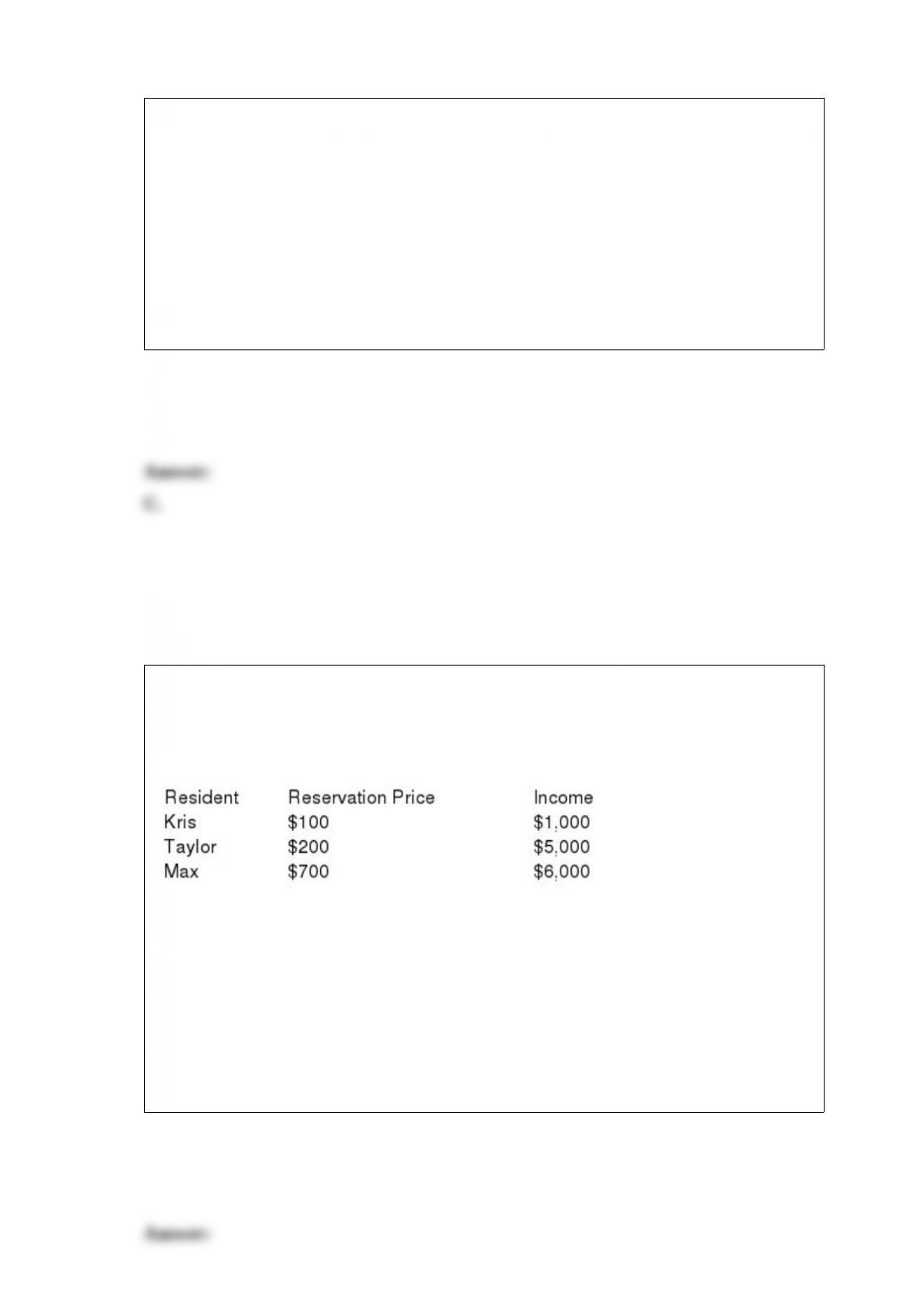
Kris, Taylor and Max are the only three residents in a neighborhood. A public good that
would benefit all of them has a one-time installation cost of $900. The value of the
public good to each resident is shown in the table below. Any tax plan must be
approved by simple majority.
Installing the public good would ______ total economic surplus by ______.
A. increase; $100
B. decrease; $100
C. decrease; $900
D. increase; $1,000
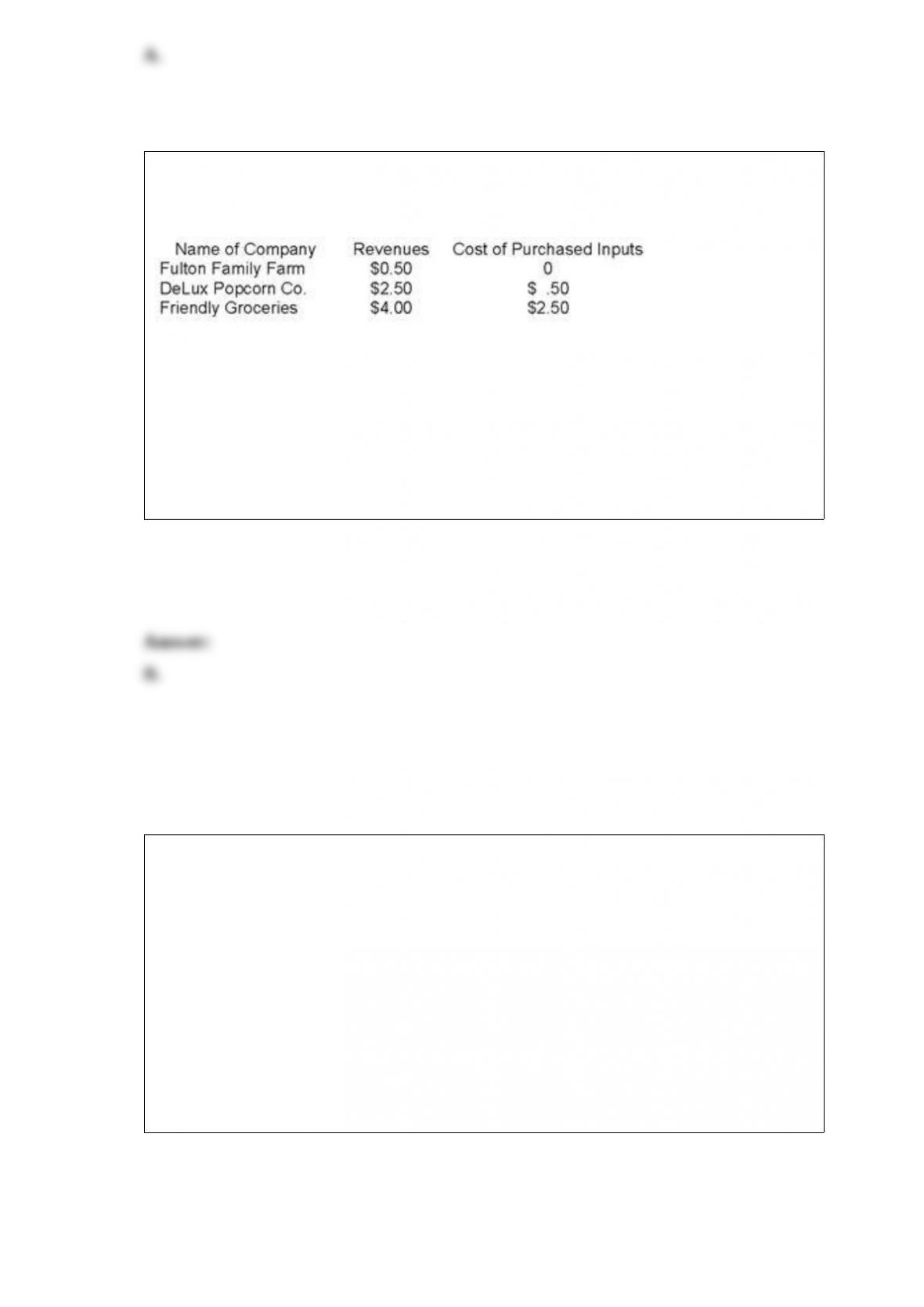
Suppose a jar of DeLux popcorn that is ultimately sold to a customer at Friendly
Groceries is produced by the following production process:
What is the sum of the value added of all of the firms?
A. $3.00
B. $4.00
C. $6.50
D. $7.00
Initially, workers in the shoe industry and the computer industry earn the same wage.
Reductions in trade barriers give domestic consumers access to cheaper shoes produced
abroad, so domestic shoe prices fall. At the same time, foreign consumers purchase
more computers, raising the relative price of computers. As a result of these changes,
wages in the shoe industry ______ and wages in the computer industry ______.
A. increase; increase
B. increase; decrease
C. decrease; increase
D. decrease; decrease
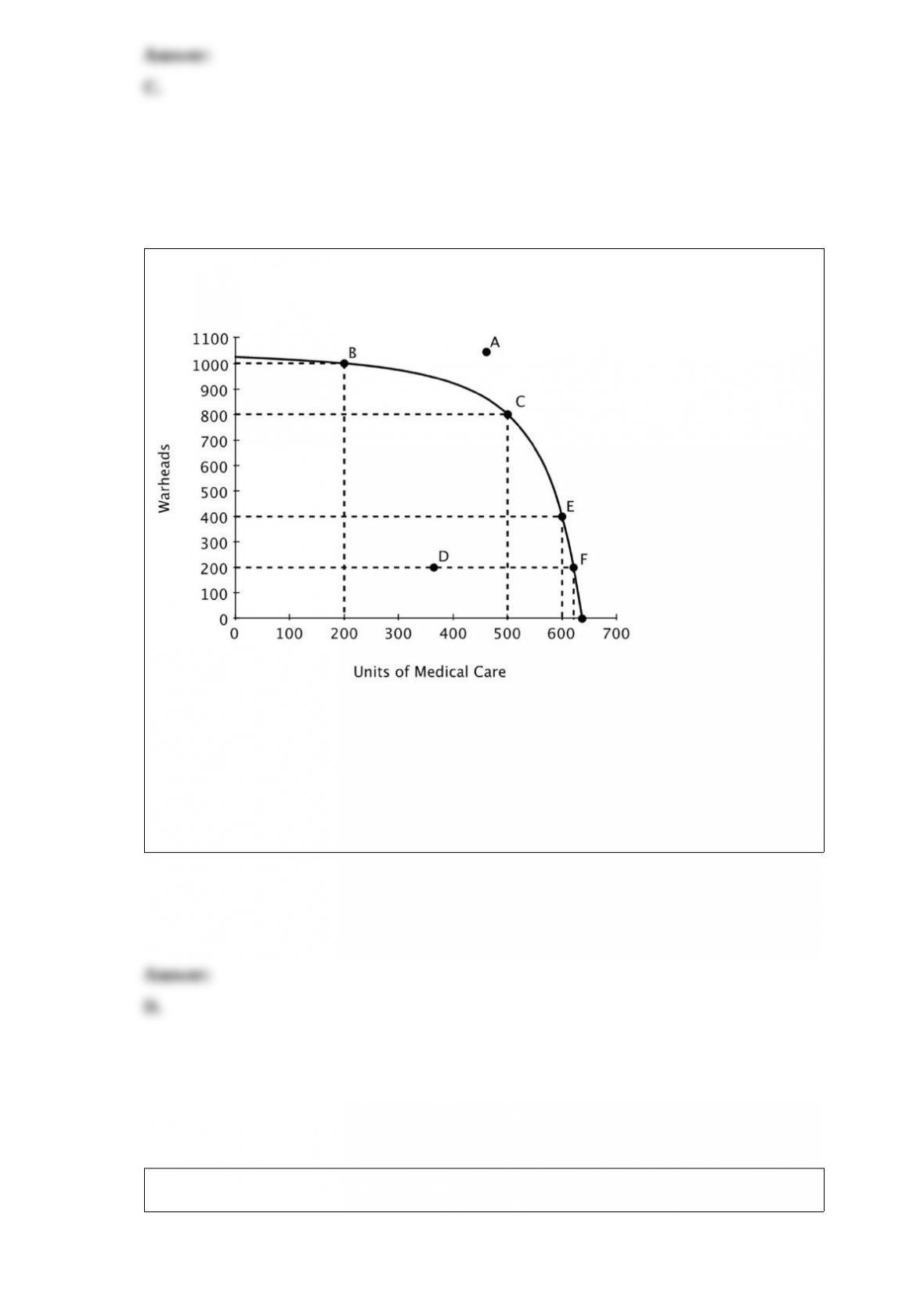
Refer to the figure below. Suppose that the government requires that resources be used
efficiently. Which of the following would the government definitely not allow?
A. Specialization in warhead production.
B. Specialization in medical care production.
C. Production at any point other than C.
D. Production at point D.
Suppose a monopolist faces the demand curve shown below:
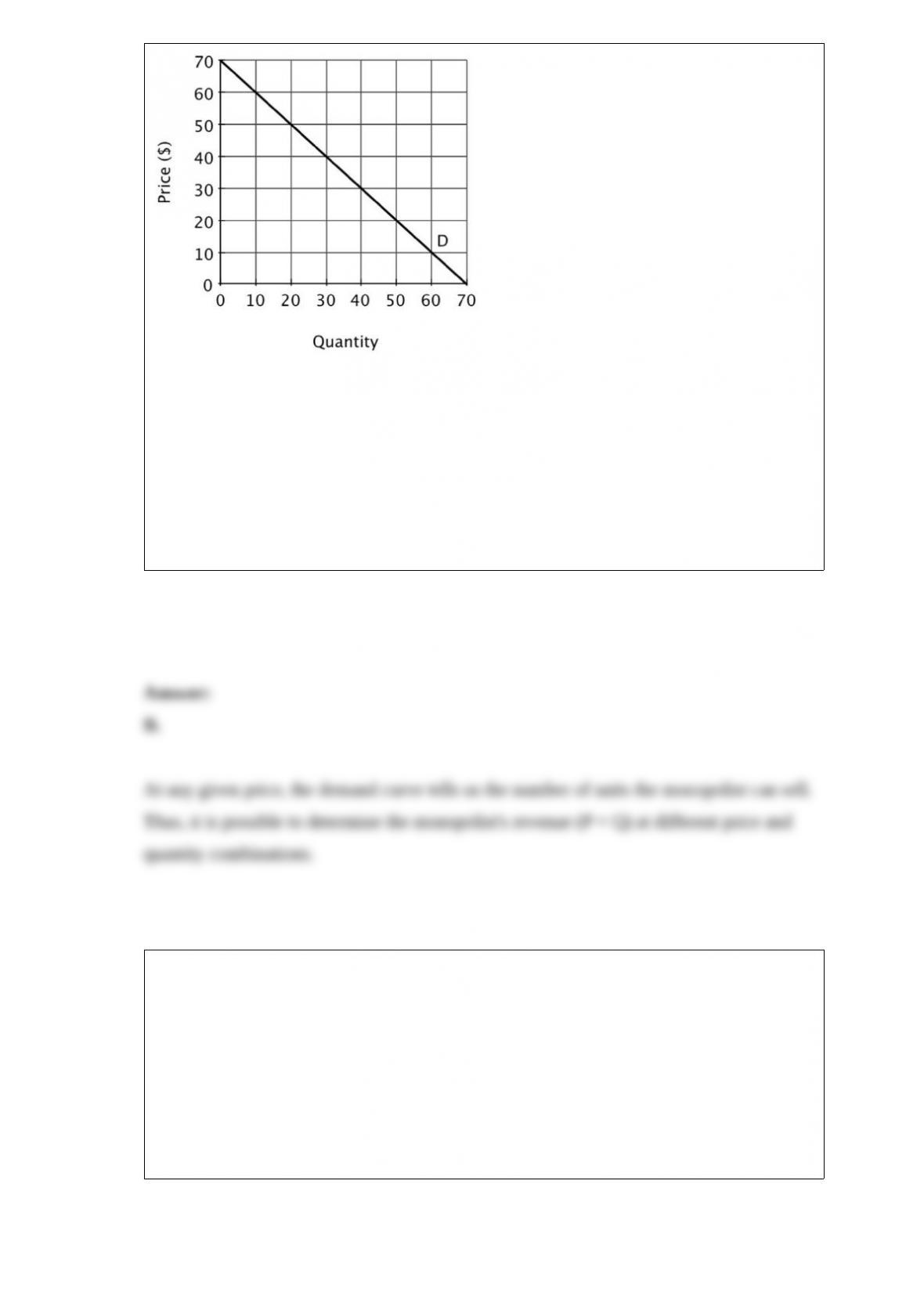
This demand curve can be used to determine:
A. the total cost associated with producing different levels of output.
B. the monopolist’s total revenue at different price and quantity combinations.
C. the impact of advertising on demand.
D. the marginal cost associated with producing different levels of output.
Inflation is a measure of the ______ of prices; the CPI is a measure of the ______ of
prices.
A. current level; rate of change in the level
B. rate of change in the level; current level
C. index; base year’s level
D. base year’s level; index

The seller of an existing house claims that it is in great shape, and he is offering a
2-year warranty on the house. His statements about the quality of his house are likely to
be:
A. credible even in the absence of a warranty.
B. overstated.
C. true because offering a warranty is a costly-to-fake signal.
D. untrue because otherwise he would not offer the warranty.
Shocks to aggregate demand ______ require the Fed to choose between inflation and
output stability; shocks to aggregate supply ______ require the Fed to choose between
inflation and output stability.
A. do; do
B. do; do not
C. may or may not; may or may not
D. do not; do
Workers should invest in additional human capital as long as the:
A. marginal benefit exceeds the marginal cost.
B. marginal cost exceeds the marginal benefit.
C. opportunity cost exceeds the marginal benefit.
D. opportunity cost is zero.